
How to Qualify for FHA Loans in Kentucky: Key Guidelines

Kentucky FHA Loan Requirements 2026: Credit, Down Payment, Limits & Approval Guide | Joel Lobb
Updated for 2026

Kentucky FHA Loan Requirements 2026: Credit, Down Payment, Limits & Approval Guide

Everything Kentucky first-time homebuyers need to know — credit scores, down payment, debt-to-income, mortgage insurance, property rules, waiting periods, and the deal-killers many lenders do not explain upfront.

Get pre-approved in as little as 24 hours — even if your credit is not perfect.

3.5% Minimum Down Low down payment option
580 Minimum Score Credit-friendly program
43% Typical Max DTI Can go higher with AUS
1.75% Upfront MIP Usually financed
2 yrs Work History Same field is what matters
$0 Application Fee No upfront application cost

Trusted by 1,300+ Kentucky families • 20+ years experience • FHA, VA, USDA & KHC specialist

What Is an FHA Loan and Why Does It Matter in Kentucky?

An FHA loan is a mortgage insured by the Federal Housing Administration under HUD. The FHA does not lend money directly. Instead, it insures approved lenders against loss, which allows those lenders to offer more flexible approval guidelines than many conventional programs.

For Kentucky homebuyers, especially first-time buyers, FHA financing can be a practical path to homeownership because it may allow:

  • Lower minimum credit scores than many conventional loans
  • Down payment as low as 3.5%
  • Gift funds for down payment and closing costs
  • Higher debt-to-income ratios in many cases
  • A way to buy after bankruptcy or foreclosure once waiting periods are met

1. Income & Employment Requirements

Two-Year Work History Is the Baseline

FHA generally looks for a two-year employment history. That does not always mean two years with the same employer. The bigger issue is consistency in the same line of work and the ability to document stable income.

  • Two years of employment history is preferred
  • Job changes are usually fine if they are in the same field or a logical advancement
  • Recent graduates may be able to use education history to support the file
  • Self-employed borrowers generally need two years of tax returns
  • Part-time, overtime, bonus, and commission income usually need a history before counting
💡

Kentucky tip: A job change for more pay in the same field is usually not the problem. Unexplained gaps, inconsistent hours, and unstable earnings are what create underwriting friction.

2. Credit Score & Down Payment

FHA Credit Score Tiers

Credit Score Range Minimum Down Payment Real-World Status
620 and above 3.5% Most lender-friendly
580 to 619 3.5% Usually workable
500 to 579 10% Limited lender options
Below 500 Not eligible Not FHA eligible
⚠️

Lender overlays matter. FHA may allow lower scores, but many lenders set stricter internal minimums. That is why borrowers often hear one thing online and something very different when they actually apply.

3. Debt-to-Income Limits

Front-End and Back-End DTI

Debt-to-income ratio measures how much of your gross monthly income goes toward monthly debt obligations. FHA reviews both housing-only and total debt ratios.

DTI Type What It Includes Common Target
Front-End Mortgage payment, taxes, insurance, and FHA mortgage insurance About 31%
Back-End Housing payment plus all monthly debts on credit About 43%
💡

AUS flexibility: With a strong automated approval, debt ratios can often go above 43%. With manual underwriting, the file usually gets much tighter and compensating factors matter a lot more.

4. Acceptable Down Payment Sources

Funds Must Be Verified and Sourced

FHA is flexible about where funds come from, but not loose about documentation. Every dollar used for down payment and closing costs needs a clean paper trail.

Acceptable Sources

  • Personal checking or savings
  • Verified gift funds from family or eligible donors
  • Retirement account withdrawals or loans when documented
  • Sale of personal property with documentation
  • Approved down payment assistance programs

Common Problems

  • Cash deposits with no paper trail
  • Borrowed funds from unapproved sources
  • Undocumented transfers between accounts
  • Large deposits that cannot be explained
  • Gift funds without a gift letter and evidence of transfer
⚠️

Bottom line: The money itself is often not the issue. Documentation is the issue. If the money cannot be sourced, it can derail the approval even when the borrower otherwise qualifies.

5. Property Requirements

The Home Has to Meet FHA Standards

FHA is not just approving the borrower. It is also approving the collateral. The property must be safe, sound, and marketable.

  • The property must be owner-occupied as a primary residence
  • The appraisal must support value and FHA minimum property standards
  • Health and safety issues may need to be repaired before closing
  • Utilities generally need to be on for proper appraisal review
  • Manufactured homes have additional foundation and eligibility requirements
💡

Important: FHA financing can be used on single-family homes, many condos, certain multi-unit owner-occupied properties, and some manufactured homes, but every category has its own eligibility rules.

6. Bankruptcy & Foreclosure Waiting Periods

Waiting Periods Do Exist, but FHA Is More Forgiving Than Many Programs

Credit Event Typical FHA Waiting Period Notes
Chapter 7 Bankruptcy 2 years From discharge date in most cases
Chapter 13 Bankruptcy 12 months On-time trustee payments and court approval usually required
Foreclosure 3 years From completion date in most cases
Short Sale Varies May be sooner depending on how it reported and current credit profile

7. Federal Debt & the CAIVRS Check

CAIVRS Is the Federal Database Many Buyers Never Hear About

Before FHA approval, borrowers are checked through CAIVRS, the federal database that flags certain unresolved government-related defaults or claims.

  • Defaulted federally backed student loans
  • Prior FHA or other government-backed loan claims
  • Certain unresolved federal delinquencies or judgments
🚫

A CAIVRS hit can stop the deal cold. This is not something you finesse around. The underlying issue usually has to be resolved before the FHA loan can move forward.

8. FHA Mortgage Insurance Premium

Mortgage insurance is part of the FHA tradeoff. It is one reason FHA works for lower down payment and more flexible credit, but it also increases the payment.

Upfront MIP
1.75%
Usually financed into the loan amount
Annual MIP
0.45%–1.05%
Paid monthly as part of the mortgage payment

On a $200,000 FHA loan, the upfront mortgage insurance premium adds about $3,500 to the loan amount if financed. Monthly mortgage insurance varies, but it can make a meaningful difference in payment planning.

💡

Long-term strategy: Many FHA borrowers later refinance into a conventional loan once they build equity and improve credit, because FHA mortgage insurance does not work like conventional PMI in many cases.

The Top FHA Deal-Killers in Kentucky

After working through hundreds of FHA files, these are the issues that most often kill deals, delay closings, or force borrowers to regroup.

Credit overlays

The FHA guideline may say one thing, but the actual lender may require a higher score or cleaner profile.

Unsourced funds

Cash deposits, undocumented transfers, or gift money with no paper trail can stop the loan.

Appraisal issues

Safety, condition, value, or eligibility problems can delay or kill the transaction.

Federal debt problems

Defaulted student loans or other federal issues can cause a CAIVRS denial.

High debt ratios

If the automated system does not approve it, manual underwriting can get strict quickly.

Inconsistent income

Variable hours, weak earnings history, or recent instability can reduce qualifying income.

The Smart Long-Term FHA Strategy

FHA is often the best entry point, not always the best forever loan. For many Kentucky buyers, the real win is using FHA to get in the home now, then improving the credit profile and refinancing later when the numbers make sense.

1

Get pre-approved

Run the numbers honestly and determine what is actually workable today.

2

Use the right assistance

Layer in any available gift funds or down payment assistance that fits the file.

3

Buy with a plan

Get into the home, stabilize finances, build equity, and improve the credit profile.

4

Refinance later

Review conventional refinance options when rates, equity, and scores line up.

Frequently Asked Questions — Kentucky FHA Loans

Can I get an FHA loan with a 580 credit score in Kentucky?

Yes. FHA guidelines allow 580 with 3.5% down, but many lenders have overlays. Real-world approval depends on the full file, not just the score.

Is there down payment assistance available for Kentucky FHA loans?

Yes. Some Kentucky borrowers may qualify for Kentucky Housing Corporation down payment assistance, depending on income, credit, and program limits.

How long does FHA approval take in Kentucky?

A pre-approval can often be issued quickly with full documentation. From contract to closing, many FHA purchases land in the 30 to 45 day range, though every file is different.

Can I use an FHA loan to buy a duplex in Kentucky?

Yes, if you live in one unit as your primary residence and the property meets FHA rules. FHA is not for a pure non-owner-occupied investment purchase.

Does FHA mortgage insurance ever go away?

That depends on the loan structure, but many FHA borrowers eventually refinance into conventional financing once they have enough equity and improved credit.

What is the FHA loan limit for Kentucky in 2026?

Loan limits depend on property type and county rules in effect for the year. Always verify current limits for the specific property and loan structure before proceeding.

Ready to Apply for an FHA Loan in Kentucky?

Start your free mortgage review with Joel Lobb. Get straight answers on credit, income, down payment, and what you may qualify for now — without wasting time on the wrong program.

JL

Joel Lobb — Kentucky Mortgage Loan Officer

20+ years of experience | 1,300+ Kentucky families helped | FHA, VA, USDA, KHC & Conventional loans

NMLS #57916 Company NMLS #1738461 Licensed in Kentucky Equal Housing Lender

NMLS #57916 | Company NMLS #1738461 | Equal Housing Lender. This is not a commitment to lend. All loans are subject to credit approval and program requirements. This website is not affiliated with or endorsed by FHA, VA, USDA, KHC, or any government agency. Licensed in Kentucky only. NMLS Consumer Access
Your Guide to Kentucky FHA Loans

Kentucky FHA loans can be an excellent option for first-time homebuyers and borrowers with lower incomes or less-than-perfect credit. They can also be an easy way to refinance. .

Features and benefits:

  • Low down payment from borrower or other approved source1
  • 580 credit score with 96.5 Financing and down to 500 score with 500 score on case by case
  • Streamline option refinance with no appraisal
  • Up to 6% seller contributions to pay your closing costs and prepaids
  • AUS with FHA TOTAL Mortgage Scorecard
  • Waivers for some ratio and documentation

Purchase, rate/term, or cash-out refinance of a primary residence. Program terms available may vary based on the state or county in which the financed
property is located. Mortgage insurance is required.
CONSIDERATIONS: Important information will be provided to you in the disclosures you receive after we have received your application and the loan
documents you are provided at loan closing. Please consult your tax advisor regarding the deductibility of interest.
Contributions may have limitations based upon occupancy and loan to value ratios and cannot be used for purposes of down payment, reserve
requirement or meet minimum contribution requirements
Programs for qualified borrowers. All borrowers are subject to credit approval, underwriting approval and product requirements, including loan to
value, credit score limits and other lender terms and conditions. Fees and charges may vary by state and are subject to change without notice. Some
restrictions may apply. Not a commitment to lend. 11/22

Getting An FHA Loan

In order to get an FHA loan to buy your next house, it’s a good idea to first check your credit score. That way, you can see what your maximum LTV would be through the FHA and decide whether an FHA loan might be right for you.

Depending on which FHA lender you’re working with, it may also be a good idea to get pre-qualified for an FHA loan. This can help you establish how much you’ll likely be able to borrow and what your interest rate may be.

Application and Underwriting

Once you’ve identified a home you want to purchase and are ready to formally apply for your mortgage loan, you’ll need to choose an FHA-approved lender and work through its individual application and underwriting process. The application process will include completion of a Uniform Residential Loan Application.

As part of your application, you’ll also need to get an appraisal for the home you’re buying, so your lender can ensure your loan won’t violate FHA’s LTV limits. From there, you’ll need to work through your individual lender’s underwriting process, which will include showing proof of income, running credit checks and demonstrating that you can afford your down payment.

Some of the documentation you’ll likely need to supply for underwriting include:

  • A credit report
  • Employment history for two years
  • Income verification with recent pay stubs, bank statements and/or three years of tax returns
  • Proof that you are using the loan for a primary residence
  • An FHA-approved appraisal

After you complete your lender’s application process and underwriting, your lender can formally approve your loan and you can close on your home.

Who Should Consider FHA Loans

FHA loans don’t have stated income maximums or minimums, but are generally designed to benefit low- to moderate-income Americans who would have trouble qualifying for conventional financing or affording the down payment required by other loans.

Some potential cases when FHA loans can be particularly helpful include:

  • First-time homebuyers who can’t afford a large down payment
  • People who are rebuilding their credit
  • Seniors who need to convert equity in their homes to cash

Types Of FHA Loans

There are more than a dozen home loan programs available through the FHA. Many of these programs are ideal for different borrowers in a variety of circumstances, offering everything from 30-year fixed-rate mortgages to adjustable rates, improvement loans, refinancing solutions and even reverse mortgages.

Some of the most popular FHA loan programs are:

  • FHA Section 203(b) loan. The FHA’s most popular home loan program, offering fixed rates on properties from one to four units.
  • FHA Section 203(k) loan. FHA mortgages designed to help homebuyers finance up to $35,000 in improvements to their new homes.
  • Streamline Refinancing. An option for existing FHA borrowers to refinance their loans with streamlined underwriting.

FHA Loans Vs. Conventional Mortgages

Most conventional mortgages require down payments of at least 20% of a home’s purchase price in order to avoid paying private mortgage insurance, along with minimum credit scores of 620 to 640 in order to qualify. With private mortgage insurance (PMI) that helps homeowners pay their mortgage if they lose their jobs, some lenders require lower down payments.

FHA loans have two types of built-in mortgage insurance that allow borrowers to buy homes with as little as 3.5% down—or 10% if they have bad credit. In addition, these loans allow homebuyers to qualify for lower interest rates than they would get with conventional mortgages, all because their loans are federally insured.

FHA LoanConventional Mortgage
Minimum credit score500620
Minimum down payment3.5% if your credit score is 580 or higher; 10% for scores under 58020% to avoid mortgage insurance
Maximum loan term30 years30 years
Mortgage insurance requirementTwo types of mortgage insurance requiredRequired if down payment is under 20%

Pros of FHA Loans

  • High maximum loan-to-value
  • Competitive interest rates
  • Multiple programs available
  • Can qualify with bad credit
  • Closing costs are sometimes paid by lenders

Cons of FHA Loans

  • Mortgage insurance is required for extra cost
  • Only available for a primary residence
  • Must show proof of income
  • Debt-to-income ratio must be under 43% (slightly lower than a conventional loan requires)

Bottom Line

The Federal Housing Administration (FHA) was created in the 1930s in response to the Great Depression to help Americans who couldn’t otherwise afford the dream of homeownership.

Today, the FHA continues to help Americans through more than a dozen loan programs that help Americans with low incomes or bad credit qualify for lower interest rates than they would otherwise get, and buy homes with much smaller down payments than those required by conventional lending tools. The FHA does this by working with approved lenders to insure loans across the country and by building two types of mortgage insurance into all of the loans that it insures.

So, if you have poor credit or are struggling to save for a down payment, you may want to consider using an FHA loan for your next home purchase.

https://www.mylouisvillekentuckymortgage.com/

Options for Bad Credit Home Buyers in Kentucky

Bad Credit Home Loans in Kentucky

Many Kentucky homebuyers assume a low credit score automatically disqualifies them from buying a home. That assumption is incorrect. Several mortgage programs are specifically designed to help buyers with past credit issues qualify for financing sooner than expected.

In Kentucky, the most common loan options for buyers with bad or fair credit include FHA, VA, USDA, and select conventional loan programs. Each option has different credit score thresholds, down payment requirements, and underwriting flexibility.

Minimum Credit Score Requirements by Loan Type

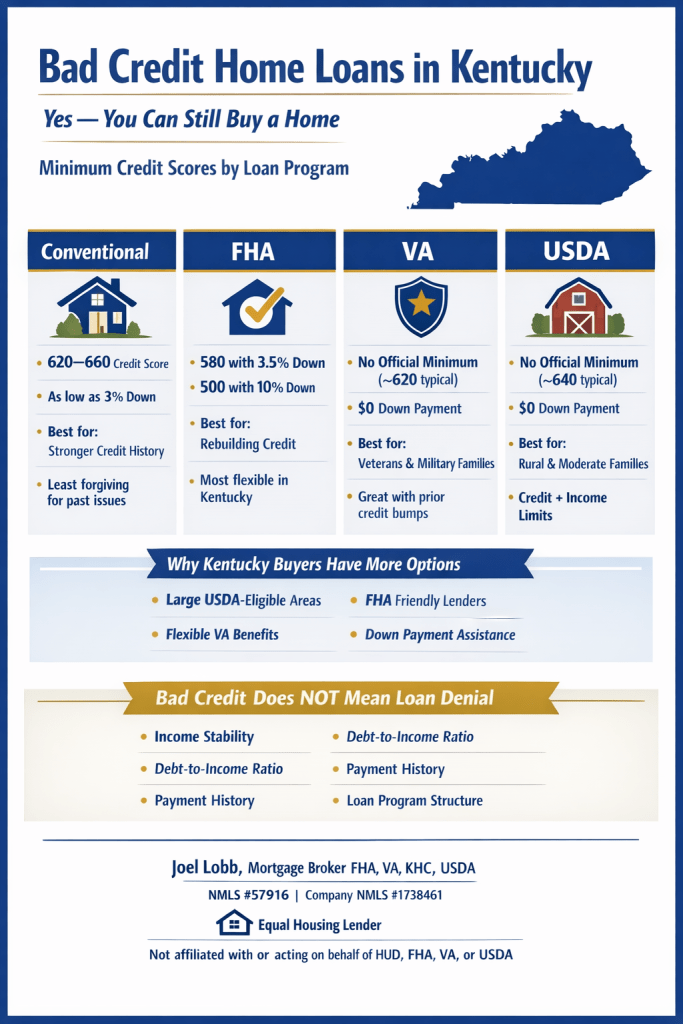
Conventional loans typically require a minimum credit score between 620 and 660, depending on the program and automated underwriting results. While down payments can be as low as 3 percent, conventional loans are generally the least forgiving when it comes to recent late payments, collections, or limited credit history.

FHA loans in Kentucky are the most common solution for buyers rebuilding credit. FHA financing allows approvals with credit scores as low as 580 with only 3.5 percent down. In limited cases, buyers with scores down to 500 may qualify with a 10 percent down payment, provided the overall risk profile is strong.

Eligible service members and veterans may benefit from VA loans in Kentucky, which do not have an official minimum credit score requirement set by the agency. Most lenders look for scores around 620, but VA loans remain one of the most flexible options available, offering zero down payment and no monthly mortgage insurance.

For buyers purchasing outside major metro areas, USDA loans in Kentucky can provide 100 percent financing with competitive interest rates. While there is no official minimum credit score, most USDA lenders require a 640 score for automated approval, along with meeting income and household eligibility guidelines.

Why Kentucky Buyers Often Qualify With Lower Credit Scores

  • Large portions of Kentucky qualify for USDA rural housing loans
  • FHA loans are widely accepted by Kentucky lenders
  • VA loans provide exceptional flexibility for eligible veterans
  • Down payment assistance programs can be layered correctly with the right loan structure

What Mortgage Underwriters Actually Review

Mortgage approval is based on the full financial picture, not just the credit score. Underwriters evaluate income stability, work history, debt-to-income ratio, recent payment behavior, available assets, and how the loan is structured.

In many cases, a borrower with a lower credit score but strong income stability and clean recent payment history can be a stronger approval than someone with a higher score and excessive debt.

Bottom Line for Kentucky Homebuyers

Bad credit does not automatically mean loan denial. The right loan program, structured correctly from the start, often matters more than the credit score alone. Many Kentucky buyers qualify months or even years sooner than they expect once their options are reviewed properly.

NMLS #57916 | Company NMLS #1738461
Equal Housing Lender.
This is not a commitment to lend. All loans are subject to credit approval and program requirements.

Bad Credit Home Loans in Kentucky

Complete Guide to FHA Loan Requirements in Kentucky

FHA loans are a popular choice for many first-time homebuyers in Kentucky. This is due to their flexible qualifying criteria. If you’re considering an FHA loan in the Bluegrass State, understanding the key qualifying factors is crucial. Here’s a comprehensive guide to the criteria you need to know:

  1. Credit Score Requirements:
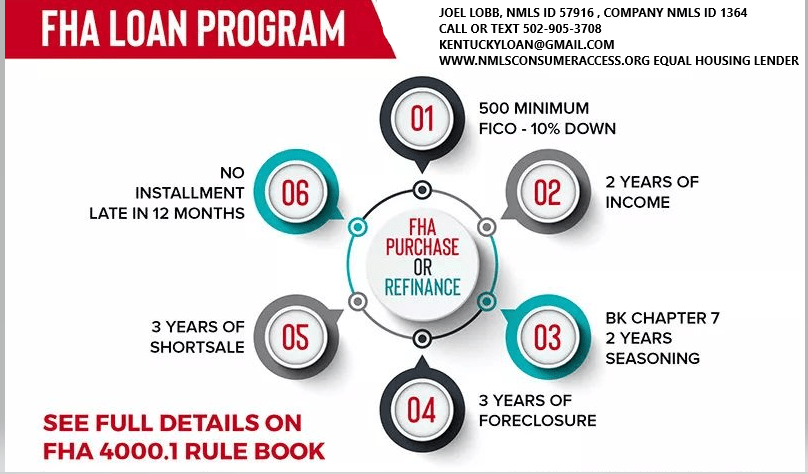
    • FHA loans are known for accommodating borrowers with lower credit scores. The minimum required credit score can vary. Typically, a credit score of 580 or higher is needed to qualify for the minimum down payment of 3.5%. Borrowers with credit scores between 500 and 579 might still qualify. They will need a higher down payment, usually around 10%.
  2. Down Payment:
    • The minimum down payment for an FHA loan in Kentucky is 3.5% of the home’s purchase price. This is advantageous for buyers who may not have substantial savings for a larger down payment, making homeownership more accessible.
  3. Work History:
    • Lenders typically look for a steady 2 year employment history when considering FHA loan applications. A consistent work history is beneficial. It is preferable to have worked with the same employer or within the same field. This helps demonstrate financial stability and the ability to repay the loan.
  4. Debt-to-Income Ratio (DTI):
    • The debt-to-income ratio is a crucial factor in mortgage approval. For FHA loans, the maximum allowable DTI ratio is typically around 40% to 45% of your gross monthly income. It can go higher up to 56% with good credit scores, a large down payment, or a shorter-term loan. Lenders may also consider higher ratios in certain cases if compensating factors are present.
  5. Bankruptcy and Foreclosure:
    • FHA loans have lenient guidelines regarding bankruptcy and foreclosure. Generally, borrowers with a past bankruptcy may qualify for an FHA loan after two years. This is possible if they have re-established good credit and demonstrated responsible financial behavior. For foreclosures, the waiting period is usually three years.
  6. Mortgage Term:
    • FHA loans offer various mortgage term options, including 15-year, 20 year, 25 year and 30-year fixed-rate loans. The choice of term depends on your financial goals and ability to manage monthly payments.
    • Occupancy: Primary residences with 1-4 units. Not for investment properties or second homes.
    • Mortgage Insurance on the loan for life of loan. Larger down payments and shorter terms will reduce the upfront mi and monthly mi premiums
    • can be used for refinances, not only for purchases.
    • No income limits nor property restrictions on where home is located
    • Can close within 30 days typically with good appraisal and title work

FHA Loan Requirements in Kentucky for Credit scores, Down payment, Debt Ratio and work history below

RequirementDetails
Credit Score– 580+: Eligible for a 3.5% down payment.
– 500-579: Requires a 10% down payment.
Down PaymentMinimum of 3.5% for qualified buyers; 10% for lower credit scores below 580 to 500 score range
Debt-to-Income Ratio (DTI)– Ideal: 45% or lower on front end ratio or housing ratio.
– Acceptable: Up to 57% with compensating factors. There are two ratios. Front end and back end with front end being maxed at 45% and the backed end ratio being 56.99% with an AUS approval. If manually underwritten, see guidelines here
Employment HistoryMust provide at least **2 years of consistent employment—College transcripts can supplement with a less than 2 year work history

Key Benefits of FHA Loans in Kentucky

  1. Low Credit Score Requirements
    • FHA loans accept borrowers with credit scores as low as 500. However, a score of 580+ qualifies you for the lowest down payment option.
  2. Low Down Payment Options
    • You can purchase a home with as little as 3.5% down if you meet credit requirements, making FHA loans more accessible than conventional loans.
  3. Competitive Interest Rates
    • FHA loans typically offer rates comparable to conventional mortgages. They may even offer lower rates. This could save you money over the life of the loan.
  4. Flexible Loan Uses
    • With an FHA 203(k) loan, you can bundle home purchase and renovation costs into a single mortgage.
  5. Assumable Loans
    • FHA loans can be transferred to a new buyer. This feature is especially valuable if you sell your home when interest rates are higher.

Understanding these qualifying criteria can help you navigate the FHA loan application process in Kentucky more effectively. Working with an experienced mortgage professional can provide valuable guidance. They offer assistance tailored to your specific financial situation and homeownership goals.

Joel Lobb  Mortgage Loan Officer

Any questions, please don’t hesitate to reach out via, text, email,  or call.  Advice is always free. 
 
One of Kentucky’s highest rated mortgage loan officers for FHA, VA, USDA, Kentucky Housing KHC and conventional mortgage loans.  
1 – 📅 Email – kentuckyloan@gmail.com 
2.  📞 Call/Text – 502-905-3708
 

Joel Lobb
Mortgage Loan Officer – Expert on Kentucky Mortgage Loans

🌐 Websitewww.mylouisvillekentuckymortgage.com
🏢 Address911 Barret Ave., Louisville, KY 40204


Evo Mortgage
Company NMLS# 1738461
Personal NMLS# 57916

For assistance with Kentucky mortgage loans, reach out via email, call, or text Joel Lobb directly.

Kentucky Local Home Loan Lender Services

✅ First-Time Home Buyers Welcome
✅ FHA, Rural Housing (USDA), VA, and Kentucky Housing Corporation (KHC) Loans
✅ Conventional Loan Options Available
✅ Fast Local Decision-Making
✅ Experienced Guidance Through the Home Buying Process


NMLS 57916  | Company NMLS #173846
The view and opinions stated on this website belong solely to the authors, and are intended for informational purposes only. The posted information does not guarantee approvalnor does it comprise full underwriting guidelines. This does not represent being part of a government agency. The views expressed on this post are mine and do not necessarily reflect the view of my employer. Not all products or services mentioned on this site may fit all people.
(www.nmlsconsumeraccess.org).
Kentucky First Time Homebuyers FHA, VA, USDA & Rural Housing, KHC and Fannie Mae mortgage loans
 

MINIMUM CREDIT SCORES REQUIRED FOR KENTUCKY FHA, VA, USDA MORTGAGE LOANS

  1. Kentucky FHA Loans: Kentucky FHA loans are known for their lenient credit score requirements, making them accessible to borrowers with lower credit scores. However, a minimum score of 500 to 580 is typically required, depending on the down payment.

  2. Kentucky VA Loans: VA loans offer flexible credit score requirements, while on paper VA states they don’t require a minimum score to insure the mortgage loan,  most lenders preferring a FICO score of 620 or higher. Veterans, active-duty service members, and eligible spouses can benefit from VA loan options.

  3. Kentucky USDA Loans: USDA loans are designed for rural homebuyers and require no minimum FICO score , but most lenders will want a credit score of 640 or higher. These loans offer zero down payment options for eligible properties.

  4. KHC Mortgage Loans: Kentucky Housing Corporation (KHC) mortgage loans may vary in credit score requirements depending on the lender. It’s essential to work with a knowledgeable mortgage broker like Joel Lobb to understand specific lender guidelines. KHC requires a minimum 620 credit score for FHA, VA, USDA and 660 for Conventional loan programs 


Text/call: 502-905-3708

email:
 kentuckyloan@gmail.com

http://www.mylouisvillekentuckymortgage.com/