Author: Kentucky Mortgage Broker Offering FHA, VA, USDA, Conventional, and KHC Down Payment Assistance Home Loans
Thank you for visiting. I hope you find this website both informative and empowering as you explore your mortgage options. My goal is to help you feel confident in selecting the right home loan for your unique situation. I proudly serve all 120 counties in Kentucky, offering a full range of mortgage loan programs, including: FHA Loans VA Loans USDA Rural Housing Loans Fannie Mae Conventional Loans KHC Down Payment Assistance Programs With over 20 years of lending experience, I’ve had the privilege of helping more than 1,300 Kentucky families achieve their homeownership goals. Whether you're a first-time homebuyer or seeking a second opinion, I’m here to offer honest, no-pressure advice—always free of charge. I am dedicated to: Attending as many closings as possible Providing responsive, personalized service Ensuring quick, efficient, and accurate loan processing Making myself accessible every step of the way I've been consistently recognized as a top mortgage loan officer in Kentucky for VA, FHA, USDA, and KHC programs. I take pride in being thorough, transparent, and attentive with each and every client. Please take a moment to read my reviews below. If you have questions or need guidance, feel free to call or text me directly. Call/text at 502-905-3708. Free Mortgage Pre-Qualifications same day on most applications.
Email me at kentuckyloan@gmail.com with your questions
I specialize in Kentucky FHA, VA ,USDA, KHC, Conventional and Jumbo mortgage loans. I am based out of Louisville Kentucky. For the first time buyer, we offer Kentucky Housing or KHC loans with down payment assistance.
This website is not an government agency, and does
not officially represent the HUD, VA, USDA or FHA or any other government agency.
NMLS# 57916 http://www.nmlsconsumeraccess.org/
Joel Lobb Senior Loan Officer/p>
call/text phone: (502) 905-3708 kentuckyloan@gmail.com Company ID #1738461
EQUAL HOUSING LENDER
http://www.mylouisvillekentuckymortgage.com/
Medical Debt and Mortgage Approval for Kentucky Homebuyers
Medical debt has long been a challenge for many Americans. It particularly affects credit scores and the ability to secure a mortgage loan. Fortunately, the Consumer Financial Protection Bureau (CFPB) has finalized a new rule. This rule is set to remove medical debt from consumer credit reports. As a result, more opportunities may open up for homebuyers in Kentucky. Here’s how this change can affect your mortgage approval process. Also, understand what you need to know about medical debt and credit scores in Kentucky.
What’s Changing with Medical Debt and Credit Reports?
The CFPB has implemented a new rule to remove medical debt from credit reports. This change is significant for borrowers in Kentucky. Medical debt often lowers credit scores. It creates hurdles in the mortgage approval process.
Here’s what to expect from the new rule:
Implementation Timeline: The rule is expected to take effect in at least 60 days.
Debt Removed: Over $49 billion in medical debt will be erased from credit reporting systems.
Consumer Impact: An estimated 15+ million Americans will see their credit reports improved.
Credit Score Boost: Consumers affected by this change could see an average credit score increase of 20 points.
Mortgage Approvals: This change is anticipated to result in over 22,000 additional mortgage approvals annually across the U.S.
How Medical Debt Affects Credit Scores in Kentucky
Before this rule, unpaid medical bills often appeared on credit reports, negatively impacting credit scores. In Kentucky, this has been a common issue for homebuyers trying to secure mortgage loans.
Key Effects of Medical Debt on Credit Scores:
Lower Credit Scores: Medical debt can drag down your FICO score, making it harder to qualify for favorable loan terms.
Higher Interest Rates: A lower score often leads to higher interest rates on mortgages.
Mortgage Denials: In some cases, excessive medical debt could result in outright denials of loan applications.
Even with medical debt on your report, mortgage lenders may consider compensating factors. These factors include stable income, down payment assistance, or other positive financial attributes.
How Credit Scores Impact Mortgage Loan Approval in Kentucky
Mortgage lenders in Kentucky use credit scores as one of the primary factors to determine loan eligibility. Here’s how it works:
Credit Score Requirements by Loan Type:
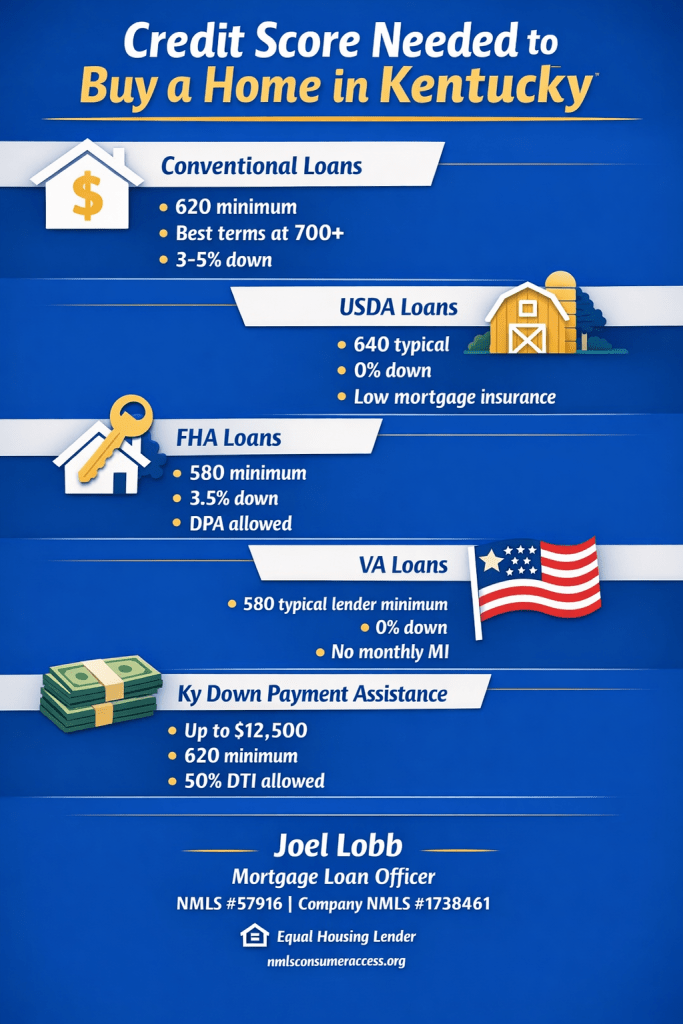
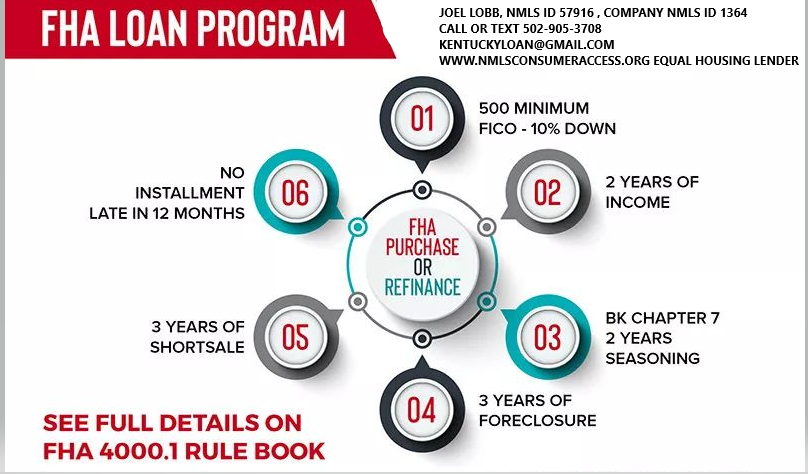
FHA Loans: Minimum credit score of 580 with a 3.5% down payment. Scores as low as 500 may be considered with a 10% down payment.
Conventional Loans: Minimum credit score of 620 or higher.
VA Loans: No minimum credit score set by the VA, but most lenders prefer a score of 580-620.
USDA Loans: Minimum credit score of 640 for automatic approval, though manual underwriting is possible for lower scores.
Impact of Credit Score on Interest Rates: Higher credit scores lead to better mortgage rates. Lower scores can result in higher monthly payments.
Debt-to-Income Ratio (DTI): Lenders calculate your DTI to ensure you can manage your mortgage payments alongside other debts. Medical debt previously factored into this calculation, potentially increasing your DTI and reducing your borrowing power.
There are many ways to get the mortgage to buy your first home. The FHA is one option. If you are a first-time homebuyer in Kentucky, an FHA loan could be the perfect option for you. There are many flexible requirements, low down payments, and financial assistance options available. These are just a few of the many things that can help make homeownership more accessible.
What is an FHA Loan?
An FHA loan is a government-backed mortgage insured by the Federal Housing Administration (FHA). It’s designed for low-to-moderate-income borrowers, offering relaxed qualification standards compared to conventional loans. Here are the main advantages:
Low down payment: As little as 3.5% of the purchase price.
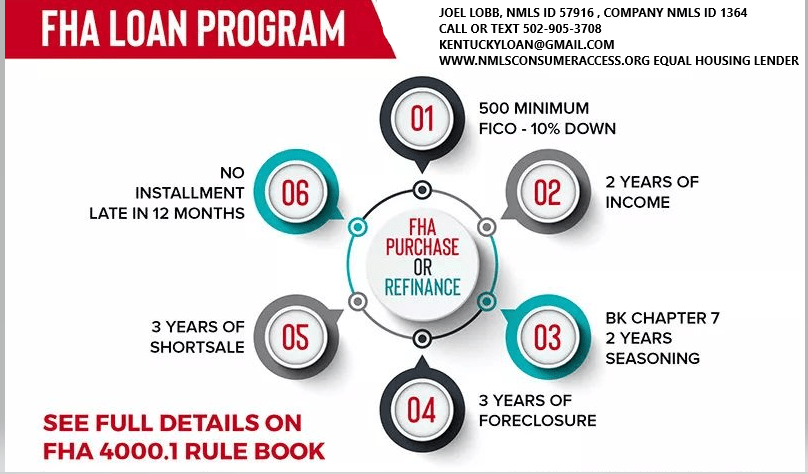
Lower credit score requirements: Minimum score of 500 with 10% down or 580 with 3.5% down.
Seller-paid closing costs: Sellers can contribute up to 6% of the purchase price.
Flexible qualifying criteria: Higher debt-to-income (DTI) ratios and options for non-occupant co-signers.
How to Qualify for a Kentucky FHA Loan
1. Credit Score Requirements
580 or higher: You’ll need a minimum credit score of 580 to qualify for the 3.5% down payment option.
500-579: You can still qualify with a 10% down payment, but many lenders prefer a score of 580 or higher.
Bankruptcy or Foreclosure:
Chapter 7 bankruptcy: Must be 2 years removed, with good credit since.
Chapter 13 bankruptcy: Can qualify after 1 year of on-time payments with trustee approval.
Foreclosure: Must be 3 years removed, unless there are extenuating circumstances.
2. Income and Debt-to-Income Ratio
DTI ratio: Typically, up to 45%% of your income can go toward your mortgage payment, and up to 56.9% can go toward all debts, depending on your credit and financial history.
Work history: You must have a stable employment history of at least 2 years in the same field. Recent graduates can use college transcripts as a substitute.
3. Down Payment and Gift Options
3.5% down payment: This can be gifted by a family member, employer, or nonprofit organization, drawn off a retirement account like a 401k or money saved up.
Cash deposits: Cash cannot be used as proof of funds for your down payment—only traceable sources are allowed.
4. Property Requirements
Must be your primary residence. FHA loans are not for investment properties or second homes.
Eligible property types: Single-family homes, townhomes, condos (must be approved condo development on HUD approved list), duplexes, and some manufactured homes (if affixed to a permanent foundation).
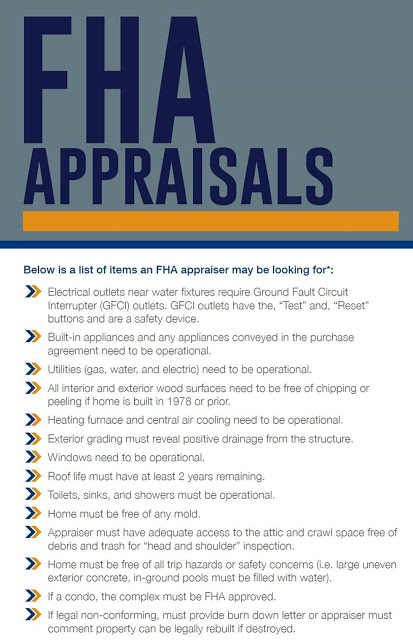
Appraisal: The property must be appraised by an FHA-approved appraiser to meet HUD standards.
5. Mortgage Insurance Premium (MIP)
Upfront MIP: 1.75% of the loan amount, which can be rolled into the loan.
Annual MIP: 0.45%-1.05% of the loan amount, depending on the down payment and loan term.
Kentucky FHA Loan Limits for 2025
In all Kentucky counties, the FHA loan limit is $524,225 for a single-family home up to $1,008,300 for a four-unit property
Why Choose an FHA Loan as a Kentucky First-Time Buyer?
Pros
Lower credit thresholds: You can qualify with a credit score as low as 500.
Smaller down payments: With as little as 3.5% down with a 580 credit score
Seller-paid costs: The seller can pay a significant portion of your closing costs.
Higher debt to income ratios
Lenient on past bankruptcies and foreclosures.
Cons
Mortgage insurance: You’ll pay MIP for the life of the loan if your down payment is less than 10%.
Property requirements: Homes must meet specific standards, which may limit your options.
a lot of sellers will not accept an FHA mortgage as a offer due to property may need work to meet FHA HUD minimum standards
Purchase price limits and only can be used for primary residence
FHA Loans vs. Conventional Loans
Feature
FHA Loan
Conventional Loan
Credit Score
500+
620+
Down Payment
3.5% (580+ credit score)
3%-20%
Mortgage Insurance
Required for life of loan
Can be removed at 20% equity
Debt-to-Income Ratio
Up to 55%
Up to 45%
Property Standards
Strict requirements
More flexibility
Other Kentucky First-Time Homebuyer Programs
1. Kentucky Housing Corporation (KHC)
Down payment assistance up to $10,000.
Tax credit programs for first-time buyers.
2. USDA Loans
Zero-down-payment option for eligible rural areas.
Minimum credit score of 620-640 preferred.
3. VA Loans
No down payment or private mortgage insurance required for eligible veterans. No minimum credit score, higher debt to income ratios allowed and no monthly mortgage insurance and low 30 year fixed rates
Need Help Getting Approved for an FHA Loan in Kentucky?
As an experienced mortgage loan officer specializing in FHA loans for Kentucky first-time homebuyers, I’m here to guide you every step of the way.
The Federal Housing Administration (FHA) announced the publication of its Condominium Project Approval Final Rule effective with new case number assignments on or after October 15, 2019.
For more information, please read the press release issued by the Department of Housing and Urban Development (HUD).
Kentucky Mortgage loans done through FHA’s new condo rule and the new Condominium Project Approval section of the Single-Family Housing Policy Handbook were designed to be flexible and responsive to market conditions, and provide a comprehensive revision to Kentucky FHA condominium project approval policy. In particular, the new policy will allow certain individual condominium units to be eligible for
FHA to make financing easier for condo owners in Kentucky
The Legacy “Spot Condo” is Now Single Unit Approval
Effective for case number assignments on or after October 15th, 2019, Kentucky FHA borrowers may obtain Single Unit Approval (SUA) on non-FHA approved condominium properties that meet eligibility requirements (detailed below).A Significant Kentucky FHA First-Time Buyer Opportunity for Condo Lovers!
As a result of Kentucky FHA’s new policy, it is estimated that 20,000 to 60,000 condominium units could become eligible for FHA-insured financing annually.
HOA Budget 10% reserve requirement (or amount supported by reserve study)
Applications must receive an Accept from TOTAL Mortgage Scorecard or have a maximum 90% LTV for an Accept Risk Classification requiring a downgrade to Manual Underwriting.
Maximum of 35% commercial space
Maximum 10% individual ownership
Has a Certificate of Occupancy that was issued at least one year ago or has been occupied
Manufactured homes, gut rehab or new construction is not eligible
No more than 15% of units are 60 days delinquent
Not located in an approved condominium project or unapproved phase of a condominium project with an approved Legal Phase in HOA dues
Here is a brief summary on getting a mortgage loan while in a Chapter 13 Bankruptcy:
You must have 12 payments paid into the Chapter 13 before you can apply for a mortgage loan.
The payments must be made on time for last 12 months or after 12 months if you have been in longer, so no late payments to the Chapter 13 while in it.
You have to ask permission from the courts to seek a mortgage loan. They usually grants this. I have never not seen them grant it.
You have to qualify with the new house payment along with Chapter 13 payments and other debts listed on credit report. Debt to income ratios usually center around 31 and 43% respectively, meaning the new house payment should not be more than 31% of your gross monthly income and your total house payment and debts listed on credit report along with Chapter 13 payment should not be more than 43% of your total gross monthly income.
Credit scores: Most FHA lenders I work with will want a 620 middle score. You have three fico scores from Experian, Equifax, and Transunion, and they throw out the high and low score and take middle score. For example, if you had a 598, 679, and 590 scores respectively for all three bureaus listed above, your qualifying score would be 598.
There are some FHA investors that I am set up with that will go down to 580, but I have seen in my past experiences 620 will get you a better deal and far greater chance of closing on your loan with FHA.
Down payment: For FHA loans, you will need to have at least 3.5% down payment saved up. It is extremely hard to find a no money down loan program to get you approved for a mortgage while you are in a Chapter 13 plan.
FHA and USDA are really the only two options that I know of that offer financing for a borrower with a current Chapter 13 Bankruptcy plan plan, so keep that in mind.
Conventional loan program offered by Fannie Mae will not allow a mortgage loan for someone in a Chapter 13 Bankruptcy plan.
On USDA loans, it is possible to get 100% Financing after you have paid into the plan for 12 months with a good pay history. The credit scores needed for a USDA loan approval really need to be above 640 in my past experience in getting them approved. A lot of USDA lenders will say they will do down to 620, but it is very difficult getting them approved. Best to get your scores up to increase your changes in qualifying for a USDA loan. There is not much that difference in getting your scores up to that range if you are at a 620 score now.
With USDA loans, they have income and property eligibility requirements that FHA does not have, so below is a rough run down of FHA vs USDA loan for you:
Typically, USDA-eligible properties are located in rural areas. It is a mistake, however, to think that you have to live far out in the country to qualify for a USDA loan. USDA-eligible properties are often located near urban areas.
A property’s eligibility is determined by its location with respect to USDA’s map of eligible locations. The USDA program also places limits on your household income based on median earnings in an area. If you exceed that limit, you can’t obtain a USDA loan.
The FHA, by contrast, does not place limits on household earnings. The FHA, however, does establish a maximum limit on the amount of money that can be borrowed through the program.
So if you were in a hurry to buy, after you have been in your Chapter 13 plan for 12 months, I can look at getting you approved to buy a home if you wish:
How to Get Approved for a Kentucky Mortgage While in A Chapter 13 Bankruptcy:
If you have questions about qualifying as first time home buyer in Kentucky, please call, text, email or fill out free prequalification below for your next mortgage loan pre-approval.
This web site is not the FHA, VA, USDA, HUD or any other government organization responsible for managing, insuring, regulating or issuing residential mortgage loans.
All approvals and rates are not guaranteed, and are only issued based on standard mortgage qualifying guidelines
Remember, we are even available this weekend for pre-qualifications or questions. Call our cell phone or email us. If you miss us, leave a message and we WILL call you back
Chapter 13 bankruptcy can impact your ability to qualify for various mortgage loan programs like FHA, VA, USDA, and Fannie Mae.
Chapter 13 bankruptcy can impact your ability to qualify for various mortgage loan programs like FHA, VA, USDA, and Fannie Mae. Here are the details for each program regarding waiting times, credit score requirements, down payment, and qualification criteria after a Chapter 13 bankruptcy:
FHA Loan after Chapter 13 Bankruptcy:
Waiting Time: Typically, you’ll need to wait at least two years after the discharge date of your Chapter 13 bankruptcy before applying for an FHA loan.
Credit Score: FHA loans are known for their flexibility with credit scores. While there’s no specific minimum score, a higher score (usually around 580 or above) can help you qualify for better terms.
Down Payment: The down payment requirement for an FHA loan after Chapter 13 bankruptcy is relatively low, usually starting at 3.5% of the purchase price.
Qualification with Chapter 13 Bankruptcy: To qualify, you must demonstrate that you’ve made all Chapter 13 payments on time for at least one year and receive approval from the bankruptcy court to take on new debt.
VA Loan after Chapter 13 Bankruptcy:
Waiting Time: The waiting time for a VA loan after Chapter 13 bankruptcy is generally two years from the discharge date.
Credit Score: VA loans also have flexible credit score requirements, with many lenders looking for scores around 620 or higher.
Down Payment: VA loans are known for offering zero-down financing, but eligibility depends on your military service record and whether you’ve used your VA loan benefits before.
Qualification with Chapter 13 Bankruptcy: Similar to FHA, you’ll need to demonstrate a consistent payment history under your Chapter 13 plan and receive approval from the bankruptcy court.
USDA Loan after Chapter 13 Bankruptcy:
Waiting Time: USDA loans typically require a waiting period of three years from the discharge date of your Chapter 13 bankruptcy.
Credit Score: While there’s no official minimum credit score, most lenders look for scores of 640 or higher for USDA loans.
Down Payment: USDA loans offer low to no down payment options, making them attractive for eligible borrowers in rural areas.
Qualification with Chapter 13 Bankruptcy: You’ll need to show that you’ve been making timely payments under your Chapter 13 plan for at least one year and obtain approval from the bankruptcy court.
Fannie Mae Loan after Chapter 13 Bankruptcy:
Waiting Time: Fannie Mae typically requires a waiting period of two years from the discharge date of your Chapter 13 bankruptcy.
Credit Score: Fannie Mae loans often have stricter credit score requirements compared to FHA, VA, and USDA loans. A score of around 620 or higher is generally needed.
Down Payment: Down payment requirements vary based on the type of Fannie Mae loan you apply for, but they can range from 3% to 20%.
Qualification with Chapter 13 Bankruptcy: You’ll need to demonstrate responsible financial management after bankruptcy, including rebuilding your credit and showing a stable income.
In all cases, it’s essential to work with a knowledgeable mortgage broker like Joel Lobb, who can guide you through the specific requirements and help you navigate the loan application process after a Chapter 13 bankruptcy.
Joel Lobb Mortgage Loan Officer NMLS 57916
EVO Mortgage 911 Barret Ave, Louisville, KY 40204 Company NMLS ID # 173846
The view and opinions stated on this website belong solely to the authors, and are intended for informational purposes only. The posted information does not guarantee approval, nor does it comprise full underwriting guidelines. This does not represent being part of a government agency. The views expressed on this post are mine and do not necessarily reflect the view of my employer. Not all products or services mentioned on this site may fit all people. NMLS ID# 57916, (www.nmlsconsumeraccess.org).
Kentucky offers several grant programs to help residents achieve their dream of homeownership. These programs provide financial assistance to eligible buyers, making the purchase of a home more affordable. Here’s an overview of the current grant options available to Kentucky homebuyers:
1. Kentucky Housing Corporation (KHC) Down Payment Assistance Program
The KHC offers up to $10,000 in down payment assistance to eligible first-time homebuyers. This program can be used in conjunction with KHC’s first mortgage loans.
Eligibility:
Must be a first-time homebuyer or not have owned a home in the past three years
Meet income and purchase price limits, which vary by county
Complete a homebuyer education course
2. Kentucky Affordable Housing Trust Fund
This program provides funds to create or preserve affordable housing for low-income households. While not a direct grant to homebuyers, it can help create affordable housing opportunities.
3. USDA Rural Development Grant
Although not specific to Kentucky, this federal program is available in many rural areas of the state.
Key features:
Provides loans and grants for low-income individuals in rural areas
Can be used for home purchases or repairs
Income limits and location restrictions apply
4. Louisville Metro Down Payment Assistance Program
Specific to Louisville, this program offers forgivable loans of up to $25,000 to help with down payment and closing costs.
Eligibility:
Must be a first-time homebuyer
Income must be at or below 80% of the area median income
Property must be located within Louisville Metro
5. Lexington Homeownership Assistance Program
This program, specific to Lexington, provides up to $15,000 in down payment and closing cost assistance.
Eligibility:
Must be a first-time homebuyer
Income must be at or below 80% of the area median income
Property must be located within Lexington-Fayette Urban County
6. Individual Development Account (IDA) Program
While not exclusive to homebuying, this program can help prospective homeowners save for a down payment.
Key features:
Provides matching funds for savings (typically $2 for every $1 saved)
Can be used for homeownership, education, or starting a small business
Income and asset limits apply
How to Apply
To apply for these grants, contact the respective program administrators:
For city-specific programs: Contact your local housing authority or visit the city’s official website
Remember that grant availability and terms may change, so it’s essential to check with the program administrators for the most up-to-date information. Additionally, many of these programs require participants to complete homebuyer education courses, which can provide valuable information about the homebuying process.
By taking advantage of these grant programs, Kentucky residents can make their dream of homeownership more attainable. Be sure to explore all options and consult with housing counselors or financial advisors to determine the best path to homeownership for your specific situation.