FHA UFMIP Refund: Official HUD Rules Kentucky Homeowners Need to Know
If you refinance an existing FHA loan into a new FHA loan, HUD may provide a partial refund of your upfront mortgage insurance premium.
What is an FHA UFMIP Refund?
FHA requires an upfront mortgage insurance premium (UFMIP), typically 1.75% of the base loan amount.
According to HUD guidance, borrowers who refinance an FHA-insured loan into another FHA-insured loan
may be eligible for a partial refund of the previously paid UFMIP.
The refund is not paid in cash. It is applied as a credit toward the new upfront mortgage insurance premium on the new FHA loan.
HUD Requirements for Eligibility
Existing loan must be FHA-insured
New loan must also be FHA-insured
Loan must not be delinquent beyond HUD allowable limits
Refinance must meet FHA net tangible benefit requirements
How the FHA UFMIP Refund is Calculated
HUD does not use a flat percentage schedule for public guidance. Instead, the refund is calculated
using FHA’s official insurance amortization method based on:
Time elapsed since loan endorsement
Original upfront premium paid
Remaining insurance exposure
The refund amount declines monthly and is administered through FHA Connection at the time of refinance.
Critical HUD Rule
No refund is due after the third year (36 months) of insurance.
Example (HUD-Based Explanation)
Example scenario based on FHA structure:
Loan Amount: $200,000
UFMIP Paid: $3,500
Refinance within first 12–24 months
A portion of the $3,500 may be credited toward the new FHA upfront premium,
depending on the exact month of refinance and HUD’s internal calculation.
What This Means Strategically
From a lending strategy standpoint, this creates a limited-time refinance window where:
You may recover part of your upfront cost
You may reduce your interest rate
You may lower your monthly payment
However, the benefit declines every month and disappears after 36 months. Timing is critical.
Common Misconceptions
There is no guaranteed refund percentage
Refunds are not issued as cash payments
This does not apply to conventional, VA, or USDA refinancing
When Should Kentucky Homeowners Review This?
If your FHA loan closed within the last 36 months, it is worth evaluating your refinance options immediately.
Waiting reduces or eliminates your refund eligibility.
Free FHA Refinance Review
Find out if you qualify for a UFMIP refund and lower payment.
Call/Text: 502-905-3708
Joel Lobb, Mortgage Broker FHA, VA, KHC, USDA
Joel Lobb | Mortgage Loan Officer | NMLS #57916 | Company NMLS #1738461 | Equal Housing Lender
This is not a commitment to lend. All loans are subject to credit approval and program requirements.
This website is not affiliated with or endorsed by FHA, VA, USDA, KHC, or any government agency.
Kentucky FHA Refinance Guide (HUD-Compliant)
FHA UFMIP Refund: Official HUD Rules Kentucky Homeowners Need to Know
If you refinance an existing FHA loan into a new FHA loan, HUD may provide a partial refund of your upfront mortgage insurance premium.
FHA borrowers in Kentucky often overlook one major refinance benefit: if you refinance from one FHA-insured loan into another FHA-insured loan, part of the upfront mortgage insurance premium you previously paid may be credited toward the new loan.
Timing matters. The longer you wait, the smaller the benefit becomes. After 36 months, the refund opportunity is generally gone.
Refinance timing directly impacts how much FHA UFMIP may be credited toward your new loan.
What is an FHA UFMIP Refund?
FHA requires an upfront mortgage insurance premium (UFMIP), typically 1.75% of the base loan amount.
If you refinance your existing FHA loan into another FHA-insured loan, part of that previously paid premium may be credited toward the new upfront mortgage insurance premium.
HUD Requirements for Eligibility
Existing loan must be FHA-insured
New loan must also be FHA-insured
Loan must meet FHA payment history guidelines
Refinance must meet net tangible benefit requirements
Critical HUD Rule
No refund is due after 36 months.
Free FHA Refinance Review
Find out if you qualify for a UFMIP refund and lower your payment.
Call/Text: 502-905-3708
Joel Lobb, Mortgage Broker FHA, VA, KHC, USDA
Joel Lobb | Mortgage Loan Officer | NMLS #57916 | Company NMLS #1738461 | Equal Housing Lender
This is not a commitment to lend. All loans are subject to credit approval and program requirements.
This website is not affiliated with or endorsed by FHA, VA, USDA, KHC, or any government agency.
Evo Mortgage Company NMLS# 1738461 Personal NMLS# 57916
For assistance with Kentucky mortgage loans, reach out via email, call, or text Joel Lobb directly.
Kentucky Local Home Loan Lender Services
First-Time Home Buyers Welcome FHA, Rural Housing (USDA), VA, and Kentucky Housing Corporation (KHC) Loans Conventional Loan Options Available Fast Local Decision-Making Experienced Guidance Through the Home Buying Process
If you are an individual with disabilities who needs accommodation, please contact us at 502-905-3708. If you are having difficulty using our website to apply for a loan, please contact us at 502-905-3708.
Disclaimer: No statement on this site is a commitment to make a loan. Loans are subject to borrower qualifications. These include income, property evaluation, sufficient equity in the home to meet Loan-to-Value requirements, and final credit approval. Approvals depend on underwriting guidelines, interest rates, and program guidelines. These can change without notice based on the applicant’s eligibility and market conditions. Refinancing an existing loan may result in total finance charges being higher over the life of a loan. Reduction in payments may reflect a longer loan term. Terms of any loan may be subject to payment of points and fees by the applicant Equal Opportunity Lender. NMLS#57916http://www.nmlsconsumeraccess.org/
Kentucky FHA Streamline Refinance: Lower Your FHA Payment With Less Hassle
If you already have an FHA mortgage in Kentucky and you’re searching online for a way to lower your house payment, an FHA Streamline Refinance may be the fastest path to a lower monthly payment. In many cases it requires less documentation than a standard refinance, and it often does not require a new appraisal.
This guide breaks down how an FHA Streamline Refinance works in Kentucky, what “mortgage insurance” (MI) changes mean for your payment, how streamline differs from a regular refinance, and what the closing costs typically look like. Then you’ll see a side-by-side payment example so you can quickly estimate how much you might save.
Call or text 502-905-3708 for a free FHA refinance review (Kentucky only).
An FHA Streamline Refinance is a refinance option for homeowners who already have an FHA-insured mortgage. It’s called “streamline” because the process can be simpler than a standard refinance.
In many cases, a streamline can be used to:
Lower your interest rate and reduce your monthly principal-and-interest payment
Move from an adjustable-rate to a fixed-rate mortgage (or vice versa)
Shorten your term (for example, 30 years to 15 years) or adjust the term to fit your budget
Potentially improve long-term cost if your current FHA mortgage insurance is high
Important: FHA streamline refinances generally require a “net tangible benefit,” meaning the refinance must clearly improve your situation (most commonly a lower payment or more stable terms).
People often ask, “Is streamline the same as a normal refinance?” It’s not. Here’s the practical difference for Kentucky homeowners.
Category
FHA Streamline Refinance
Regular Refinance (full documentation)
Who it’s for
Only borrowers with an existing FHA mortgage
FHA, Conventional, VA, USDA refis (depending on eligibility)
Appraisal
Often not required (depends on lender/transaction type)
Typically required
Income/asset documentation
Often reduced compared to a full refinance (lender overlays may apply)
Full documentation is standard
Credit qualification
Can be simplified (lender overlays may require a minimum score)
Full credit underwriting is standard
Cash out
Not a cash-out program
Cash-out may be available (program rules apply)
Main goal
Lower payment and/or improve terms with fewer steps
Rate/term improvement, payoff liens, or cash-out depending on goals
If you want to pull equity out, you’re usually looking at a different product (such as an FHA cash-out refinance or another cash-out option). A streamline is built for payment improvement, not cash-out.
Closing costs for a streamline: what you’ll actually pay
Even when a streamline is “simpler,” there are still real costs. Here are the common categories you’ll see on a Loan Estimate:
Lender fees (origination/underwriting/processing, if charged)
Title work and settlement fees
Recording and state/local charges
Prepaid interest, escrow setup (taxes/insurance), if applicable
Mortgage insurance items (depending on FHA rules for your specific case)
Many homeowners search for “no-cost FHA streamline.” What that usually means is the lender credit covers some or all closing costs. It does not mean the refinance is free. A lender credit typically comes with a slightly higher rate. The right choice depends on your break-even timeline and how long you plan to keep the home.
CTA: Call or text 502-905-3708 and I’ll run both options side-by-side: (1) lowest rate, (2) lowest out-of-pocket.
Payment example chart: interest rate vs mortgage insurance
Most borrowers focus only on interest rate. With FHA loans, mortgage insurance can also be a meaningful part of the monthly payment. Below is a simple example to help you compare.
Example assumptions (for illustration only):
Base loan amount: $200,000
30-year term
Principal and interest only (taxes and insurance not included)
Mortgage insurance shown as an estimated monthly MI amount
Scenario
Interest rate
Estimated monthly P&I
Estimated monthly FHA MI
Estimated total (P&I + MI)
Estimated monthly savings
Current FHA loan (example)
7.00%
$1,330
$170
$1,500
—
Streamline refinance (example)
5.75%
$1,168
$135
$1,303
$197
How to read this:
The rate reduction lowers principal and interest.
Mortgage insurance may also change based on FHA rules for your specific FHA case number/endorsement date and the new loan structure.
Your real payment change depends on your current balance, remaining term, current MI factor, escrow, and pricing on the day you lock.
If you want, I can run your exact numbers and provide a clear “before vs after” worksheet.
How to apply for an FHA Streamline Refinance in Kentucky
Here’s the clean step-by-step path I use with Kentucky FHA homeowners:
Quick review call (10 minutes): current FHA loan, payment, goals, occupancy, and timeframe.
Case-specific eligibility check: confirm streamline eligibility and net tangible benefit.
Pricing options: compare “lowest rate” vs “lender credit/no out-of-pocket” options.
Disclosures and documentation: provide whatever your lender’s overlay requires (often reduced vs full refi).
Title work and closing: finalize closing costs, escrows, and signing.
Primary CTA:
Call or text 502-905-3708 for a free Kentucky FHA Streamline Refinance review. You’ll get a clear estimate of payment savings, costs, and break-even timeline.
External links for topical authority (add as needed):
Will an FHA streamline refinance require an appraisal in Kentucky?
Often, no. Many streamline refinances are completed without a new appraisal, but lender overlays and transaction specifics can change the requirements.
Can I do an FHA Streamline if my home value is down?
Possibly. Since many streamlines do not require a new appraisal, value changes may not prevent approval. The final answer depends on the lender’s overlay and the exact streamline type.
Can I roll closing costs into the loan?
In many refinance structures, some costs may be financed or offset with lender credit. The right approach depends on your break-even timeline and monthly savings.
Is a streamline always the best refinance choice?
No. If you need cash-out, want to remove mortgage insurance via a different program, or need to restructure debt, a full refinance may be a better fit. The correct recommendation comes from a side-by-side comparison.
Free Kentucky FHA refinance review
Joel Lobb Mortgage Broker NMLS #57916 Licensed in Kentucky only Company NMLS #1738461 Call or text: 502-905-3708 www.nmlsconsumeraccess.org
Not a commitment to lend. All loans subject to credit approval and underwriting. Program guidelines and lender overlays can change without notice. Not affiliated with any government agency, including FHA.
FHA loans are a popular choice for many first-time homebuyers in Kentucky. This is due to their flexible qualifying criteria. If you’re considering an FHA loan in the Bluegrass State, understanding the key qualifying factors is crucial. Here’s a comprehensive guide to the criteria you need to know:
Credit Score Requirements:
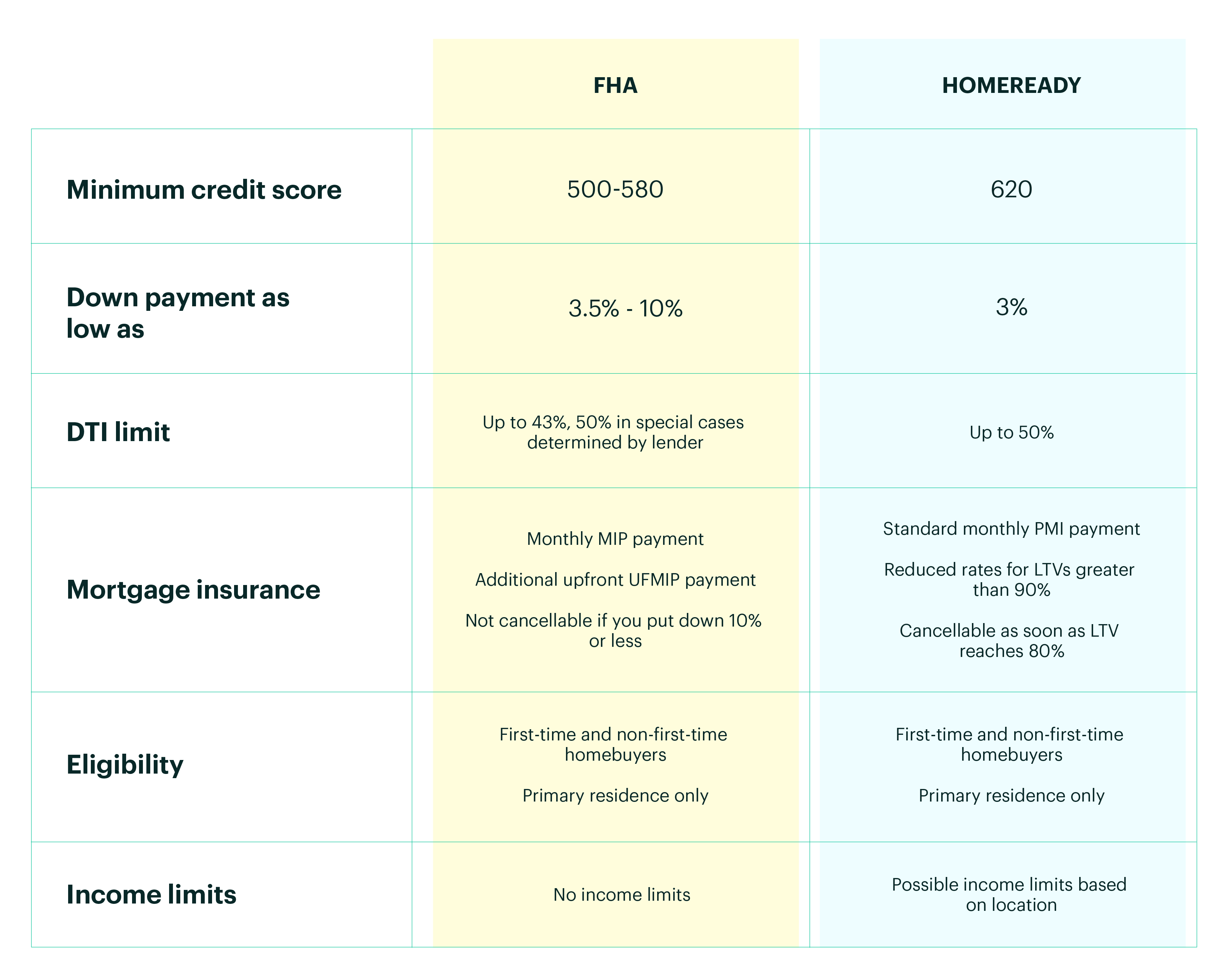
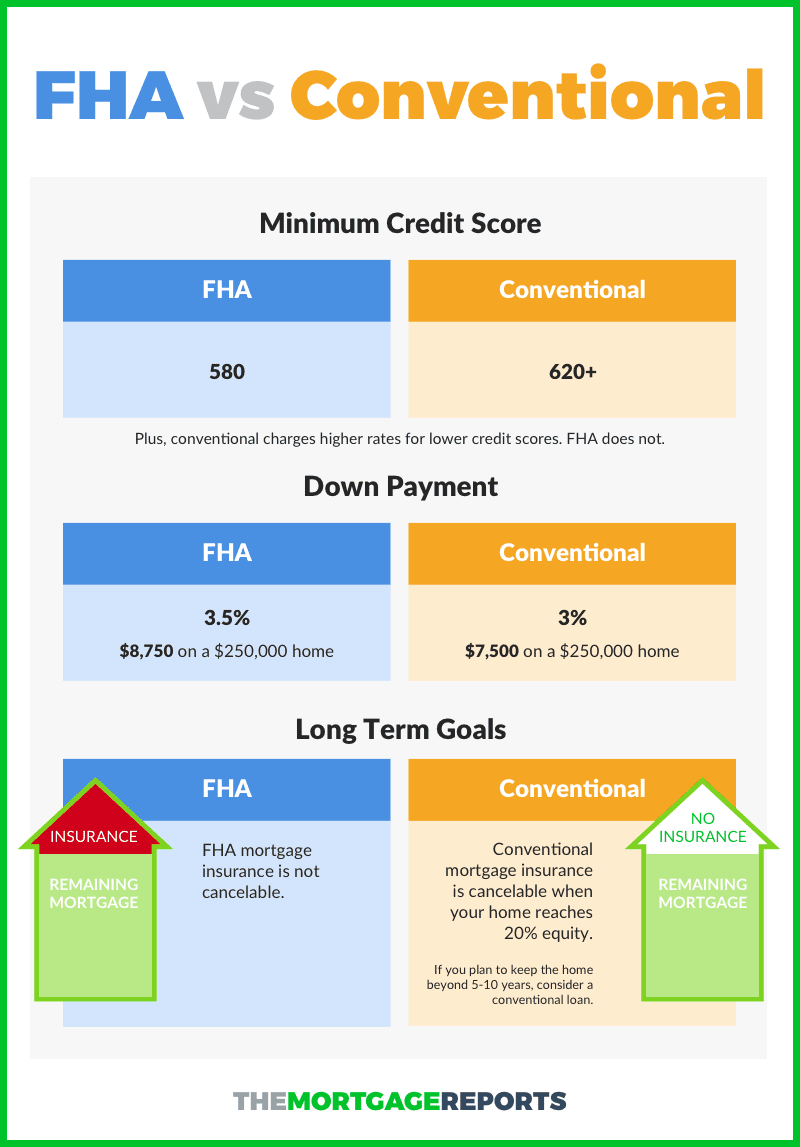
FHA loans are known for accommodating borrowers with lower credit scores. The minimum required credit score can vary. Typically, a credit score of 580 or higher is needed to qualify for the minimum down payment of 3.5%. Borrowers with credit scores between 500 and 579 might still qualify. They will need a higher down payment, usually around 10%.
Down Payment:
The minimum down payment for an FHA loan in Kentucky is 3.5% of the home’s purchase price. This is advantageous for buyers who may not have substantial savings for a larger down payment, making homeownership more accessible.
Work History:
Lenders typically look for a steady 2 year employment history when considering FHA loan applications. A consistent work history is beneficial. It is preferable to have worked with the same employer or within the same field. This helps demonstrate financial stability and the ability to repay the loan.
Debt-to-Income Ratio (DTI):
The debt-to-income ratio is a crucial factor in mortgage approval. For FHA loans, the maximum allowable DTI ratio is typically around 40% to 45% of your gross monthly income. It can go higher up to 56% with good credit scores, a large down payment, or a shorter-term loan. Lenders may also consider higher ratios in certain cases if compensating factors are present.
Bankruptcy and Foreclosure:
FHA loans have lenient guidelines regarding bankruptcy and foreclosure. Generally, borrowers with a past bankruptcy may qualify for an FHA loan after two years. This is possible if they have re-established good credit and demonstrated responsible financial behavior. For foreclosures, the waiting period is usually three years.
Mortgage Term:
FHA loans offer various mortgage term options, including 15-year, 20 year, 25 year and 30-year fixed-rate loans. The choice of term depends on your financial goals and ability to manage monthly payments.
Occupancy: Primary residences with 1-4 units. Not for investment properties or second homes.
Mortgage Insurance on the loan for life of loan. Larger down payments and shorter terms will reduce the upfront mi and monthly mi premiums
can be used for refinances, not only for purchases.
No income limits nor property restrictions on where home is located
Can close within 30 days typically with good appraisal and title work
FHA Loan Requirements in Kentucky for Credit scores, Down payment, Debt Ratio and work history below
Requirement
Details
Credit Score
– 580+: Eligible for a 3.5% down payment. – 500-579: Requires a 10% down payment.
Down Payment
Minimum of 3.5% for qualified buyers; 10% for lower credit scores below 580 to 500 score range
Debt-to-Income Ratio (DTI)
– Ideal: 45% or lower on front end ratio or housing ratio. – Acceptable: Up to 57% with compensating factors. There are two ratios. Front end and back end with front end being maxed at 45% and the backed end ratio being 56.99% with an AUS approval. If manually underwritten, see guidelines here
Employment History
Must provide at least **2 years of consistent employment—College transcripts can supplement with a less than 2 year work history
Key Benefits of FHA Loans in Kentucky
Low Credit Score Requirements
FHA loans accept borrowers with credit scores as low as 500. However, a score of 580+ qualifies you for the lowest down payment option.
Low Down Payment Options
You can purchase a home with as little as 3.5% down if you meet credit requirements, making FHA loans more accessible than conventional loans.
Competitive Interest Rates
FHA loans typically offer rates comparable to conventional mortgages. They may even offer lower rates. This could save you money over the life of the loan.
Flexible Loan Uses
With an FHA 203(k) loan, you can bundle home purchase and renovation costs into a single mortgage.
Assumable Loans
FHA loans can be transferred to a new buyer. This feature is especially valuable if you sell your home when interest rates are higher.
Understanding these qualifying criteria can help you navigate the FHA loan application process in Kentucky more effectively. Working with an experienced mortgage professional can provide valuable guidance. They offer assistance tailored to your specific financial situation and homeownership goals.
Joel Lobb Mortgage Loan Officer
Any questions, please don’t hesitate to reach out via, text, email, or call. Advice is always free.
One of Kentucky’s highest rated mortgage loan officers for FHA, VA, USDA, Kentucky Housing KHC and conventional mortgage loans.
Evo Mortgage Company NMLS# 1738461 Personal NMLS# 57916
For assistance with Kentucky mortgage loans, reach out via email, call, or text Joel Lobb directly.
Kentucky Local Home Loan Lender Services
First-Time Home Buyers Welcome FHA, Rural Housing (USDA), VA, and Kentucky Housing Corporation (KHC) Loans Conventional Loan Options Available Fast Local Decision-Making Experienced Guidance Through the Home Buying Process
NMLS 57916 | Company NMLS #173846
The view and opinions stated on this website belong solely to the authors, and are intended for informational purposes only. The posted information does not guarantee approval, nor does it comprise full underwriting guidelines. This does not represent being part of a government agency. The views expressed on this post are mine and do not necessarily reflect the view of my employer. Not all products or services mentioned on this site may fit all people. (www.nmlsconsumeraccess.org).
Kentucky First Time Homebuyers FHA, VA, USDA & Rural Housing, KHC and Fannie Mae mortgage loans
Just like the gas prices at the pump, mortgage rates can change daily or throughout the day. Typically mortgage rates are published at 10-11 am daily by most lenders and you can lock up through the close of business which is usually around 6-7 PM. Mortgage rates can change up or down throughout the day based on various financial, economics, and geopolitical news in the US Financial markets and World markets. Generally speaking, good economic news is bad for rates and vice versa, bad economic news is good for mortgage rates.
The good news is this: Once you find a home and get it under contract, you can lock your mortgage loan rate. Typically it takes about 30-45 days to close a mortgage loan in Kentucky, so the typical lock is for 30-60 days. If rates get better you may be able to negotiate a better rate with your lender, but they usually have to improve by at least 25 basis points (.25) to do that. Not all lenders offer this option. The longer you lock the loan, the greater the costs. It is usually free to lock in a loan for up to 90 days without having to pay a fee.
What a lot of lenders are experiencing now is that some loans don’t close on time for various reasons. You can always extend the lock on the loan but it will costs you usually .125 basis points to do so. If you let the lock expire on the loan, then you have to take worse case pricing on that day when you go to relock. It is usually best to extend the lock on your loan.
2. What kind of Credit Score Do I need to qualify?
When applying for a mortgage loan, lenders will pull what they call a “tri-merge” credit report which will show three different fico scores from Trans union, Equifax, and Experian. The lenders will throw out the high and low score and take the “middle score” For example, if you had a 614, 610, and 629 score from the three main credit bureaus, your qualifying score would be 614. Most lenders will want at least two scores. So if you only have one score, you may not qualify. Lenders will have to pull their own credit report and scores so if you had it ran somewhere else or saw it on a website or credit card you may own, it will not matter to the lender, because they have to use their own credit report and scores. Most lenders will pull your credit report for free nowadays so this should not be a big deal as long as your scores are high enough. The Secondary Market of Mortgage loans offered by FHA, VA, USDA, Fannie Mae, and KHC all have their minimum fico score requirements and lenders will create overlays in addition to what the Government agencies will accept, so even if on paper FHA says they will go down to 580 or 500 in some cases on fico scores, very few lenders will go below the 620 threshold. If you have low fico scores it may make sense to check around with different lenders to see what their minimum fico scores are for loans. The lenders I currently deal with have the following fico cutoffs for credit scores: FHA–580 minimum score VA—-580 minimum score Fannie Mae–620 minimum score USDA–620 minimum score KHC with Down Payment Assistance –620 minimum score.
As you can see, 580-620 is the minimum score with most lenders for a FHA, VA, or Fannie Mae loan, is required for the no down payment programs offered by USDA for Kentucky for First Time Home Buyers wanting to go no money down.
3. What are the down payment requirements?
The most popular programs for Kentucky First Time Home Buyers usually involves one of the following housing programs outlined in bold below: FHA:
FHA will allow a home buyer to purchase a house with as little as 3.5% down. If your credit scores are low, say 680 and below, a lot of times it makes sense to go FHA because everyone pays the same mortgage insurance premiums no matter what your score is, and the down payment can be gifted to you. Meaning you really don’t have to have any skin into the game when it comes to down payment.
They even allow down payment assistance for down payment requirements of 3.5% through eligible parties like Kentucky Housing, Welcome Home Grants and Louisville KY and Covington Kentucky Down Payment Grants.
Lastly, FHA will allow for higher debt to income ratios with sometimes getting loan pre-approvals up to 55% of your total gross monthly income. So if you have a debt to income ratio of over 50%, Fannie Mae will not do the loan and USDA usually likes their debt to income ratios no more than 45%.
Think back to the last time you financed a purchase — be it a home, automobile, or what have you… You may remember having heard the term “debt-to-income ratio.” Today I want to spend some time going over exactly what this ratio is, and to also touch on how it can effect your personal finances.
4. What is your debt-to-income ratio?
Commonly referred to as your “DTI,” your debt-to-income ratio is a personal finance benchmark that relates your monthly debt payments to your monthly gross income. As an example… Let’s say that your gross monthly salary is $5,000 and you are spending $2,800 of it toward monthly debt payments. In that case, your DTI would be an unhealthy 56%. This version of your DTI is sometimes referred to as your “back-end” DTI. This is often broken down further to give a front-end debt-to-income ratio, which is a component of your back-end DTI.
How to calculate your front-end DTI for a Kentucky Mortgage Loan Approval
Your front-end DTI is calculated by dividing your monthly housing costs by your monthly gross income. Front-end DTI for renters is simply the amount paid in rent, whereas for homeowners it is the sum of mortgage principal, interest, property taxes, and home insurance (i.e., your PITI) divided by gross monthly income.
From above, if that $2,800 in debt payments is attributable to $1,500 in housing costs and $1,300 in non-housing costs, then your front-end DTI is $1,500/$5,000 = 30% (and your back-end ratio is still 56%, as calculated above). Fannie Mae: Fannie Mae requires just 3% down with their new Home Possible Program, but if you use their traditional mortgage loan, then 5% is the Fannie Mae Standard. Fannie Mae will go down 620 score, but if your scores are below 680, I would look seriously at the FHA loan program because Fannie Mae has steep increases to the interest rate and the mortgage insurance premiums if your scores are low. A couple of good things about Fannie Mae is that you can buy a larger priced home and have a large loan amount due to FHA only allowing most Kentucky Home Buyers a maximum mortgage loan amount of $356,000 for a max FHA loan and $545,000 for Fannie Mae Conventional loans in Kentucky for 2020. Lastly when it comes to mortgage insurance, FHA mortgage insurance premiums are for life of loan while Fannie Mae mortgage insurance premiums drop off when you develop 80% equity position in your house. But as a tell most people, nobody has a loan for 30 years, and the average mortgage is either refinanced or home sold within the first 5-7 years. VA Loans-
VA loans offer eligible Veterans and Active Duty Personnel to buy a home going no money down with no monthly mortgage insurance. This is probably the best no money down loan out there since the rates are traditionally very low on comparison to other government insured mortgages and no monthly mortgage insurance. The VA loan can be used anywhere in the state of Kentucky with the maximum VA loan limit being removed for 2021 USDA Loans-
USDA loans offer people buying a home in rural areas (typically towns of $20k or less) to buy a home going zero down. You cannot currently own another home and there is household income limits of $90,200 for a household family of four, and up to $119,300 for a household of five or more. You search USDA website for eligible areas and household income limits below at the yellow highlighted link :
KHC or Kentucky Housing- Kentucky First Time Home Buyers typically use KHC for their down payment assistance. KHC currently offers $10,000 for down payment assistance and sometimes throughout the year they will offer low mortgage rates on their mortgage revenue bond program.
The down payment assistance usually never runs out because you have to pay it back in the form of a second mortgage. It helps a lot of home buyers that want to buy in urban areas that cannot utilizer the USDA program in rural areas. Most of the time the first mortgage is a FHA loan tied with the 2nd mortgage fore down payment assistance. All KHC programs require a 620 score and rates are locked for 45 days.
5. What if I have had a bankruptcy or foreclosure in the past?
FHA and VA are the easiest on previous bankruptcies. FHA and VA both require 2 years removed from the discharge date on a Chapter 7. If you are in the middle of a Chapter 13, FHA will allow for financing with a 12 month clean history payment to the Chapter 13 courts, and with trustee permission.
VA requires 2 years removed from a foreclosure (sheriff sale date of home) and FHA requires 3 years.
USDA requires 3 years removed from both a foreclosure and bankruptcy, but on the foreclosure they do not go off the sale date. This may save you a little time if you had a previous foreclosure.
Fannie Mae (Conventional Loan)
Fannie Mae is by far the strictest. They require 4-7 years out of a foreclosure or bankruptcy
If you have questions about qualifying as first time home buyer in Kentucky, please call, text, email or fill out free prequalification below for your next mortgage loan pre-approval.
The view and opinions stated on this website belong solely to the authors, and are intended for informational purposes only. The posted information does not guarantee approval, nor does it comprise full underwriting guidelines. This does not represent being part of a government agency. The views expressed on this post are mine and do not necessarily reflect the views of my employer. Not all products or services mentioned on this site may fit all people
CONFIDENTIALITY NOTICE: This message is covered by the Electronic Communications Privacy Act, Title 18, United States Code, §§ 2510-2521. This e-mail and any attached files are deemed privileged and confidential, and are intended solely for the use of the individual(s) or entity to whom this e-mail is addressed. If you are not one of the named recipient(s) or believe that you have received this message in error, please delete this e-mail and any attached files from all locations in your computer, server, network, etc., and notify the sender IMMEDIATELY at 502-327-9770. Any other use, re-creation, dissemination, forwarding, or copying of this e-mail and any attached files is strictly prohibited and may be unlawful. Receipt by anyone other than the named recipient(s) is not a waiver of any attorney-client, work product, or other applicable privilege. E-mail is an informal method of communication and is subject to possible data corruption, either accidentally or intentionally. Therefore, it is normally inappropriate to rely on legal advice contained in an e-mail without obtaining further confirmation of said advice.
FHA stands for the Federal Housing Administration which is a government agency created to increase home-ownership across the United States all the way back in 1934. The agency itself doesn’t offer home loans but insures loan that are offered by private lenders (i.e. mortgage companies).
It’s important to understand the different types of loan programs available to you and what benefits and drawbacks there are to each type.
For example, if you’re looking to find a fixer upper this may not be the right loan program for you. But an FHA loan may be a better fit for you if you have little cash saved up for a down payment or if you don’t have a high credit score.
No age limit. just must be 18 years of age to apply.
Must occupy the home as a primary residence, no rental homes or investment property
An appraisal must be done by an FHA-approved appraiser.Typically FHA appraisal in Kentucky costs anywhere from low-end $325 to $525 with most FHA lenders in KY.
Home inspection is not required
Termite inspection not required
2 years removed from Chapter 7 bankruptcy, and 1 year in Chapter 13 bankruptcy is possible to get a loan while in bankruptcy
Foreclosure or short sale on previous home mortgage requires 3 years removal from those dates.
Mortgage insurance (MIP) is required
Upfront Mortgage Insurance Premium is 1.75% and monthly mortgage insurance is .85% or .80% depending on loan term and loan to value.
Mortgage insurance is for life of loan.
No matter your credit scores, everyone pays the same mortgage insurance premiums.
Must have 2 years of employment history proving a reliable source of income
500 FICO score requirement with at least 10% down payment
580 FICO score requirement with at least 3.5% down payment
Gifts and down payment assistance programs are allowed to meet your down payment requirements. Cannot come from seller, but seller can contribute up to 6% of the sales price toward buyer’s closing costs and prepaids.
Student loan payments are factored into the debt-to-income ratio when applying. Typically if loans are deferred, or in an income=based repayment plan, the FHA underwriters will use 1% of the outstanding balance, which sometimes can make it difficult to qualify.
Your debt-to-income ratio must not be higher than 31% or total debt obligation cannot be higher than 43% of your current income. This is for a manual underwriter, meaning that if the AUS underwriting system by mortgage lenders will approve you for a higher debt to income ratio, that is fine.
If you are an individual with disabilities who needs accommodation, or you are having difficulty using our website to apply for a loan, please contact us at 502-905-3708.
Disclaimer: No statement on this site is a commitment to make a loan. Loans are subject to borrower qualifications, including income, property evaluation, sufficient equity in the home to meet Loan-to-Value requirements, and final credit approval. Approvals are subject to underwriting guidelines, interest rates, and program guidelines and are subject to change without notice based on applicant’s eligibility and market conditions. Refinancing an existing loan may result in total finance charges being higher over the life of a loan. Reduction in payments may reflect a longer loan term. Terms of any loan may be subject to payment of points and fees by the applicant Equal Opportunity Lender. NMLS#57916http://www.nmlsconsumeraccess.org/
— Some products and services may not be available in all states. Credit and collateral are subject to approval. Terms and conditions apply. This is not a commitment to lend. Programs, rates, terms and conditions are subject to change without notice. The content in this marketing advertisement has not been approved, reviewed, sponsored or endorsed by any department or government agency. Rates are subject to change and are subject to borrower(s) qualification.




 Website: www.mylouisvillekentuckymortgage.com
 Address: 911 Barret Ave., Louisville, KY 40204
 First-Time Home Buyers Welcome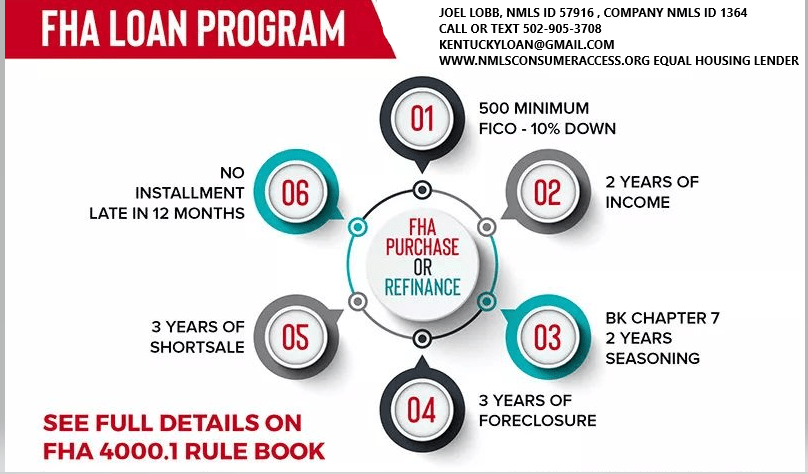

 Email –
 Call/Text –



 Kentucky FHA Mortgage Lender