
How to Qualify for FHA Loans in Kentucky: Key Guidelines

Kentucky FHA Loan Requirements 2026: Credit, Down Payment, Limits & Approval Guide | Joel Lobb
Updated for 2026

Kentucky FHA Loan Requirements 2026: Credit, Down Payment, Limits & Approval Guide

Everything Kentucky first-time homebuyers need to know — credit scores, down payment, debt-to-income, mortgage insurance, property rules, waiting periods, and the deal-killers many lenders do not explain upfront.

Get pre-approved in as little as 24 hours — even if your credit is not perfect.

3.5% Minimum Down Low down payment option
580 Minimum Score Credit-friendly program
43% Typical Max DTI Can go higher with AUS
1.75% Upfront MIP Usually financed
2 yrs Work History Same field is what matters
$0 Application Fee No upfront application cost

Trusted by 1,300+ Kentucky families • 20+ years experience • FHA, VA, USDA & KHC specialist

What Is an FHA Loan and Why Does It Matter in Kentucky?

An FHA loan is a mortgage insured by the Federal Housing Administration under HUD. The FHA does not lend money directly. Instead, it insures approved lenders against loss, which allows those lenders to offer more flexible approval guidelines than many conventional programs.

For Kentucky homebuyers, especially first-time buyers, FHA financing can be a practical path to homeownership because it may allow:

  • Lower minimum credit scores than many conventional loans
  • Down payment as low as 3.5%
  • Gift funds for down payment and closing costs
  • Higher debt-to-income ratios in many cases
  • A way to buy after bankruptcy or foreclosure once waiting periods are met

1. Income & Employment Requirements

Two-Year Work History Is the Baseline

FHA generally looks for a two-year employment history. That does not always mean two years with the same employer. The bigger issue is consistency in the same line of work and the ability to document stable income.

  • Two years of employment history is preferred
  • Job changes are usually fine if they are in the same field or a logical advancement
  • Recent graduates may be able to use education history to support the file
  • Self-employed borrowers generally need two years of tax returns
  • Part-time, overtime, bonus, and commission income usually need a history before counting
💡

Kentucky tip: A job change for more pay in the same field is usually not the problem. Unexplained gaps, inconsistent hours, and unstable earnings are what create underwriting friction.

2. Credit Score & Down Payment

FHA Credit Score Tiers

Credit Score Range Minimum Down Payment Real-World Status
620 and above 3.5% Most lender-friendly
580 to 619 3.5% Usually workable
500 to 579 10% Limited lender options
Below 500 Not eligible Not FHA eligible
⚠️

Lender overlays matter. FHA may allow lower scores, but many lenders set stricter internal minimums. That is why borrowers often hear one thing online and something very different when they actually apply.

3. Debt-to-Income Limits

Front-End and Back-End DTI

Debt-to-income ratio measures how much of your gross monthly income goes toward monthly debt obligations. FHA reviews both housing-only and total debt ratios.

DTI Type What It Includes Common Target
Front-End Mortgage payment, taxes, insurance, and FHA mortgage insurance About 31%
Back-End Housing payment plus all monthly debts on credit About 43%
💡

AUS flexibility: With a strong automated approval, debt ratios can often go above 43%. With manual underwriting, the file usually gets much tighter and compensating factors matter a lot more.

4. Acceptable Down Payment Sources

Funds Must Be Verified and Sourced

FHA is flexible about where funds come from, but not loose about documentation. Every dollar used for down payment and closing costs needs a clean paper trail.

Acceptable Sources

  • Personal checking or savings
  • Verified gift funds from family or eligible donors
  • Retirement account withdrawals or loans when documented
  • Sale of personal property with documentation
  • Approved down payment assistance programs

Common Problems

  • Cash deposits with no paper trail
  • Borrowed funds from unapproved sources
  • Undocumented transfers between accounts
  • Large deposits that cannot be explained
  • Gift funds without a gift letter and evidence of transfer
⚠️

Bottom line: The money itself is often not the issue. Documentation is the issue. If the money cannot be sourced, it can derail the approval even when the borrower otherwise qualifies.

5. Property Requirements

The Home Has to Meet FHA Standards

FHA is not just approving the borrower. It is also approving the collateral. The property must be safe, sound, and marketable.

  • The property must be owner-occupied as a primary residence
  • The appraisal must support value and FHA minimum property standards
  • Health and safety issues may need to be repaired before closing
  • Utilities generally need to be on for proper appraisal review
  • Manufactured homes have additional foundation and eligibility requirements
💡

Important: FHA financing can be used on single-family homes, many condos, certain multi-unit owner-occupied properties, and some manufactured homes, but every category has its own eligibility rules.

6. Bankruptcy & Foreclosure Waiting Periods

Waiting Periods Do Exist, but FHA Is More Forgiving Than Many Programs

Credit Event Typical FHA Waiting Period Notes
Chapter 7 Bankruptcy 2 years From discharge date in most cases
Chapter 13 Bankruptcy 12 months On-time trustee payments and court approval usually required
Foreclosure 3 years From completion date in most cases
Short Sale Varies May be sooner depending on how it reported and current credit profile

7. Federal Debt & the CAIVRS Check

CAIVRS Is the Federal Database Many Buyers Never Hear About

Before FHA approval, borrowers are checked through CAIVRS, the federal database that flags certain unresolved government-related defaults or claims.

  • Defaulted federally backed student loans
  • Prior FHA or other government-backed loan claims
  • Certain unresolved federal delinquencies or judgments
🚫

A CAIVRS hit can stop the deal cold. This is not something you finesse around. The underlying issue usually has to be resolved before the FHA loan can move forward.

8. FHA Mortgage Insurance Premium

Mortgage insurance is part of the FHA tradeoff. It is one reason FHA works for lower down payment and more flexible credit, but it also increases the payment.

Upfront MIP
1.75%
Usually financed into the loan amount
Annual MIP
0.45%–1.05%
Paid monthly as part of the mortgage payment

On a $200,000 FHA loan, the upfront mortgage insurance premium adds about $3,500 to the loan amount if financed. Monthly mortgage insurance varies, but it can make a meaningful difference in payment planning.

💡

Long-term strategy: Many FHA borrowers later refinance into a conventional loan once they build equity and improve credit, because FHA mortgage insurance does not work like conventional PMI in many cases.

The Top FHA Deal-Killers in Kentucky

After working through hundreds of FHA files, these are the issues that most often kill deals, delay closings, or force borrowers to regroup.

Credit overlays

The FHA guideline may say one thing, but the actual lender may require a higher score or cleaner profile.

Unsourced funds

Cash deposits, undocumented transfers, or gift money with no paper trail can stop the loan.

Appraisal issues

Safety, condition, value, or eligibility problems can delay or kill the transaction.

Federal debt problems

Defaulted student loans or other federal issues can cause a CAIVRS denial.

High debt ratios

If the automated system does not approve it, manual underwriting can get strict quickly.

Inconsistent income

Variable hours, weak earnings history, or recent instability can reduce qualifying income.

The Smart Long-Term FHA Strategy

FHA is often the best entry point, not always the best forever loan. For many Kentucky buyers, the real win is using FHA to get in the home now, then improving the credit profile and refinancing later when the numbers make sense.

1

Get pre-approved

Run the numbers honestly and determine what is actually workable today.

2

Use the right assistance

Layer in any available gift funds or down payment assistance that fits the file.

3

Buy with a plan

Get into the home, stabilize finances, build equity, and improve the credit profile.

4

Refinance later

Review conventional refinance options when rates, equity, and scores line up.

Frequently Asked Questions — Kentucky FHA Loans

Can I get an FHA loan with a 580 credit score in Kentucky?

Yes. FHA guidelines allow 580 with 3.5% down, but many lenders have overlays. Real-world approval depends on the full file, not just the score.

Is there down payment assistance available for Kentucky FHA loans?

Yes. Some Kentucky borrowers may qualify for Kentucky Housing Corporation down payment assistance, depending on income, credit, and program limits.

How long does FHA approval take in Kentucky?

A pre-approval can often be issued quickly with full documentation. From contract to closing, many FHA purchases land in the 30 to 45 day range, though every file is different.

Can I use an FHA loan to buy a duplex in Kentucky?

Yes, if you live in one unit as your primary residence and the property meets FHA rules. FHA is not for a pure non-owner-occupied investment purchase.

Does FHA mortgage insurance ever go away?

That depends on the loan structure, but many FHA borrowers eventually refinance into conventional financing once they have enough equity and improved credit.

What is the FHA loan limit for Kentucky in 2026?

Loan limits depend on property type and county rules in effect for the year. Always verify current limits for the specific property and loan structure before proceeding.

Ready to Apply for an FHA Loan in Kentucky?

Start your free mortgage review with Joel Lobb. Get straight answers on credit, income, down payment, and what you may qualify for now — without wasting time on the wrong program.

JL

Joel Lobb — Kentucky Mortgage Loan Officer

20+ years of experience | 1,300+ Kentucky families helped | FHA, VA, USDA, KHC & Conventional loans

NMLS #57916 Company NMLS #1738461 Licensed in Kentucky Equal Housing Lender

NMLS #57916 | Company NMLS #1738461 | Equal Housing Lender. This is not a commitment to lend. All loans are subject to credit approval and program requirements. This website is not affiliated with or endorsed by FHA, VA, USDA, KHC, or any government agency. Licensed in Kentucky only. NMLS Consumer Access
Kentucky FHA Loan Essentials for New Homebuyers

Louisville Kentucky Mortgage Lender for FHA, VA, KHC, USDA and Rural  Housing Kentucky Mortgages: What is the difference between Conventional, FHA  and VA Mortgage loans in Kentucky?


<!– WordPress.com-friendly page content (no , no , no ) –>

Kentucky FHA Loans (2026): Requirements, Down Payment, Credit Scores, and How to Get Approved

If you are buying a home in Kentucky and want a low down payment option with more flexible credit guidelines, an FHA loan is often the most practical path. This guide covers the FHA rules that matter in 2026, the common underwriting issues that slow people down, and the fastest way to get a clean pre-approval.

Want a same-day pre-approval review? Call or text 502-905-3708 or email kentuckyloan@gmail.com.

Helpful links (official + Kentucky-specific):
• FHA loan limits lookup (by Kentucky county): HUD FHA Mortgage Limits
• FHA underwriting rules source document: HUD Handbook 4000.1
• Kentucky Housing down payment assistance overview: KHC Down Payment Assistance


Quick FHA Requirements Snapshot (Kentucky)

  • Minimum down payment: 3.5% with 580+ credit score; 10% with 500–579 (case-by-case).
  • Primary residence only (no investment property).
  • FHA appraisal required and the home must meet FHA property standards.
  • Seller concessions allowed up to 6% of the sales price toward certain closing costs and fees.
  • Mortgage insurance is required (upfront + monthly/annual).

Want me to price your payment and cash-to-close fast? Text “FHA” to 502-905-3708 and I will reply with a document checklist.


Credit Score Guidelines for Kentucky FHA Loans

FHA guidelines allow:

  • 580+ credit score: eligible for the 3.5% minimum down payment option.
  • 500–579 credit score: may be eligible with 10% down (approval depends on the full file).
  • Below 500: generally not eligible for FHA financing.

Important: lenders can add “overlays” (stricter requirements than FHA). That is why two lenders can give two different answers on the same borrower. If you want a straight answer, I will review your scenario and tell you what is realistically approvable.

Next step: Call or text 502-905-3708 for a quick credit-and-income review.


Down Payment and Closing Costs (What Kentucky Buyers Actually Pay)

FHA requires a minimum down payment based on credit score. Closing costs are separate and typically include lender fees, title, escrow, and prepaid items like taxes and homeowners insurance.

3 ways Kentucky FHA buyers reduce cash-to-close

  • Seller concessions (up to 6% of the sales price, when allowed and properly structured).
  • KHC Down Payment Assistance (for eligible borrowers using a KHC first mortgage).
  • Lender credits (higher rate trade-off to reduce upfront costs, when it makes sense).

External reference on seller concessions: HUD guidance on interested party contributions


Kentucky FHA Loan Limits (2026)

FHA loan limits change by county and are updated periodically. The cleanest way to avoid outdated numbers is to pull your county limit directly from HUD.

Use this official lookup tool: HUD FHA Mortgage Limits by County

If you text me your county (or the property address), I will confirm the current FHA limit and your max purchase price: 502-905-3708.


Debt-to-Income Ratio (DTI): What FHA Looks At

FHA underwriting looks at housing expense compared to income and total monthly debts compared to income. A common baseline guideline you will see referenced is 31% for housing and 43% for total debt, with exceptions possible depending on automated underwriting results and compensating factors.

  • Housing ratio (front-end): proposed house payment compared to gross monthly income.
  • Total DTI (back-end): house payment plus monthly debts compared to gross monthly income.

If your DTI is tight, the fix is usually one of these: adjust purchase price, restructure debt, improve credit, or document additional qualifying income correctly.


Types of FHA Loans Kentucky Buyers Use Most

FHA 203(b) Standard Purchase

The most common FHA loan for buying a primary residence in Kentucky.

FHA 203(k) Renovation Loan

Combines purchase plus renovation costs into one loan for qualifying homes that need repairs or updates.

FHA Streamline Refinance

For existing FHA borrowers looking to reduce payment with simplified documentation (when eligible).

FHA Cash-Out Refinance

For homeowners who want to access equity (subject to FHA rules and underwriting).

Internal links (recommended):
• VA Loans: Kentucky VA Home Loans
• USDA Loans: Kentucky USDA Zero Down Loans
• KHC Programs: Kentucky Housing (KHC) Loan Programs


KHC Down Payment Assistance (Pairs Well with FHA)

Kentucky Housing Corporation (KHC) offers down payment assistance for eligible borrowers using a KHC first mortgage. KHC’s Regular DAP has been listed as assistance up to $12,500, repayable over 15 years at 4.75% (subject to program terms, eligibility, and availability). Confirm current options here: KHC Down Payment Assistance.

If you want a straight answer on eligibility (income limits, purchase price limits, and which first mortgage fits), call or text me: 502-905-3708.


How to Apply for an FHA Loan in Kentucky (Simple Process)

  1. Quick consult (10 minutes): goals, county, price range, and down payment plan.
  2. Document review: paystubs, W-2s, bank statements, and ID.
  3. Run automated underwriting and issue a clean pre-approval.
  4. Home shopping + contract.
  5. Appraisal, underwriting, and final approval.
  6. Closing and keys.

Primary CTA:
Call or Text 502-905-3708 for FHA Pre-Approval
Email: kentuckyloan@gmail.com

Secondary CTA (site):
Start here: mylouisvillekentuckymortgage.com


FHA FAQ (Kentucky)

Do FHA loans have income limits?

FHA itself does not set income limits. However, down payment assistance programs (like KHC) typically do.

How long does an FHA loan take to close?

Many FHA purchases close in the 30–45 day range, depending on appraisal timing, documentation, and underwriting conditions.

Can the seller pay my closing costs on FHA?

Seller concessions are allowed up to 6% of the sales price toward certain costs when structured correctly. Reference: HUD guidance.

Where can I verify FHA loan limits for my Kentucky county?

Use HUD’s official lookup tool: FHA Mortgage Limits.


About

Joel Lobb — Kentucky Mortgage Loan Officer
NMLS Personal ID: 57916 | Company NMLS: 1738461
Call/Text: 502-905-3708 | Email: kentuckyloan@gmail.com
NMLS Consumer Access: nmlsconsumeraccess.org


Equal Housing Lender
Joel Lobb | NMLS 57916 | Company NMLS 1738461
10602 Timberwood Circle, Louisville, KY 40223
This is an advertisement. Not a commitment to lend. All loan approvals are subject to underwriting guidelines and program eligibility. Terms and conditions apply. Programs, rates, and guidelines are subject to change without notice.
This website is not endorsed by or affiliated with the FHA, VA, USDA, KHC, or any government agency.

2026 Kentucky FHA Loan Guide: Benefits & Updates

Kentucky FHA Loan Guide 2026: Limits, Gift Funds, KHC Down Payment Help, and Welcome Home Grant

Buying a home in Kentucky in 2026? This guide breaks down the FHA loan limit, gift fund rules, KHC down payment assistance, and the Welcome Home Grant in a clean, mobile-friendly format with no scripts.

2026 FHA limit: $541,287 3.5% down with 580+ KHC DAP up to $12,500 Welcome Home opens April 6, 2026

If you are a Kentucky first-time home buyer, or even a repeat buyer looking for a low down payment option, FHA financing remains one of the strongest mortgage programs available in 2026. FHA works well for many buyers because it allows a lower down payment, flexible credit guidelines, and in many cases the ability to combine with down payment assistance.

On top of that, Kentucky buyers may also be able to use Kentucky Housing Corporation down payment assistance or the Welcome Home Grant to reduce cash needed at closing. When the loan is structured correctly, that can make the difference between buying now and waiting another year.

2026 Kentucky FHA quick update The 2026 FHA one-unit loan limit in Kentucky is $541,287. KHC continues offering up to $12,500 in Regular DAP. The Welcome Home Program opens April 6, 2026 at 8:00 a.m. ET. Gift fund documentation is cleaner than it used to be, but large deposits still need to be documented properly.

2026 Kentucky FHA Loan Highlights

$541,287
2026 FHA loan limit
Standard one-unit Kentucky FHA limit
3.5%
Minimum FHA down payment
For borrowers with a 580 or higher credit score
580
Typical minimum score for 3.5% down FHA
Lower scores may require more money down
$12,500
KHC Regular DAP
Repayable over 15 years at 4.75%
$10,000–$20,000
Welcome Home assistance
Grant funds available through participating lenders while funds last

FHA Gift Funds and Large Deposits in 2026

One of the biggest advantages for FHA borrowers today is that gift fund documentation is cleaner than it used to be. That matters because many Kentucky buyers rely on family help for down payment or closing costs.

Even with that improvement, large deposits still matter. If a deposit is unusually large compared to your monthly qualifying income, underwriting will usually require an explanation and documentation showing where the money came from.

The bottom line is simple: gift funds can absolutely help, but the file still needs to be documented the right way from the start.

KHC Down Payment Assistance 2026

The Kentucky Housing Corporation loan program remains one of the best tools available for Kentucky buyers who need help with down payment and closing costs.

How KHC helps FHA buyers

KHC Regular DAP can be paired with an eligible KHC first mortgage. For borrowers who qualify, that can help cover some or all of the FHA down payment and part of the closing costs.

This is especially useful for buyers who have the income to qualify but do not have a large amount of liquid cash saved. That is a common issue, and KHC helps address it directly.

Regular DAP is offered up to $12,500 and is repaid over 15 years at 4.75 percent.

Basic KHC eligibility points

  • You must use an eligible KHC first mortgage program.
  • You must meet KHC credit score requirements.
  • You must stay within applicable income and purchase price limits.
  • The home must be a primary residence.
  • Program overlays and lender guidelines still apply.

Welcome Home Grant 2026

Separate from KHC

The Welcome Home Program is separate from KHC down payment assistance. A lot of buyers mix those up, but they are not the same program and they do not operate the same way.

The Welcome Home Program opens April 6, 2026 at 8:00 a.m. Eastern Time. Funds are first-come, first-served, so serious buyers need to be fully pre-approved and ready before the window opens.

  • Program opens April 6, 2026
  • Opening time is 8:00 a.m. ET
  • Potential grant range is generally $10,000 to $20,000
  • Available through participating lenders
  • Income, occupancy, and program rules apply
  • Funds can run out quickly

Official program information: FHLB Cincinnati Welcome Home Program

Internal Links to Related Kentucky Loan Programs

Official External Resources

How to Buy a House in Kentucky with an FHA Loan

1. Review your credit

Know where your mortgage scores stand before you start shopping.

2. Get pre-approved

Review your credit, income, assets, and employment up front so the right loan structure is clear from the beginning.

3. Review assistance options

Do not stop at FHA only. Check KHC and Welcome Home eligibility at the same time.

4. Gather documents early

Have pay stubs, W-2s, bank statements, ID, and documentation for any unusual deposits ready early.

5. Structure the offer correctly

Seller concessions, program fit, and property eligibility all matter before contract execution.

6. Move through underwriting and closing

Clean files close faster. Disorganized files do not.

Ready to Buy a Home in Kentucky?

Get a straight answer on your FHA, KHC, USDA, or VA options and find out which loan structure fits your situation best.

Frequently Asked Questions

What is the Kentucky FHA loan limit for 2026?

The standard one-unit FHA loan limit for Kentucky in 2026 is $541,287.

How much is KHC down payment assistance in 2026?

KHC Regular DAP is offered up to $12,500 and is repayable over 15 years at 4.75 percent for eligible borrowers.

When does the Welcome Home Program open in 2026?

The 2026 Welcome Home Program opens April 6, 2026 at 8:00 a.m. Eastern Time.

Can I use gift funds on an FHA loan?

Yes. FHA allows gift funds, but they still have to be documented properly for underwriting.

Which is better in Kentucky: FHA, USDA, VA, or KHC?

That depends on your credit, income, location, veteran status, and cash available. The right answer is the loan structure that gives you the best overall execution, not just the one with the most familiar name.

About Joel Lobb

Joel Lobb is a Kentucky mortgage professional helping home buyers with FHA, VA, USDA, KHC, and conventional financing across Kentucky.

NMLS #57916
Company NMLS #1738461
Phone: 502-905-3708
Email: kentuckyloan@gmail.com

Verify license at NMLS Consumer Access

Disclaimer: This information is for educational purposes only and is not a commitment to lend. All loans are subject to credit approval, income verification, asset review, and property approval. Program guidelines, rates, limits, and eligibility can change. Equal Housing Lender.

Kentucky FHA Loans: Your Complete Guide to FHA Loans in Kentucky


Are you considering a home purchase in Kentucky ? If so, then a Kentucky FHA loan might be for you. This Kentucky FHA Mortgage  guide will provide you with all the FHA loan information you need to buy a home in Kentucky using the FHA loan program

What Is A Kentucky FHA Loan?

If you’re looking to buy a home but have limited funds for a down payment or a lower credit score, then an Kentucky  FHA loan might be a good option for you. This is a type of a  Kentucky mortgage insured by the Federal Housing Administration (FHA), which allows Kentucky FHA  lenders to be more flexible with their requirements for borrowers who may not meet traditional criteria. 

How do Kentucky FHA loans work?

KEntucky FHA loans are a government-backed program which makes homeownership more accessible through more lenient lending requirements. With an FHA loan, a borrower could put down as little as 3.5% if their credit score is at least 580, or 10% if their credit score is at least 500. Nevertheless, there is a trade-off; regardless of the amount you put down, there is a requirement to pay for mortgage insurance upfront and monthly  premiums and it is for life of loan 

The FHA collects a one-time upfront mortgage insurance premium (UFMIP). This premium needs to be entirely financed into the mortgage or paid in full at closing. Additionally, there is an annual mortgage insurance premium, also called monthly MIP, which is collected in monthly installments.

The annual mortgage insurance amount depends on factors such as the loan-to-value ratio (LTV), down payment size, and mortgage term length. Lenders calculate the annual payment as a percentage of the base loan value.


Benefits Of Kentucky FHA Loan 

There are several key benefits that make Kentucky FHA loans an attractive option. Here are a few of the benefits: 

  • Low to zero down Down Payments: FHA loans are designed to help borrowers with limited funds for down payments. Specifically, if your credit score is above 580, you could qualify for a down payment of 3.5%.  
  • Flexible Credit Requirements: FHA loans have lower credit score requirements compared to conventional loans. Even with a credit score as low as 500, you may qualify with a 10% down payment. 
  • Lower Debt-to-Income Ratio (DTI): Compared to conventional loans, FHA loans typically allow borrowers with higher levels of debt to still qualify by allowing a higher Debt-to-Income Ratio (DTI). 
  • Gift Funds and Grants: You could leverage gift funds and grants from family or approved organizations to contribute towards your down payment.  

Kentucky FHA Loan Requirements 

To be eligible for an Kentucky FHA loan there are some specific requirements you must meet. Here is an overview of these requirements:   

FHA Loan Down Payment  

The amount you’ll need to pay as a down payment on an FHA loan depends on your credit score. If your credit score is 580 or higher, then you could pay as little as 3.5% of the loan amount. However, if your credit score falls between 500 and 579, you’ll need to pay a larger down payment of 10%. If you’re short on funds, there are several DPA programs available which could help for Kentucky Homebuyers with zero down payments to get into a house.! 

Kentucky FHA Mortgage Insurance Premiums 

All FHA borrowers, no matter how much of a down payment they make, must purchase both upfront and annual mortgage insurance. 

What does Kentucky FHA mortgage insurance cover on your home loan? 

Kentucky FHA mortgage insurance protects lenders in case you, the borrower, default on your mortgage. This allows lenders to offer FHA loans with lower down payments and potentially less strict credit score requirements. Essentially, it mitigates the lender’s risk, making Kentucky FHA loans more accessible to first-time homebuyers or those with limited savings. 

How much is FHA mortgage insurance? 

FHA mortgage insurance has two components – an upfront premium and an annual premium. The upfront premium is a one-time payment that you need to make at the time of loan closing, and it amounts to 1.75% of the loan amount. 

On the other hand, the annual premium is a recurring cost that you need to pay as a part of your monthly mortgage payment. The amount of the annual premium may vary depending on factors such as the loan term, loan amount, and loan-to-value ratio (LTV). 

Oftentimes, with credit improvement and an increase in home equity (at least 80% loan-to-value), borrowers with FHA loans opt to refinance to a conventional loan program. This helps eliminate the monthly mortgage insurance premium portion of the monthly mortgage payment. 

How To Calculate Kentucky FHA Mortgage Insurance 

To calculate your Kentucky  FHA Mortgage Insurance, you can either use the HUD Calculator or follow these simple steps using your specific information: 

  1. Determine the amount of your loan. 
  2. Calculate your loan-to-value (LTV) ratio by dividing the loan amount by the appraised value of the home. 
  3. Find the annual MIP rate based on your LTV ratio and loan term. You can find this information on the HUD website
  4. Multiply the loan amount by the annual MIP rate to get the annual MIP amount. 


Can I remove KEntucky FHA mortgage insurance? 

If you have an FHA loan, you can’t remove the Mortgage Insurance Premium (MIP) as easily as you can with Private Mortgage Insurance (PMI). To remove MIP from your FHA loan, you could refinance into a Conventional Loan. Once your home has at least 20% equity, you typically won’t have to pay PMI with a conventional loan. 

Kentucky FHA Minimum Credit Score 

 To qualify for an Kentucky FHA loan, your FICO credit score needs to be at least 580. IF below 580, you will need 10% down payment and few lenders will do this honestly so it is best to raise your score above 580

Kentucky  FHA Mortgage Debt to Income Ratios 

Your debt-to-income ratio is the percentage of your gross income used to cover your mortgage and other debt payments. 

Debt to income  ratio for FHA loans is 3o to 45%  on the front end although this may vary based on your credit score and may go up to 57% with an AUS approval though Fannie Mae DO or Freddie Mac LP underwriting system. 

Calculating Your DTI for kentucky FHA Mortgage 

To calculate your Debt-to-Income Ratio (DTI) you could either use our mortgage calculator or follow these simple steps:  

  1. Add up all your monthly debt payments, including car loans, student loans, credit card debt, and the estimated monthly mortgage payment for the FHA loan you are considering. 
  1. Calculate your pre-tax gross monthly income. 
  1. Once you have these numbers, use the following formula to calculate your DTI Ratio: DTI Ratio = Total Monthly Debt Payments / Gross Monthly Income. 

Kentucky FHA Loan Income Requirements 

Kentucky HA loans don’t have any specific minimum or maximum income requirements.


Kentucky FHA Loan Limits 

The maximum amount you can borrow on an FHA loan (which is set by The Federal Housing Administration)  As of May 2024, the Federal Housing Administration (FHA) loan limits for single-family homes in Kentucky are $498,257

Kentucky FHA Mortgage Rates 

Kentucky FHA loans typically have lower interest rates than conventional loans but inline with other government backed loans like Kentucky VA and USDA loans . This is because the Federal Housing Administration (FHA) or HUD , which manages the FHA loan program in Kentucky , insures these mortgages. This insurance protects private lenders from the risk of borrower default, which enables them to offer lower rates with a government guarantee if loan defaults

Types Of Kentucky FHA Loans 

 FHA loans available, each with unique requirements and benefits. Here are some of the most common options. 

Home Purchase  

Kentucky FHA loans are commonly used to finance the purchase of a single-family house, townhouse, or condominium, 2-4 units homes in Kentucky

FHA Rate Term Refinance 

A Kentucky FHA Rate Term Refinance enables you to refinance your current Kentucky FHA loan and potentially obtain a lower interest rate or adjust the loan term.  

Kentucky FHA Streamline Refinance

The Kentucky FHA Streamline option allows refinancing without an appraisal, providing a fast and simple process for borrowers with existing FHA-insured mortgages that can reduce closing costs due to not having to do an appraisal and skipping a lot of verifications that was done when you use the FHA loan the first time to buy the house. 

Kentucky FHA Cash Out Refinance  

An Kentucky FHA Cash Out Refinance allows you to leverage the equity you’ve built up in your home by letting you finance up to 80% of the home’s value to use the cash home equity –Refinance must be in a 1st lien position due to FHA does not allow for second mortgages

Kentucky FHA Cash Out Refinance 

These loans cater to homebuyers interested in purchasing a fixer upper. FHA 203k loans combine financing for both the purchase and renovation of a property, allowing you to roll renovation costs into your mortgage payment. This eliminates the need for a separate renovation loan, simplifying the financing process. 

Kentucky FHA 100% Financing 

This program provides homebuyers with 100% financing for Kentcky FHA loans, without requiring a down payment (closing costs are still required). This is achieved through a combination of a 1st and 2nd mortgage. 

This DPA program through KHC, 5% grant, and 3.5% grant from Federal Agency  can be used to obtain an FHA loan. The 2nd mortgage can be up to 3.5% of the sales price or the appraised value, whichever is less. The term for the 2nd mortgage is 10 years. 

Kentucky FHA vs Kentucky  Conventional Loan 

Kentucky FHA and Kentucky conventional loans are two popular options for financing a home. Nevertheless, there are some differences between the two

Kentucky FHA loans are provided by lenders approved by the Federal Housing Administration and guaranteed by the government. These loans usually have more relaxed eligibility requirements compared to conventional loans, and FHA loans may require smaller down payments. However, you will need to pay mortgage insurance premiums (MIPs) for at least 11 years, or the full term of the loan. 

On the other hand, conventional loans are not backed by any government agency and may have stricter lending standards. They may require larger down payments than FHA loans, and if you provide less than 20% as a down payment, you will have to pay for private mortgage insurance (PMI). However, you can request to cancel PMI when your balance reaches 80% of the original home value. 

How To Apply For A Kentucky FHA Loan 


Find an approved- FHA Lender in Kentucky 

To apply for an Kentucky FHA loan,  contact me below 


Text/call: 502-905-3708
fax: 502-327-9119
email:
 kentuckyloan@gmail.com

http://www.mylouisvillekentuckymortgage.com/

Documents Needed for a FHA loan in Kentucky

Kentucky FHA Mortgage Application Checklist of Documents Needed below 👇

W-2 forms (previous 2 years)
Paycheck stubs (last 30 days – most current)
Employer name and address with phone number to verify employment (2 year history including any gaps)
Bank accounts statement (recent 2 months – all pages
Statements for 401(k)s, stocks and other investments (most recent)
federal tax returns (previous 2 years)
Residency history (2 year history)
Photo identification for applicant and co-applicant (valid Driver’s License

Can You Have Two Kentucky FHA Loans at One Time?


FHA will not insure more than one Property as a Principal Residence for any Borrower, except as noted below. FHA will not insure a Mortgage if it is determined that the transaction was designed to use FHA mortgage insurance as a vehicle for obtaining Investment Properties, even if the Property to be insured will be the only one owned using FHA mortgage insurance.

Properties previously acquired as Investment Properties are not subject to these restrictions.

Listed below are the only circumstances in which a Borrower with an existing FHA-insured Mortgage for a Principal Residence may obtain an additional FHA-insured Mortgage on a new Principal Residence:

RELOCATION – A Borrower may be eligible to obtain another FHA-insured Mortgage without being required to sell an existing Property covered by an FHA-insured Mortgage if the Borrower is:
– relocating or has relocated for an employment-related reason; and
– establishing or has established a new Principal Residence in an area more than 100 miles from the Borrower’s current Principal Residence.

If the Borrower moves back to the original area, the Borrower is not required to live in the original house and may obtain a new FHA-insured Mortgage on a new Principal Residence provided the relocation meets the two requirements above.

INCREASE IN FAMILY SIZE – A Borrower may be eligible for another house with an FHA-insured Mortgage if the Borrower provides satisfactory evidence that:
– the Borrower has had an increase in legal dependents and the Property now fails to meet family needs; and
– the Loan-to-Value (LTV) ratio on the current Principal Residence is equal to or less than 75% or is paid down to that amount, based on the outstanding Mortgage balance and a current residential appraisal.
  
VACATING A JOINTLY-OWNED PROPERTY 
– A Borrower may be eligible for another FHA-insured Mortgage if the Borrower is vacating (with no intent to return) the Principal Residence which will remain occupied by an existing co-Borrower.

NON-OCCUPYING CO-BORROWER – A non-occupying co-Borrower on an existing FHA-insured Mortgage may qualify for an FHA-insured Mortgage on a new Property to be their own Principal Residence.

Can you buy a Kentucky duplex with an Kentucky FHA loan? 

FHA loans are a great way to finance the purchase of a duplex. Remember, you must live in one of the units as your primary residence for at least one year in order to be eligible for an FHA loan. This requirement is in place because FHA loans are intended to help people buy homes they will live in, not as investment home opportunities. Buying a duplex allows you to earn rental income while also enjoying the experience of being a homeowner. 

Can you get an Kentucky FHA loan twice? 


FHA will not insure more than one Property as a Principal Residence for any Borrower, except as noted below. FHA will not insure a Mortgage if it is determined that the transaction was designed to use FHA mortgage insurance as a vehicle for obtaining Investment Properties, even if the Property to be insured will be the only one owned using FHA mortgage insurance.

Properties previously acquired as Investment Properties are not subject to these restrictions.

Listed below are the only circumstances in which a Borrower with an existing FHA-insured Mortgage for a Principal Residence may obtain an additional FHA-insured Mortgage on a new Principal Residence:

RELOCATION – A Borrower may be eligible to obtain another FHA-insured Mortgage without being required to sell an existing Property covered by an FHA-insured Mortgage if the Borrower is:
– relocating or has relocated for an employment-related reason; and
– establishing or has established a new Principal Residence in an area more than 100 miles from the Borrower’s current Principal Residence.

If the Borrower moves back to the original area, the Borrower is not required to live in the original house and may obtain a new FHA-insured Mortgage on a new Principal Residence provided the relocation meets the two requirements above.

INCREASE IN FAMILY SIZE – A Borrower may be eligible for another house with an FHA-insured Mortgage if the Borrower provides satisfactory evidence that:
– the Borrower has had an increase in legal dependents and the Property now fails to meet family needs; and
– the Loan-to-Value (LTV) ratio on the current Principal Residence is equal to or less than 75% or is paid down to that amount, based on the outstanding Mortgage balance and a current residential appraisal.
  
VACATING A JOINTLY-OWNED PROPERTY 
– A Borrower may be eligible for another FHA-insured Mortgage if the Borrower is vacating (with no intent to return) the Principal Residence which will remain occupied by an existing co-Borrower.

NON-OCCUPYING CO-BORROWER – A non-occupying co-Borrower on an existing FHA-insured Mortgage may qualify for an FHA-insured Mortgage on a new Property to be their own Principal Residence.

. 

Are Kentucky FHA loans assumable? 


Assumable Mortgages are a type of financing arrangement in which the outstanding mortgage and its terms can be transferred from the current owner to a buyer.
 
By assuming the previous owner’s remaining debt, the buyer can avoid having to obtain his or her own mortgage. Buyers are typically attracted to homes with existing assumable mortgages during times of rising interest rates. This is because they can assume the seller’s mortgage, which was created when interest rates were lower, and use it to finance their purchase.
 
If the home’s purchase price exceeds the mortgage balance by a significant amount, the buyer will either need to provide a sizable down payment or obtain a new mortgage anyway.
 
For example, if a buyer is purchasing a home for $250,000, and the seller’s assumable mortgage only has a balance of $110,000, the buyer would need a down payment of $140,000 to cover the difference, or would have to get a separate mortgage to secure the needed funds.

fha assumable homes in louisville

Joel Lobb  Mortgage Loan Officer

American Mortgage Solutions, Inc.
10602 Timberwood Circle
Louisville, KY 40223
Company NMLS ID #1364

Text/call: 502-905-3708
fax: 502-327-9119
email:
 kentuckyloan@gmail.com

http://www.mylouisvillekentuckymortgage.com/

NMLS 57916  | Company NMLS #1364/MB73346135166/MBR1574The view and opinions stated on this website belong solely to the authors, and are intended for informational purposes only. The posted information does not guarantee approvalnor does it comprise full underwriting guidelines. This does not represent being part of a government agency. The views expressed on this post are mine and do not necessarily reflect the view of my employer. Not all products or services mentioned on this site may fit all people.
NMLS ID# 57916, (www.nmlsconsumeraccess.org).

Lower Mortgage Insurance Premiums on Kentucky FHA loans in 2023

On February 22, 2023, HUD announced a 30 basis point MIP reduction on certain Kentucky FHA loans. According to the government agency, an estimated 850,000 borrowers could benefit this coming year, and the average Kentucky FHA homeowner will save $800 annually.

What you need to know:

  • The new rate is effective on loans endorsed for insurance by FHA on or after March 20, 2023.
  • Current clients could refinance to lower their monthly payments or shorten their term.
  • A lower MIP could open the door for more homebuyers who previously could not qualify.
  • FHA loans have many benefits, including flexible qualifications and low down payment requirements, and they allow for down payment assistance. Plus, there are no appraisal fees on a streamline refinance.

Contact your borrowers and prospects who are currently in an Kentucky FHA loan or could benefit from one to discuss how this change can work to their advantage. 

FHA Reduces Annual Mortgage Insurance Premiums
by 30 Basis Points to Support Affordable Homeownership

The Federal Housing Administration (FHA) announced today through Mortgagee Letter 2023-05 a 30 basis point reduction to the Annual Mortgage Insurance Premiums (annual MIP) it charges borrowers for FHA-insured Single Family Title II forward mortgages. This reduction supports the Biden-Harris Administration’s goals of making homeownership more accessible and affordable for the nation’s homebuyers. FHA mortgage insurance facilitates broader availability of mortgage financing to those not adequately served by the conventional mortgage market, particularly households of color for whom FHA-insured mortgages have been a cornerstone of access to affordable homeownership.


Today’s Mortgagee Letter provides additional information for mortgagees to implement the annual MIP reductions effective for mortgages endorsed for FHA insurance on or after March 20, 2023.


FHA estimates this reduction will benefit approximately 850,000 borrowers over the coming year, saving them $678 million in aggregate in the first year of their FHA-insured mortgage. For the average borrower purchasing a one-unit single family home with a down payment of 3.5 percent and a mortgage amount of $467,700 the national median home price as of December 2022 – FHA’s annual MIP reduction will save them more than $1,400 in the first year of their mortgage.

Wednesday, the Biden-Harris Administration announced reduced costs for FHA-backed mortgages.

In lowering annual mortgage insurance premiums 0.30 percentage points, the government makes homeownership more affordable and attainable for first-time buyers.

Kentucky FHA Mortgage Loan Lender Guidelines

 Buying a Kentucky Home with a FHA Mortgage

Is an Kentucky FHA loan right for you?

Here are some benefits of Kentucky FHA loans 🤩
✅ Low down payment options
✅ Down payment assistance programs available
✅ Higher DTI ratios accepted

FHA requires you to establish that the income is in fact stable. I am covering Time on Job, Part Time Income, Seasonal Income and Job Gaps below.
 
Time on Job
There is not a minimum length of time a borrower must have held a position for the income to be eligible. However, the application must identify the most recent 2 years of employment.
If the borrower’s employment history indicates that they were in school or in the military, then the borrower must provide evidence supporting this such as college transcripts or discharge papers.
The current type of employment has to be supported by the college transcripts or discharge papers showing that he borrower’s training enabled them to gain employment in their field of training.
 
Part Time Income 

Part-time and second job income can be used to qualify if documentation is obtained to prove that the borrower has worked the part-time job uninterrupted for the past two years, and plans to continue.
For Qualifying purposed, “part-time” income refers to jobs taken to supplement the borrower’s main income from regular employment, such as a second job that is less than 40 hours per week.
Income: Is averaged over the previous 2 years. If there was a pay rate increase and we can document the increase in pay, you can average the new pay rate over 12 months.
 
Seasonal Income
Seasonal income may be acceptable for qualifying. It is not unusual to have out-of-season income from unemployment income. If the borrower has a 2 year history and continuance is probable, this type of income may be allowed to qualify the borrower.
The key here is history and continuance.
 
Job Gaps
The borrower must provide a signed explanation for gaps in employment as follows:
Income can be considered effective if the following can be verified:
1. Borrower has been employed in the current job for at least six months at the time of the case number assignment AND
2. A two year work history prior to the absence from employment.
 

What does FHA stand for?

FHA stands for Federal Housing Administration, and the FHA is a government agency that insures mortgages. It was created just after the Great Depression, at a time when homeownership was prohibitively expensive and difficult to achieve because so many Americans lacked the savings and credit history to qualify for a loan. The government stepped in and began backing mortgages with more accessible terms. Approved lenders began funding FHA loans, which offered more reasonable down payment and credit score standards.

Today, government-backed mortgages still offer a safety net to lenders—because a federal entity (in this case, the FHA) is guaranteeing the loans, there’s less financial risk if a borrower defaults on their payments. Lenders are then able to loosen their qualifying guidelines, making mortgages available to middle and low income borrowers who might not otherwise be approved under conventional standards.

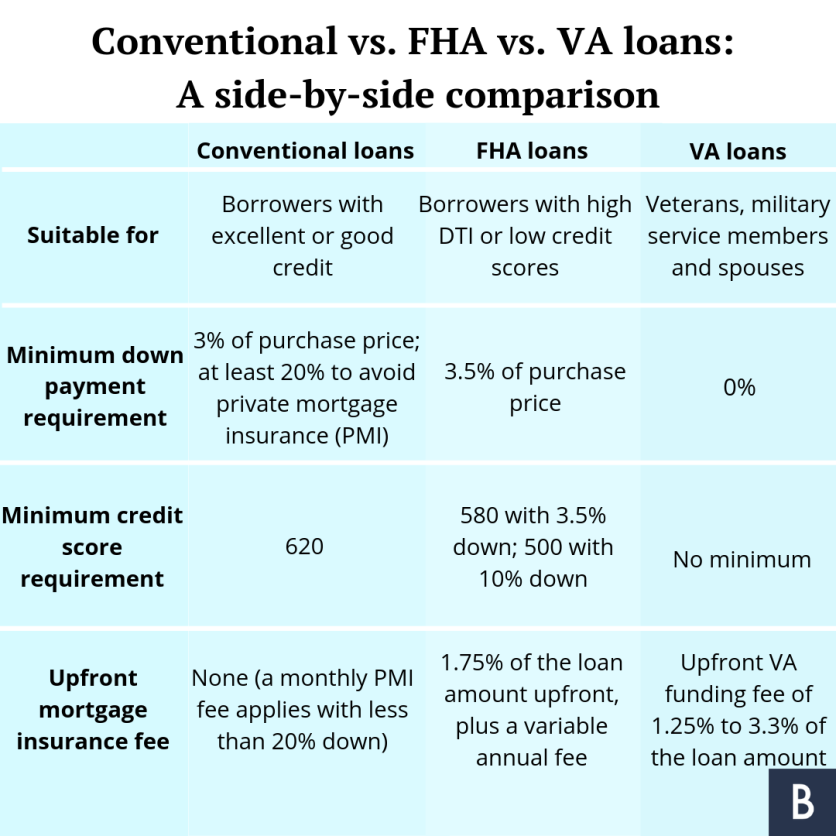
What’s the difference between FHA and conventional loans?

Home loans fall into two broad categories: government and conventional. A conventional loan is any mortgage that is not insured by a federal entity. Because private lenders assume all the risk in funding conventional loans, the requirements to qualify for these loans are more strict. Generally speaking, FHA loans might be a good fit if you have less money set aside to fund your down payment and/or you have a below-average credit score. While low down payment minimums and competitive interest rates are still possible with a conventional loan, you’ll need to show a strong credit score to qualify for those advantages.

Each loan type has advantages and disadvantages—including different mortgage insurance requirements, loan limits, and property appraisal guidelines—so choosing the one that works best for you really depends on your financial profile and your homebuying priorities.

FHA loans pros and cons

FHA loans are meant to make homeownership more accessible to people with fewer savings set aside and lower credit scores. They can be a great fit for some borrowers, particularly first time homebuyers who often need lower down payment options, but you should weigh the costs and benefits of any mortgage before committing. Here’s a breakdown of the key pros and cons when it comes to FHA loans:

Pros Cons
Low down payment. Down payments make up the majority of cash to close in any purchase loan, and saving up for one can be a significant barrier for some borrowers. FHA loans make it possible to put down as little as 3.5% upfront and still get competitive rates. Mandatory MIP payments. FHA loans are more lenient, but they also come with insurance costs to mitigate risk to the lender. You’ll have to pay Mortgage Insurance Premiums (MIP) no matter what—either for 11 years or for the life of your loan, depending on your down payment.
Lower credit score. Credit scores can be a major hurdle when it comes to conventional loans, but borrowers with credit scores starting at 500 can qualify for FHA loans. Less competitive. Sometimes sellers can be more hesitant to accept FHA loans. In a competitive market, you might not win out against conventional loan bids.
Higher DTI accepted. Your debt-to-income (DTI) ratio gives lenders an understanding of other major financial obligations in your life. This ratio is a key factor in any loan application because it indicates your ability to afford a mortgage based on current household income and existing debt. Again, FHA loans offer more leniency here and borrowers at or below 43% DTI can qualify. Stricter property standards. To offset risk and further protect lenders, FHA loans have strict criteria when it comes to assessing the condition of any property being purchased with an FHA loan. The downside? The house you want to buy might not qualify for an FHA loan. The upside? You’re less likely to be financially burdened by a home that requires expensive repairs or updates.
No income limitations. It’s a common misconception that FHA loans are only available to first-time homebuyers or borrowers with limited income—but they’re not. There’s no maximum income limit that would disqualify you from this type of loan. Loan limits: FHA loan limits are typically lower than conventional loan limits, which means you might not be able to get funding for more expensive houses. This isn’t necessarily a bad thing, since it helps ensure that borrowers get loans they can afford to repay.

How to qualify for an FHA loan

Qualifying for an FHA loan is generally easier than qualifying for a conventional loan, but you’ll still need to meet some basic minimum standards set by the FHA. While the government insures these loans, the funding itself comes through FHA-approved lenders each lending institution may have slightly different qualifying guidelines for its borrowers. Keep in mind that, while these FHA standards offer a basic framework, you’ll need to confirm the individual qualifying rules with your specific lender.

  • Credit score minimum 500. Your exact credit score will play a big role in determining your down payment minimum; typically, the higher your credit score, the lower your down payment and the more favorable your interest rate.

  • Debt-to-income ratio at or below 56.9%. DTI is a standard way of comparing the amount of money you earn to the amount you spend paying off other debts, and FHA loans are more lax on this number.

  • Steady income and proof of employment. Being able to provide at least 2 years of income and employment records is a standard requirement for all loans.

  • Down payment between 3.5%-10%. The down payment minimum for an FHA loan is typically lower than conventional loan, and can be as little as 3.5% depending on your credit score and lender.

  • Property standards apply. You won’t qualify for an FHA loan if the house you want to buy doesn’t pass the appraisal process, which is more strict with this type of loan than conventional mortgages.

  • Maximum FHA loan amount. The amount of money you borrow cannot exceed the FHA loan limits; this number changes based on your county and is determined by how expensive the local market is; the maximum FHA loan limit in 2021 is $420,000 (check HUD resources to confirm the latest limits.)


Joel Lobb
Senior Loan Officer
(NMLS#57916)

American Mortgage Solutions, Inc.
10602 Timberwood Circle, Suite 3
Louisville, KY 40223

text or call my phone: (502) 905-3708
email me at kentuckyloan@gmail.com

The view and opinions stated on this website belong solely to the authors, and are intended for informational purposes only. The posted information does not guarantee approval, nor does it comprise full underwriting guidelines. This does not represent being part of a government agency.

The views expressed on this post are mine and do not necessarily reflect the view of my employer. Not all products or services mentioned on this site may fit all people. NMLS ID# 57916, (http://www.nmlsconsumeraccess.org). Mortgage loans only offered in Kentucky.
All loans and lines are subject to credit approval, verification, and collateral evaluation and are originated by lender. Products and interest rates are subject to change without notice.

Joel E Lobb
American Mortgage
5029053708
email us here
Kentucky FHA, VA, USDA & Rural Housing, KHC and Fannie Mae mortgage loans.

Kentucky Mortgage Broker Offering FHA, VA, USDA, Conventional, and KHC Down Payment Assistance Home Loans's avatarLouisville Kentucky Mortgage Loans

View original post

KENTUCKY FHA MORTGAGE GUIDELINES FOR 2020

  • FHA – 620+ Min Fico Approve Eligible / NO OVERLAYS-NONE!
  • FHA – 620+ FICO for PURCH, RT, C/O including Flips & High Balance
  • FHA – 640+ REFERS OK!—no overlays -u/w directly to 4000.1
  • FHA – 640+ MANUALS up to 50% DTI (with 2 comp factors)
  • FHA – 620+ No DTI CAP – Follow AUS Findings!!! (with approved eligible)
  • FHA – 620+ NO Minimum Credit History or Trades with AUS Approval!
  • FHA – 620+ – No VOR Unless Required by DU Findings!
  • FHA – Transfer appraisals from ANY lender/AMC OK!
  • FHA – ORDER YOUR APPRAISAL FROM 20+ AMCs YOU CHOOSE!
  • FHA – Collections – HUD Guides Apply –
  • FHA – Mortgage Lates OK if AUS Approved!!!
  • FHA – ESCROW STATE – Non Purchasing Spouse derogs ignored – only affects DTI
  • FHA – Borrower w/ Work Permits, Non-Resident Alien OK!
  • FHA – 1 Day off Market for Cashout Refi! – Must be off market before date of loan application!
  • FHA – Rental Income on 2-4 units ok FTHB
  • FHA – STREAMLINE – 620 Minimum 
  • FHA – Streamline – 620 Score – No Appraisal, No Income, No AVM, No Credit Qualifying!!!
  • FHA – Streamline -Investment and 2nd Homes OK!
  • FHA – Streamline – Mtg only on subject property only!

FHA Announces COVID-19 Temporary Guidance for Kentucky FHA Mortgage Loans

Kentucky FHA Temporary Guideline Changes:
Rental Income & Self-Employment Income

FHA Announces COVID-19 Temporary Guidance for Kentucky FHA Mortgage Loans
Due to the ongoing effect of COVID-19, FHA has announced in ML 2020-03, updates to the following temporary guidelines below effective with case number assignments on or after 8/12/2020 -11/30/2020:

Rental Income for Kentucky FHA Mortgage Loans

  • When qualifying utilizing rental income, for each property generating rental income the following is required:
    • Reduce the effective income associated with the calculation of rental income by 25%, or
    • Verify 6 months PITI reserves, or
    • Verify the borrower has received the previous 2 months rental payments as evidenced by borrower’s bank statements showing the deposit. (This option is applicable only for borrowers with a history of rental income from the property).

Self Employment Income for Kentucky FHA Mortgage loans 

  • Self-employment income must be stable with a reasonable expectation that it will continue. Verification of the existence of the borrower’s business within 10 calendar days prior to the date of the Note to confirm that the Borrower’s business is open and operating.  One (1) of the following to verify and confirm that the business is open and operating:
    • Evidence of current work (executed contracts or signed invoices that indicate the business is operating on the day the lender verifies self-employment);
    • Evidence of current business receipts within 10 days (Note Fairway Policy) of the note date (payment for services performed);
    • Lender certification that the business is open and operating (lender confirmed through a phone call or other means) (Note Fairway Policy); or
    • Business website demonstrating activity supporting current business operations (timely appointments for estimates or service can be scheduled).


fha pic

Joel Lobb
Mortgage Loan Officer
Individual NMLS ID #57916
 
American Mortgage Solutions, Inc.
 

Text/call:      502-905-3708

fax:            502-327-9119
email:
          kentuckyloan@gmail.com