
Understanding USDA Loan Asset Requirements in Kentucky

USDA Loan Asset Requirements in Kentucky: What First-Time Homebuyers Need to Know

If you’re applying for a USDA Rural Housing loan in Kentucky, understanding the asset documentation requirements is a critical step in the approval process. Whether you’re a first-time homebuyer in Louisville, Lexington, or a rural Kentucky community, here’s exactly what you need to know about assets when applying for a USDA mortgage loan.

Do You Need Assets to Qualify for a USDA Loan in Kentucky?

Good news for many Kentucky homebuyers — assets are not required to qualify for a USDA Rural Housing loan. However, if you do disclose assets on your loan application, every asset listed must be supported with proper documentation. Incomplete or unsupported asset disclosures can delay or jeopardize your approval.

USDA Loan Asset Documentation Requirements

Below is a complete breakdown of how different types of assets are handled under USDA Rural Housing loan guidelines in Kentucky:

1. Bank Accounts (Checking & Savings)

To verify funds held in a bank account, your lender will require one of the following:

  • A completed Verification of Deposit (VOD) showing the average 2-month balance, or
  • Two consecutive months of bank statements dated within 45 days of the loan application date

Important: Cash on hand is not acceptable as a verified asset for USDA loan purposes. All funds must be traceable and documented.

2. Large Deposits or Sudden Increases in Liquid Assets

If your bank statements show large, unexplained deposits or a significant jump in your account balance, your lender will require a satisfactory written explanation along with supporting documentation. This is a standard USDA underwriting requirement designed to ensure the source of funds is legitimate and not a loan.

3. Earnest Money Deposits

Your earnest money deposit (the good-faith deposit made when you go under contract on a home) may be counted as an asset — provided it is not already reflected in your existing liquid asset balances. Be sure to provide a copy of your cancelled check or wire confirmation as documentation.

4. Retirement Accounts (401k, IRA, Pension)

Retirement accounts such as a 401(k) or IRA can be used as assets for USDA loan qualification, but only at 60% of the vested account balance. This adjustment accounts for early withdrawal penalties and taxes. A current account statement is required.

5. Gift Funds

Gift funds from a family member or approved donor are allowed under USDA guidelines. To properly document a gift, you will need:

  • A signed gift letter from the donor clearly stating the amount of the gift
  • Confirmation that the gift does not need to be repaid
  • Documentation showing the transfer of funds (bank statements, wire transfer, etc.)

6. Proceeds from the Sale of Real Property

If you are using proceeds from the sale of a home or other real estate, you must provide a HUD-1 Settlement Statement or equivalent closing disclosure showing the actual net cash proceeds received by the borrower after all costs and payoffs.

7. Stocks, Bonds, and Investment Accounts

Stocks, bonds, and brokerage accounts must be documented with an official statement from the stockbroker or financial institution managing the portfolio. The statement should show current market value and be dated within 45 days of application.

8. Net Family Assets Greater Than $5,000 — Income Calculation Rule

This is an often-overlooked USDA guideline. If a household’s net family assets exceed $5,000, USDA requires that the greater of the following be counted as income:

  • The actual income earned from those net family assets (e.g., interest, dividends), or
  • A percentage of the asset value based on the current passbook savings rate

This imputed income is added to your annual household income and can affect USDA income eligibility. Be sure to discuss this with your loan officer if you have significant savings, investments, or property holdings.


Why Asset Documentation Matters for Your Kentucky USDA Loan Approval

USDA underwriters review asset documentation not just to verify your down payment and closing costs, but also to ensure your loan complies with federal housing guidelines. Incomplete or missing asset paperwork is one of the most common reasons for loan delays in Kentucky. Working with an experienced local mortgage loan officer who knows USDA guidelines inside and out can make all the difference.

Get Pre-Approved for a USDA Loan in Kentucky Today

With over 20 years of experience helping Kentucky families achieve homeownership, I specialize in USDA Rural Housing loans, FHA, VA, KHC (Kentucky Housing Corporation), and Conventional mortgage loans. I offer free mortgage pre-qualifications with same-day approvals on most applications.

If you’re a first-time homebuyer in Kentucky with little or no money saved for a down payment, ask me about Kentucky Housing Corporation (KHC) down payment assistance programs — funds are still available and can significantly reduce your upfront costs.


Contact Joel Lobb — Kentucky Mortgage Loan Officer

Joel Lobb | Senior Mortgage Loan Officer

📞 Call or Text: (502) 905-3708

📧 Email: kentuckyloan@gmail.com

🌐 Website: www.mylouisvillekentuckymortgage.com

NMLS #57916 | Company NMLS #1738461

Verify license: www.nmlsconsumeraccess.org

Kentucky Mortgage License Only

⚖️ Equal Housing Lender
This website is not affiliated with or endorsed by HUD, FHA, VA, USDA, or any government agency. It is an independent platform created to educate and assist Kentucky homebuyers.

Getting a Mortgage in Chapter 13 Bankruptcy: Kentucky Guide

Home Bankruptcy Mortgage Help Can You Get a Kentucky Mortgage While in Chapter 13 Bankruptcy?

Can You Get a Kentucky Mortgage While in Chapter 13 Bankruptcy?

Yes — you can get a Kentucky mortgage while in an active Chapter 13 bankruptcy, but this is a narrow approval lane. Most borrowers do not qualify unless they have at least 12 months of on-time payments, court approval, and a debt-to-income ratio that still works with the bankruptcy payment included.

Need a real answer instead of a guess?
Call or text 502-905-3708 for a free Kentucky mortgage review.

What Are the Requirements for a Kentucky Mortgage During Chapter 13?

1) 12 Months of On-Time Chapter 13 Payments

You generally must show at least 12 consecutive months of on-time Chapter 13 payments before applying for a mortgage. If you are only at month 10 or 11, most lenders will not move forward.

2) Court Approval Is Required

You usually need written permission from the bankruptcy court before taking on a new mortgage. Your bankruptcy attorney typically files a motion to incur debt or motion to borrow, and the court reviews whether the proposed payment fits your budget.

3) You Still Must Qualify Financially

Chapter 13 does not override standard underwriting. You still need acceptable income, employment stability, credit, assets, and debt-to-income ratios. The Chapter 13 plan payment must be counted in your total debt ratio.

Debt-to-Income Ratio Guidelines

Most manually underwritten Chapter 13 mortgage files aim for these general benchmarks:

  • Housing ratio around 31% of gross monthly income
  • Total debt ratio around 43% of gross monthly income

Some files can stretch higher with strong compensating factors, but if the new house payment plus your bankruptcy payment and other debts push the numbers too far, the loan usually will not work.

Credit Score Requirements

Mortgage lenders do not use the scores shown on most consumer apps. They use mortgage-specific FICO scores from Experian, Equifax, and TransUnion, then qualify you off the middle score.

  • 620 and above: strongest approval range
  • 580 to 619: possible, but tougher
  • Below 580: usually not realistic right now

If your mortgage scores are under 620, it may make more sense to improve the file first rather than force a weak approval attempt.

Best Loan Programs for Kentucky Borrowers in Chapter 13

FHA Loans

FHA loans are the most common option for borrowers in an active Chapter 13 bankruptcy because they allow more flexible credit guidelines and manual underwriting in many cases.

  • 3.5% down payment minimum
  • Flexible credit compared to conventional loans
  • Often the best fit for credit rebuilding buyers

Read the full Kentucky FHA loan guide

USDA Loans

USDA loans can offer 100% financing, but they are more restrictive. The property must be in an eligible rural area and household income limits apply. In practice, these files usually work best when the borrower has stronger credit.

  • No down payment required
  • Property must be in an eligible USDA area
  • Household income limits apply
  • Stronger credit usually improves odds

Read the Kentucky USDA loan guide

VA Loans

If you are an eligible veteran or active-duty borrower, a VA loan may be an option during Chapter 13. The biggest advantages are no down payment and no monthly mortgage insurance, but the file still must be manually underwritten when required.

  • Zero down payment for eligible borrowers
  • No monthly mortgage insurance
  • Strong option for qualified veterans

Read the Kentucky VA loan guide

KHC Down Payment Assistance

Kentucky Housing Corporation programs may help eligible borrowers with down payment and closing cost assistance, depending on income, credit profile, and the first mortgage program being used.

  • Can help reduce cash to close
  • Often paired with FHA, VA, USDA, or conventional first mortgages
  • Program terms depend on borrower eligibility and current offerings

Read the Kentucky KHC mortgage guide

Why Most Chapter 13 Mortgage Files Get Denied

  • Applying before 12 full months of Chapter 13 payments are complete
  • Late bankruptcy plan payments
  • Using consumer credit scores instead of mortgage scores
  • Forgetting to include the Chapter 13 payment in debt-to-income calculations
  • Trying to get zero down financing with weak credit and no reserves
  • Not getting court approval before moving forward

How to Improve Your Approval Odds

  • Make every Chapter 13 payment on time
  • Keep credit card balances low
  • Avoid overdrafts and negative bank balances
  • Do not open new credit accounts
  • Build savings for down payment, closing costs, and reserves
  • Talk with a mortgage broker before house hunting

Internal Link Silo: Related Kentucky Mortgage Guides

FHA Loan Resources

Learn down payment rules, credit score requirements, mortgage insurance, and FHA eligibility in Kentucky.

Explore Kentucky FHA loan options

USDA Rural Housing Resources

See how zero-down USDA financing works in eligible Kentucky rural and suburban areas.

Explore Kentucky USDA loan options

VA Loan Resources

Review eligibility, no-down-payment advantages, and VA-specific financing rules for Kentucky veterans.

Explore Kentucky VA loan options

KHC Down Payment Assistance

See how Kentucky Housing Corporation programs may help with down payment and closing costs.

Explore Kentucky KHC programs

Credit Repair and Mortgage Scores

Understand how mortgage credit scores work and what steps may improve your approval chances.

Read the Kentucky credit improvement guide

Frequently Asked Questions

Can I get a mortgage before 12 months in Chapter 13?

No. In most cases, you need 12 full months of on-time Chapter 13 payments before applying.

Do I need court approval to buy a house during Chapter 13?

Yes. Most borrowers need written permission from the bankruptcy court before taking on a new mortgage.

What loan is usually best during Chapter 13 bankruptcy?

FHA is usually the most common and practical option, although USDA and VA may also work depending on eligibility.

Can I get a zero down mortgage while in Chapter 13?

Possibly. USDA and VA may allow zero down for eligible borrowers, but these files still must meet stricter underwriting requirements.

Do lenders use Credit Karma scores?

No. Mortgage lenders use mortgage-specific FICO scores and qualify you based on the middle score.

Get a Free Kentucky Mortgage Review

Want to know whether you can qualify while in Chapter 13 bankruptcy?

Call/Text: 502-905-3708

kentuckyloan@gmail.com

Apply or learn more online


Joel Lobb, Mortgage Broker FHA, VA, KHC, USDA

NMLS #57916 | Company NMLS #1738461

Equal Housing Lender

This is not a commitment to lend. All loans are subject to credit approval and program requirements.

This website is not affiliated with or endorsed by FHA, VA, USDA, KHC, or any government agency.

{ “@context”:”https://schema.org”, “@type”:”BreadcrumbList”, “itemListElement”:[ { “@type”:”ListItem”, “position”:1, “name”:”Home”, “item”:”https://www.mylouisvillekentuckymortgage.com/” }, { “@type”:”ListItem”, “position”:2, “name”:”Bankruptcy Mortgage Help”, “item”:”https://www.mylouisvillekentuckymortgage.com/category/bankruptcy/” }, { “@type”:”ListItem”, “position”:3, “name”:”Can You Get a Kentucky Mortgage While in Chapter 13 Bankruptcy?”, “item”:”https://www.mylouisvillekentuckymortgage.com/kentucky-mortgage-chapter-13-bankruptcy/” } ] } { “@context”:”https://schema.org”, “@type”:”FAQPage”, “mainEntity”:[ { “@type”:”Question”, “name”:”Can I get a mortgage before 12 months in Chapter 13?”, “acceptedAnswer”:{ “@type”:”Answer”, “text”:”No. In most cases, you need 12 full months of on-time Chapter 13 payments before applying.” } }, { “@type”:”Question”, “name”:”Do I need court approval to buy a house during Chapter 13?”, “acceptedAnswer”:{ “@type”:”Answer”, “text”:”Yes. Most borrowers need written permission from the bankruptcy court before taking on a new mortgage.” } }, { “@type”:”Question”, “name”:”What loan is usually best during Chapter 13 bankruptcy?”, “acceptedAnswer”:{ “@type”:”Answer”, “text”:”FHA is usually the most common and practical option, although USDA and VA may also work depending on eligibility.” } }, { “@type”:”Question”, “name”:”Can I get a zero down mortgage while in Chapter 13?”, “acceptedAnswer”:{ “@type”:”Answer”, “text”:”Possibly. USDA and VA may allow zero down for eligible borrowers, but these files still must meet stricter underwriting requirements.” } }, { “@type”:”Question”, “name”:”Do lenders use Credit Karma scores?”, “acceptedAnswer”:{ “@type”:”Answer”, “text”:”No. Mortgage lenders use mortgage-specific FICO scores and qualify you based on the middle score.” } } ] } { “@context”:”https://schema.org”, “@type”:”Article”, “headline”:”Can You Get a Kentucky Mortgage While in Chapter 13 Bankruptcy?”, “description”:”Learn how to qualify for a Kentucky mortgage while in Chapter 13 bankruptcy, including the 12-month payment rule, court approval, FHA, USDA, VA, and KHC options.”, “mainEntityOfPage”:{ “@type”:”WebPage”, “@id”:”https://www.mylouisvillekentuckymortgage.com/kentucky-mortgage-chapter-13-bankruptcy/” }, “author”:{ “@type”:”Person”, “name”:”Joel Lobb” }, “publisher”:{ “@type”:”Organization”, “name”:”Joel Lobb, Mortgage Broker FHA, VA, KHC, USDA”, “logo”:{ “@type”:”ImageObject”, “url”:”https://www.mylouisvillekentuckymortgage.com/wp-content/uploads/your-logo.png” } }, “datePublished”:”2026-03-31″, “dateModified”:”2026-03-31″ }

Kentucky Down Payment Assistance: Get $12,500 for Your Home

Kentucky Down Payment Assistance

This type of loan is administered by KHC in the state of Kentucky. They typically have $12,500 down payment assistance year around, that is in the form of a second mortgage that you pay back over 15 years at a interest rate of 4.75% depending on your income in the household.

Video: Kentucky down payment assistance — get $12,500 for your home
▶ Click to watch on YouTube

Joel has worked with KHC for 12 of his 20 years in the mortgage lending business. Joel said, “A lot of my clients would not have been able to purchase a home of their own or possibly delayed their purchase due to lack of down payment but with the $6,000 DAP loan program, this gets them into a house sooner and starts their path to homeownership while building equity instead of throwing their money away.”

When you’re ready to purchase a home in Joel’s area, contact him at:
Phone: 502-905-3708
Email: Kentuckyloan@gmail.com
Website: www.mylouisvillekentuckymortgage.com

Got questions about your Kentucky mortgage? Contact Joel Lobb

FHA vs. Conventional Loans: A Kentucky Homebuyer’s Guide

FHA vs. Conventional Loans: Which Is Better for Kentucky Homebuyers?

Compare FHA and conventional loans for Kentucky homebuyers. Learn credit requirements, down payments, mortgage insurance, and which loan fits your situation.

When comparing FHA loans vs conventional loans in Kentucky, the decision comes down to four core factors: credit score, down payment, debt-to-income ratio, and mortgage insurance. Both loan programs are widely used across Louisville, Lexington, Northern Kentucky, and rural areas, but they serve very different borrower profiles.

FHA Loans: Built for Flexibility

Kentucky FHA loans are designed for buyers who need more flexibility. FHA financing is often a strong option for borrowers with credit scores under 680, limited savings, or little to no cash reserves after closing. FHA also allows buyers to qualify sooner after major credit events, including foreclosures that are three to seven years old and short sales that occurred two to four years ago.

Another major advantage of FHA loans in Kentucky is gifting. The entire down payment and most closing costs can be covered with gift funds from approved sources. This makes FHA especially popular with first-time homebuyers and buyers using down payment assistance programs.

FHA Mortgage Insurance (MIP) Breakdown:

  • Upfront mortgage insurance premium: 1.75% of loan amount (rolled into the loan)
  • 30-year loans with less than 5% down: 0.85% annually
  • 30-year loans with 5%+ down: 0.80% annually
  • 15-year loans: 0.45% to 0.70% annually (depending on down payment)

Conventional Loans: For Stronger Credit

Kentucky conventional loans are best suited for borrowers with stronger credit and more money saved. Conventional financing generally favors buyers with credit scores above 680, at least five percent down, and reserves remaining after closing. Borrowers with foreclosures over seven years old or short sales that occurred five to seven years ago typically fit conventional guidelines more easily.

One of the biggest advantages of conventional loans is mortgage insurance flexibility. Unlike FHA, there is no upfront mortgage insurance premium. Monthly private mortgage insurance can be lower for borrowers with strong credit, and PMI automatically drops off once the loan reaches roughly 80 percent loan-to-value. FHA mortgage insurance, by contrast, usually lasts for the life of the loan when the down payment is less than ten percent.

Quick Comparison Table

Factor FHA Loans Conventional Loans
Credit Score Required 580+ 3.5% down payment (some lenders 500+ 10% down payment) 720+ typically
Down Payment 3.5% (with 580+ score) 3-5% minimum, typically 5%
Mortgage Insurance Required on all loans (lifetime with <10% down) Only if less than 20% down; drops at 80% LTV
Upfront Insurance Premium 1.75% None
Gift Funds 100% of down payment allowed Limited or restricted
Max Debt-to-Income Up to 56.99% (with compensating factors) Typically 45%
Property Types Owner-occupied only Owner-occupied and investment
Appraisal Standards Stricter More flexible

The Bottom Line

FHA loans are ideal for Kentucky buyers rebuilding credit, using gift funds, or purchasing with limited savings. Conventional loans reward borrowers with stronger credit, larger down payments, and long-term equity goals.

Most homeowners do not keep a mortgage for 30 years. Because many refinance or sell within five to seven years, FHA’s lifetime mortgage insurance is often less of a concern than it appears on paper. In many cases, the lower interest rate and easier approval standards outweigh the insurance cost.

Joel Lobb
Mortgage Broker – FHA, VA, USDA, KHC, Fannie Mae
EVO Mortgage • Helping Kentucky Homebuyers Since 2001
📞 Call/Text: 502-905-3708
📧 Email: kentuckyloan@gmail.com
🌐 Website: www.mylouisvillekentuckymortgage.com
🏠 Address: 911 Barret Ave, Louisville, KY 40204
NMLS #57916 | Company NMLS #1738461
Free Info & Homebuyer Advice →
Kentucky Mortgage Loan Expert
FHA | VA | USDA | KHC Down Payment Assistance | Fannie Mae
Equal Housing Lender. This is not a commitment to lend. All loans are subject to credit approval and program requirements.

Complete Guide to FHA Loan Requirements in Kentucky

FHA loans are a popular choice for many first-time homebuyers in Kentucky. This is due to their flexible qualifying criteria. If you’re considering an FHA loan in the Bluegrass State, understanding the key qualifying factors is crucial. Here’s a comprehensive guide to the criteria you need to know:

  1. Credit Score Requirements:
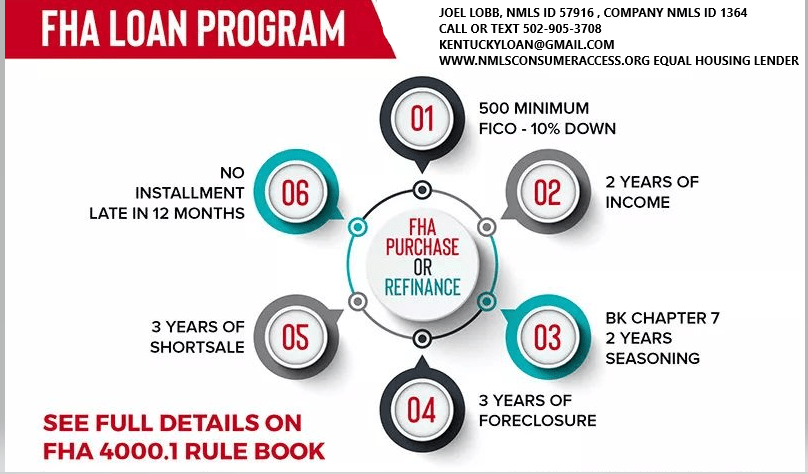
    • FHA loans are known for accommodating borrowers with lower credit scores. The minimum required credit score can vary. Typically, a credit score of 580 or higher is needed to qualify for the minimum down payment of 3.5%. Borrowers with credit scores between 500 and 579 might still qualify. They will need a higher down payment, usually around 10%.
  2. Down Payment:
    • The minimum down payment for an FHA loan in Kentucky is 3.5% of the home’s purchase price. This is advantageous for buyers who may not have substantial savings for a larger down payment, making homeownership more accessible.
  3. Work History:
    • Lenders typically look for a steady 2 year employment history when considering FHA loan applications. A consistent work history is beneficial. It is preferable to have worked with the same employer or within the same field. This helps demonstrate financial stability and the ability to repay the loan.
  4. Debt-to-Income Ratio (DTI):
    • The debt-to-income ratio is a crucial factor in mortgage approval. For FHA loans, the maximum allowable DTI ratio is typically around 40% to 45% of your gross monthly income. It can go higher up to 56% with good credit scores, a large down payment, or a shorter-term loan. Lenders may also consider higher ratios in certain cases if compensating factors are present.
  5. Bankruptcy and Foreclosure:
    • FHA loans have lenient guidelines regarding bankruptcy and foreclosure. Generally, borrowers with a past bankruptcy may qualify for an FHA loan after two years. This is possible if they have re-established good credit and demonstrated responsible financial behavior. For foreclosures, the waiting period is usually three years.
  6. Mortgage Term:
    • FHA loans offer various mortgage term options, including 15-year, 20 year, 25 year and 30-year fixed-rate loans. The choice of term depends on your financial goals and ability to manage monthly payments.
    • Occupancy: Primary residences with 1-4 units. Not for investment properties or second homes.
    • Mortgage Insurance on the loan for life of loan. Larger down payments and shorter terms will reduce the upfront mi and monthly mi premiums
    • can be used for refinances, not only for purchases.
    • No income limits nor property restrictions on where home is located
    • Can close within 30 days typically with good appraisal and title work

FHA Loan Requirements in Kentucky for Credit scores, Down payment, Debt Ratio and work history below

RequirementDetails
Credit Score– 580+: Eligible for a 3.5% down payment.
– 500-579: Requires a 10% down payment.
Down PaymentMinimum of 3.5% for qualified buyers; 10% for lower credit scores below 580 to 500 score range
Debt-to-Income Ratio (DTI)– Ideal: 45% or lower on front end ratio or housing ratio.
– Acceptable: Up to 57% with compensating factors. There are two ratios. Front end and back end with front end being maxed at 45% and the backed end ratio being 56.99% with an AUS approval. If manually underwritten, see guidelines here
Employment HistoryMust provide at least **2 years of consistent employment—College transcripts can supplement with a less than 2 year work history

Key Benefits of FHA Loans in Kentucky

  1. Low Credit Score Requirements
    • FHA loans accept borrowers with credit scores as low as 500. However, a score of 580+ qualifies you for the lowest down payment option.
  2. Low Down Payment Options
    • You can purchase a home with as little as 3.5% down if you meet credit requirements, making FHA loans more accessible than conventional loans.
  3. Competitive Interest Rates
    • FHA loans typically offer rates comparable to conventional mortgages. They may even offer lower rates. This could save you money over the life of the loan.
  4. Flexible Loan Uses
    • With an FHA 203(k) loan, you can bundle home purchase and renovation costs into a single mortgage.
  5. Assumable Loans
    • FHA loans can be transferred to a new buyer. This feature is especially valuable if you sell your home when interest rates are higher.

Understanding these qualifying criteria can help you navigate the FHA loan application process in Kentucky more effectively. Working with an experienced mortgage professional can provide valuable guidance. They offer assistance tailored to your specific financial situation and homeownership goals.

Joel Lobb  Mortgage Loan Officer

Any questions, please don’t hesitate to reach out via, text, email,  or call.  Advice is always free. 
 
One of Kentucky’s highest rated mortgage loan officers for FHA, VA, USDA, Kentucky Housing KHC and conventional mortgage loans.  
1 – 📅 Email – kentuckyloan@gmail.com 
2.  📞 Call/Text – 502-905-3708
 

Joel Lobb
Mortgage Loan Officer – Expert on Kentucky Mortgage Loans

🌐 Websitewww.mylouisvillekentuckymortgage.com
🏢 Address911 Barret Ave., Louisville, KY 40204


Evo Mortgage
Company NMLS# 1738461
Personal NMLS# 57916

For assistance with Kentucky mortgage loans, reach out via email, call, or text Joel Lobb directly.

Kentucky Local Home Loan Lender Services

✅ First-Time Home Buyers Welcome
✅ FHA, Rural Housing (USDA), VA, and Kentucky Housing Corporation (KHC) Loans
✅ Conventional Loan Options Available
✅ Fast Local Decision-Making
✅ Experienced Guidance Through the Home Buying Process


NMLS 57916  | Company NMLS #173846
The view and opinions stated on this website belong solely to the authors, and are intended for informational purposes only. The posted information does not guarantee approvalnor does it comprise full underwriting guidelines. This does not represent being part of a government agency. The views expressed on this post are mine and do not necessarily reflect the view of my employer. Not all products or services mentioned on this site may fit all people.
(www.nmlsconsumeraccess.org).
Kentucky First Time Homebuyers FHA, VA, USDA & Rural Housing, KHC and Fannie Mae mortgage loans