Kentucky FHA Appraisal Requirements For A Mortgage Loan Approval.

Kentucky FHA Appraisal Requirements For A Mortgage Loan Approval.
  • Ordered through a third party source. Interested/vested parties may not initiate the appraisal. I.E> buyers, sellers, realtors, loan officer, family members
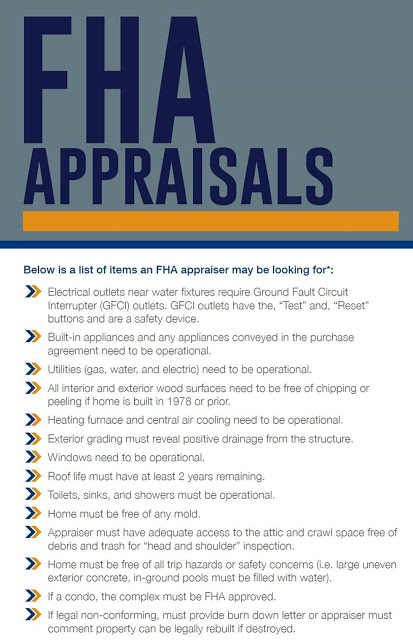
  • Property must meet HUD’s minimum property standards. i.e.: permanent heat source, utilities must be on and in working order at time of inspection
  • Flips < 90 days – not allowed Per HUD -If current owner owned less than 90 days FHA will not insure. Sometimes a second appraisal will be required by FHA investor if sold within the last 6 months for a large profit. Receipts of work done may be needed to substantiate  increase in value of home in short-time period.
  • Transferred appraisal – ok
  • Appraisal valid 120 days – 30 day extension possible*
  • Property eligibility – No location restrictions.
  • New Construction Available
Kentucky FHA Appraisal Requirements For A Mortgage Loan Approval.

FHA MORTGAGE LOANS AND FLIPPING RULE FOR APPRAISALS
Resales Occurring 90 Days or Fewer after Acquisition:
 Not eligible for FHA financing
Resales occurring between 91 days and 180 Days after Acquisition:
 Obtain 2nd appraisal if resold between 91 to 180 days after acquisition
 Obtain 2nd appraisal if resale price is 100% or more over price paid by seller
 If 2nd appraisal is more than 5% lower than value of first appraisal, the lower value must be used
 Borrower not allowed to pay for 2nd appraisal
Exceptions to FHA Flipping Rules:
 Property purchased by an employer or relocation company due to relocation of an employee
 Resales by HUD – REO program
 Sales by other government agencies (i.e., IRS, court-ordered, DEA, etc.)
 Sales of non-profit agencies approved to purchase HUD properties
 Acquisition due to inheritance
 Sales of properties by federally chartered financial institutions
 Sales of properties by GSE’s
 Sales of properties by local or state governments
 Sales by builders selling a new home
 Sales of properties in federally declared disaster areas
NOTE: Mortgage Company must obtain a 12-month chain of title to document time restrictions above.
VA MORTGAGE AND FLIPPING RULE

 No Flipping Rules – Overlays may apply or at Underwriter’s discretion

 
USDA RURAL HOUSING MORTGAGE FLIPPING RULES
 Lender is responsible to ensure that any recently sold property’s value is strongly supported when a significant
increase between sale and purchase occurs.
 Lender must ensure that the appraisal value is supported with validated comps and protect the borrower from
predatory lending.

Fannie Mae Appraisal Flipping Rules
 No Flipping Rules – Lender overlays may apply
Freddie Mac
 No Flipping Rules – Lender overlays may apply

Applies to case numbers assigned on or after June 1, 2022

Updates the initial appraisal validity period from 120 days to 180 days from the effective date of the appraisal report;
Extends the appraisal update validity period from 240 days to one year from the effective date of the initial appraisal report;

Allows the appraisal update to be ordered AFTER an appraisal expires; and
Eliminates the optional 30-day extension.

✨This is big news for FHA ✨

The guideline change also puts FHA appraisal expirations on par with conventional loan expiration dates.

Kentucky FHA appraisals can take home buyers by surprise. That’s why we’ve put together some good-to-know info about the process. Feel free to use this to help educate your clients.

Joel Lobb
Senior  Loan Officer
(NMLS#57916)
text or call my phone: (502) 905-3708
email me at kentuckyloan@gmail.com
The view and opinions stated on this website belong solely to the authors, and are intended for informational purposes only. The posted information does not guarantee approval, nor does it comprise full underwriting guidelines. This does not represent being part of a government agency. The views expressed on this post are mine and do not necessarily reflect the view of my employer. Not all products or services mentioned on this site may fit all people. NMLS ID# 57916, (www.nmlsconsumeraccess.org). Mortgage loans only offered in Kentucky.
All loans and lines are subject to credit approval, verification, and collateral evaluation and are originated by lender. Products and interest rates are subject to change without notice.


http://www.emailmeform.com/builder/form/0bfJs9b6bK8TGoc6mQk9hIu


FHA Guidelines for Well Water in Kentucky

Image result for fha minimum property standards

Below are Kentucky  FHA guidelines for a property that has well water and septic tanks for waste disposal .  The Kentucky FHA appraiser should be able to address the distance between the well and septic for distance requirements, and comment if public sewers are available.

Well water test will be required as a closing condition. FHA mortgages loans in Kentucky  require a septic inspection unless the appraiser mentions it is necessary.

(O) Water Supply Systems in Kentucky 

(1) Public Water Supply System The Mortgagee must confirm that a connection is made to a public or Community Water System whenever feasible and available at a reasonable cost. If connection costs to the public or community system are not reasonable, the existing onsite systems are acceptable, provided they are functioning properly and meet the requirements of the local health department.

(2) Individual Water Supply Systems (Wells) When an Individual Water Supply System is present, the Mortgagee must ensure that the water quality meets the requirements of the health authority with jurisdiction. If there are no local (or state) water quality standards, then water quality must meet the standards set by the EPA, as presented in the National Primary Drinking Water regulations in 40 CFR §§ 141 and 142. Soil poisoning is an unacceptable method for treating termites unless the Mortgagee obtains satisfactory assurance that the treatment will not endanger the quality of the water supply. Requirements for the location of wells for FHA-insured Properties are located in 24 CFR § 200.926d (f) (3). The following tables provide the minimum distance required between wells and sources of pollution for Existing Construction:

Individual Water Supply System for Minimum Property
Requirements for Existing Construction*
1 Property line/10 feet
2 Septic tank/50 feet
3 Drain field/100 feet
4 Septic tank drain field reduced to 75 feet if allowed by local authority
5 If the subject Property line is adjacent to residential Property then local well distance requirements prevail. If the subject Property is adjacent to non-residential Property or roadway, there needs to be a separation distance of at least 10 feet from the property line.
* distance requirements of local authority prevail if greater than stated above

The following provides the minimum requirements for water wells:

Water Wells Minimum Property Standards for New Construction
24 CFR § 200.926d(f)(1)
1 Lead-free piping
2 If no local chemical and bacteriological water standards, state standards apply
3 Connection of public water whenever feasible
4 Wells must deliver water flow of five gallons per minute over at least a four-hour period
Water Wells Minimum Property Requirements for Existing Construction
1 Existing wells must deliver water flow of three to five gallons per minute
2 No exposure to environmental contamination
3 Continuing supply of safe and potable water
4 Domestic hot water
5 Water quality must meet requirements of local jurisdiction or the EPA if no local standard

Shared WellsThe Mortgagee must confirm that a Shared Well:

  • serves existing Properties that cannot feasibly be connected to an acceptable public or Community Water supply System;
  • is capable of providing a continuous supply of water to involved Dwelling Units so that each existing Property simultaneously will be assured of at least three gallons per minute (five gallons per minute for Proposed Construction) over a continuous four-hour period. (The well itself may have a lesser yield if pressurized storage is provided in an amount that will make 720 gallons of water available to each connected existing dwelling during a continuous four-hour period or 1,200 gallons of water available to each proposed dwelling during a continuous four-hour period. The shared well system yield must be demonstrated by a certified pumping test or other means acceptable to all agreeing parties.);
  • provides safe and potable water. An inspection is required under the same circumstances as an individual well. This may be evidenced by a letter from the health authority having jurisdiction or, in the absence of local health department standards, by a certified water quality analysis demonstrating that the well water complies with the EPA’s National Interim Primary Drinking Water Regulations;
  • has a valve on each dwelling service line as it leaves the well so that water may be shut off to each served dwelling without interrupting service to the other Properties; and
  • serves no more than four living units or Properties.

For both proposed and existing Properties, the Mortgagee must ensure that the shared well agreement complies with the guidance provided in the following table.

Item Provisions that must be reflected in any acceptable shared well agreement include the following:
1 Require that the agreement is binding upon signatory parties and their successors in title, recorded in local deed records when executed and recorded, and reflects joiner by any Mortgagee holding a Mortgage on any Property connected to the Shared Well.
2 Permit well water sampling and testing by the local authority at the request of any party at any time.
3 Require that corrective measures be implemented if testing reveals a significant water quality deficiency, but only with the consent of a majority of all parties.
4 Ensure continuity of water service to “supplied” parties if the “supplying” party has no further need for the shared well system. (“Supplied” parties normally should assume all costs for their continuing water supply.)
5 Prohibit well water usage by any party for other than bona fide domestic purposes.
6 Prohibit connection of any additional living unit to the shared well system without:·        the consent of all parties;

·        the appropriate amendment of the agreement; and

·        compliance with item 3.

7 Prohibit any party from locating or relocating any element of an individual sewage disposal system within 75 feet (100 feet for Proposed Construction) of the Shared Well.
8 Establish Easements for all elements of the system, ensuring access and necessary working space for system operation, maintenance, improvement, inspection and testing.
9 Specify that no party may install landscaping or improvements that will impair use of the Easements.
10 Specify that any removal and replacement of preexisting site improvements, necessary for system operation, maintenance, replacement, improvement, inspection or testing, will be at the cost of their owner, except for costs to remove and replace common boundary fencing or walls, which must be shared equally between or among parties.
11 Establish the right of any party to act to correct an emergency in the absence of the other parties onsite. An emergency must be defined as failure of any shared portion of the system to deliver water upon demand.
12 Permit an agreement amendment to ensure equitable readjustment of shared costs when there may be significant changes in well pump energy rates or the occupancy or use of an involved Property.
13 Require the consent of a majority of all parties upon cost sharing, except in emergencies, before actions are taken for system maintenance, replacement or improvement.
14 Require that any necessary replacement or improvement of a system element(s) will at least restore original system performance.
15 Specify required cost sharing for:·        the energy supply for the well pump;

·        system maintenance, including repairs, testing, inspection and disinfection;

·        system component replacement due to wear, obsolescence, incrustation or corrosion; and

·        system improvement to increase the service life of a material or component to restore well yield or to provide necessary system protection.

16 Specify that no party is responsible for unilaterally incurred shared well debts of another party, except for correction of emergency situations. Emergency correction costs must be equally shared.
17 Require that each party be responsible for:·        prompt repair of any detected leak in this water service line or plumbing system;

·        repair costs to correct system damage caused by a resident or guest at their Property; and

·        necessary repair or replacement of the service line connecting the system to the dwelling.

18 Require equal sharing of repair costs for system damage caused by persons other than a resident or guest at a Property sharing the well.
19 Ensure equal sharing of costs for abandoning all or part of the shared system so that contamination of ground water or other hazards will be avoided.
20 Ensure prompt collection from all parties and prompt payment of system operation, maintenance, replacement or improvement costs.
21 Specify that the recorded agreement may not be amended during the term of a federally-insured or -guaranteed Mortgage on any Property served, except as provided in items 5 and 11 above.
22 Provide for binding arbitration of any dispute or impasse between parties with regard to the system or terms of agreement. Binding arbitration must be through the American Arbitration Association or a similar body and may be initiated at any time by any party to the agreement. Parties to the agreement must equally share arbitration costs.
http://www.emailmeform.com/builder/form/0bfJs9b6bK8TGoc6mQk9hIu
 
Joel Lobb
Mortgage Broker – FHA, VA, USDA, KHC, Fannie Mae
EVO Mortgage • Helping Kentucky Homebuyers Since 2001
📞 Call/Text: 502-905-3708
📧 Email: kentuckyloan@gmail.com
🌐 Website: www.mylouisvillekentuckymortgage.com
🏠 Address: 911 Barret Ave, Louisville, KY 40204
NMLS #57916 | Company NMLS #1738461
Free Info & Homebuyer Advice →
Kentucky Mortgage Loan Expert
FHA | VA | USDA | KHC Down Payment Assistance | Fannie Mae
Equal Housing Lender. This is not a commitment to lend. All loans are subject to credit approval and program requirements.
http://www.nmlsconsumeraccess.org/
Disclaimer: No statement on this site is a commitment to make a loan. Loans are subject to borrower qualifications, including income, property evaluation, sufficient equity in the home to meet Loan-to-Value requirements, and final credit approval. Approvals are subject to underwriting guidelines, interest rates, and program guidelines and are subject to change without notice based on applicant’s eligibility and market conditions. Refinancing an existing loan may result in total finance charges being higher over the life of a loan. Reduction in payments may reflect a longer loan term. Terms of any loan may be subject to payment of points and fees by the applicant  Equal Opportunity Lender. NMLS#57916 http://www.nmlsconsumeraccess.org/
 
— Some products and services may not be available in all states. Credit and collateral are subject to approval. Terms and conditions apply. This is not a commitment to lend. Programs, rates, terms and conditions are subject to change without notice. The content in this marketing advertisement has not been approved, reviewed, sponsored or endorsed by any department or government agency. Rates are subject to change and are subject to borrower(s) qualification.
 

Qualifying for an FHA Loan in Kentucky

FHA loans are a popular choice for many first-time homebuyers in Kentucky. This is due to their flexible qualifying criteria. If you’re considering an FHA loan in the Bluegrass State, understanding the key qualifying factors is crucial. Here’s a comprehensive guide to the criteria you need to know:

  1. Credit Score Requirements:
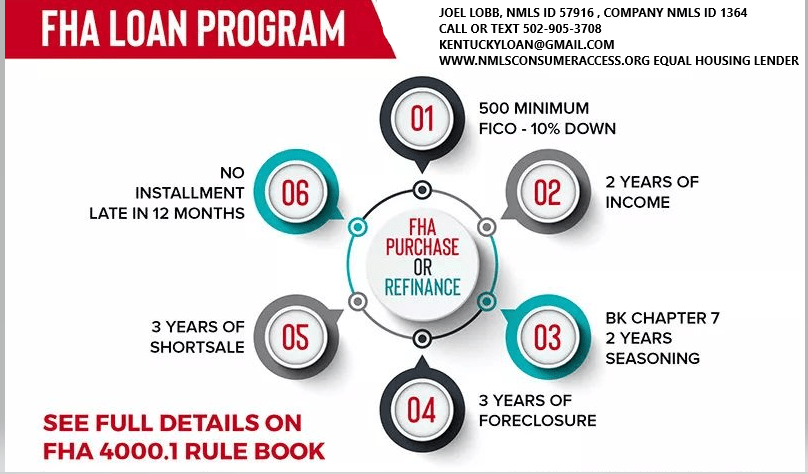
    • FHA loans are known for accommodating borrowers with lower credit scores. The minimum required credit score can vary. Typically, a credit score of 580 or higher is needed to qualify for the minimum down payment of 3.5%. Borrowers with credit scores between 500 and 579 might still qualify. They will need a higher down payment, usually around 10%.
  2. Down Payment:
    • The minimum down payment for an FHA loan in Kentucky is 3.5% of the home’s purchase price. This is advantageous for buyers who may not have substantial savings for a larger down payment, making homeownership more accessible.
  3. Work History:
    • Lenders typically look for a steady 2 year employment history when considering FHA loan applications. A consistent work history is beneficial. It is preferable to have worked with the same employer or within the same field. This helps demonstrate financial stability and the ability to repay the loan.
  4. Debt-to-Income Ratio (DTI):
    • The debt-to-income ratio is a crucial factor in mortgage approval. For FHA loans, the maximum allowable DTI ratio is typically around 40% to 45% of your gross monthly income. It can go higher up to 56% with good credit scores, a large down payment, or a shorter-term loan. Lenders may also consider higher ratios in certain cases if compensating factors are present.
  5. Bankruptcy and Foreclosure:
    • FHA loans have lenient guidelines regarding bankruptcy and foreclosure. Generally, borrowers with a past bankruptcy may qualify for an FHA loan after two years. This is possible if they have re-established good credit and demonstrated responsible financial behavior. For foreclosures, the waiting period is usually three years.
  6. Mortgage Term:
    • FHA loans offer various mortgage term options, including 15-year, 20 year, 25 year and 30-year fixed-rate loans. The choice of term depends on your financial goals and ability to manage monthly payments.
    • Occupancy: Primary residences with 1-4 units. Not for investment properties or second homes.
    • Mortgage Insurance on the loan for life of loan. Larger down payments and shorter terms will reduce the upfront mi and monthly mi premiums
    • can be used for refinances, not only for purchases.
    • Max FHA loan in Kentucky for 2025 is Kentucky FHA Loan Limits by County
      $524,225 1 unit
      $671,200 2 unit
      $811,275 3 unit
      $1,008,300 4 unit– This changes every year
    • No income limits nor property restrictions on where home is located
    • Can close within 30 days typically with good appraisal and title work

FHA Loan Requirements in Kentucky for Credit scores, Down payment, Debt Ratio and work history below

RequirementDetails
Credit Score– 580+: Eligible for a 3.5% down payment.
– 500-579: Requires a 10% down payment.
Down PaymentMinimum of 3.5% for qualified buyers; 10% for lower credit scores below 580 to 500 score range
Debt-to-Income Ratio (DTI)– Ideal: 45% or lower on front end ratio or housing ratio.
– Acceptable: Up to 57% with compensating factors. There are two ratios. Front end and back end with front end being maxed at 45% and the backed end ratio being 56.99% with an AUS approval. If manually underwritten, see guidelines here
Employment HistoryMust provide at least **2 years of consistent employment—College transcripts can supplement with a less than 2 year work history

Key Benefits of FHA Loans in Kentucky

  1. Low Credit Score Requirements
    • FHA loans accept borrowers with credit scores as low as 500. However, a score of 580+ qualifies you for the lowest down payment option.
  2. Low Down Payment Options
    • You can purchase a home with as little as 3.5% down if you meet credit requirements, making FHA loans more accessible than conventional loans.
  3. Competitive Interest Rates
    • FHA loans typically offer rates comparable to conventional mortgages. They may even offer lower rates. This could save you money over the life of the loan.
  4. Flexible Loan Uses
    • With an FHA 203(k) loan, you can bundle home purchase and renovation costs into a single mortgage.
  5. Assumable Loans
    • FHA loans can be transferred to a new buyer. This feature is especially valuable if you sell your home when interest rates are higher.

Understanding these qualifying criteria can help you navigate the FHA loan application process in Kentucky more effectively. Working with an experienced mortgage professional can provide valuable guidance. They offer assistance tailored to your specific financial situation and homeownership goals.

Joel Lobb  Mortgage Loan Officer

Any questions, please don’t hesitate to reach out via, text, email,  or call.  Advice is always free. 
 
One of Kentucky’s highest rated mortgage loan officers for FHA, VA, USDA, Kentucky Housing KHC and conventional mortgage loans.  
1 – 📅 Email – kentuckyloan@gmail.com 
2.  📞 Call/Text – 502-905-3708
 

Joel Lobb
Mortgage Loan Officer – Expert on Kentucky Mortgage Loans


🌐 Websitewww.mylouisvillekentuckymortgage.com
🏢 Address911 Barret Ave., Louisville, KY 40204


Evo Mortgage
Company NMLS# 1738461
Personal NMLS# 57916

For assistance with Kentucky mortgage loans, reach out via email, call, or text Joel Lobb directly.

Kentucky Local Home Loan Lender Services

✅ First-Time Home Buyers Welcome
✅ FHA, Rural Housing (USDA), VA, and Kentucky Housing Corporation (KHC) Loans
✅ Conventional Loan Options Available
✅ Fast Local Decision-Making
✅ Experienced Guidance Through the Home Buying Process


NMLS 57916  | Company NMLS #173846
The view and opinions stated on this website belong solely to the authors, and are intended for informational purposes only. The posted information does not guarantee approvalnor does it comprise full underwriting guidelines. This does not represent being part of a government agency. The views expressed on this post are mine and do not necessarily reflect the view of my employer. Not all products or services mentioned on this site may fit all people.
(www.nmlsconsumeraccess.org).


Kentucky First Time Homebuyers FHA, VA, USDA & Rural Housing, KHC and Fannie Mae mortgage loans
 

Mobile Home Loans in Kentucky

Mobile Home Loans in Kentucky: FHA, VA, USDA, and Conventional Guidelines for 2025

Are you a Kentucky homebuyers looking for information on mobile home loans? Manufactured homes are an affordable option for many buyers. With flexible financing options like Kentucky FHA, VA, USDA, and Conventional loans, achieving homeownership in Kentucky is easier than ever. This guide provides the guidelines for each loan program. It also explains how you can qualify for a free mortgage loan approval for your mobile home in Kentucky.

Mobile Home Loan Options in Kentucky

Manufactured homes offer affordable housing solutions, but the financing process requires specific guidelines. Here’s a breakdown of the major loan programs for mobile home loans in Kentucky, their qualifications, and how they work.

FHA Mobile Home Loans in Kentucky

The FHA Loan Program is one of the most popular options for manufactured homes in Kentucky. This program requires a low credit score and offers competitive terms. It is ideal for first-time buyers or those with less-than-perfect credit.

  • Minimum Credit Score: 500 qualifying FICO score.
  • Property Types: Singlewide, Doublewide, and Triplewide manufactured homes.
  • Loan-to-Value (LTV): Up to 96.5% LTV for purchase and 80% for cash-out refinancing.
  • Underwriting: Manual underwrites are allowed.
  • Key Guidelines:
    • Homes must have been constructed after June 15, 1976.
    • The home cannot have been previously installed or occupied at another site.
    • Real property conversion is required at closing.
    • Primary residence only.
  • Advantages: No pricing adjuster for manufactured homes.

VA Mobile Home Loans in Kentucky

If you are a veteran or active-duty service member, consider the VA Loan Program. It is an excellent option for financing a mobile home. This program offers 100% financing with no down payment required.

  1. Minimum Credit Score: 500 qualifying FICO score.
  2. Property Types: Singlewide, Doublewide, and Triplewide units.
  3. Loan-to-Value (LTV): Up to 100% for purchases and 90% for cash-out refinancing.
  4. Underwriting: Manual underwrites are allowed.
  5. Key Guidelines:
    • Homes must have been constructed after June 15, 1976.
    • The home cannot have been previously installed or occupied at another site.
    • Real property conversion is required at closing.
    • Primary residence only.

USDA Mobile Home Loans in Kentucky

The USDA Loan Program provides 100% financing for manufactured homes in eligible rural areas of Kentucky. This loan is ideal for homebuyers looking for affordable financing with no down payment.

  1. Minimum Credit Score: 550 qualifying FICO score.
  2. Property Types: Singlewide, Doublewide, and Triplewide units.
  3. Loan-to-Value (LTV): Up to 100% for purchases.
  4. Home Requirements:
    • Must be a 2006 model or newer.
    • Located in a USDA-eligible rural area.
  5. Underwriting: Manual underwriting is required (Max DTI: 29/41).
  6. Key Guidelines:
    • The home cannot have been previously installed or occupied at another site.
    • Real property conversion is required at closing.
    • Primary residence only.
  7. Eligible States: RD Program available in KY and select other states.

Conventional Mobile Home Loans in Kentucky

The Conventional Loan Program is another option for financing manufactured homes in Kentucky. It offers competitive terms for buyers with stronger credit profiles.

  1. Minimum Credit Score: 620 qualifying FICO score.
  2. Property Types: Singlewide, Doublewide, and Triplewide units.
  3. Loan-to-Value (LTV): Up to 95% for purchases and 65% for cash-out refinancing.
    • Cash-out refinancing is not allowed on singlewide homes.
  4. Key Guidelines:
    • Homes must have been constructed after June 15, 1976.
    • The home cannot have been previously installed or occupied at another site.
    • Real property conversion is required at closing.
    • Both primary residences and second homes are allowed.
    • Small pricing adjuster applies for manufactured homes.

Mobile Home Loans in Kentucky: FHA, VA, USDA, and Conventional Guidelines

If you’re a Kentucky homebuyer looking to finance a mobile home, understanding the different loan options and guidelines is essential. Below, we break down the requirements for FHA loans. We also cover the requirements for VA, USDA, and Conventional loans. This information will help you secure a mobile home loan in Kentucky. Learn how you can qualify for a free mortgage loan pre-approval today!

Loan ProgramCredit Score RequirementEligible Property TypesLoan-to-Value (LTV)Key GuidelinesAdditional Notes
FHA Loan500 minimum FICO scoreSinglewide, Doublewide, Triplewide homesPurchase/Rate-Term up to 96.5% LTV
Cash-Out up to 80% LTV
– Manual underwriting allowed
– Real Property Conversion allowed at closing
– Primary residence only
– Exempt from ATR Points/Fees Test
– No prior installation/occupancy at another site
– No pricing adjuster for mobile homes
– Home must be constructed after June 15, 1976
VA Loan500 minimum FICO scoreSinglewide, Doublewide, Triplewide homesPurchase/Rate-Term up to 100% LTV
Cash-Out up to 90% LTV
– Manual underwriting allowed
– Real Property Conversion allowed at closing
– Primary residence only
– Exempt from ATR Points/Fees Test
– No prior installation/occupancy at another site
– No pricing adjuster for mobile homes
– Home must be constructed after June 15, 1976
USDA Loan550 minimum FICO scoreSinglewide, Doublewide, Triplewide homesPurchase up to 100% LTV– Manual underwriting required (Max DTI: 29/41)
– Home must be a 2006 model or newer
– Located in USDA-eligible rural areas
– Primary residence only
– No prior installation/occupancy at another site
– No pricing adjuster for mobile homes
– RD Program available in specific states, including Kentucky
Conventional Loan620 minimum FICO scoreSinglewide, Doublewide, Triplewide homesPurchase/Rate-Term up to 95% LTV
Cash-Out up to 65% LTV
– Real Property Conversion allowed at closing
– Primary and second homes allowed
– Cash-Out not allowed on Singlewide homes
– No prior installation/occupancy at another site
– Small 50 pricing adjuster for mobile homes
– Home must be constructed after June 15, 1976

Why Choose a Mobile Home Loan in Kentucky?

Mobile homes, also known as manufactured homes, offer an affordable housing solution for Kentucky residents. Whether you’re a first-time homebuyer or looking to refinance your property, government-backed loans can help. Conventional options also provide flexible terms. These options make homeownership a reality.


How to Qualify for a Mobile Home Loan in Kentucky

  1. Step 1: Check your credit score against the loan program requirements. The minimum FICO score is 500 for FHA and VA loans. For USDA loans, it is 550. Conventional loans require a score of 620.
  2. Step 2: Ensure the mobile home meets eligibility guidelines (e.g., it must be a 2006 model or newer for USDA loans or constructed after June 15, 1976, for FHA, VA, and Conventional loans).
  3. Step 3: Verify the home is not previously installed or occupied at another site.
  4. Step 4: Contact a trusted Kentucky mortgage lender to get a free pre-approval for your mobile home loan.

Free Pre-Approval for Mobile Home Loans in Kentucky

Ready to take the next step? As a Kentucky homebuyer, you can benefit from free mortgage loan pre-approval for your mobile home loan. You might be interested in an FHA, VA, USDA, or Conventional loan. Our experts will guide you through the process. They will find the best option for your needs.

Why Choose a Mobile Home Loan in Kentucky?

Manufactured homes in Kentucky offer affordability, flexibility, and modern designs. Whether you’re a first-time homebuyer or someone looking to refinance your current mobile home, these loan programs provide tailored solutions. They meet your needs. With low credit score requirements and flexible terms, financing your manufactured home is within reach.

Get Pre-Approved for a Mobile Home Loan in Kentucky Today!

Ready to take the next step? Get a free mortgage pre-approval for your mobile home loan in Kentucky today. We offer expert guidance on FHA, VA, USDA, and Conventional loan programs. We’ll help you find the best financing option for your needs.

Contact us now to get started on your journey to owning a manufactured home in Kentucky. Call or apply online for your free pre-qualification and same-day approval!


  Email – kentuckyloan@gmail.com

  Call/Text – 502-905-3708

Joel Lobb
Mortgage Loan Officer – Expert on Kentucky Mortgage Loans


 Websitewww.mylouisvillekentuckymortgage.com
 Address: 911 Barret Ave., Louisville, KY 40204


Evo Mortgage
Company NMLS# 1738461
Personal NMLS# 57916

For assistance with Kentucky mortgage loans, reach out via email, call, or text Joel Lobb directly.

5 Things to Know about buying a house and getting a Mortgage Loan approval in Kentucky for 2023


1. Do Mortgage Rates Change Daily?

Just like the gas prices at the pump, mortgage rates can change daily or throughout the day. Typically mortgage rates are published at 10-11 am daily by most lenders and you can lock up through the close of business which is usually around 6-7 PM. Mortgage rates can change up or down throughout the day based on various financial, economics, and geopolitical news in the US Financial markets and World markets. Generally speaking, good economic news is bad for rates and vice versa, bad economic news is good for mortgage rates.

The good news is this: Once you find a home and get it under contract, you can lock your mortgage loan rate. Typically it takes about 30-45 days to close a mortgage loan in Kentucky, so the typical lock is for 30-60 days. If rates get better you may be able to negotiate a better rate with your lender, but they usually have to improve by at least 25 basis points (.25) to do that. Not all lenders offer this option. The longer you lock the loan, the greater the costs. It is usually free to lock in a loan for up to 90 days without having to pay a fee.

What a lot of lenders are experiencing now is that some loans don’t close on time for various reasons. You can always extend the lock on the loan but it will costs you usually .125 basis points to do so. If you let the lock expire on the loan, then you have to take worse case pricing on that day when you go to relock. It is usually best to extend the lock on your loan.

2. What kind of Credit Score Do I need to qualify?

When applying for a mortgage loan, lenders will pull what they call a “tri-merge” credit report which will show three different fico scores from Trans union, Equifax, and Experian. The lenders will throw out the high and low score and take the “middle score” For example, if you had a 614, 610, and 629 score from the three main credit bureaus, your qualifying score would be 614. Most lenders will want at least two scores. So if you only have one score, you may not qualify. Lenders will have to pull their own credit report and scores so if you had it ran somewhere else or saw it on a website or credit card you may own, it will not matter to the lender, because they have to use their own credit report and scores.
Most lenders will pull your credit report for free nowadays so this should not be a big deal as long as your scores are high enough.
The Secondary Market of Mortgage loans offered by FHA, VA, USDA, Fannie Mae, and KHC all have their minimum fico score requirements and lenders will create overlays in addition to what the Government agencies will accept, so even if on paper FHA says they will go down to 580 or 500 in some cases on fico scores, very few lenders will go below the 620 threshold.
If you have low fico scores it may make sense to check around with different lenders to see what their minimum fico scores are for loans.
The lenders I currently deal with have the following fico cutoffs for credit scores:
FHA–580 minimum score
VA—-580 minimum score
Fannie Mae–620 minimum score
USDA–620 minimum score
KHC with Down Payment Assistance –620 minimum score.

As you can see, 580-620 is the minimum score with most lenders for a FHA, VA, or Fannie Mae loan, is required for the no down payment programs offered by USDA for Kentucky for First Time Home Buyers wanting to go no money down.

3. What are the down payment requirements?

The most popular programs for Kentucky First Time Home Buyers usually involves one of the following housing programs outlined in bold below:
FHA:

FHA will allow a home buyer to purchase a house with as little as 3.5% down. If your credit scores are low, say 680 and below, a lot of times it makes sense to go FHA because everyone pays the same mortgage insurance premiums no matter what your score is, and the down payment can be gifted to you. Meaning you really don’t have to have any skin into the game when it comes to down payment.

They even allow down payment assistance for down payment requirements of 3.5% through eligible parties like Kentucky Housing, Welcome Home Grants and Louisville KY and Covington Kentucky Down Payment Grants.

Lastly, FHA will allow for higher debt to income ratios with sometimes getting loan pre-approvals up to 55% of your total gross monthly income. So if you have a debt to income ratio of over 50%, Fannie Mae will not do the loan and USDA usually likes their debt to income ratios no more than 45%.

Think back to the last time you financed a purchase — be it a home, automobile, or what have you… You may remember having heard the term “debt-to-income ratio.” Today I want to spend some time going over exactly what this ratio is, and to also touch on how it can effect your personal finances.

4. What is your debt-to-income ratio?

Commonly referred to as your “DTI,” your debt-to-income ratio is a personal finance benchmark that relates your monthly debt payments to your monthly gross income.
As an example… Let’s say that your gross monthly salary is $5,000 and you are spending $2,800 of it toward monthly debt payments. In that case, your DTI would be an unhealthy 56%.
This version of your DTI is sometimes referred to as your “back-end” DTI. This is often broken down further to give a front-end debt-to-income ratio, which is a component of your back-end DTI.

How to calculate your front-end DTI for a Kentucky Mortgage Loan Approval

Your front-end DTI is calculated by dividing your monthly housing costs by your monthly gross income. Front-end DTI for renters is simply the amount paid in rent, whereas for homeowners it is the sum of mortgage principal, interest, property taxes, and home insurance (i.e., your PITI) divided by gross monthly income.

From above, if that $2,800 in debt payments is attributable to $1,500 in housing costs and $1,300 in non-housing costs, then your front-end DTI is $1,500/$5,000 = 30% (and your back-end ratio is still 56%, as calculated above).
Fannie Mae:
Fannie Mae requires just 3% down with their new Home Possible Program, but if you use their traditional mortgage loan, then 5% is the Fannie Mae Standard. Fannie Mae will go down 620 score, but if your scores are below 680, I would look seriously at the FHA loan program because Fannie Mae has steep increases to the interest rate and the mortgage insurance premiums if your scores are low.
A couple of good things about Fannie Mae is that you can buy a larger priced home and have a large loan amount due to FHA only allowing most Kentucky Home Buyers a maximum mortgage loan amount of $356,000 for a max FHA loan and $545,000 for Fannie Mae Conventional loans in Kentucky for 2020.
Lastly when it comes to mortgage insurance, FHA mortgage insurance premiums are for life of loan while Fannie Mae mortgage insurance premiums drop off when you develop 80% equity position in your house.
But as a tell most people, nobody has a loan for 30 years, and the average mortgage is either refinanced or home sold within the first 5-7 years.
VA Loans-

VA loans offer eligible Veterans and Active Duty Personnel to buy a home going no money down with no monthly mortgage insurance. This is probably the best no money down loan out there since the rates are traditionally very low on comparison to other government insured mortgages and no monthly mortgage insurance. The VA loan can be used anywhere in the state of Kentucky with the maximum VA loan limit being removed for 2021
USDA Loans-

USDA loans offer people buying a home in rural areas (typically towns of $20k or less) to buy a home going zero down. You cannot currently own another home and there is household income limits of $90,200 for a household family of four, and up to $119,300 for a household of five or more. You search USDA website for eligible areas and household income limits below at the yellow highlighted link :

KHC or Kentucky Housing-
Kentucky First Time Home Buyers typically use KHC for their down payment assistance. KHC currently offers $10,000 for down payment assistance and sometimes throughout the year they will offer low mortgage rates on their mortgage revenue bond program.

The down payment assistance usually never runs out because you have to pay it back in the form of a second mortgage. It helps a lot of home buyers that want to buy in urban areas that cannot utilizer the USDA program in rural areas. Most of the time the first mortgage is a FHA loan tied with the 2nd mortgage fore down payment assistance. All KHC programs require a 620 score and rates are locked for 45 days.

5. What if I have had a bankruptcy or foreclosure in the past?

FHA and VA are the easiest on previous bankruptcies. FHA and VA both require 2 years removed from the discharge date on a Chapter 7. If you are in the middle of a Chapter 13, FHA will allow for financing with a 12 month clean history payment to the Chapter 13 courts, and with trustee permission.

VA requires 2 years removed from a foreclosure (sheriff sale date of home) and FHA requires 3 years.

USDA requires 3 years removed from both a foreclosure and bankruptcy, but on the foreclosure they do not go off the sale date. This may save you a little time if you had a previous foreclosure.

Fannie Mae (Conventional Loan)

Fannie Mae is by far the strictest. They require 4-7 years out of a foreclosure or bankruptcy

If you have questions about qualifying as first time home buyer in Kentucky, please call, text, email or fill out free prequalification below for your next mortgage loan pre-approval.

Bankruptcy Requriements for a FHA, VA, USDA, and Fannie Mae Loan Approval in Kentucky
click on link to apply for free mortgage quote

Joel Lobb
Senior Loan Officer

(NMLS#57916)

Text or call phone: (502) 905-3708

email me at kentuckyloan@gmail.com

http://www.mylouisvillekentuckymortgage.com/

The view and opinions stated on this website belong solely to the authors, and are intended for informational purposes only. The posted information does not guarantee approval, nor does it comprise full underwriting guidelines. This does not represent being part of a government agency. The views expressed on this post are mine and do not necessarily reflect the views of my employer. Not all products or services mentioned on this site may fit all people

CONFIDENTIALITY NOTICE: This message is covered by the Electronic Communications Privacy Act, Title 18, United States Code, §§ 2510-2521. This e-mail and any attached files are deemed privileged and confidential, and are intended solely for the use of the individual(s) or entity to whom this e-mail is addressed. If you are not one of the named recipient(s) or believe that you have received this message in error, please delete this e-mail and any attached files from all locations in your computer, server, network, etc., and notify the sender IMMEDIATELY at 502-327-9770. Any other use, re-creation, dissemination, forwarding, or copying of this e-mail and any attached files is strictly prohibited and may be unlawful. Receipt by anyone other than the named recipient(s) is not a waiver of any attorney-client, work product, or other applicable privilege. E-mail is an informal method of communication and is subject to possible data corruption, either accidentally or intentionally. Therefore, it is normally inappropriate to rely on legal advice contained in an e-mail without obtaining further confirmation of said advice.

What income is acceptable for FHA, VA, USDA and Fannie Mae Mortgage Loan Approval in Kentucky?

How to qualify for a Kentucky mortgage

The type of mortgage you’re applying for determines the minimum requirements you’ll have to meet for your down payment, credit score, and debt-to-income ratio.

Find out what type of loan you might qualify for or what aspects of your finances you’ll need to improve to get a better shot at qualifying for a mortgage.

Loan Type Min. Down Payment Min. Credit Score Max DTI Property Type
Conventional 3% 620 45% Primary, secondary, investment
VA 0% none none Primary
FHA 3.5% 500 50% Primary
USDA 0% none 41% Primary

Keep in mind: The minimum down payment, minimum credit score, and maximum DTI shown in the table apply to mortgages used to purchase a primary residence. While you can use a conventional loan or a jumbo loan to purchase a home for another purpose, you might need a larger down payment, a higher credit score, more cash reserves, or all three.

Credit score needed to buy a house

Mortgage lending is risky, and lenders want a way to quantify that risk. They use your three-digit credit score to gauge the risk of loaning you money since your credit score helps predict your likelihood of paying back a loan on time. Lenders also consider other data, such as your income, employment, debts and assets to decide whether to offer you a loan.

Different lenders and loan types have different borrower requirements, loan terms and minimum credit scores. Here are the requirements for some of the most common types of mortgages.

Conventional loan

Minimum credit score: 620

A conventional loan is a mortgage that isn’t backed by a federal agency. Most mortgage lenders offer conventional loans, and many lenders sell these loans to Fannie Mae or Freddie Mac — two government-sponsored enterprises. Conventional loans can have either fixed or adjustable rates, and terms ranging from 10 to 30 years.

You can get a conventional loan with a down payment as low as 3% of the home’s purchase price, so this type of loan makes sense if you don’t have enough for a traditional down payment. However, if your down payment is less than 20%, you’re required to pay for private mortgage insurance (PMI), which is an insurance policy designed to protect the lender if you stop making payments. You can ask your servicer to cancel PMI once the principal balance of your mortgage falls below 80% of the original value of your home.

FHA loan

Minimum credit score (10% down): 500

Minimum credit score (3.5% down): 580

FHA loans are backed by the Federal Housing Administration (FHA), a part of the U.S. Department of Housing and Urban Development (HUD). The FHA incentivizes lenders to make mortgage loans available to borrowers who might not otherwise qualify by guaranteeing the federal government will repay the mortgage if the borrower stops making payments. This makes an FHA loan a good option if you have a lower credit score.

FHA loans come in 15- or 30-year terms with fixed interest rates. Unlike conventional mortgages, which only require PMI for borrowers with less than 20% down, all FHA borrowers must pay an up-front mortgage insurance premium (MIP) and an annual MIP, as long as the loan is outstanding.

VA loan

Minimum credit score: N/A

VA loans are mortgages backed by the U.S. Department of Veterans Affairs (VA). The VA guarantees loans made by VA-approved lenders to qualifying veterans or service members of the U.S. armed forces, or their spouses. This type of loan is a great option for veterans and their spouses, especially if they don’t have the best credit and don’t have enough for a down payment.

VA loans are fixed-rate mortgages with 10-, 15-, 20- or 30-year terms.

Most VA loans don’t require a down payment or monthly mortgage insurance premiums. However, they do require a one-time VA funding fee, that ranges from 1.4% to 3.6% of the loan amount.

USDA loan

Minimum credit score: N/A

The U.S. Department of Agriculture guarantees loans for borrowers interested in buying homes in certain rural areas. USDA loans don’t require a minimum down payment, but you have to meet the USDA’s income eligibility limits, which vary by location.

All USDA mortgages have fixed interest rates and 30-year repayment terms.

USDA-approved lenders must pay an up-front guarantee fee of up to 3.5% of the purchase price to the USDA. That fee can be passed on to borrowers and financed into the home loan. If the home you want to buy is within an eligible rural area (defined by the USDA) and you meet the other requirements, this could be a great loan option for you.

What else do mortgage lenders consider?

Your credit score isn’t the only factor lenders consider when reviewing your loan application. Here are some of the other factors lenders use when deciding whether to give you a mortgage.

  • Debt-to-income ratio — Your debt-to-income (DTI) ratio is the amount of debt payments you make each month (including your mortgage payments) relative to your gross monthly income. For example, if your mortgage payments, car loan and credit card payments add up to $1,800 per month and you have a $6,000 monthly income, your debt-to-income ratio would be $1,800/$6,000, or 30%. Most conventional mortgages require a DTI ratio no greater than 36%. However, you may be approved with a DTI up to 45% if you meet other requirements.
  • Employment history — When you apply for a mortgage, lenders will ask for proof of employment — typically two years’ worth of W-2s and tax returns, as well as your two most recent pay stubs. Lenders prefer to work with people who have stable employment and consistent income.
  • Down payment — Putting money down to buy a home gives you immediate equity in the home and helps to ensure the lender recoups their loss if you stop making payments and they need to foreclose on the home. Most loans — other than VA and USDA loans — require a down payment of at least 3%, although a higher down payment could help you qualify for a lower interest rate or make up for other less-than-ideal aspects of your mortgage application.
  • The home’s value and condition — Lenders want to ensure the home collateralizing the loan is in good condition and worth what you’re paying for it. Typically, they’ll require an appraisal to determine the home’s value and may also require a home inspection to ensure there aren’t any unknown issues with the property.

Kentucky Mortgage Broker Offering FHA, VA, USDA, Conventional, and KHC Down Payment Assistance Home Loans's avatarLouisville Kentucky Mortgage Loans

View original post

Kentucky FHA Loans in the State of Kentucky for 2022

Advantages of Kentucky FHA Mortgage Loans

  • You can often make a down payment as low as 3.5 percent down to a 580 credit score
  • You can finance a home with a 500 credit score with 10% down payment.
  •  Kentucky FHA loans are assumable meaning that if you have a good rate on your current mortgage and the potential buyer of your home meets FHA guidelines, then he can assume your low rate mortgage
  • Kentucky FHA loans offer streamline refinancing without credit score minimums, verification of income, and no appraisals to refinance to a lower rate making it easier to qualify.
  • Kentucky FHA loans offer flexible terms when it comes to previous bankruptcy or foreclosures. 2 years removed from Chapter 7 with reestablished
  •  credit, or if a Chapter 13, one year in the payment plan is eligible for FHA financing.
  • Foreclosures on a past home. FHA will finance a home 3 years removed from the sale date of your foreclosure property
  • 30 year fixed rate mortgage with usually the best going rates on government insured loans like FHA, VA, USDA etc.
  • No prepayment penalty on Kentucky FHA loans.
  • Higher debt to income ratio requirements when compared to Conventional loans because most Fannie Mae Conventional loans cannot have a higher debt to income ratio than 45% on the back-end
  • You can make an FHA loan anywhere in the state of Kentucky with no geographical restrictions.
  • Will allow for down payment assistance and grants for borrowers minimum down payments in the State of Kentucky through the likes of KHC, Welcome Home Grant, and Kentucky Housing Down Payment Second Mortgage loans.
  • Kentucky FHA loans allow for unoccupied cosigner. For example, lets say you have a daughter that is getting ready to graduate college and does not have the income or credit history established yet to buy a home. FHA allows a family-member to co-sign for them to buy a home and you don’t have to occupy as primary residence. Note, FHA co-singers are not allowed to makeup for some that has bad credit, because they will take the lowest credit scores of both applicants. FHA usually allows for co-singers lack of income purposes only.
  • Can usually close within 30 days just like a regular conventional mortgage. No extra time to close an FHA loan in Kentucky versus other secondary market loans like VA, USDA, Fannie Mae.
  • You can use the FHA loan over and over. You can actually have two FHA loans open at the same time, but it gets tricky on this. Call or text me with more info if you have an FHA loan currently and would like to use FHA Financing again.
  • FHA loans aren’t just for first time home buyers in Kentucky.


Disadvantages of Kentucky FHA Mortgage Loans

  • There are loan limits in the State of Kentucky on FHA Mortgage loans. The maximum FHA loan in the state of Kentucky is $$420,680 for 2022.  So if you were needing to finance a loan over this amount, you would need to look at doing a Conventional loan with the updated 2021 Kentucky State Loan Limits for a Fannie Mae loan being $647,250
  • If buying a condo in Kentucky, FHA requires the condo development be FHA approved. There is a >>>list here of Kentucky FHA approved condos here.
  • Seller must have own the home for 90 days before you can make an offer on the home. This comes into play where the seller bought the home as an investor and rehabbed the property and wants to sell for a quick profit. FHA mandates seller must maintain for 90 days before you can write up an offer on it. Also called FHA Flipping Policy. Read more here  
  • There is mortgage insurance. This is one of the biggest disadvantages for FHA loans. But as I tell most people, nobody rarely has a loan for 30 years, so if it meets your payment and your cash to close requirement, I tell people to go with it because it can be refinanced down the road and you are getting one of the lowers 30 year fixed rates out there. Both upfront and monthly mortgage insurance premiums you have to pay HUD/FHA. These premiums change whenever FHA/HUD replenish their insurance pool to pay claims from defaults, but currently the FHA upfront mortgage insurance premium is 1.75% and monthly is .85% and .80% of the loan amount. If you happen do a 15 year term or shorter, the mortgage insurance is cheaper monthly with .45 and .70 respectively  each month. The upfront mortgage insurance is the same for a 30 year and 15 year at 1.75%
  • FHA Mortgage insurance can be on the loan for life of loan. This is a recent change made in 2016 when FHA lowered there premiums for upfront and monthly mi premiums, but made the mortgage insurance for life of loan for some FHA loans. 
  • If you put down more than 10% on the loan, or have at least 10% equity in the home for a refinance, you only have to pay mortgage insurance for 11 years before it automatically falls off.
  • Obviously you can refinance out of an FHA loan at anytime, since it does not a prepayment penalty, and you can potentially get a refund of your upfront mortgage insurance if paid off within 3 years on sliding scale.
  • I have incorporated some charts below to illustrate the different Kentucky FHA Mortgage Insurance premiums to explain it better.
  • The upfront mortgage insurance is usually financed into the loan, so it will look like you are borrowing more than the standard 3.5% down payment because this is financed into the loan. Some borrowers elect to pay it out of pocket upfront, but I have never seen this done in my 20 years of doing FHA loans in the State of Kentucky
  • Kentucky FHA Loans Greater Than 15 Years MIP Chart
  • 👇
    Base Loan Amt. LTV Annual MIP
    ≤$625,500 ≤95.00% 80 bps (0.80%)
    ≤$625,500 >95.00% 85 bps (0.85%)
    >$625,500 ≤95.00% 100 bps (1.00%)
    >$625,500 >95.00% 105 bps (1.05%)

    Kentucky FHA Loans Less Than or Equal to 15 Years MIP Chart👇

    Base Loan Amt. LTV Annual MIP
    ≤$625,500 ≤90.00% 45 bps (0.45%)
    ≤$625,500 >90.00% 70 bps (0.70%)
    >$625,500 ≤78.00% 45 bps (0.45%)
    >$625,500 78.01% – 90.00% 70 bps (0.70%)
    >$625,500 >90.00% 95 bps (0.95%)

    When can I get the FHA mortgage insurance off my Mortgage Loan? See chart below 👇👇

Image result for fha cancellation of mortgage insurance chart kentucky

  • Appraisals. On an FHA appraisal, the FHA appraiser has to turn on the utilities to make sure they are in worked order when he gets there. This is different that Conventional loan appraisals. A lot of realtors or buyers think that FHA loans are harder due to appraisals, but honestly, they’re really not. FHA puts these minimum HUD standards in place to make sure the home is in good working order and SAFE to live in. I.e.is there any lead based paint or chipping paint that could lead to poisoning  It is all about Safety with FHA and HUD on these appraisals. The value is determined just like a regular Conventional, USDA, VA appraisals whereas they compare the house to 3 recent homes sold in the area to get a value.
  • Some lenders don’t offer FHA loans due to their complexity and sale on the secondary market, so if you call a local lender in Kentucky and they don’t offer FHA loans, the reason is usually they don’t have the team in place to do them or don’t want to do them due to lack of experience on the secondary government market.
  • Government Liens. FHA will not be an option for you usually if you have unpaid federal tax liens, delinquency  on federal backed-government loans, or a claim with social security etc. FHA loans are ran through aCAVIRS alert system to check to see if you are delinquent on any federal oblation. If so, this swill stop you until you can clear the CAVIRS alert system. For example, I did a loan for a buyer that had a delinquent federal debt with his student loan that happened over 14 years old. It was off the credit report and title search, so I had to switch to a conventional loan to make the home loan work.
  • FHA loans are not good for second homes or investment properties. FHA loans are mainly for single family residence 1-4 unit, that are going to occupied primarily as main home.

In summary, FHA loans have few drawbacks other than the mortgage insurance in my opinion. It is a great first time home buyer program or borrowers with past credit problems to get into a house of their own with very little out of pocket, at a low 30 year fixed rate, and no prepayment penalty

Questions about qualifying for a FHA loan in Kentucky . Give me text, call or email below. Love to help you out on your next home or refinance in Kentucky

Read more below about specific FHA Loans in Kentucky.👇👇👇
Joel Lobb (NMLS#57916)
Senior  Loan Officer
American Mortgage Solutions, Inc.
10602 Timberwood Circle Suite 3
Louisville, KY 40223
Company ID #1364 | MB73346


Text/call 502-905-3708

kentuckyloan@gmail.com

If you are an individual with disabilities who needs accommodation, or you are having difficulty using our website to apply for a loan, please contact us at 502-905-3708.

Disclaimer: No statement on this site is a commitment to make a loan. Loans are subject to borrower qualifications, including income, property evaluation, sufficient equity in the home to meet Loan-to-Value requirements, and final credit approval. Approvals are subject to underwriting guidelines, interest rates, and program guidelines and are subject to change without notice based on applicant’s eligibility and market conditions. Refinancing an existing loan may result in total finance charges being higher over the life of a loan. Reduction in payments may reflect a longer loan term. Terms of any loan may be subject to payment of points and fees by the applicant  Equal Opportunity Lender. NMLS#57916http://www.nmlsconsumeraccess.org/

— Some products and services may not be available in all states. Credit and collateral are subject to approval. Terms and conditions apply. This is not a commitment to lend. Programs, rates, terms and conditions are subject to change without notice. The content in this marketing advertisement has not been approved, reviewed, sponsored or endorsed by any department or government agency. Rates are subject to change and are subject to borrower(s) qualification.

Louisville Kentucky Mortgage Broker Offering FHA, VA, USDA, Conventional, and KHC Zero Down Payment Home Loans | October 17, 2018 at 3:54 pm | Tags: fha gift fundsfha loan kentuckyFHA Loans Kentucky Housing First time home buyerfha mortgagefha mortgage loangift funds for fha mortgagekentucky fha loans |

Kentucky FHA Mortgage Loans Impacted by COVID-19

FHA Mortgagee Letter ML-2020-05

FHA has published guidance for lenders during the current market environment.
Appraisal Guidance
FHA  will allow the Exterior Only and Desktop appraisal options. Originators and appraisers are expected to familiarize themselves with FHA’s adaptation requirements. All appraisals must still be run through FHA’s EAD portal. (Please note that a 2055 or 1072 cannot be sent through the EAD portal).

If a Desktop appraisal is deemed to be the best option – Home Point will require a photo of the exterior of the home and each comparable. Appraisers may use public records or other reliable sources (such as MLS) for these photos.
Income Guidance
FHA will allow the use of an email correspondence from the employer’s work email as reverification of employment.
The existing Home Point requirement for an additional Reverification dated within 48 business hours of closing still applies and only the email option listed above is eligible for that verification.

Summary of Changes
1. Changes to FHA’s re-verification of employment:
• FHA is allowing flexibilities related to the Mortgagee’s process of completing re-verification of employment, which includes verbal verification of employment. This is applicable for all FHA Title II forward and reverse mortgage programs, where re-verification of employment is required.
2. Changes to FHA’s Appraisal Protocols are as follows:
• Most Single Family forward and HECM for Purchase transactions may utilize an optional Exterior-Only or Desktop-Only Appraisal inspection scope of work.
• Traditional HECM, HECM-to-HECM refinances, Rate and Term Refinances and Simple Refinances of properties may utilize an optional Exterior-Only inspection scope of work.
• All appraisals made in connection with the servicing of FHA’s forward or reverse mortgage portfolios may utilize either the Exterior-Only or Desktop-Only Appraisal inspection scope of work.
• No changes are made to Streamline Refinances, which do not require appraisals or to the appraisal requirements for FHA’s Cash-Out refinance, 203(k), and certain purchase transactions.
Re-verification of Employment

Mortgagees do not need to provide a re-verification of employment within 10 days of the Note date as described in Handbook 4000.1, Sections II.A.4.c.ii(C)(1)-(2) and II.A.5.b.ii(C)(1)-(2) Traditional and Alternative Current Employment Documentations, provided that the Mortgagee is not aware of any loss of employment by the borrower and has obtained:
• For forward purchase transactions, evidence the Borrower has a minimum of 2 months of Principal, Interest, Taxes and Insurance (PITI) in reserves; and
• A year-to-date paystub or direct electronic verification of income for the pay period that immediately precedes the Note date, or
• A bank statement showing direct deposit from the Borrower’s employment for the pay period that immediately precedes the Note date.

Appraisal Policy
Mortgagees do not need to provide a re-verification of employment within 10 days of disbursement as described in Section 3.8 and 3.9 of the HECM Financial Assessment and Property Charge Guide, provided that the Mortgagee is not aware of any loss of employment by the borrower and has obtained:
• A year-to-date paystub or direct electronic verification of income for the pay period that immediately precedes the Note date, or
• A bank statement showing direct deposit from the Borrower’s employment for the pay period that immediately precedes the Note date
When applicable, as described below, the appraiser may amend the scope of work to perform an Exterior-Only (viewing from the street) or Desktop-Only. The Appraiser may rely on supplemental information from other reliable sources such as Multiple Listing Service (MLS), and Tax Assessor’s Property Record to prepare an appraisal report. The Appraiser may rely on information from an interested party to the transaction (borrower, real estate agent, property contact, etc.) with clear appraisal report disclosure when additional verification is not feasible. The appraisal report must contain adequate information to enable the intended users to understand the extent of the inspection that was performed.
The Exterior-Only and Desktop-Only Appraisal options must continue to be reported on the current FHA approved appraisal forms with amended certifications and scope of work disclosures.
Appraisal Forms and Amended Certifications
The optional Exterior-Only and Desktop-Only appraisals must be reported on the existing Acceptable Appraisal Reporting Forms by Property and Assignment Type. These forms will require amended certifications and clear scope of work disclosures. Mortgagees are reminded that Exterior Appraisal forms Fannie Mae 2055 and Fannie Mae 1075 are not FHA approved forms and are not compatible with FHA’s Electronic Appraisal Delivery (EAD) portal.
The appraisal report must include a signed certification indicating whether the Appraiser did or did not personally inspect the subject property and the extent of the inspection. FHA has provided model certifications for the Exterior-Only and Desktop-Only scope of work.


COVID-19 Questions and Answers
Last revised: March 27, 2020
Q1. What is FHA’s Office of Single Family Housing doing to prepare for possible disruptions in its business operations should the Coronavirus (COVID-19) warrant office closures?
A1. All of FHA, including Single Family, is prepared to operate remotely to ensure our business operations continue with as little disruption as possible in the event of office closures.
Q2. Is FHA continuing to endorse loans?
A2. Insurance endorsements for all FHA Title I loans and Title II forward and reverse mortgages continues; however, there may be processing delays if staff is working remotely.
Q3. Is the FHA Resource Center continuing normal operations?
A3. Yes. However, if the Homeownership Centers (HOCs) are closed there will not be FHA staff members available to receive escalated calls. If this occurs, we recommend that stakeholders email their questions to the FHA Resource Center at: answers@hud.gov for a quicker response.
Q4. (REVISED 3.18.20) Must lenders still complete the annual recertification by March 31, 2020?
A4. (REVISED 3.18.20) FHA has extended the due date for annual recertification to April 30, 2020 for those lenders with a December fiscal year end. However, lenders that can complete the annual recertification before April 30th are encouraged to do so.
Q5. Are requests for lender insurance (LI) authority being processed?
A5. Yes. The LI approval process is electronic, so lenders may continue to submit these requests.
Q6. Can lenders still submit applications to become FHA-approved lenders?
A6. Yes. The FHA lender approval process is electronic, so lenders may continue to submit these requests.
Q7. Will FHA still conduct lender monitoring and/or loan reviews?
A7. Yes. FHA staff will conduct these reviews remotely. All on-site reviews are suspended until further notice.
Q8. Will the Credit Alert Verification Reporting System (CAIVRS) be available if there are office closures?
A8. Yes. CAIVRS will be available to determine if a borrower has a delinquent federal debt.
Q9. Will the FHA TOTAL Scorecard be available for lenders?
A9. Yes. The FHA TOTAL Scorecard will be available.
Q10. (Revised 3.27.20) Will FHA still conduct in-person lender trainings?
A10. (Revised 3.27.20) No. All FHA Single Family in-person trainings are suspended. Online webinar trainings will continue. FHA will continue to assess the situation to determine when in-person trainings can resume.
Q11. Are there special loss mitigation program options available to borrowers who may be negatively impacted by the Coronavirus?
A11. As with any other event that negatively impacts a borrower’s ability to pay their monthly mortgage payment, FHA’s suite of loss mitigation options provides solutions that mortgagees should offer to distressed borrowers – including those that could be impacted by the Coronavirus – to help prevent them from going into foreclosure. An example of one of these options is our Special Forbearance for unemployed borrowers. The SFB-Unemployment Option is a Home Retention Option available when one or more of the Borrowers has become unemployed and this loss of employment has negatively affected the Borrower’s ability to continue to make their monthly Mortgage Payment. These home retention options are located in FHA’s Single Family Housing Policy Handbook 4000.1 (SF Handbook) Section III.A.2. See FHA INFO 20-18 for more details. FHA is closely monitoring the situation and will provide updated guidance, as needed.
Q12. Is FHA requiring servicers to conduct occupancy exterior inspections during this time?
A12. Yes. The standard in FHA’s SF Handbook states that the mortgagee must perform a visual exterior inspection. No physical contact with the borrower and/or occupants is required. For more information, please see SF Handbook, Section III.A.2.h.xi — Occupancy Inspection.
Q13. Does FHA require physical contact with the borrower and/or occupants when acquiring possession of a property in connection with occupied conveyances?
A13. No. When identifying property occupants, FHA does not require physical contact with the borrower and/or occupants. For more information, please see SF Handbook, Section III.A.2.s. —Acquiring Possession.
Q14. Will I be able to place a bid on a HUD-owned property via the HUD Homestore bid site?
A14. Yes. The bidding site is available.
Q15. Is FHA continuing to process claims?
A15. FHA will continue to process claims; however, servicers may experience slightly longer processing timeframes if there are office closures, particularly for any claims submitted manually and Title I claim submissions and Title I manufactured housing endorsements.
Q 16. Is HUD suspending credit reporting for FHA-Insured mortgages?
A 16. FHA requires servicers to comply with the credit reporting requirements of the Fair Credit Reporting Act (FCRA); however, FHA encourages servicers to consider the impacts of COVID-19 on borrowers’ financial situations and any flexibilities a servicer may have under the FCRA when taking negative credit reporting actions.
Q17. (REVISED 3.27.20) Is FHA continuing to require appraisals with interior property inspections for Single Family programs?
A17. (REVISED 3.27.20) In accordance with Mortgagee Letter 2020-05, exceptions for two additional appraisal inspection scope of work options may be used for certain cases. The exterior-only appraisal and the desktop-only appraisal options are permitted when circumstances warrant. The FHA roster appraiser must complete all required appraisals in accordance with acceptable Appraisal Reporting Forms and Protocols. See ML 2020-05 for more program specific details.
Q18. Are face-to-face interviews still required under FHA’s Default Servicing early default intervention requirements?
A18. FHA has published a regulatory waiver and an accompanying SF Handbook waiver to allow mortgagees to utilize alternative methods for contacting borrowers, in lieu of face-to-face interviews, to meet the requirements of SF Handbook, Section III.A.2.h.xii. For more information, please see Regulatory Waiver and Handbook Waiver.
Q&As (3.18.2020)
Q19. Will lenders be penalized if they are unable to submit case binders to FHA within 10 business days of the binder request as a result of temporary lender office closures or reductions in on-site staff?
A19: No. Lenders should make every effort to submit case binders to FHA as quickly as possible, but they will not be penalized for overdue binder requests caused by their temporary office closures or staff reductions related to Coronavirus disease 2019 (COVID-19).
Q20. Will FHA suspend foreclosures and evictions on single family properties now that a Presidentially-Declared COVID-19 National Emergency has been declared? A20. Yes. FHA published Mortgagee Letter (ML) 2020-04, “Foreclosure and Eviction Moratorium in connection with the Presidentially-Declared COVID-19 National Emergency,” on March 18, 2020. This ML announced an immediate foreclosure and eviction moratorium for all FHA-insured single family mortgages for a 60-day period.
Q21: Is FHA providing an automatic extension to foreclosure deadlines following the expiration of this moratorium? A21: Yes. FHA is providing mortgagees an automatic 60-day extension following the moratorium expiration date to commence or recommence foreclosure action or evaluate the borrower under HUD’s Loss Mitigation Program.
Q22. Why is FHA granting a foreclosure moratorium for HECMs instead of an extension to the HECM foreclosure timelines?
A22. FHA is authorizing a foreclosure moratorium for Home Equity Conversion Mortgages (HECMs) through guidance in ML 2020-04, which is being provided in response to the unprecedented national emergency and the exigent circumstances surrounding the COVID-19 crisis. HUD’s
Presidentially-declared major disaster rea (PDMDA) guidance concerning extensions of HECM foreclosure timelines as provided in FHA INFO 18-40 is unaffected by the guidance.
New Q&As (3.27.2020)
Q24. When are exceptions to the appraisal inspection protocols for the use of exterior-only and desktop-only scope of work permitted?
A24. An exception for the exterior-only option is limited to purchase cases, rate and term refinances, simple refinances, and HECMs. An exception for the desktop-only option is limited to purchase cases.
Q25. What precautions should appraisers take while conducting a property appraisal report with inspection?
A25. Appraisers are advised to establish safety policies and procedures for their clients per the current guidance and recommendations provided by the Centers for Disease Control (CDC) as well as local, state, and federal resources. When scheduling property inspections, appraisers should discuss established protocols to reduce the risk of COVID-19 exposure.
Q26. Does the appraiser have to perform an interior inspection of the subject property?
A26. Certain FHA cases may now be completed with exterior-only or desktop-only scope of work. The appraiser should monitor the client’s engagement letters and instructions. For cases requiring the standard protocols of a complete interior and exterior viewing, the appraiser should follow safe practices and keep the client informed.
Q27. When performing an exterior-only or desktop-only scope of work, should the appraisal subject to inspection be completed at a later date?
A27. The appraisal does not need to be subject to an inspection at a later date solely because an interior or physical inspection was not performed. The appraiser must identify any necessary extraordinary assumptions based on the limited inspection scope of work and complete the appraisal based upon these assumptions. The appraisal will be completed “AS IS” unless deficiencies in Minimum Property Requirements (MPR) are observed or known to the appraiser based on the scope of inspection.
Q28. Which appraisal forms will be used for the exterior-only and desktop-only appraisals?
A28. The current acceptable appraisal reporting forms based on property/assignment type will continue to be used for all appraisals, including those with limited inspection scope of work. The appraiser must include the amended model certification and scope of work with the appraisal form. See acceptable reporting forms below:
Q29. Where should the appraiser get the subject property data necessary to complete the appraisal form for an exterior-only or desktop-only scope of work?
A29. To identify the property characteristics necessary to develop the appraisal, the appraiser may rely on third party data from the following sources: prior appraisals, tax assessor’s property record, and the Multiple Listing Service (MLS). The Appraiser may also obtain and rely on information from the homeowner with disclosures. Extraordinary assumptions are permitted when necessary in the development of a credible appraisal and should be clearly stated.
Q30. Are there any additional changes to the appraisal form data requirements to clearly communicate that a modified scope of work was completed?
A30. Yes. To better identify a modified scope of work appraisal, the Map Reference text field within the subject section of the form should be used to state “desktop” or “exterior,” when applicable.
Q31. Is the appraiser still responsible for identification of property deficiencies and minimum property requirements?
A31. While the FHA minimum property requirements (MPR) has not changed, the appraiser is required to observe, analyze, and report only what is evident based on the assignment scope of work.
Property/Assignment
Type
Acceptable Reporting Form
Single Family, Detached, Attached or Semi-Detached Residential Property
Fannie Mae Form 1004/Freddie Mac Form 70, Uniform Residential Appraisal Report (URAR); Mortgage Industry Standards Maintenance Organization (MISMO) 2.6 Government-Sponsored Enterprise (GSE) format
Single Unit Condominium
Fannie Mae Form 1073/Freddie Mac Form 465, Individual Condominium Unit Appraisal Report; MISMO 2.6 GSE format
Manufactured (HUD Code) Housing
Fannie Mae Form 1004C/Freddie Mac Form 70B, Manufactured Home Appraisal Report; MISMO 2.6 Errata 1 format
Small Residential Income Properties(Two to Four Units)
Fannie Mae Form 1025/Freddie Mac Form 72, Small Residential Income Property Appraisal Report; MISMO 2.6 Errata 1 format
Update of Appraisal(All Property Types)
Summary Appraisal Update Report Section of Fannie Mae Form 1004D/Freddie Mac Form 442, Appraisal Update and/or Completion Report; MISMO 2.6 Errata 1 format
Compliance or Final Inspection for New Construction or Manufactured Housing
Form HUD-92051, Compliance Inspection Report, in Portable Document Format (PDF)
Compliance or Final Inspection for Existing Property
Certification of Completion Section of Fannie Mae Form 1004D/Freddie Mac Form 442, Appraisal Update and/or Completion Report; MISMO 2.6 Errata 1 format

Kentucky FHA Property Flipping Guidelines

Image result for Kentucky FHA Property Flipping Guidelines
FHA’s re-sale restriction period is defined as the time between the date of acquisition (original settlement date) and the date of execution of the new sales contract (the new loan closing date)
Re-sales of a property less than 90 days after acquisition are not eligible for an FHA insured mortgage
Re-sales occurring between 91 and 180 days of acquisition with a sale price 100% over the original purchase price must have the value supported by a 2nd appraisal
Re-Sales occurring between 91 days and 12 months of acquisition with a re-sale price 5% greater than the lowest sales price of the property during the 12 months preceding the sales contract may be subject to a 2nd appraisal
Exceptions to the time restrictions on sales:

Sales by HUD of Real Estate-Owned (REO) properties under 24 CFR part 291 and of single family assets in revitalization areas pursuant to section 204 of the National Housing Act (12 U.S.C. 1710);
Sales by another agency of the United States Government of REO single family properties pursuant to programs operated by these agencies;

Sales of properties by nonprofit organizations approved to purchase HUD REO single family properties at a discount with resale restrictions;
Sales of properties that were acquired by the sellers by inheritance;
Sales of properties purchased by an employer or relocation agency in connection with the relocation of an employee;
Sales of properties by state- and federally-chartered financial institutions and government-sponsored enterprises (GSEs);
Sales of properties by local and state government agencies; and
Only upon announcement by HUD through issuance of a notice, sales of properties located in areas designated by the President as federal disaster areas. The notice will specify how long the exception will be in effect.
Read More about Flipping Rules for FHA, VA , USDA and KY Housing Mortgage Loanss in Kentucky at the link below
👇👇👇

http://www.emailmeform.com/builder/form/0bfJs9b6bK8TGoc6mQk9hIu
 
Joel Lobb (NMLS#57916)
Senior  Loan Officer
 
American Mortgage Solutions, Inc.
Company ID #1364 | MB73346


Text/call 502-905-3708
kentuckyloan@gmail.com


http://www.nmlsconsumeraccess.org/
Disclaimer: No statement on this site is a commitment to make a loan. Loans are subject to borrower qualifications, including income, property evaluation, sufficient equity in the home to meet Loan-to-Value requirements, and final credit approval. Approvals are subject to underwriting guidelines, interest rates, and program guidelines and are subject to change without notice based on applicant’s eligibility and market conditions. Refinancing an existing loan may result in total finance charges being higher over the life of a loan. Reduction in payments may reflect a longer loan term. Terms of any loan may be subject to payment of points and fees by the applicant  Equal Opportunity Lender. NMLS#57916http://www.nmlsconsumeraccess.org/

— Some products and services may not be available in all states. Credit and collateral are subject to approval. Terms and conditions apply. This is not a commitment to lend. Programs, rates, terms and conditions are subject to change without notice. The content in this marketing advertisement has not been approved, reviewed, sponsored or endorsed by any department or government agency. Rates are subject to change and are subject to borrower(s) qualification.

FHA eliminates two unnecessary and outdated lending roadblocks

The Federal Housing Administration has taken steps to reduce some of the regulatory burdens that belabor the lending process, releasing two mortgagee letters Tuesday with updated guidelines on home warranty and inspection requirements for single-family FHA loans. FHA Commissioner Brian Montgomery said the moves align with the administration’s goal streamline and update guidelines in an effort to reduce regulatory barriers.

Source: FHA eliminates two unnecessary and outdated lending roadblocksKentucky FHA Guidelines for Inspections and Warranty's

Kentucky FHA Loan Requirements For Loan Approval.

images (3)


FHA Handbook 4000.1 Updates

Administration (FHA) Single Family Housing Policy Handbook 4000.1. These updates are effective September 30, 2016 and

 Clarification that an Upfront Mortgage Insurance Premium (UFMIP) refund calculation applies even if original UFMIP was
not financed.
 Mortgage Debt Not Included in Credit Report: Clarification that a manual downgrade is not required when there is no history of late payments, as detailed below.
o Not currently delinquent; and
o No 30 day late payments within 12 months of the case number assignment date; and
o No more than 2 x 30 day late payments within 24 months of the case number assignment date.
 A link has been added in the FHA Product Description from Mortgage Payment History requirements to “Credit History
Requirements for Manually Underwritten Loans.”
Appliances that add contributory value must be operable.
 Mechanical components and utilities: The appraiser must report the utility, safety, and capacity of the mechanical systems.
The appraiser must observe and operate all applicable mechanical systems and utilities. In conjunction with this guidance,
existing FHA Handbook guidance on the following topics will be added:
o Electrical System
o Heating and Cooling
o Plumbing
o Utilities

If you have questions about qualifying as first time home buyer in Kentucky, please call, text, email or fill out free prequalification below for your next mortgage loan pre-approval.


The view and opinions stated on this website belong solely to the authors, and are intended for informational purposes only.  The posted information does not guarantee approval, nor does it comprise full underwriting guidelines.  This does not represent being part of a government agency. The views expressed on this post are mine and do not necessarily reflect the views of my employer. Not all products or services mentioned on this site may fit all people