Kentucky FHA Manual Underwriting: A Complete Guide


KENTUCKY FHA MORTGAGE MANUAL UNDERWRITING GUIDELINES FOR VA RESIDUAL INCOME


Kentucky FHA Mortgage  Manual Undewriting Guidelines for FHA Mortgage Refer Eligible or Manual Downgrades


Continue reading “Kentucky FHA Manual Underwriting: A Complete Guide”

2026 FHA Loan Options for Kentucky Homebuyers

Kentucky FHA Loan Requirements – Updated for 2026

Kentucky FHA loan guidelines are established by the U.S. Department of Housing and Urban Development (HUD). FHA loans remain one of the most flexible mortgage options available to Kentucky homebuyers, particularly first-time buyers, borrowers rebuilding credit, and households using down payment assistance.

Employment and Income Requirements

Borrowers must demonstrate a stable employment history covering the most recent two years. This does not require the same employer, but the work history must show consistency in the same industry or line of work.

Recent college graduates may satisfy the two-year work history requirement by providing college transcripts, provided the current employment aligns logically with the education received.

Self-employed borrowers must document a minimum two-year history of self-employment and provide the most recent two years of federal tax returns filed with the IRS. FHA underwriting uses a two-year average of qualifying income, adjusted for business stability and trends.

All income must be verifiable through acceptable documentation such as pay stubs, W-2s, or tax returns. Cash income, undocumented deposits, or bank-statement-only income is not permitted for FHA qualifying purposes.

Down Payment Requirements

FHA loans require a minimum down payment of 3.5 percent for borrowers with credit scores of 580 or higher.

Borrowers with credit scores between 500 and 579 are limited to a maximum loan-to-value of 90 percent, requiring a minimum 10 percent down payment. In practice, most lenders apply overlays requiring higher credit scores, typically between 580 and 620, even though HUD technically allows lower scores.

Down payment funds must come from an approved source. Acceptable sources include personal savings, retirement account loans or withdrawals, and properly documented gift funds. Large or undocumented cash deposits are not allowed and remain one of the most common reasons for FHA loan delays or denials in underwriting.

Occupancy and Property Use

FHA loans are for primary residences only. The borrower must occupy the property as their primary home and move in within 60 days of closing. FHA financing may not be used for rental properties or investment homes.

Appraisal and Property Standards

The property must be appraised by a Kentucky-licensed, FHA-approved appraiser. The home must meet HUD’s minimum property standards, meaning it must be safe, sound, and secure.

Common appraisal concerns include peeling paint, exposed wiring, missing handrails, roof condition, and health or safety hazards. Most FHA appraisal issues are correctable prior to closing.

Debt-to-Income Ratio Guidelines

FHA evaluates two debt ratios:

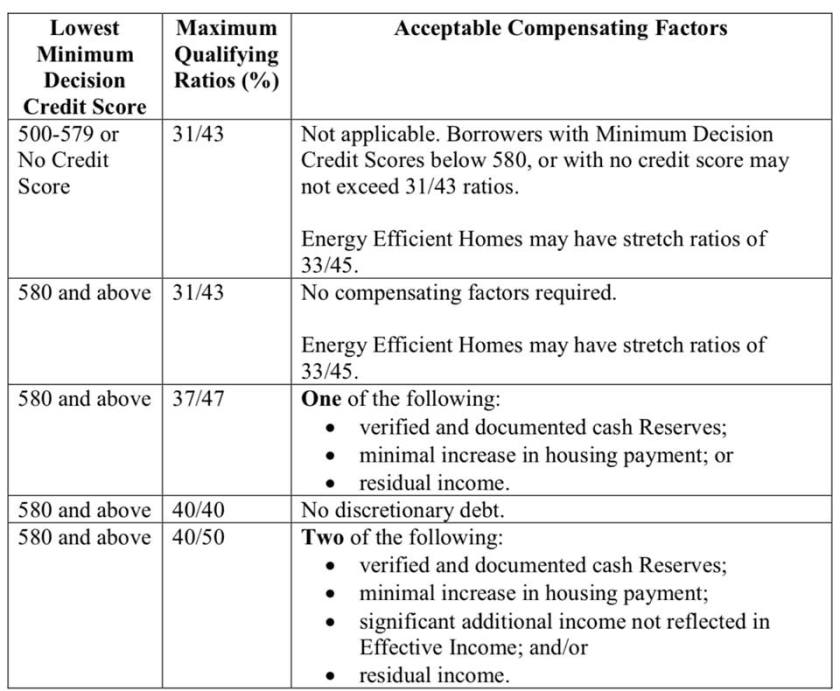
The housing ratio (front-end), which includes principal, interest, property taxes, homeowners insurance, mortgage insurance, and HOA dues, is typically capped at 31 percent of gross monthly income.

The total debt ratio (back-end), which includes the housing payment plus all other monthly obligations reported on credit, is typically capped at 43 percent.

However, borrowers receiving an “Approve/Eligible” finding through FHA’s automated underwriting system may qualify with higher ratios, depending on credit scores, cash reserves, and other compensating factors.

Credit Score and Credit History Requirements

The minimum FHA credit score for maximum financing remains 580 in 2026. This does not guarantee approval, as lenders apply additional underwriting standards and overlays.

Borrowers must demonstrate acceptable recent payment history. FHA places significant weight on the most recent 12 months of credit performance.

Bankruptcy and Foreclosure Guidelines

Chapter 7 bankruptcy requires a minimum waiting period of two years from discharge, with re-established good credit and on-time payments afterward.

Chapter 13 bankruptcy may be eligible after at least 12 months of on-time plan payments, with trustee approval, and the borrower must qualify including the Chapter 13 payment.

Foreclosure generally requires a three-year waiting period from the date of foreclosure completion. Exceptions may be considered only for documented extenuating circumstances beyond the borrower’s control. Job relocation alone does not qualify as an extenuating circumstance.

Federal Debt and CAIVRS Requirements

Borrowers may not have delinquent federal debt, defaulted federal student loans, unpaid federal judgments, or unresolved FHA claims.

Lenders are required to check the CAIVRS (Credit Alert Interactive Voice Response System) database for all federally backed loans, including FHA, VA, USDA, and SBA loans. Title 31 of the U.S. Code prohibits delinquent federal debtors from receiving federal loan insurance or guarantees.

If a CAIVRS alert appears, the debt must be resolved or paid in full before closing.

FHA Gift Fund Rules for Down Payments

FHA permits gift funds for down payments and closing costs, provided there is no expectation of repayment.

Acceptable gift sources include relatives, employers, labor unions, close friends with a documented relationship, charitable organizations, and government or public entities.

Unacceptable gift sources include the seller, real estate agents, brokers, builders, or any party with a financial interest in the transaction.

A proper gift letter is required, stating that repayment is not expected. The donor must provide identifying information and documentation showing the transfer of funds from their account to the borrower.

Government and Employer Assistance Programs

Borrowers without access to family gift funds may qualify for state, local, or employer-assisted housing programs that provide down payment or closing cost assistance. In Kentucky, FHA loans can often be paired with Kentucky Housing Corporation (KHC) down payment assistance programs, subject to income limits and program availability.

How FHA Loans Are Used in Kentucky

FHA does not directly lend money. Instead, it insures loans made by FHA-approved lenders. These loans are designed for borrowers with limited down payment funds, past credit challenges, or non-traditional credit profiles.

Many Kentucky borrowers who do not qualify for conventional financing are still able to achieve homeownership through FHA-insured loans at competitive interest rates.

Pros and Cons of FHA Loans

Advantages include low down payment requirements, flexible credit standards, and the ability to combine FHA loans with down payment assistance programs.

Disadvantages include mandatory mortgage insurance. FHA charges an upfront mortgage insurance premium of 1.75 percent of the loan amount, which can be financed, and an annual mortgage insurance premium that ranges from approximately 0.45 percent to 1.05 percent depending on loan term, loan-to-value, and origination date. This annual premium is paid monthly and, in most cases, remains for the life of the loan unless refinanced.

Final Thoughts for Kentucky Homebuyers in 2026

FHA loans continue to be a practical, reliable option for Kentucky homebuyers who need flexibility without sacrificing long-term stability. While FHA guidelines are forgiving compared to conventional loans, preparation matters. Clean documentation, stable income, responsible credit behavior, and proper sourcing of funds are essential to a smooth approval.

Working with an experienced Kentucky FHA lender can help you navigate overlays, improve credit positioning, and pair FHA financing with available assistance programs.


Joel Lobb
NMLS #57916
Text or Call 502-905-3708
kentuckyloan@gmail.com
www.mylouisvillekentuckymortgage.com

Company NMLS #1738461
Equal Housing Lender

Information is provided for educational purposes only and does not guarantee loan approval. All loans are subject to underwriting guidelines, program availability, and lender approval.

What are the Kentucky FHA Credit Score Requirements for Mortgage Loan Approvals?

The Best Kentucky Mortgage Loan Options When Looking for your first house in Kentucky Kentucky First-time Home Buyer Programs👀💯👇‼

Kentucky Mortgage Requirements for FHA, VA, USDA and Fannie Mae

FHA loan in Kentucky you will be confronted with minimum credit score requirements set forth by FHA and the lender. Even though FHA will insure the mortgage loan at a certain credit score, you will see that lenders will create  “credit-overlays” to protect their risk and ask for a higher credit score.

So keep in mind when you are getting an FHA  lenders will have higher credit score minimums in addition to the FHA Mortgage Insurance program.

For a Kentucky Homebuyer wanting to purchase a home or refinance their existing FHA loan, FHA requires a 3.5% down payment and the borrower must have a 580 FICO Credit Score. If the score is below 580, then you would need 10% down and still qualify on a manual underwrite.

You must have a FICO score of at least 500 to be eligible for a Kentucky  FHA loan. If your FICO score is from 500 to 579, your down payment on the loan is 10 percent of the loan.

If your FICO score is 580 or higher, your down payment is only 3.5 percent. If your credit score is less than 580, it may be more cost-effective to take the necessary steps to improve your score before taking out the loan, rather than putting the money into a larger down payment.

How do they get the credit score:  There are three main credit bureaus in the US. Equifax, Experian, and Transunion. The three scores vary but should be relatively close as long as the same creditors are reporting to the same bureaus.

You will get a variation in the scores due to all creditors or collection companies don’t report to all three bureaus. This is why they take the mid score.  So if you have a 590 Experian, 680 Equifax, and 620 TransUnion, your qualifying credit score would be 620

Based on my experience with lenders that I deal with in Kentucky on FHA loans,  most lenders require 620 middle credit score for consideration for loan approval.

How do they get the score:  They take the mid score, so if you have a 590 Experian, 680 Equifax, and 620 TransUnion, your qualifying score would be 620.

Kentucky FHA Loans with less than 620 Score

If your score is below 620, a manual underwrite is where the AUS (Automated Underwriting System) refers your loan to a human being, and they look at the entire file to see if they can overturn and approve the mortgage loan because the Desktop Underwriting Automated Software could not approve you.

With scores below 620, they typically will want to verify your rent history, have no bankruptcies in the last two years, and no foreclosures in the last 3 years.

If you have had any lates since the bankruptcy this will probably result in a denial on a refer manual underwrite file.

Your max house payment will be set at 31% of your gross monthly income,  and your new house payment plus the bills you are paying on the credit report cannot be more than 43%.

Typically, on scores below 620 for FHA loans, they will also look at reserves or money you have saved up after the loan is made to try and qualify you. For example, if you have a 401k or savings account that has at least 4 months reserves (take your mortgage payment x 4) and this would equal your reserves. They look at this as a rainy day fund and could help you keep up on your bills if you were unemployed or could not work.


What credit score do you need to qualify for a Kentucky mortgage loan?

The first thing to keep in mind is that qualifying for a mortgage involves a lot more than just a credit score. While your FICO score is a very important ingredient, it is just one factor. Lenders also look at your income and level of debt, among other things.

As a rule of thumb, however, a credit score below 620 will make buying a home very difficult. A FICO score below 620 is considered sub-prime. In the past, there were mortgage companies that specialized in sub-prime mortgages. Because of the challenges in the credit market over the last year or so, however, sub-prime loans have become difficult if not impossible to obtain.

A FICO score between 600 and 640  is considered fair to good credit. But keep in mind, this range of credit scores does not guarantee you will qualify for a mortgage, and if you do qualify, it won’t get you the lowest interest rate possible. Still, to buy a home aim for a score of at least 620, recognizing that other factors weigh in the decision and that some banks may require a higher score.

What credit score do you need to get a low rate mortgage?

It uses to be that a score of about 720 would yield the lowest mortgage rates available. Today, the best rates kick in with a FICO score of 760. And interest rates go up significantly as your credit score drops. To give you an idea, the following table shows current rates by credit score and calculates a monthly principal and interest payment based on a $300,000 loan:

 
lenders will pull what they call a “tri-merge” credit report which will show three different fico scores from Transunion, Equifax, and Experian. The lenders will throw out the high and low scores and take the “middle score.” For example, if you had a 614, 610, and 629 score from the three main credit bureaus, your qualifying score would be 614.
 
 
So if you only have one score, you may not qualify. Lenders will have to pull their own credit report and scores so if you had it ran somewhere else or saw it on a website or credit card you may own, it will not matter to the lender, because they have to use their own credit report and scores.
 
Lastly, lenders will pull your credit report for free nowadays so this should not be a big deal as long as your scores are high enough.
 
 
offered by FHA, VA, USDA, Fannie Mae, and KHC all have their minimum fico score requirements and lenders will create overlays in addition to what the Government agencies will accept, so even if on paper FHA says they will go down to 580 or 500 in some cases on fico scores, 
 
If you have low fico scores it may make sense to check around with different lenders to see what their minimum fico scores are for loans.
The lenders I currently deal with have the following fico cutoffs for credit scores:
 
 
As you can see, different government-backed loan programs have different minimum score requirements with most lenders for an FHA, VA, or Fannie Mae loan, and 620  is required for the no down payment programs offered by USDA and KHC in Kentucky for First Time Home Buyers wanting to go no money down.


By paying down your credit card balances (credit utilization) and having a good pay history (payment history) ,this is the best way to raise your score. 

 The credit bureaus don’t update immediately, so I would not add to the balance or open any new bills or have any other lender do an inquiry on your credit report while we wait for the scores to hopefully go up in the next 30 days. Try to keep everything status quo and make your payments on time and keep your balances low or lower than what is now reporting on the credit report. 

FICO-Score-usage-by-industry@2x.png

How to improve your credit score!

Pay Every Single Bill on Time, or Early, Every Month

Please understand one thing; paying your bills on time each month is the single most important thing you can do to increase your credit scores.

Depending on the credit bureau, there are 4 or 5 main items that determine everyone’s credit score. Of those items, your history of paying bills makes up about 35% of the score. THIS IS HUGE!

Paying your bills on time shows lenders that you are responsible. It will also spare you from paying late fees whether it is a charge from a credit card or an added fee from your landlord.

Use a calendar, or a phone app, or some other organized system to make sure that you pay your bills on time every single month.

MAIN TIP: Do not pay ANY bill late!

Credit Cards: Lower Balances Are Always Better 


( If you don’t have a credit card, I suggest getting a secured credit card through Capital one Secured  Card Or Open Sky Credit card...click this link here 


Another big factor in calculating a credit score is the amount of credit card debt. Credit bureaus look at two things when analyzing your credit cards.

First, they look at your available credit limit. Second, they look at the existing balance on each card. From these two figures an available ratio is developed. As the ratio goes higher, so too will your credit score increase.

Here is one simple example. Suppose a person has the following credit cards, corresponding balances, and credit limits

Credit Card Current Balance Credit Limit
Chase Visa $105 $1,000
MarterCard from local bank $236 $1,500
BP MasterCard $87 $500
Totals $428 $3,000

From these numbers, we get the following calculation

$428/$3,000 = 14%

In other words, the person is using 14% of their available credit and they have 86% available credit. The closer that ratio is to 100%, the better the credit score will be.


MAIN TIP:
 Keep all credit card balances as low as possible.In this particular example, if they had a problem with their car, or needed medical attention or some other emergency, the person would have the money necessary to handle the situation without incurring new debt. This is wise on the consumer’s part and lenders like to see this kind of money management.

Credit Cards Part 2: 1 or 2 is Better Than a Wallet Full

The previous example showed a person that utilized just three credit cards. This is much better than someone who has 5+ credit cards, all with available balances. Why? Lenders do not like to see someone that has the potential to get too far in debt in a short amount of time.

Some people have 5, 10 or more credit cards and they use many of them. This shows a lack of restraint and control. It is much better, and neater, to have only 2 or 3 cards with low rates that handle all of your transactions. A lower number of cards are easier to manage and it does not give a person the temptation to go on a huge shopping spree that could take years to payoff.

MAIN TIP: Try to limit yourself to no more than 2-3 credit cards.

Keep the Good Stuff Right Where it is

Too many people make the mistake of paying off old debts, such as old credit cards, and then closing the account. This is actually a bad idea.

A small part of the credit score is based on the length of time a person has had credit. If you have a couple of credit cards with a long track history of making payments on time and keeping the balance at a manageable level, it is a bad idea to close out the card.

Similarly, if you have been paying on a car or motorcycle for a long time, do not be in a hurry to pay off the balance. Continue to make the payments like clockwork each month.

An account that has a good record will help your scores. An account that has a good record and multiple years of use will have an even better impact on your score.

MAIN TIP: Keep old accounts open if you have a good payment history with them.

Stop Filling Out Credit Applications

Multiple credit inquiries in a short amount of time can really hurt your credit scores. Lenders view the various inquiries as someone that is desperate and possibly on the verge of making a bad financial choice.Too many people make the mistake of getting more credit after they are approved for a loan. For example, if someone is approved for a new credit card, they feel good about their finances and decide to apply for credit with a local furniture store. If they get approved for the new furniture, they may decide to upgrade their car. This requires yet another loan. They are surprised to learn that their credit score has dropped and the interest rate on the new car loan will be much higher. What happened?

If you currently have 2 or 3 credit cards along with either a car loan or a student loan, don’t apply for any more debt. Make sure the payments on your current debt are all up to date and focus on paying them all down.

In a few months of making timely payments your scores should noticeably go up.

MAIN TIP: Limit your new loans as much as possible

Which credit scores do mortgage lenders use to qualify people for a mortgage?

While it’s common knowledge that mortgage lenders use FICO scores, most people with a credit history have three FICO scores, one from each of the three national credit bureaus (Experian, Equifax, and TransUnion). 

  • Which FICO Score is Used for Mortgages

Most lenders determine a borrower’s creditworthiness based on FICO® scores, a Credit Score developed by Fair Isaac Corporation (FICO™). This score tells the lender what type of credit risk you are and what your interest rate should be to reflect that risk. FICO scores have different names at each of the three major United States credit reporting companies. And there are different versions of the FICO formula. Here are the specific versions of the FICO formula used by mortgage lenders:

  • Equifax Beacon 5.0
  • Experian/Fair Isaac Risk Model v2
  • TransUnion FICO Risk Score 04

Lenders have identified a strong correlation between Mortgage performance and FICO Bureau scores (FICO score). FICO scores range from 300 to 850. The lower the FICO score, the greater the risk of default.

Which Score Gets Used?

Since most people have three FICO scores, one from each credit bureau, how do lenders choose which one to use?

For a FICO score to be considered “usable”, it must be based on adequate, concrete information. If there is too little information, or if the information is inaccurate, the FICO score may be deemed unusable for the mortgage underwriting process. Once the underwriter has determined if a score is usable or not, here’s how they decide which score(s) to use for an individual borrower:

  • If all three scores are different, they use the middle score
  • If two of the scores are the same, they use that score, regardless of whether the two repeated scores are higher or lower than the third score

Lenders have identified a strong correlation between Mortgage performance and FICO Bureau scores (FICO score). FICO scores range from 300 to 850. The lower the FICO score, the greater the risk of default.

If it helps to visualize this information:

Identifying the Underwriting Score
Example Score 1 Score 2 Score 3 Underwriting Score
Borrower 1 680 700 720 700
         

Joel Lobb

Mortgage Loan Officer

Individual NMLS ID #57916


Text/call:      502-905-3708

email:          kentuckyloan@gmail.com

https://www.mylouisvillekentuckymortgage.com/


email me at kentuckyloan@gmail.com

The view and opinions stated on this website belong solely to the authors, and are intended for informational purposes only. The posted information does not guarantee approval, nor does it comprise full underwriting guidelines. This does not represent being part of a government agency. The views expressed on this post are mine and do not necessarily reflect the view of my employer. Not all products or services mentioned on this site may fit all people. NMLS ID# 57916, (www.nmlsconsumeraccess.org). USDA Mortgage loans only offered in Kentucky.

All loans and lines are subject to credit approval, verification, and collateral evaluation

Kentucky FHA Mortgage Changes on Gifts and Deposits for Mortgage Loan Approval

 
Exciting news on Kentucky FHA guidelines. No more donor bank statements.
The second concerns large deposits. FHA now follows conventional guidelines; a large deposit is over 50% of qualifying income.
 
 
Kentucky FHA Mortgage has announced changes to its guidelines for gifts and deposits for mortgage loan approval.The two changes are: 1) Donor bank statements are no longer required. 2) FHA now follows conventional guidelines for large deposits; a large deposit is over 50% of qualifying income.Kentucky FHA Mortgage Changes on Gifts and Deposits for Mortgage Loan Approval
 
Kentucky FHA Mortgage has announced changes to its guidelines for gifts and deposits for mortgage loan approval.The two changes are: 1) Donor bank statements are no longer required. 2) FHA now follows conventional guidelines for large deposits; a large deposit is over 50% of qualifying income.Kentucky FHA Mortgage Changes on Gifts and Deposits for Mortgage Loan Approval


Kentucky FHA Mortgage has announced changes to its guidelines for gifts and deposits for mortgage loan approval.The two changes are: 1) Donor bank statements are no longer required. 2) FHA now follows conventional guidelines for large deposits; a large deposit is over 50% of qualifying income.Kentucky FHA Mortgage Changes on Gifts and Deposits for Mortgage Loan Approval

Joel Lobb  Mortgage Loan Officer

American Mortgage Solutions, Inc.
10602 Timberwood Circle
Louisville, KY 40223
Company NMLS ID #1364

Text/call: 502-905-3708
fax: 502-327-9119
email:
 joel@loansolutionsnow.com

http://www.mylouisvillekentuckymortgage.com/


NMLS 57916  | Company NMLS #1364/MB73346135166/MBR1574

Kentucky FHA Loans: Your Complete Guide to FHA Loans in Kentucky


Are you considering a home purchase in Kentucky ? If so, then a Kentucky FHA loan might be for you. This Kentucky FHA Mortgage  guide will provide you with all the FHA loan information you need to buy a home in Kentucky using the FHA loan program

What Is A Kentucky FHA Loan?

If you’re looking to buy a home but have limited funds for a down payment or a lower credit score, then an Kentucky  FHA loan might be a good option for you. This is a type of a  Kentucky mortgage insured by the Federal Housing Administration (FHA), which allows Kentucky FHA  lenders to be more flexible with their requirements for borrowers who may not meet traditional criteria. 

How do Kentucky FHA loans work?

KEntucky FHA loans are a government-backed program which makes homeownership more accessible through more lenient lending requirements. With an FHA loan, a borrower could put down as little as 3.5% if their credit score is at least 580, or 10% if their credit score is at least 500. Nevertheless, there is a trade-off; regardless of the amount you put down, there is a requirement to pay for mortgage insurance upfront and monthly  premiums and it is for life of loan 

The FHA collects a one-time upfront mortgage insurance premium (UFMIP). This premium needs to be entirely financed into the mortgage or paid in full at closing. Additionally, there is an annual mortgage insurance premium, also called monthly MIP, which is collected in monthly installments.

The annual mortgage insurance amount depends on factors such as the loan-to-value ratio (LTV), down payment size, and mortgage term length. Lenders calculate the annual payment as a percentage of the base loan value.


Benefits Of Kentucky FHA Loan 

There are several key benefits that make Kentucky FHA loans an attractive option. Here are a few of the benefits: 

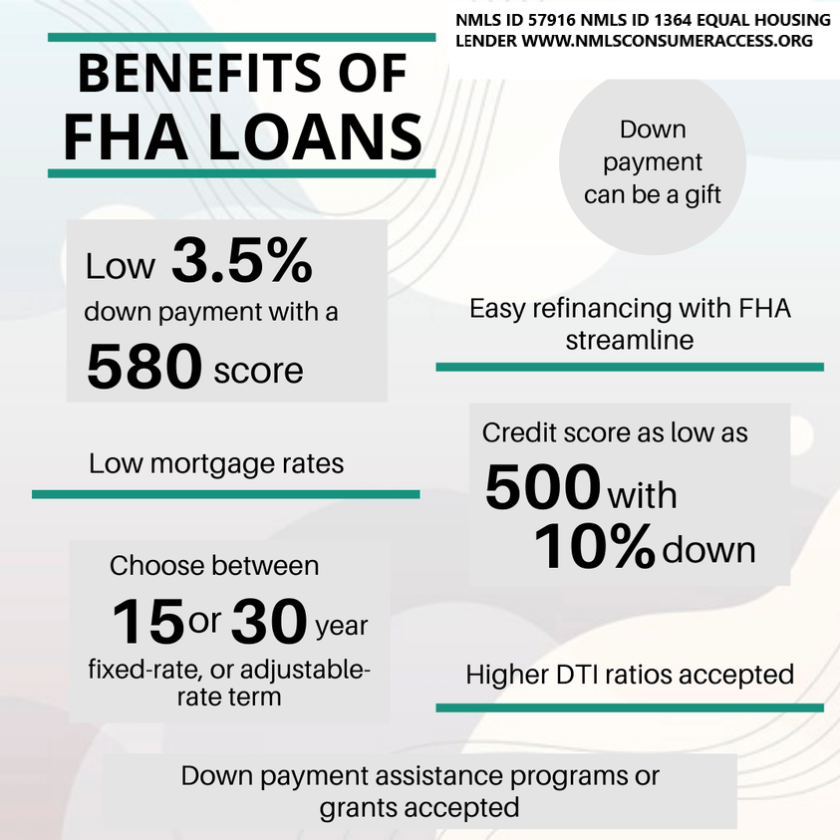
  • Low to zero down Down Payments: FHA loans are designed to help borrowers with limited funds for down payments. Specifically, if your credit score is above 580, you could qualify for a down payment of 3.5%.  
  • Flexible Credit Requirements: FHA loans have lower credit score requirements compared to conventional loans. Even with a credit score as low as 500, you may qualify with a 10% down payment. 
  • Lower Debt-to-Income Ratio (DTI): Compared to conventional loans, FHA loans typically allow borrowers with higher levels of debt to still qualify by allowing a higher Debt-to-Income Ratio (DTI). 
  • Gift Funds and Grants: You could leverage gift funds and grants from family or approved organizations to contribute towards your down payment.  

Kentucky FHA Loan Requirements 

To be eligible for an Kentucky FHA loan there are some specific requirements you must meet. Here is an overview of these requirements:   

FHA Loan Down Payment  

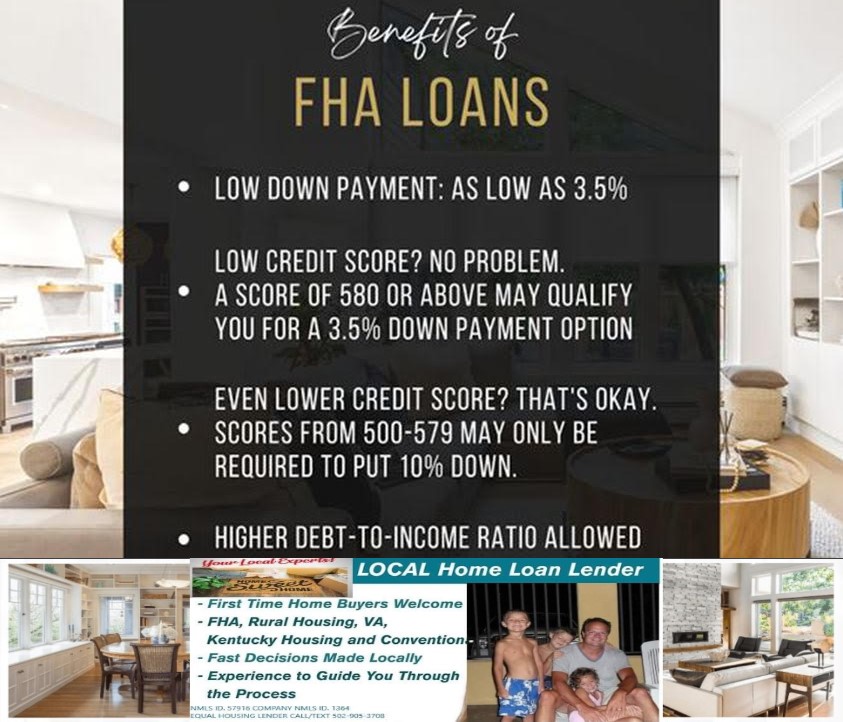
The amount you’ll need to pay as a down payment on an FHA loan depends on your credit score. If your credit score is 580 or higher, then you could pay as little as 3.5% of the loan amount. However, if your credit score falls between 500 and 579, you’ll need to pay a larger down payment of 10%. If you’re short on funds, there are several DPA programs available which could help for Kentucky Homebuyers with zero down payments to get into a house.! 

Kentucky FHA Mortgage Insurance Premiums 

All FHA borrowers, no matter how much of a down payment they make, must purchase both upfront and annual mortgage insurance. 

What does Kentucky FHA mortgage insurance cover on your home loan? 

Kentucky FHA mortgage insurance protects lenders in case you, the borrower, default on your mortgage. This allows lenders to offer FHA loans with lower down payments and potentially less strict credit score requirements. Essentially, it mitigates the lender’s risk, making Kentucky FHA loans more accessible to first-time homebuyers or those with limited savings. 

How much is FHA mortgage insurance? 

FHA mortgage insurance has two components – an upfront premium and an annual premium. The upfront premium is a one-time payment that you need to make at the time of loan closing, and it amounts to 1.75% of the loan amount. 

On the other hand, the annual premium is a recurring cost that you need to pay as a part of your monthly mortgage payment. The amount of the annual premium may vary depending on factors such as the loan term, loan amount, and loan-to-value ratio (LTV). 

Oftentimes, with credit improvement and an increase in home equity (at least 80% loan-to-value), borrowers with FHA loans opt to refinance to a conventional loan program. This helps eliminate the monthly mortgage insurance premium portion of the monthly mortgage payment. 

How To Calculate Kentucky FHA Mortgage Insurance 

To calculate your Kentucky  FHA Mortgage Insurance, you can either use the HUD Calculator or follow these simple steps using your specific information: 

  1. Determine the amount of your loan. 
  2. Calculate your loan-to-value (LTV) ratio by dividing the loan amount by the appraised value of the home. 
  3. Find the annual MIP rate based on your LTV ratio and loan term. You can find this information on the HUD website
  4. Multiply the loan amount by the annual MIP rate to get the annual MIP amount. 


Can I remove KEntucky FHA mortgage insurance? 

If you have an FHA loan, you can’t remove the Mortgage Insurance Premium (MIP) as easily as you can with Private Mortgage Insurance (PMI). To remove MIP from your FHA loan, you could refinance into a Conventional Loan. Once your home has at least 20% equity, you typically won’t have to pay PMI with a conventional loan. 

Kentucky FHA Minimum Credit Score 

 To qualify for an Kentucky FHA loan, your FICO credit score needs to be at least 580. IF below 580, you will need 10% down payment and few lenders will do this honestly so it is best to raise your score above 580

Kentucky  FHA Mortgage Debt to Income Ratios 

Your debt-to-income ratio is the percentage of your gross income used to cover your mortgage and other debt payments. 

Debt to income  ratio for FHA loans is 3o to 45%  on the front end although this may vary based on your credit score and may go up to 57% with an AUS approval though Fannie Mae DO or Freddie Mac LP underwriting system. 

Calculating Your DTI for kentucky FHA Mortgage 

To calculate your Debt-to-Income Ratio (DTI) you could either use our mortgage calculator or follow these simple steps:  

  1. Add up all your monthly debt payments, including car loans, student loans, credit card debt, and the estimated monthly mortgage payment for the FHA loan you are considering. 
  1. Calculate your pre-tax gross monthly income. 
  1. Once you have these numbers, use the following formula to calculate your DTI Ratio: DTI Ratio = Total Monthly Debt Payments / Gross Monthly Income. 

Kentucky FHA Loan Income Requirements 

Kentucky HA loans don’t have any specific minimum or maximum income requirements.


Kentucky FHA Loan Limits 

The maximum amount you can borrow on an FHA loan (which is set by The Federal Housing Administration)  As of May 2024, the Federal Housing Administration (FHA) loan limits for single-family homes in Kentucky are $498,257

Kentucky FHA Mortgage Rates 

Kentucky FHA loans typically have lower interest rates than conventional loans but inline with other government backed loans like Kentucky VA and USDA loans . This is because the Federal Housing Administration (FHA) or HUD , which manages the FHA loan program in Kentucky , insures these mortgages. This insurance protects private lenders from the risk of borrower default, which enables them to offer lower rates with a government guarantee if loan defaults

Types Of Kentucky FHA Loans 

 FHA loans available, each with unique requirements and benefits. Here are some of the most common options. 

Home Purchase  

Kentucky FHA loans are commonly used to finance the purchase of a single-family house, townhouse, or condominium, 2-4 units homes in Kentucky

FHA Rate Term Refinance 

A Kentucky FHA Rate Term Refinance enables you to refinance your current Kentucky FHA loan and potentially obtain a lower interest rate or adjust the loan term.  

Kentucky FHA Streamline Refinance

The Kentucky FHA Streamline option allows refinancing without an appraisal, providing a fast and simple process for borrowers with existing FHA-insured mortgages that can reduce closing costs due to not having to do an appraisal and skipping a lot of verifications that was done when you use the FHA loan the first time to buy the house. 

Kentucky FHA Cash Out Refinance  

An Kentucky FHA Cash Out Refinance allows you to leverage the equity you’ve built up in your home by letting you finance up to 80% of the home’s value to use the cash home equity –Refinance must be in a 1st lien position due to FHA does not allow for second mortgages

Kentucky FHA Cash Out Refinance 

These loans cater to homebuyers interested in purchasing a fixer upper. FHA 203k loans combine financing for both the purchase and renovation of a property, allowing you to roll renovation costs into your mortgage payment. This eliminates the need for a separate renovation loan, simplifying the financing process. 

Kentucky FHA 100% Financing 

This program provides homebuyers with 100% financing for Kentcky FHA loans, without requiring a down payment (closing costs are still required). This is achieved through a combination of a 1st and 2nd mortgage. 

This DPA program through KHC, 5% grant, and 3.5% grant from Federal Agency  can be used to obtain an FHA loan. The 2nd mortgage can be up to 3.5% of the sales price or the appraised value, whichever is less. The term for the 2nd mortgage is 10 years. 

Kentucky FHA vs Kentucky  Conventional Loan 

Kentucky FHA and Kentucky conventional loans are two popular options for financing a home. Nevertheless, there are some differences between the two

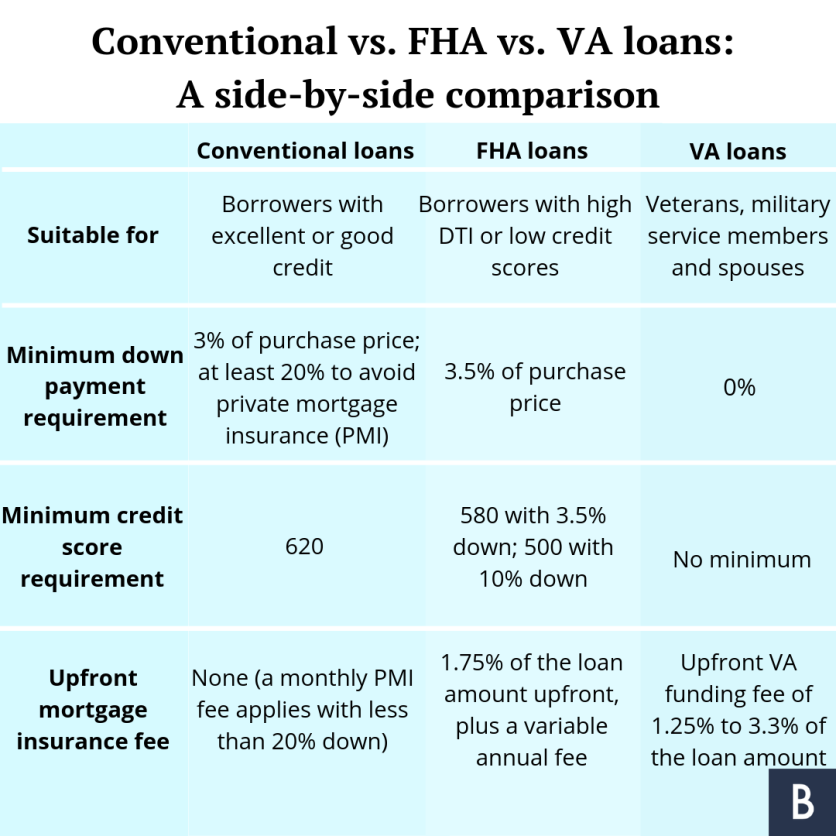
Kentucky FHA loans are provided by lenders approved by the Federal Housing Administration and guaranteed by the government. These loans usually have more relaxed eligibility requirements compared to conventional loans, and FHA loans may require smaller down payments. However, you will need to pay mortgage insurance premiums (MIPs) for at least 11 years, or the full term of the loan. 

On the other hand, conventional loans are not backed by any government agency and may have stricter lending standards. They may require larger down payments than FHA loans, and if you provide less than 20% as a down payment, you will have to pay for private mortgage insurance (PMI). However, you can request to cancel PMI when your balance reaches 80% of the original home value. 

How To Apply For A Kentucky FHA Loan 


Find an approved- FHA Lender in Kentucky 

To apply for an Kentucky FHA loan,  contact me below 


Text/call: 502-905-3708
fax: 502-327-9119
email:
 kentuckyloan@gmail.com

http://www.mylouisvillekentuckymortgage.com/

Documents Needed for a FHA loan in Kentucky

Kentucky FHA Mortgage Application Checklist of Documents Needed below 👇

W-2 forms (previous 2 years)
Paycheck stubs (last 30 days – most current)
Employer name and address with phone number to verify employment (2 year history including any gaps)
Bank accounts statement (recent 2 months – all pages
Statements for 401(k)s, stocks and other investments (most recent)
federal tax returns (previous 2 years)
Residency history (2 year history)
Photo identification for applicant and co-applicant (valid Driver’s License

Can You Have Two Kentucky FHA Loans at One Time?


FHA will not insure more than one Property as a Principal Residence for any Borrower, except as noted below. FHA will not insure a Mortgage if it is determined that the transaction was designed to use FHA mortgage insurance as a vehicle for obtaining Investment Properties, even if the Property to be insured will be the only one owned using FHA mortgage insurance.

Properties previously acquired as Investment Properties are not subject to these restrictions.

Listed below are the only circumstances in which a Borrower with an existing FHA-insured Mortgage for a Principal Residence may obtain an additional FHA-insured Mortgage on a new Principal Residence:

RELOCATION – A Borrower may be eligible to obtain another FHA-insured Mortgage without being required to sell an existing Property covered by an FHA-insured Mortgage if the Borrower is:
– relocating or has relocated for an employment-related reason; and
– establishing or has established a new Principal Residence in an area more than 100 miles from the Borrower’s current Principal Residence.

If the Borrower moves back to the original area, the Borrower is not required to live in the original house and may obtain a new FHA-insured Mortgage on a new Principal Residence provided the relocation meets the two requirements above.

INCREASE IN FAMILY SIZE – A Borrower may be eligible for another house with an FHA-insured Mortgage if the Borrower provides satisfactory evidence that:
– the Borrower has had an increase in legal dependents and the Property now fails to meet family needs; and
– the Loan-to-Value (LTV) ratio on the current Principal Residence is equal to or less than 75% or is paid down to that amount, based on the outstanding Mortgage balance and a current residential appraisal.
  
VACATING A JOINTLY-OWNED PROPERTY 
– A Borrower may be eligible for another FHA-insured Mortgage if the Borrower is vacating (with no intent to return) the Principal Residence which will remain occupied by an existing co-Borrower.

NON-OCCUPYING CO-BORROWER – A non-occupying co-Borrower on an existing FHA-insured Mortgage may qualify for an FHA-insured Mortgage on a new Property to be their own Principal Residence.

Can you buy a Kentucky duplex with an Kentucky FHA loan? 

FHA loans are a great way to finance the purchase of a duplex. Remember, you must live in one of the units as your primary residence for at least one year in order to be eligible for an FHA loan. This requirement is in place because FHA loans are intended to help people buy homes they will live in, not as investment home opportunities. Buying a duplex allows you to earn rental income while also enjoying the experience of being a homeowner. 

Can you get an Kentucky FHA loan twice? 


FHA will not insure more than one Property as a Principal Residence for any Borrower, except as noted below. FHA will not insure a Mortgage if it is determined that the transaction was designed to use FHA mortgage insurance as a vehicle for obtaining Investment Properties, even if the Property to be insured will be the only one owned using FHA mortgage insurance.

Properties previously acquired as Investment Properties are not subject to these restrictions.

Listed below are the only circumstances in which a Borrower with an existing FHA-insured Mortgage for a Principal Residence may obtain an additional FHA-insured Mortgage on a new Principal Residence:

RELOCATION – A Borrower may be eligible to obtain another FHA-insured Mortgage without being required to sell an existing Property covered by an FHA-insured Mortgage if the Borrower is:
– relocating or has relocated for an employment-related reason; and
– establishing or has established a new Principal Residence in an area more than 100 miles from the Borrower’s current Principal Residence.

If the Borrower moves back to the original area, the Borrower is not required to live in the original house and may obtain a new FHA-insured Mortgage on a new Principal Residence provided the relocation meets the two requirements above.

INCREASE IN FAMILY SIZE – A Borrower may be eligible for another house with an FHA-insured Mortgage if the Borrower provides satisfactory evidence that:
– the Borrower has had an increase in legal dependents and the Property now fails to meet family needs; and
– the Loan-to-Value (LTV) ratio on the current Principal Residence is equal to or less than 75% or is paid down to that amount, based on the outstanding Mortgage balance and a current residential appraisal.
  
VACATING A JOINTLY-OWNED PROPERTY 
– A Borrower may be eligible for another FHA-insured Mortgage if the Borrower is vacating (with no intent to return) the Principal Residence which will remain occupied by an existing co-Borrower.

NON-OCCUPYING CO-BORROWER – A non-occupying co-Borrower on an existing FHA-insured Mortgage may qualify for an FHA-insured Mortgage on a new Property to be their own Principal Residence.

. 

Are Kentucky FHA loans assumable? 


Assumable Mortgages are a type of financing arrangement in which the outstanding mortgage and its terms can be transferred from the current owner to a buyer.
 
By assuming the previous owner’s remaining debt, the buyer can avoid having to obtain his or her own mortgage. Buyers are typically attracted to homes with existing assumable mortgages during times of rising interest rates. This is because they can assume the seller’s mortgage, which was created when interest rates were lower, and use it to finance their purchase.
 
If the home’s purchase price exceeds the mortgage balance by a significant amount, the buyer will either need to provide a sizable down payment or obtain a new mortgage anyway.
 
For example, if a buyer is purchasing a home for $250,000, and the seller’s assumable mortgage only has a balance of $110,000, the buyer would need a down payment of $140,000 to cover the difference, or would have to get a separate mortgage to secure the needed funds.

fha assumable homes in louisville

Joel Lobb  Mortgage Loan Officer

American Mortgage Solutions, Inc.
10602 Timberwood Circle
Louisville, KY 40223
Company NMLS ID #1364

Text/call: 502-905-3708
fax: 502-327-9119
email:
 kentuckyloan@gmail.com

http://www.mylouisvillekentuckymortgage.com/

NMLS 57916  | Company NMLS #1364/MB73346135166/MBR1574The view and opinions stated on this website belong solely to the authors, and are intended for informational purposes only. The posted information does not guarantee approvalnor does it comprise full underwriting guidelines. This does not represent being part of a government agency. The views expressed on this post are mine and do not necessarily reflect the view of my employer. Not all products or services mentioned on this site may fit all people.
NMLS ID# 57916, (www.nmlsconsumeraccess.org).

How to Qualify For a Kentucky FHA Mortgage Loan


The requirements for Kentucky FHA loans are set by HUD.

  • Borrowers must have a steady employment history of the last two years within the same industry or line of work. Recent college graduates can use their transcripts to supplant the 2-year work history rule as long as it makes sense.
  • Self-Employed will need a 2-year history of tax returns filed with IRS. They will take a 2-year average.
  • FHA requires a 3.5% down payment. Can be gifted from a family member or from a retirement savings plan, or money saved up. Any type of cash deposits is not allowed for down payments. No exceptions to this rule!! This is one of the biggest issues I see in FHA underwriting nowadays.
  •  FHA loans are for primary residence occupancy. Not rental houses.
  • Borrowers must have a property appraisal from an FHA-approved appraiser.
  • Borrowers’ front-end ratio (mortgage payment plus HOA fees, property taxes, mortgage insurance, homeowners insurance) needs to be less than 31 percent of their gross income, typically. You may be able to get approved with as high a percentage as 43 percent. If the Automated Underwriting System gives you an Approved Eligible you can go higher on the debt ratios
  • Borrowers must have a minimum credit score of 580 for maximum financing with a 3.5% down payment
  • Borrowers must have a minimum credit score of 500-579 for maximum LTV of 90 percent with a minimum down payment of 10 percent. Most lenders will not go below 580 to 620 score, and very few lenders will go to 580 score. It’s best to work on getting your scores up before you apply or work with a loan officer to improve them.
  • 2 years removed from Chapter 7 is required with good pay history after bankruptcy
  • 1 year removed from Chapter 13 is okay with an excellent pay history with the Chapter 13 plan and permission from the trustee. You will need to qualify with the Chapter 13 payment along with a new house payment. Again, scores will play into your loan pre-approval.
  • Typically borrowers must be three years out of foreclosure and have re-established good credit. Exceptions can be made if there were extenuating circumstances and you’ve improved your credit. If you were unable to sell your home because you had to move to a new area, this does not qualify as an exception to the three-year foreclosure guideline.
  • The property must be appraised by a Kentucky FHA-approved appraiser.
  • The property must be safe, sound and secure, in compliance with minimum property standards as defined by the U.S. Department of Housing and Urban Development, or HUD.
  • You may not have delinquent federal debt or judgments, or debt associated with past FHA loans. Caivrs Alert System will show up if you owe the government money.

Why Lenders Use CAIVRS

It is true that your CAIVRS report can help lenders to predict the risk of doing business with you, just like a traditional consumer credit report. But the primary reason lenders check your CAIVRS report is because they are generally required to do so for any applications that involve a federal loan (FHA, VA, USDA, SBA, etc.). Lenders are required to conduct a CAIVRS search because of Title 31 of the United States Code (Section 3720B) bars “delinquent federal debtors from obtaining federal loans or loan insurance guarantees.”

Kentucky FHA Loan Requirements for 2023

  • Gift Rules for Down-Payment Sources Guidelines on FHA Mortgage ProgramsOne of the biggest obstacles to buying a home for Americans is the down payment. There was a time when you needed a 20% down payment and a high credit score to buy a home. But in 2022, you can buy a home with average to below-average credit and low down payment in some cases. One of the most popular loan programs for these buyers if the FHA loan. A major advantage of the FHA mortgage loan is you can get approved with only a 3.5% down payment with a 580 or higher credit score. If you have a lower score than that, you need a 10% down payment.Still, there are situations where the borrower is having trouble coming up with the down payment for the loan. What to do then? FHA guidelines do allow other options. Keep reading to learn more.More on FHA Down Payments and Approved SourcesAs we noted above, you are required to have at least a 3.5% down payment to be approved for an FHA loan. The money must be verified by the FHA-approved lender to come from an ‘approved source.’ What is an approved source, anyway? Most people get their down payment from cash reserves, investments, borrow from 401k or IRA, etc. The idea behind verifying where the money came from is to make sure the borrower did not get the down payment from a credit card or payday loan, etc.But there are other options for your down payment. The funds also can come from a gift. The gift and the giver do need to meet FHA requirements, but this flexible guideline makes it possible to get into an FHA loan with, technically, zero money down. To determine if the down payment gift can be used or not, it is necessary to check HUD rules. According to HUD 41.55.1 Chapter 5 Section B, for the funds to be a gift, there cannot be any expected repayment of the money.Also, FHA will scrutinize the giver of the gift. Chapter 5 of the HUD Code states the cash gift is OK if it comes from your relative; employer or labor union; close friend with a defined interest in you; charitable organization; government agency or public entity.FHA also states who cannot give gift funds to you for the down payment. These are the seller; the real estate agent or broker on the deal; the builder or an associated entity.Gift Terms ExplainedThe gift for your down payment cannot be made based upon paying it back later. You are required to get a gift letter from the person or organization. The letter should state that you are not required to pay the money back. It also should provide the contact information for the borrower, such as name, address, and phone number. Also included should be the bank account from which the funds will be sent.The gift donor should be OK with giving a bank statement with the letter. Also, he or she should ensure that the transfer amount matches what is in the gift letter and what is deposited into your account.FHA rules are very specific on these areas to ensure that the home buying process through FHA is fair and just. But as long as you follow the FHA rules, you should be able to get help with your down payment from a friend or relative.Don’t Have Friends or Family Who Can Help?Not every borrower has friends or family who can give them a gift for their down payment. But HUD lists many government programs spread throughout the country in most states that can offer down payment and closing cost help for certain borrowers.It also is worth checking if your employer and state have employer-assisted housing. This program can help people with moderate incomes to get a loan to cover closing costs and down payment. Look up FHA  in your state on Google to see what is available.The FHA is actually not the lender. They insure the loans that are issued by FHA-approved lenders. FHA loans are gear more toward borrower’s with less than 20% down payment and credit issues in the past.Qualifying for a FHA Loan Mortgage In KentuckyCredit Scores and Down Payment Percentages – Each year, the rules for qualifying for these loans changes. For 2022, applicants need a minimum credit score of 580 in order to get the low down payment, which is 3.5 percent.For those whose credit score is less than 580, they will have to come up with 10 percent for their down payment. This does not guaranteed a mortgage loan approval if you have the certain credit scores, just a the minimum required.Compensating Factors for FHA loan ApprovalThe credit score is just one part of the story. The FHA will also evaluate the borrower’s bankruptcies, foreclosures, prior payment history on other debts. They will also want information on difficulties that kept the borrower from making payments on other debts in the past.https://www.youtube.com/embed/iM74Gt0GmMI?version=3&rel=1&showsearch=0&showinfo=1&iv_load_policy=1&fs=1&hl=en&autohide=2&wmode=transparentNegative strikes against qualifying for the loan include not having any credit history or a bankruptcy.Someone with a bankruptcy will have to wait for two or more years after their bankruptcy before applying for an FHA-insured loan.If you have late payments on debt obligations, it is best to wait until you have had a full year of on-time payments before you apply for a FHA-insured loan.If you have had a foreclosure in the past, you may still be able to get a FHA-insured loan three years after your foreclosure. The lender will be looking at the circumstances behind the foreclosure.If you have had any civil judgement against you for money owed, collections actions or unpaid/unresolved federal debt, the FHA-approved lender will be required by the FHA to establish that all of these outstanding issues are resolved or paid before you can go through closing.Watch out for student loans if they are delinquent because sometime this can cause a lien against you in the form of a CAVIRS Alert with HUDAs you can see, many types of borrowers who would not be eligible for a traditional mortgage, or who would face exorbitant interest rates, will be able to qualify for a FHA-insured loan at attractive interest rates.Employment and Income for a Kentucky FHA LoanYou must have an employment history that is steady for the last two years. Does not have to be same employer.Your income has to be verifiable in some way, whether that be through pay stubs, your income tax returns. No bank statements or cash deposits , or undocumented income can be used for income qualifying purposes.Image result for Employment and Income for a Kentucky FHA LoanDebt-to-Income Ratio Requirements –Depending on the automated underwriting system from Desktop Originator, your Debt-to-income ratio is the percentage of your income before taxes that you spend on monthly debt.Taking into account the proposed mortgage payment as well as the other debts, the FHA requires that these debts all total less than 43 percent of your pretax income in order to qualify for the loan.If your debt load is too high, you will struggle to pay all of your bills and mortgage expenses and care for yourself and your family.55488026_2283733755207645_6787062571322048512_n (1)Property Requirements for a Kentucky FHA LoanIt must be the place where you intend to reside. You must move into the home within 60 days of closing the loan. The home cannot be an investment. There will be an inspection to ensure that the home is safe and habitable.It is really not too hard to pass FHA loans and the appraisal process.23444444Pros of FHA Loans –
    • New homebuyers and those who have lower credit scores or who have other blemishes on their credit history will often qualify for FHA-insured loans.
    • Even though these borrowers are considered “subprime” to a traditional lender, they will receive attractive interest rates through the FHA-insured mortgage programs.
    • The down payments required from borrowers are lower than those required by traditional mortgage lenders.
    • These loans can be combined with other forms of public assistance for lower income or new borrowers so that the borrower will not need to come up with a down payment of any kind.
    Cons of FHA Loans –
    • Since the FHA is not actually the lender, and you have to go through FHA-approved lenders, you may not qualify due to stricter standards that the lender has for the loan.
    • Because you are not paying 20 percent as a down payment, the FHA requires two mortgage insurance premiums to be paid. One is an upfront premium that is 1.75 percent of the loan amount. Lenders often will allow you to make that mortgage insurance premium a part of your loan. The second is an annual mortgage insurance premium that is .45 percent or 1.05 percent. This premium is paid monthly.
     FHA FINANCINGCREDIT REQUIREMENTS FOR KENTUCKY FHA FINANCINGWhat credit score do I need to qualify for a Kentucky FHA loan is one of the most common questions I hear from Kentucky homebuyers?The short answer is you must have a minimum credit score of 500 to be eligible for an FHA loan in Kentucky.  Anything lower than 500 disqualifies you from consideration for an FHA loan.There are two sets of credit score requirements for a Kentucky FHA LoanOne important thing to understand is that the Federal Housing Administration (FHA) does not lend money directly to home buyers. You will fill out an application with a regular lender just as you would if you were applying for any other type of mortgage. What the FHA does is ensure your loan to help protect the lender in case you default.You will be required not only to meet the FHA guidelines to qualify for a loan but also meet any additional qualifications required by the lender. This means there are two sets of requirements you have to meet with your credit score.1. The first set of requirements comes from the Department of Housing and Urban Development (HUD). HUD oversees the FHA and determines what a borrower’s minimum eligibility requirements will be to obtain an FHA loan.2. The second set of requirements comes from the mortgage lender. The mortgage lender has the right to add its requirements to those mandated by HUD.What HUD requires of borrowers to be eligible for an FHA loanThe HUD Handbook 4000.1 includes the official guidelines when it comes to the FHA mortgage insurance program.Borrowers with credit scores from 500 to 579 are eligible for a 90% loan with 10% down.Individuals with credit scores below 500 are not eligible for the FHA program.What lenders may require of borrowers to be eligible for an Kentucky FHA loanLenders have the right to add requirements over and above the minimum requirements of HUD. These additional requirements are called overlays. Your lender may or may not require them.This is not something that should come as a surprise to you, however. Requiring a credit score of 580 to 620 is not unusual. In addition to your credit score, you must have a manageable debt level that lenders are comfortable with and enough income to repay your loan.
  •  
  •  
  • Joel Lobb (NMLS#57916)
    Senior  Loan Officer
    American Mortgage Solutions, Inc.10602 Timberwood Circle Suite 3Louisville, KY 40223Company ID #1364 | MB73346
    Text/call 502-905-3708
    kentuckyloan@gmail.com

FHA Announces Consideration of Positive Rental Payment History for First Time Homebuyers

The Federal Housing Administration (FHA) Mortgagee Letter (ML) 22-17 announced that FHA’s Technology Open To Approved Lenders (TOTAL) Mortgage Scorecard will begin scoring a borrower’s positive rental payment history as part of the credit risk analysis when they are applying for FHA-insured financing.

TOTAL will begin scoring on or after October 30, 2022, as well as for case numbers assigned on or after September 20, 2021, allowing lenders to implement the guidance on existing pipeline cases without the need to obtain a new case number.

Kentucky FHA Mortgage Loan Lender Guidelines

 Buying a Kentucky Home with a FHA Mortgage

Is an Kentucky FHA loan right for you?

Here are some benefits of Kentucky FHA loans 🤩
✅ Low down payment options
✅ Down payment assistance programs available
✅ Higher DTI ratios accepted

FHA requires you to establish that the income is in fact stable. I am covering Time on Job, Part Time Income, Seasonal Income and Job Gaps below.
 
Time on Job
There is not a minimum length of time a borrower must have held a position for the income to be eligible. However, the application must identify the most recent 2 years of employment.
If the borrower’s employment history indicates that they were in school or in the military, then the borrower must provide evidence supporting this such as college transcripts or discharge papers.
The current type of employment has to be supported by the college transcripts or discharge papers showing that he borrower’s training enabled them to gain employment in their field of training.
 
Part Time Income 

Part-time and second job income can be used to qualify if documentation is obtained to prove that the borrower has worked the part-time job uninterrupted for the past two years, and plans to continue.
For Qualifying purposed, “part-time” income refers to jobs taken to supplement the borrower’s main income from regular employment, such as a second job that is less than 40 hours per week.
Income: Is averaged over the previous 2 years. If there was a pay rate increase and we can document the increase in pay, you can average the new pay rate over 12 months.
 
Seasonal Income
Seasonal income may be acceptable for qualifying. It is not unusual to have out-of-season income from unemployment income. If the borrower has a 2 year history and continuance is probable, this type of income may be allowed to qualify the borrower.
The key here is history and continuance.
 
Job Gaps
The borrower must provide a signed explanation for gaps in employment as follows:
Income can be considered effective if the following can be verified:
1. Borrower has been employed in the current job for at least six months at the time of the case number assignment AND
2. A two year work history prior to the absence from employment.
 

What does FHA stand for?

FHA stands for Federal Housing Administration, and the FHA is a government agency that insures mortgages. It was created just after the Great Depression, at a time when homeownership was prohibitively expensive and difficult to achieve because so many Americans lacked the savings and credit history to qualify for a loan. The government stepped in and began backing mortgages with more accessible terms. Approved lenders began funding FHA loans, which offered more reasonable down payment and credit score standards.

Today, government-backed mortgages still offer a safety net to lenders—because a federal entity (in this case, the FHA) is guaranteeing the loans, there’s less financial risk if a borrower defaults on their payments. Lenders are then able to loosen their qualifying guidelines, making mortgages available to middle and low income borrowers who might not otherwise be approved under conventional standards.

What’s the difference between FHA and conventional loans?

Home loans fall into two broad categories: government and conventional. A conventional loan is any mortgage that is not insured by a federal entity. Because private lenders assume all the risk in funding conventional loans, the requirements to qualify for these loans are more strict. Generally speaking, FHA loans might be a good fit if you have less money set aside to fund your down payment and/or you have a below-average credit score. While low down payment minimums and competitive interest rates are still possible with a conventional loan, you’ll need to show a strong credit score to qualify for those advantages.

Each loan type has advantages and disadvantages—including different mortgage insurance requirements, loan limits, and property appraisal guidelines—so choosing the one that works best for you really depends on your financial profile and your homebuying priorities.

FHA loans pros and cons

FHA loans are meant to make homeownership more accessible to people with fewer savings set aside and lower credit scores. They can be a great fit for some borrowers, particularly first time homebuyers who often need lower down payment options, but you should weigh the costs and benefits of any mortgage before committing. Here’s a breakdown of the key pros and cons when it comes to FHA loans:

Pros Cons
Low down payment. Down payments make up the majority of cash to close in any purchase loan, and saving up for one can be a significant barrier for some borrowers. FHA loans make it possible to put down as little as 3.5% upfront and still get competitive rates. Mandatory MIP payments. FHA loans are more lenient, but they also come with insurance costs to mitigate risk to the lender. You’ll have to pay Mortgage Insurance Premiums (MIP) no matter what—either for 11 years or for the life of your loan, depending on your down payment.
Lower credit score. Credit scores can be a major hurdle when it comes to conventional loans, but borrowers with credit scores starting at 500 can qualify for FHA loans. Less competitive. Sometimes sellers can be more hesitant to accept FHA loans. In a competitive market, you might not win out against conventional loan bids.
Higher DTI accepted. Your debt-to-income (DTI) ratio gives lenders an understanding of other major financial obligations in your life. This ratio is a key factor in any loan application because it indicates your ability to afford a mortgage based on current household income and existing debt. Again, FHA loans offer more leniency here and borrowers at or below 43% DTI can qualify. Stricter property standards. To offset risk and further protect lenders, FHA loans have strict criteria when it comes to assessing the condition of any property being purchased with an FHA loan. The downside? The house you want to buy might not qualify for an FHA loan. The upside? You’re less likely to be financially burdened by a home that requires expensive repairs or updates.
No income limitations. It’s a common misconception that FHA loans are only available to first-time homebuyers or borrowers with limited income—but they’re not. There’s no maximum income limit that would disqualify you from this type of loan. Loan limits: FHA loan limits are typically lower than conventional loan limits, which means you might not be able to get funding for more expensive houses. This isn’t necessarily a bad thing, since it helps ensure that borrowers get loans they can afford to repay.

How to qualify for an FHA loan

Qualifying for an FHA loan is generally easier than qualifying for a conventional loan, but you’ll still need to meet some basic minimum standards set by the FHA. While the government insures these loans, the funding itself comes through FHA-approved lenders each lending institution may have slightly different qualifying guidelines for its borrowers. Keep in mind that, while these FHA standards offer a basic framework, you’ll need to confirm the individual qualifying rules with your specific lender.

  • Credit score minimum 500. Your exact credit score will play a big role in determining your down payment minimum; typically, the higher your credit score, the lower your down payment and the more favorable your interest rate.

  • Debt-to-income ratio at or below 56.9%. DTI is a standard way of comparing the amount of money you earn to the amount you spend paying off other debts, and FHA loans are more lax on this number.

  • Steady income and proof of employment. Being able to provide at least 2 years of income and employment records is a standard requirement for all loans.

  • Down payment between 3.5%-10%. The down payment minimum for an FHA loan is typically lower than conventional loan, and can be as little as 3.5% depending on your credit score and lender.

  • Property standards apply. You won’t qualify for an FHA loan if the house you want to buy doesn’t pass the appraisal process, which is more strict with this type of loan than conventional mortgages.

  • Maximum FHA loan amount. The amount of money you borrow cannot exceed the FHA loan limits; this number changes based on your county and is determined by how expensive the local market is; the maximum FHA loan limit in 2021 is $420,000 (check HUD resources to confirm the latest limits.)


Joel Lobb
Senior Loan Officer
(NMLS#57916)

American Mortgage Solutions, Inc.
10602 Timberwood Circle, Suite 3
Louisville, KY 40223

text or call my phone: (502) 905-3708
email me at kentuckyloan@gmail.com

The view and opinions stated on this website belong solely to the authors, and are intended for informational purposes only. The posted information does not guarantee approval, nor does it comprise full underwriting guidelines. This does not represent being part of a government agency.

The views expressed on this post are mine and do not necessarily reflect the view of my employer. Not all products or services mentioned on this site may fit all people. NMLS ID# 57916, (http://www.nmlsconsumeraccess.org). Mortgage loans only offered in Kentucky.
All loans and lines are subject to credit approval, verification, and collateral evaluation and are originated by lender. Products and interest rates are subject to change without notice.

Joel E Lobb
American Mortgage
5029053708
email us here
Kentucky FHA, VA, USDA & Rural Housing, KHC and Fannie Mae mortgage loans.

Kentucky Mortgage Broker Offering FHA, VA, USDA, Conventional, and KHC Down Payment Assistance Home Loans's avatarLouisville Kentucky Mortgage Loans

View original post

Kentucky FHA Guidelines for 2024

FHA pros and cons

FHA loans are a good option, especially if you have low credit or a lot of debt. But they come with their own set of drawbacks too.

FHA pros

Some of the best reasons to apply for an FHA home loan include:

  • Lenient credit requirements: You can generally qualify for maximum FHA financing with a credit score of 500 to 580 versus a 620 to 640 score for a USDA loan. You might also be eligible with a credit score between 500 and 579 if you can make a 10% down payment.
  • Higher debt-to-income ratios: Your back-end DTI — that is, your total monthly debt obligations — can be as high as 56.9% for FHA loans, but only 45% for USDA loans.
  • Potentially lower interest rates: FHA interest rates can be lower than rates for USDA loans because you have the option to choose shorter repayment terms, including a 15-year fixed interest rate. The USDA only offers 30-year fixed loans, which naturally have higher rates.
  • Multi-family units can qualify: Properties with up to four units can qualify for financing with an FHA loan when one unit is your primary residence. For example, purchasing a duplex with an FHA loan is allowed as long as you live in one half of the property. Like USDA loans, however, second homes and investment properties are ineligible.

FHA cons

  • Higher down payment requirements: Depending on your credit score, you’ll need to make a 3.5% or 10% down payment. USDA loans require no down payment.
  • Higher mortgage insurance premiums: Your upfront and annual mortgage insurance premiums are higher than the USDA guarantee fee and annual fee.
  • Difficult to cancel mortgage insurance: You’ll pay an annual mortgage insurance premium for the life of the loan unless your down payment is at least 10% — in which case, you’ll only pay mortgage insurance for the first 11 years.
  •  
Louisville Kentucky Mortgage Lender for FHA, VA, KHC, USDA and Rural  Housing Kentucky Mortgages: What is the difference between Conventional, FHA  and VA Mortgage loans in Kentucky?

Kentucky FHA Loan Requirements For Loan Approval.

images (3)


FHA Handbook 4000.1 Updates

Administration (FHA) Single Family Housing Policy Handbook 4000.1. These updates are effective September 30, 2016 and

 Clarification that an Upfront Mortgage Insurance Premium (UFMIP) refund calculation applies even if original UFMIP was
not financed.
 Mortgage Debt Not Included in Credit Report: Clarification that a manual downgrade is not required when there is no history of late payments, as detailed below.
o Not currently delinquent; and
o No 30 day late payments within 12 months of the case number assignment date; and
o No more than 2 x 30 day late payments within 24 months of the case number assignment date.
 A link has been added in the FHA Product Description from Mortgage Payment History requirements to “Credit History
Requirements for Manually Underwritten Loans.”
Appliances that add contributory value must be operable.
 Mechanical components and utilities: The appraiser must report the utility, safety, and capacity of the mechanical systems.
The appraiser must observe and operate all applicable mechanical systems and utilities. In conjunction with this guidance,
existing FHA Handbook guidance on the following topics will be added:
o Electrical System
o Heating and Cooling
o Plumbing
o Utilities

If you have questions about qualifying as first time home buyer in Kentucky, please call, text, email or fill out free prequalification below for your next mortgage loan pre-approval.


The view and opinions stated on this website belong solely to the authors, and are intended for informational purposes only.  The posted information does not guarantee approval, nor does it comprise full underwriting guidelines.  This does not represent being part of a government agency. The views expressed on this post are mine and do not necessarily reflect the views of my employer. Not all products or services mentioned on this site may fit all people