Here’s what you need to know about Kentucky FHA Loans and the changes that have been made for 2022.
What is a Kentucky FHA loan?
It stands for a Federal Housing Administration loan, meaning it is backed by the U.S. government. It is not made by a government agency. You deal directly with a mortgage lender or broker to get the loan, but the FHA will typically buy the loan from the lender after it is made or guarantee the lender against loss. FHA loans typically require lower down payments and credit scores than most conventional loans, making them a clear favorite among first-time buyers.
What Are the Terms?
These loans can have terms of either 30 years or 15 years. The interest rate is fixed for the entire loan length.
FHA borrowers are required to pay mortgage insurance premiums, but after a borrower’s equity in their home increases they may be able to refinance into a conventional loan and eliminate the monthly mortgage insurance premiums.
What Are the Qualifications?
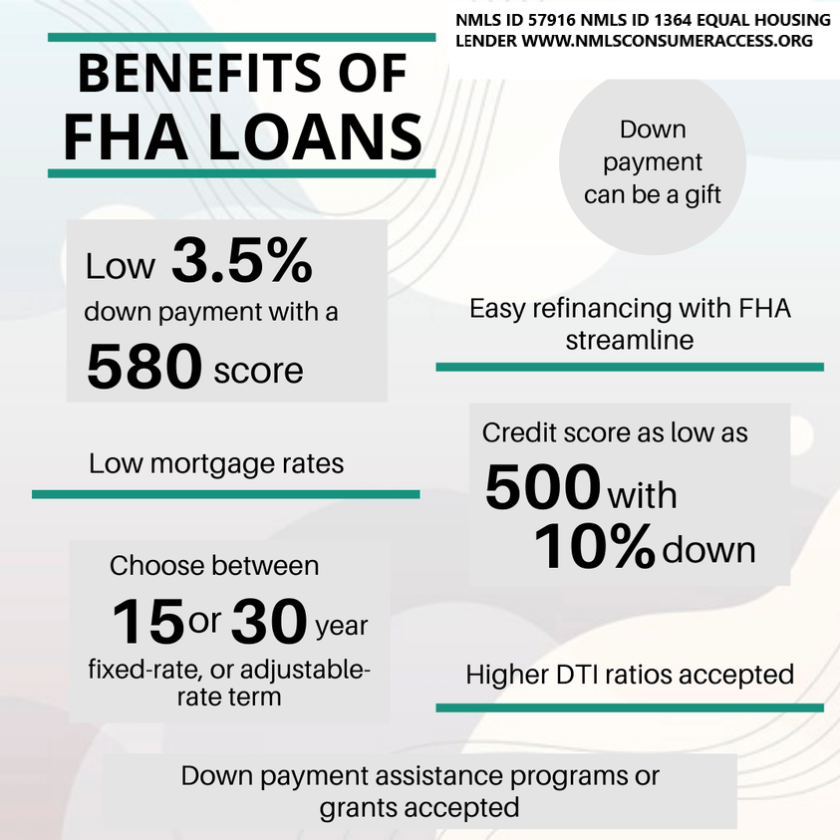
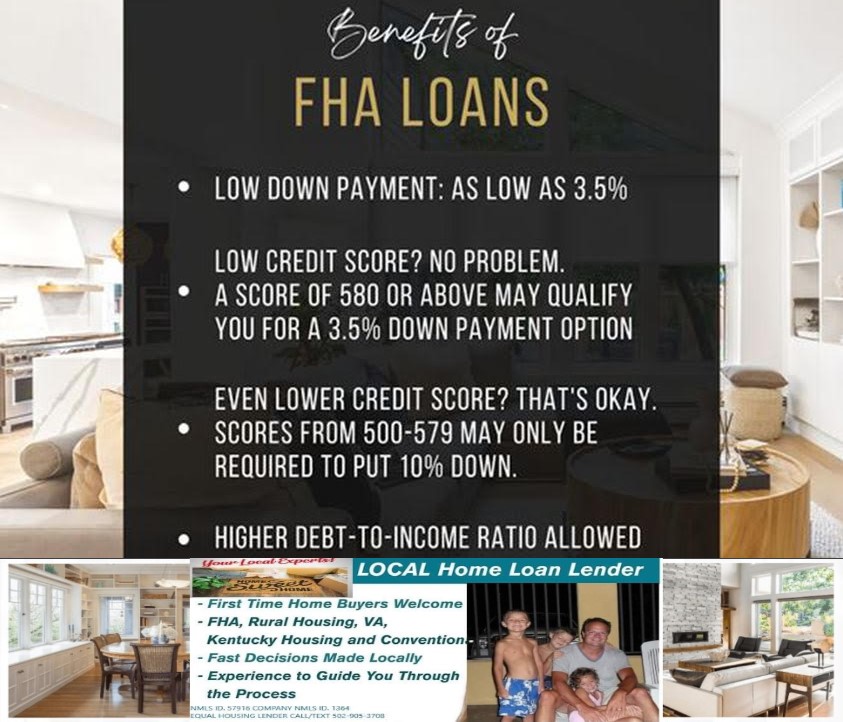
To qualify for an FHA mortgage, home buyers need a FICO credit score of 580 or higher and a down payment of 3.5% (or a minimum down payment of 10% with a 500 FICO score).
These loans also require a two-year employment and income verification and the property as must be used as a primary residence.
If a borrower has had a bankruptcy, they must wait one to two years depending on if Chapter 13 or Chapter 7 before applying and three years after a foreclosure.
Increased Loan Limits for 2022
In 2022, for most parts of the U.S., Kentucky FHA borrowers can take out a loan for up to $420,680, an increase from 2021’s limit of $356,362.
Here are some benefits of Kentucky FHA loans 🤩 ✅ Low down payment options ✅ Down payment assistance programs available ✅ Higher DTI ratios accepted
FHA requires you to establish that the income is in fact stable. I am covering Time on Job, Part Time Income, Seasonal Income and Job Gaps below.
Time on Job
There is not a minimum length of time a borrower must have held a position for the income to be eligible. However, the application must identify the most recent 2 years of employment.
If the borrower’s employment history indicates that they were in school or in the military, then the borrower must provide evidence supporting this such as college transcripts or discharge papers.
The current type of employment has to be supported by the college transcripts or discharge papers showing that he borrower’s training enabled them to gain employment in their field of training.
Part Time Income
Part-time and second job income can be used to qualify if documentation is obtained to prove that the borrower has worked the part-time job uninterrupted for the past two years, and plans to continue.
For Qualifying purposed, “part-time” income refers to jobs taken to supplement the borrower’s main income from regular employment, such as a second job that is less than 40 hours per week.
Income: Is averaged over the previous 2 years. If there was a pay rate increase and we can document the increase in pay, you can average the new pay rate over 12 months.
Seasonal Income
Seasonal income may be acceptable for qualifying. It is not unusual to have out-of-season income from unemployment income. If the borrower has a 2 year history and continuance is probable, this type of income may be allowed to qualify the borrower.
The key here is history and continuance.
Job Gaps
The borrower must provide a signed explanation for gaps in employment as follows:
Income can be considered effective if the following can be verified:
1. Borrower has been employed in the current job for at least six months at the time of the case number assignment AND
2. A two year work history prior to the absence from employment.
What does FHA stand for?
FHA stands for Federal Housing Administration, and the FHA is a government agency that insures mortgages. It was created just after the Great Depression, at a time when homeownership was prohibitively expensive and difficult to achieve because so many Americans lacked the savings and credit history to qualify for a loan. The government stepped in and began backing mortgages with more accessible terms. Approved lenders began funding FHA loans, which offered more reasonable down payment and credit score standards.
Today, government-backed mortgages still offer a safety net to lenders—because a federal entity (in this case, the FHA) is guaranteeing the loans, there’s less financial risk if a borrower defaults on their payments. Lenders are then able to loosen their qualifying guidelines, making mortgages available to middle and low income borrowers who might not otherwise be approved under conventional standards.
What’s the difference between FHA and conventional loans?
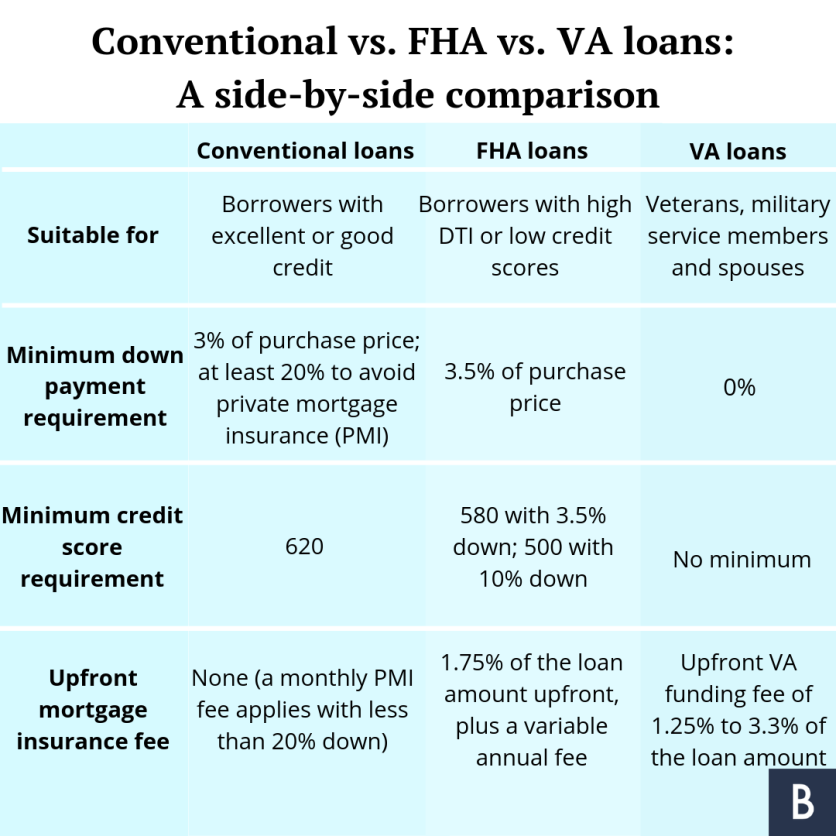
Home loans fall into two broad categories: government and conventional. A conventional loan is any mortgage that is not insured by a federal entity. Because private lenders assume all the risk in funding conventional loans, the requirements to qualify for these loans are more strict. Generally speaking, FHA loans might be a good fit if you have less money set aside to fund your down payment and/or you have a below-average credit score. While low down payment minimums and competitive interest rates are still possible with a conventional loan, you’ll need to show a strong credit score to qualify for those advantages.
Each loan type has advantages and disadvantages—including different mortgage insurance requirements, loan limits, and property appraisal guidelines—so choosing the one that works best for you really depends on your financial profile and your homebuying priorities.
FHA loans pros and cons
FHA loans are meant to make homeownership more accessible to people with fewer savings set aside and lower credit scores. They can be a great fit for some borrowers, particularly first time homebuyers who often need lower down payment options, but you should weigh the costs and benefits of any mortgage before committing. Here’s a breakdown of the key pros and cons when it comes to FHA loans:
Pros
Cons
Low down payment. Down payments make up the majority of cash to close in any purchase loan, and saving up for one can be a significant barrier for some borrowers. FHA loans make it possible to put down as little as 3.5% upfront and still get competitive rates.
Mandatory MIP payments. FHA loans are more lenient, but they also come with insurance costs to mitigate risk to the lender. You’ll have to pay Mortgage Insurance Premiums (MIP) no matter what—either for 11 years or for the life of your loan, depending on your down payment.
Lower credit score. Credit scores can be a major hurdle when it comes to conventional loans, but borrowers with credit scores starting at 500 can qualify for FHA loans.
Less competitive. Sometimes sellers can be more hesitant to accept FHA loans. In a competitive market, you might not win out against conventional loan bids.
Higher DTI accepted. Your debt-to-income (DTI) ratio gives lenders an understanding of other major financial obligations in your life. This ratio is a key factor in any loan application because it indicates your ability to afford a mortgage based on current household income and existing debt. Again, FHA loans offer more leniency here and borrowers at or below 43% DTI can qualify.
Stricter property standards. To offset risk and further protect lenders, FHA loans have strict criteria when it comes to assessing the condition of any property being purchased with an FHA loan. The downside? The house you want to buy might not qualify for an FHA loan. The upside? You’re less likely to be financially burdened by a home that requires expensive repairs or updates.
No income limitations. It’s a common misconception that FHA loans are only available to first-time homebuyers or borrowers with limited income—but they’re not. There’s no maximum income limit that would disqualify you from this type of loan.
Loan limits: FHA loan limits are typically lower than conventional loan limits, which means you might not be able to get funding for more expensive houses. This isn’t necessarily a bad thing, since it helps ensure that borrowers get loans they can afford to repay.
How to qualify for an FHA loan
Qualifying for an FHA loan is generally easier than qualifying for a conventional loan, but you’ll still need to meet some basic minimum standards set by the FHA. While the government insures these loans, the funding itself comes through FHA-approved lenders each lending institution may have slightly different qualifying guidelines for its borrowers. Keep in mind that, while these FHA standards offer a basic framework, you’ll need to confirm the individual qualifying rules with your specific lender.
Credit score minimum 500. Your exact credit score will play a big role in determining your down payment minimum; typically, the higher your credit score, the lower your down payment and the more favorable your interest rate.
Debt-to-income ratio at or below 56.9%. DTI is a standard way of comparing the amount of money you earn to the amount you spend paying off other debts, and FHA loans are more lax on this number.
Steady income and proof of employment. Being able to provide at least 2 years of income and employment records is a standard requirement for all loans.
Down payment between 3.5%-10%. The down payment minimum for an FHA loan is typically lower than conventional loan, and can be as little as 3.5% depending on your credit score and lender.
Property standards apply. You won’t qualify for an FHA loan if the house you want to buy doesn’t pass the appraisal process, which is more strict with this type of loan than conventional mortgages.
Maximum FHA loan amount. The amount of money you borrow cannot exceed the FHA loan limits; this number changes based on your county and is determined by how expensive the local market is; the maximum FHA loan limit in 2021 is $420,000 (check HUD resources to confirm the latest limits.)
Joel Lobb Senior Loan Officer (NMLS#57916)
American Mortgage Solutions, Inc. 10602 Timberwood Circle, Suite 3 Louisville, KY 40223
The view and opinions stated on this website belong solely to the authors, and are intended for informational purposes only. The posted information does not guarantee approval, nor does it comprise full underwriting guidelines. This does not represent being part of a government agency.
The views expressed on this post are mine and do not necessarily reflect the view of my employer. Not all products or services mentioned on this site may fit all people. NMLS ID# 57916, (http://www.nmlsconsumeraccess.org). Mortgage loans only offered in Kentucky. All loans and lines are subject to credit approval, verification, and collateral evaluation and are originated by lender. Products and interest rates are subject to change without notice.
Joel E Lobb American Mortgage 5029053708 email us here
Kentucky FHA, VA, USDA & Rural Housing, KHC and Fannie Mae mortgage loans.
FHA loans are a good option, especially if you have low credit or a lot of debt. But they come with their own set of drawbacks too.
FHA pros
Some of the best reasons to apply for an FHA home loan include:
Lenient credit requirements: You can generally qualify for maximum FHA financing with a credit score of 500 to 580 versus a 620 to 640 score for a USDA loan. You might also be eligible with a credit score between 500 and 579 if you can make a 10% down payment.
Higher debt-to-income ratios: Your back-end DTI — that is, your total monthly debt obligations — can be as high as 56.9% for FHA loans, but only 45% for USDA loans.
Potentially lower interest rates: FHA interest rates can be lower than rates for USDA loans because you have the option to choose shorter repayment terms, including a 15-year fixed interest rate. The USDA only offers 30-year fixed loans, which naturally have higher rates.
Multi-family units can qualify: Properties with up to four units can qualify for financing with an FHA loan when one unit is your primary residence. For example, purchasing a duplex with an FHA loan is allowed as long as you live in one half of the property. Like USDA loans, however, second homes and investment properties are ineligible.
FHA cons
Higher down payment requirements: Depending on your credit score, you’ll need to make a 3.5% or 10% down payment. USDA loans require no down payment.
Higher mortgage insurance premiums: Your upfront and annual mortgage insurance premiums are higher than the USDA guarantee fee and annual fee.
Difficult to cancel mortgage insurance: You’ll pay an annual mortgage insurance premium for the life of the loan unless your down payment is at least 10% — in which case, you’ll only pay mortgage insurance for the first 11 years.
Types of Kentucky Mortgage Loans to Consider After Bankruptcy
If you want to try to get a Kentucky mortgage after bankruptcy, you can research a number of different types of loans. Each mortgage loan has its own unique requirements for bankruptcy filers.
Kentucky FHA Loans
Federal Housing Administration (FHA) loans are managed by the federal government and may allow you to buy a house with a down payment that’s as little as 3.5% of the purchase price. The downfall of FHA loans, however, is that you’ll have to pay for mortgage insurance, which will result in higher monthly payments.
To get a mortgage after bankruptcy using an FHA loan, you’ll have to adhere to these waiting periods:
Chapter 7: Two years from your discharge date
Chapter 11: No waiting period
Chapter 13: One year from your discharge date
Kentucky USDA Loans
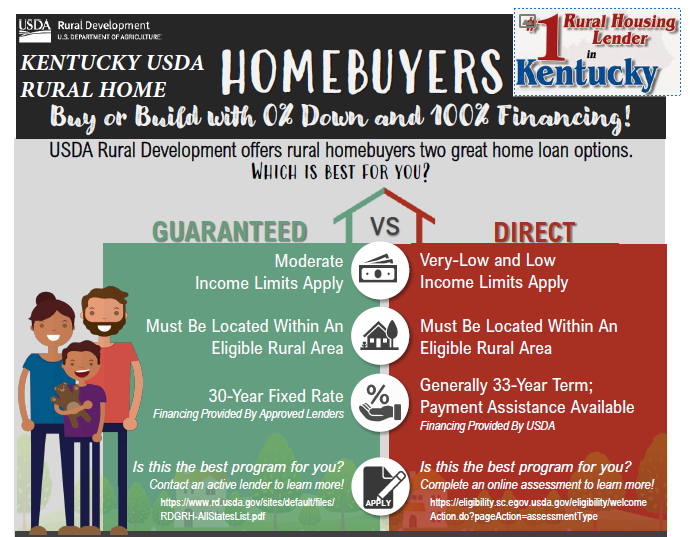
U.S. Department of Agriculture (USDA) loans are designed for rural borrowers who meet certain income requirements. It may be a good option if you’d like to buy a house in a rural area, have a low or modest income, and aren’t eligible for a conventional loan. If you go this route, you may not have to put any money down and you may be able to secure a low interest rate.
If you’re a veteran or currently serving in the military, you may be eligible for a Department of Veterans Affairs (VA) loan. A VA loan doesn’t require a down payment or charge private mortgage insurance and can give you the chance to lock in a low interest rate. If you pursue a VA loan, however, you’ll have to pay a funding fee, which will be a percentage of your home price.
Here are the waiting requirements you should be aware of if you’d like to get a VA loan after bankruptcy:
Chapter 7: Two years from your discharge date
Chapter 11: No waiting period
Chapter 13: One year from your discharge date
Kentucky Conventional Loans
Since conventional loans are not guaranteed or insured by government agencies, you can expect stricter requirements, such as having a good credit score, if you apply for one. If you get a conventional loan and put down less than 20% of the cost of your new home, you’ll need to pay private mortgage insurance.
The waiting requirements for taking out a conventional loan after bankruptcy are as follows:
Chapter 7: Four years from your discharge date
Chapter 11: Four years from your discharge date
Chapter 13: Two years from your discharge date or four years from your dismissal date
Chapter 7 Bankruptcy
A four-year waiting period is required, measured from the discharge or dismissal date of the bankruptcy action until the application date.
Chapter 13 Bankruptcy two years from the discharge date to the application date, or four years from the dismissal date to the application date.
The shorter waiting period based on the discharge date recognizes that borrowers have already met a portion of the waiting period within the time needed for the successful completion of a Chapter 13 plan and subsequent discharge.
A borrower who was unable to complete the Chapter 13 plan and received a dismissal will be held to a four-year waiting period.
Exceptions for Extenuating Circumstances
A two-year waiting period is permitted after a Chapter 13 dismissal, if extenuating circumstances can be documented. There are no exceptions permitted to the two-year waiting period after a Chapter 13 discharge.
Foreclosure / Short Sale
A seven-year waiting period is required. In all instances, the “date of foreclosure” is considered the date of the foreclosure deed. The end date of the waiting period is the application date.
Foreclosure / Short Sale – Extenuating Circumstance A three-year waiting period is permitted if extenuating circumstances can be documented. Additional requirements apply between three and seven years, which include:
FHA Loan Guidelines for Bankruptcy and Foreclosure
Chapter 7
Chapter 7 bankruptcy discharged more than 24 months prior to the application date may be allowed.
Chapter 7 bankruptcy discharged between 12 and 24 months prior to the application date requires satisfactorily established credit and documentation showing the circumstances which caused the bankruptcy were beyond the borrower’s control (i.e. unemployment, medical bills not covered by insurance). In these instances, the file must be manually downgraded to a refer and manually underwritten. It falls upon the underwriter to make a final determination as to the overall quality of the file.
Chapter 7 bankruptcy discharged less than 12 months prior to the application date is not allowed.
Chapter 13
Loans where the borrower is currently in a Chapter 13 bankruptcy or had a Chapter 13 bankruptcy which was discharged within the previous 2 years require manual downgrade and must be underwritten manually. Note that manual underwrites require Underwriting Management approval.
A borrower who is currently in a Chapter 13 bankruptcy may be eligible for FHA financing provided all of the following conditions are met in addition to standard manual underwriting requirements:
Foreclosure / Short Sale
A foreclosure less than 3 years ago is not allowed.
In all instances, the “date of foreclosure” is considered the date of the foreclosure deed. The end date of the time frame is determined by the application date.
Kentucky VA Loan Guidelines for Bankruptcy and Foreclosure
Chapter 7
Chapter 7 bankruptcy discharged more than 24 months prior to application date may be disregarded.
Chapter 7 bankruptcy discharged between 12 and 24 months prior to application date requires satisfactorily established credit and documentation showing the circumstances which caused the bankruptcy were beyond the borrower’s control (i.e. unemployment, medical bills not covered by insurance). In these instances, the file must be manually downgraded to a refer and manually underwritten. It falls upon the underwriter to make a final determination as to the overall quality of the file.
Chapter 7 bankruptcy discharged less than 12 months prior to application date is not allowed.
Note that for High Balance Transactions a minimum of 7 years must have elapsed since the discharge date regardless of AUS findings.
Chapter 13
The borrower’s credit history since the bankruptcy, the circumstances behind the bankruptcy, and the discharge date all factor in to the final determination by the underwriter.
A borrower who is currently in a Chapter 13 bankruptcy may be eligible for VA financing
Foreclosure / Short Sale
Foreclosure more than 36 months prior to application date may be disregarded.
Foreclosure less than 36 months prior to application date is not allowed.
Note that for High Balance Transactions a minimum of 7 years must have elapsed since the foreclosure date regardless of AUS findings.
In all instances, the “date of foreclosure” is considered the date of the foreclosure deed.
USDA Guidelines for Bankruptcy and Foreclosure
Chapter 7
The Discharge date and GUS findings both play an important role in determining the viability and future repayment of the new loan. As such, Chapter 7 bankruptcy seasoning is evaluated by GUS.
Chapter 13
Loans where the borrower is currently in a Chapter 13 bankruptcy or had a Chapter 13 bankruptcy which was discharged within the previous 3 years require a manual downgrade and must be underwritten manually.
A borrower who is currently in a Chapter 13 bankruptcy may be eligible for RD financing provided all of the following conditions are met in addition to standard manual underwriting requirements:
• At least 12 months of payments have been made satisfactorily
• The Trustee or bankruptcy judge’s approval to enter into the mortgage transaction is documented
• Bankruptcy payments are included in the borrower’s debt ratio
Foreclosure / Short Sale
The foreclosure date and GUS findings both play an important role in determining the viability and future repayment of the new loan. As such, foreclosure seasoning is evaluated by GUS.
A foreclosure does not automatically disqualify a borrower from RD financing. In all instances, the “date of foreclosure” is considered the date of the foreclosure deed.
You can obtain a copy of your bankruptcy paperwork from the website below:
Disclaimer: No statement on this site is a commitment to make a loan. Loans are subject to borrower qualifications, including income, property evaluation, sufficient equity in the home to meet Loan-to-Value requirements, and final credit approval. Approvals are subject to underwriting guidelines, interest rates, and program guidelines and are subject to change without notice based on applicant’s eligibility and market conditions. Refinancing an existing loan may result in total finance charges being higher over the life of a loan. Reduction in payments may reflect a longer loan term. Terms of any loan may be subject to payment of points and fees by the applicant Equal Opportunity Lender. NMLS#57916http://www.nmlsconsumeraccess.org/
The KY USDA home loans are perfect for first time buyers for many reasons. They have low interest rates, absolutely no down payment, no mortgage insurance, flexible credit guidelines, and most of the closing costs can be worked into the overall amount of the loan.
Advantages of a USDA vs. FHA & Other Loans
The USDA Home Loan program offers many advantages that traditional mortgage programs simply do not offer. First of all, all USDA home loans come with low interest rates, 100% financing, and require zero down payment. In fact, the USDA home loan program is the only home loan program in the country, besides the military, that requires absolutely no money for the purchase of a home. Instead, these funds can be used to pay to furnish the home, closing costs, make home renovations.
USDA home loans also have very flexible credit guidelines compared to most traditional lenders, with non-traditional credit histories being accepted. FHA home loans require a minimum of 3.5% down payment and have relatively high monthly mortgage insurance premiums.
Kentucky USDA Income Eligibility
Because USDA home loans are designed for moderate, to low income families, there are income limit restrictions. To be eligible for a USDA loan, your adjusted annual household income cannot exceed 115% of the median average income for that area.
This means if your total household income is above the average median income for that area, you may not be able to qualify. However, there are special deductions in place, such as childcare expenses, caring for elderly family members, or children in college, that can help to reduce your overall annual income. The borrower’s total housing and other consumer credit payments should account for no more than 4% of the total income. Income limits vary by county. Check your county Kentucky income limits here!
USDA Credit Eligibility
While it is true that USDA home loan program offers some the most credit flexible guidelines available, you still will need to have a minimum credit score of 620 to 640 to qualify.
However, some lenders may accept a credit score of as low as 580, if you can prove that some of your debts were circumstantial, temporary in nature, or beyond your control.
You must also have any bankruptcies or foreclosures discharged in the last 3 years, no outstanding tax liens and no accounts that have gone to collections within the past 12 months.
The view and opinions stated on this website belong solely to the authors, and are intended for informational purposes only. The posted information does not guarantee approval, nor does it comprise full underwriting guidelines. This does not represent being part of a government agency. The views expressed on this post are mine and do not necessarily reflect the view of my employer. Not all products or services mentioned on this site may fit all people.









 Kentucky FHA Mortgage Lender