How to Access KHC’s $12,500 Down Payment Assistance

Kentucky Down Payment Assistance

This type of loan is administered by KHC in the state of Kentucky. They typically have $12,500  down payment assistance year around, that is in the form of a second mortgage that you pay back over 15 years at a interest rate of   4.75% depending on your income in the household.

Joel has worked with KHC for 12 of his 20 years in the mortgage lending business. Joel said, “A lot of my clients would not have been able to purchase a home of their own or possibly delayed their purchase due to lack of down payment but with the $6,000 DAP loan program, this gets them into a house sooner and starts their path to homeownership while building equity instead of throwing their money away.”

When you’re ready to purchase a home in Joel’s area, contact him at:
Phone: 502-905-3708
Email: Kentuckyloan@gmail.com
Website: www.mylouisvillekentuckymortgage.com

2026 FHA Loan Options for Kentucky Homebuyers

Kentucky FHA Loan Requirements – Updated for 2026

Kentucky FHA loan guidelines are established by the U.S. Department of Housing and Urban Development (HUD). FHA loans remain one of the most flexible mortgage options available to Kentucky homebuyers, particularly first-time buyers, borrowers rebuilding credit, and households using down payment assistance.

Employment and Income Requirements

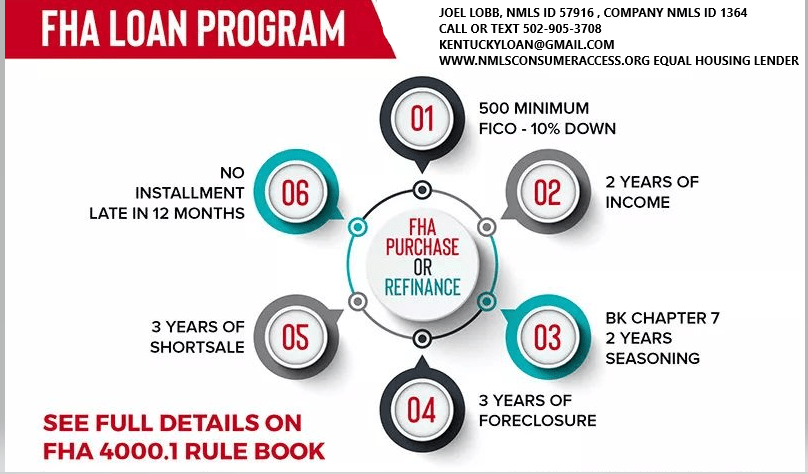
Borrowers must demonstrate a stable employment history covering the most recent two years. This does not require the same employer, but the work history must show consistency in the same industry or line of work.

Recent college graduates may satisfy the two-year work history requirement by providing college transcripts, provided the current employment aligns logically with the education received.

Self-employed borrowers must document a minimum two-year history of self-employment and provide the most recent two years of federal tax returns filed with the IRS. FHA underwriting uses a two-year average of qualifying income, adjusted for business stability and trends.

All income must be verifiable through acceptable documentation such as pay stubs, W-2s, or tax returns. Cash income, undocumented deposits, or bank-statement-only income is not permitted for FHA qualifying purposes.

Down Payment Requirements

FHA loans require a minimum down payment of 3.5 percent for borrowers with credit scores of 580 or higher.

Borrowers with credit scores between 500 and 579 are limited to a maximum loan-to-value of 90 percent, requiring a minimum 10 percent down payment. In practice, most lenders apply overlays requiring higher credit scores, typically between 580 and 620, even though HUD technically allows lower scores.

Down payment funds must come from an approved source. Acceptable sources include personal savings, retirement account loans or withdrawals, and properly documented gift funds. Large or undocumented cash deposits are not allowed and remain one of the most common reasons for FHA loan delays or denials in underwriting.

Occupancy and Property Use

FHA loans are for primary residences only. The borrower must occupy the property as their primary home and move in within 60 days of closing. FHA financing may not be used for rental properties or investment homes.

Appraisal and Property Standards

The property must be appraised by a Kentucky-licensed, FHA-approved appraiser. The home must meet HUD’s minimum property standards, meaning it must be safe, sound, and secure.

Common appraisal concerns include peeling paint, exposed wiring, missing handrails, roof condition, and health or safety hazards. Most FHA appraisal issues are correctable prior to closing.

Debt-to-Income Ratio Guidelines

FHA evaluates two debt ratios:

The housing ratio (front-end), which includes principal, interest, property taxes, homeowners insurance, mortgage insurance, and HOA dues, is typically capped at 31 percent of gross monthly income.

The total debt ratio (back-end), which includes the housing payment plus all other monthly obligations reported on credit, is typically capped at 43 percent.

However, borrowers receiving an “Approve/Eligible” finding through FHA’s automated underwriting system may qualify with higher ratios, depending on credit scores, cash reserves, and other compensating factors.

Credit Score and Credit History Requirements

The minimum FHA credit score for maximum financing remains 580 in 2026. This does not guarantee approval, as lenders apply additional underwriting standards and overlays.

Borrowers must demonstrate acceptable recent payment history. FHA places significant weight on the most recent 12 months of credit performance.

Bankruptcy and Foreclosure Guidelines

Chapter 7 bankruptcy requires a minimum waiting period of two years from discharge, with re-established good credit and on-time payments afterward.

Chapter 13 bankruptcy may be eligible after at least 12 months of on-time plan payments, with trustee approval, and the borrower must qualify including the Chapter 13 payment.

Foreclosure generally requires a three-year waiting period from the date of foreclosure completion. Exceptions may be considered only for documented extenuating circumstances beyond the borrower’s control. Job relocation alone does not qualify as an extenuating circumstance.

Federal Debt and CAIVRS Requirements

Borrowers may not have delinquent federal debt, defaulted federal student loans, unpaid federal judgments, or unresolved FHA claims.

Lenders are required to check the CAIVRS (Credit Alert Interactive Voice Response System) database for all federally backed loans, including FHA, VA, USDA, and SBA loans. Title 31 of the U.S. Code prohibits delinquent federal debtors from receiving federal loan insurance or guarantees.

If a CAIVRS alert appears, the debt must be resolved or paid in full before closing.

FHA Gift Fund Rules for Down Payments

FHA permits gift funds for down payments and closing costs, provided there is no expectation of repayment.

Acceptable gift sources include relatives, employers, labor unions, close friends with a documented relationship, charitable organizations, and government or public entities.

Unacceptable gift sources include the seller, real estate agents, brokers, builders, or any party with a financial interest in the transaction.

A proper gift letter is required, stating that repayment is not expected. The donor must provide identifying information and documentation showing the transfer of funds from their account to the borrower.

Government and Employer Assistance Programs

Borrowers without access to family gift funds may qualify for state, local, or employer-assisted housing programs that provide down payment or closing cost assistance. In Kentucky, FHA loans can often be paired with Kentucky Housing Corporation (KHC) down payment assistance programs, subject to income limits and program availability.

How FHA Loans Are Used in Kentucky

FHA does not directly lend money. Instead, it insures loans made by FHA-approved lenders. These loans are designed for borrowers with limited down payment funds, past credit challenges, or non-traditional credit profiles.

Many Kentucky borrowers who do not qualify for conventional financing are still able to achieve homeownership through FHA-insured loans at competitive interest rates.

Pros and Cons of FHA Loans

Advantages include low down payment requirements, flexible credit standards, and the ability to combine FHA loans with down payment assistance programs.

Disadvantages include mandatory mortgage insurance. FHA charges an upfront mortgage insurance premium of 1.75 percent of the loan amount, which can be financed, and an annual mortgage insurance premium that ranges from approximately 0.45 percent to 1.05 percent depending on loan term, loan-to-value, and origination date. This annual premium is paid monthly and, in most cases, remains for the life of the loan unless refinanced.

Final Thoughts for Kentucky Homebuyers in 2026

FHA loans continue to be a practical, reliable option for Kentucky homebuyers who need flexibility without sacrificing long-term stability. While FHA guidelines are forgiving compared to conventional loans, preparation matters. Clean documentation, stable income, responsible credit behavior, and proper sourcing of funds are essential to a smooth approval.

Working with an experienced Kentucky FHA lender can help you navigate overlays, improve credit positioning, and pair FHA financing with available assistance programs.


Joel Lobb
NMLS #57916
Text or Call 502-905-3708
kentuckyloan@gmail.com
www.mylouisvillekentuckymortgage.com

Company NMLS #1738461
Equal Housing Lender

Information is provided for educational purposes only and does not guarantee loan approval. All loans are subject to underwriting guidelines, program availability, and lender approval.


Qualifying for an FHA Loan in Kentucky

FHA loans are a popular choice for many first-time homebuyers in Kentucky. This is due to their flexible qualifying criteria. If you’re considering an FHA loan in the Bluegrass State, understanding the key qualifying factors is crucial. Here’s a comprehensive guide to the criteria you need to know:

  1. Credit Score Requirements:
    • FHA loans are known for accommodating borrowers with lower credit scores. The minimum required credit score can vary. Typically, a credit score of 580 or higher is needed to qualify for the minimum down payment of 3.5%. Borrowers with credit scores between 500 and 579 might still qualify. They will need a higher down payment, usually around 10%.
  2. Down Payment:
    • The minimum down payment for an FHA loan in Kentucky is 3.5% of the home’s purchase price. This is advantageous for buyers who may not have substantial savings for a larger down payment, making homeownership more accessible.
  3. Work History:
    • Lenders typically look for a steady 2 year employment history when considering FHA loan applications. A consistent work history is beneficial. It is preferable to have worked with the same employer or within the same field. This helps demonstrate financial stability and the ability to repay the loan.
  4. Debt-to-Income Ratio (DTI):
    • The debt-to-income ratio is a crucial factor in mortgage approval. For FHA loans, the maximum allowable DTI ratio is typically around 40% to 45% of your gross monthly income. It can go higher up to 56% with good credit scores, a large down payment, or a shorter-term loan. Lenders may also consider higher ratios in certain cases if compensating factors are present.
  5. Bankruptcy and Foreclosure:
    • FHA loans have lenient guidelines regarding bankruptcy and foreclosure. Generally, borrowers with a past bankruptcy may qualify for an FHA loan after two years. This is possible if they have re-established good credit and demonstrated responsible financial behavior. For foreclosures, the waiting period is usually three years.
  6. Mortgage Term:
    • FHA loans offer various mortgage term options, including 15-year, 20 year, 25 year and 30-year fixed-rate loans. The choice of term depends on your financial goals and ability to manage monthly payments.
    • Occupancy: Primary residences with 1-4 units. Not for investment properties or second homes.
    • Mortgage Insurance on the loan for life of loan. Larger down payments and shorter terms will reduce the upfront mi and monthly mi premiums
    • can be used for refinances, not only for purchases.
    • Max FHA loan in Kentucky for 2025 is Kentucky FHA Loan Limits by County
      $524,225 1 unit
      $671,200 2 unit
      $811,275 3 unit
      $1,008,300 4 unit– This changes every year
    • No income limits nor property restrictions on where home is located
    • Can close within 30 days typically with good appraisal and title work

FHA Loan Requirements in Kentucky for Credit scores, Down payment, Debt Ratio and work history below

RequirementDetails
Credit Score– 580+: Eligible for a 3.5% down payment.
– 500-579: Requires a 10% down payment.
Down PaymentMinimum of 3.5% for qualified buyers; 10% for lower credit scores below 580 to 500 score range
Debt-to-Income Ratio (DTI)– Ideal: 45% or lower on front end ratio or housing ratio.
– Acceptable: Up to 57% with compensating factors. There are two ratios. Front end and back end with front end being maxed at 45% and the backed end ratio being 56.99% with an AUS approval. If manually underwritten, see guidelines here
Employment HistoryMust provide at least **2 years of consistent employment—College transcripts can supplement with a less than 2 year work history

Key Benefits of FHA Loans in Kentucky

  1. Low Credit Score Requirements
    • FHA loans accept borrowers with credit scores as low as 500. However, a score of 580+ qualifies you for the lowest down payment option.
  2. Low Down Payment Options
    • You can purchase a home with as little as 3.5% down if you meet credit requirements, making FHA loans more accessible than conventional loans.
  3. Competitive Interest Rates
    • FHA loans typically offer rates comparable to conventional mortgages. They may even offer lower rates. This could save you money over the life of the loan.
  4. Flexible Loan Uses
    • With an FHA 203(k) loan, you can bundle home purchase and renovation costs into a single mortgage.
  5. Assumable Loans
    • FHA loans can be transferred to a new buyer. This feature is especially valuable if you sell your home when interest rates are higher.

Understanding these qualifying criteria can help you navigate the FHA loan application process in Kentucky more effectively. Working with an experienced mortgage professional can provide valuable guidance. They offer assistance tailored to your specific financial situation and homeownership goals.

Joel Lobb  Mortgage Loan Officer

Any questions, please don’t hesitate to reach out via, text, email,  or call.  Advice is always free. 
 
One of Kentucky’s highest rated mortgage loan officers for FHA, VA, USDA, Kentucky Housing KHC and conventional mortgage loans.  
1 – 📅 Email – kentuckyloan@gmail.com 
2.  📞 Call/Text – 502-905-3708
 

Joel Lobb
Mortgage Loan Officer – Expert on Kentucky Mortgage Loans


🌐 Websitewww.mylouisvillekentuckymortgage.com
🏢 Address911 Barret Ave., Louisville, KY 40204


Evo Mortgage
Company NMLS# 1738461
Personal NMLS# 57916

For assistance with Kentucky mortgage loans, reach out via email, call, or text Joel Lobb directly.

Kentucky Local Home Loan Lender Services

✅ First-Time Home Buyers Welcome
✅ FHA, Rural Housing (USDA), VA, and Kentucky Housing Corporation (KHC) Loans
✅ Conventional Loan Options Available
✅ Fast Local Decision-Making
✅ Experienced Guidance Through the Home Buying Process


NMLS 57916  | Company NMLS #173846
The view and opinions stated on this website belong solely to the authors, and are intended for informational purposes only. The posted information does not guarantee approvalnor does it comprise full underwriting guidelines. This does not represent being part of a government agency. The views expressed on this post are mine and do not necessarily reflect the view of my employer. Not all products or services mentioned on this site may fit all people.
(www.nmlsconsumeraccess.org).


Kentucky First Time Homebuyers FHA, VA, USDA & Rural Housing, KHC and Fannie Mae mortgage loans
 

Kentucky Housing Corp KHC New income limits and Purchase Price Limits for 2024 Kentucky Homebuyer’s

The income limitations listed below are imposed by federal law.

Failure to comply with them may create adverse consequences for Kentucky Housing Corporation and its bondholders.

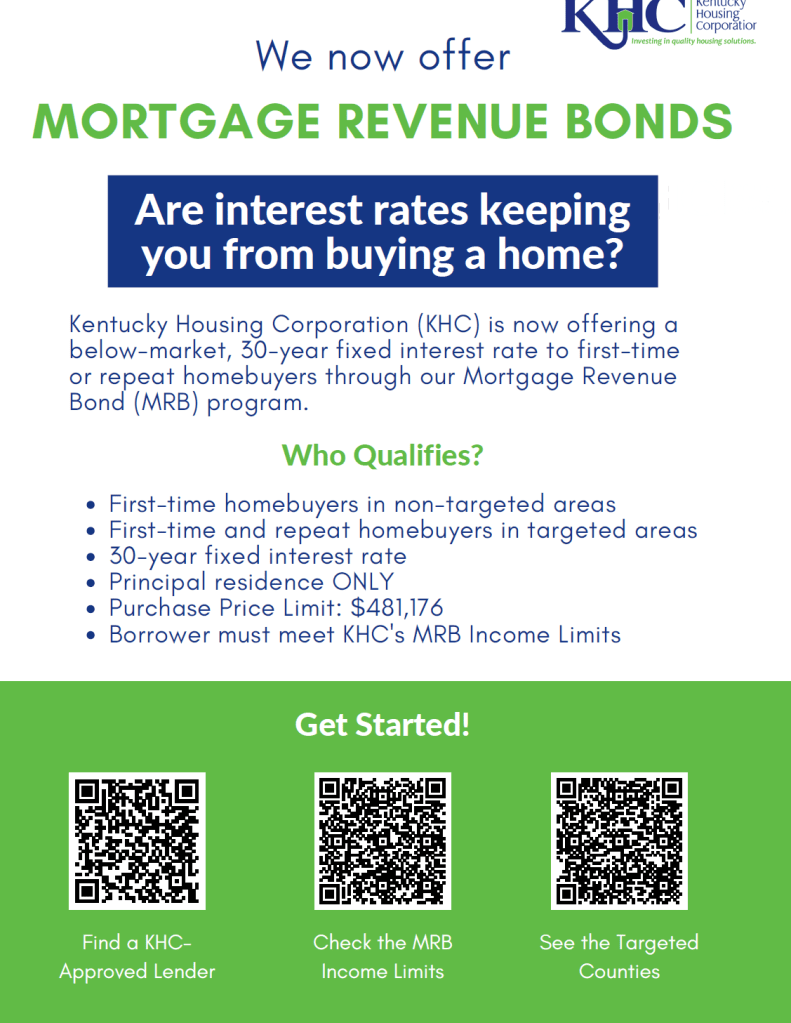
Funding Source: MRB (Purchase Price Limit – $510,939)

County

1-2

Person

3+

Person


County

1-2

Person

3+

Person


County

1-2

Person

3+

Person

Adair**

80,800

92,920

Grant

87,480

102,060

McLean

92,325

106,174

Allen

86,160

100,520

Graves

84,720

98,840

Meade

91,005

104,656

Anderson

91,345

105,047

Grayson

80,800

92,920

Menifee

96,960

113,120

Ballard

88,440

103,180

Green**

80,800

92,920

Mercer

92,105

105,921

Barren**

80,800

92,920

Greenup**

85,560

99,820

Metcalfe

96,960

113,120

Bath

96,960

113,120

Hancock

92,325

106,174

Monroe**

80,800

92,920

Bell

96,960

113,120

Hardin

93,245

107,232

Montgomery

85,920

100,240

Boone**

104,800

120,520

Harlan

96,960

113,120

Morgan

96,960

113,120

Bourbon

95,200

109,480

Harrison

93,120

107,324

Muhlenberg

86,400

100,800

Boyd**

85,560

99,820

Hart**

80,800

92,920

Nelson

91,605

105,346

Boyle

88,800

103,600

Henderson**

92,245

106,082

Nicholas

83,760

97,720

Bracken

104,800

120,520

Henry

96,400

110,860

Ohio

80,800

92,920

Breathitt

96,960

113,120

Hickman

87,480

102,060

Oldham

96,400

110,860

Breckinridge

84,360

98,420

Hopkins**

82,800

96,600

Owen

86,400

100,800

Bullitt

96,400

110,860

Jackson

96,960

113,120

Owsley

96,960

113,120

Butler

80,800

93,940

Jefferson**

96,400

110,860

Pendleton

104,800

120,520

Caldwell

80,800

93,660

Jessamine

95,200

109,480

Perry

96,960

113,120

Calloway**

90,720

105,840

Johnson

96,960

113,120

Pike

96,960

113,120

Campbell**

104,800

120,520

Kenton**

104,800

120,520

Powell

96,960

113,120

Carlisle

84,360

98,420

Knott

96,960

113,120

Pulaski**

80,800

92,920

Carroll

80,800

92,920

Knox

96,960

113,120

Robertson

96,960

113,120

Carter

96,960

113,120

Larue

93,245

107,232

Rockcastle

96,960

113,120

Casey

96,960

113,120

Laurel**

80,800

92,920

Rowan

96,960

113,120

Christian**

92,785

106,703

Lawrence

96,960

113,120

Russell

81,840

95,480

Clark**

95,200

109,480

Lee

96,960

113,120

Scott**

95,200

109,480

Clay

96,960

113,120

Leslie

96,960

113,120

Shelby

100,500

115,575

Clinton

96,960

113,120

Letcher

96,960

113,120

Simpson

87,000

101,500

Crittenden

92,040

107,380

Lewis

96,960

113,120

Spencer

96,400

110,860

Cumberland**

80,800

92,920

Lincoln**

80,800

92,920

Taylor

84,720

98,840

Daviess**

92,325

106,174

Livingston

86,040

100,380

Todd

84,720

98,840

Edmonson

91,765

105,530

Logan

88,800

103,600

Trigg

92,785

106,703

Elliott

96,960

113,120

Lyon

92,485

106,358

Trimble

93,005

106,956

Estill

96,960

113,120

Madison**

92,045

105,852

Union

84,360

98,420

Fayette**

95,200

109,480

Magoffin

96,960

113,120

Warren**

91,765

105,530

Fleming**

80,800

92,920

Marion

85,680

99,960

Washington

92,245

106,082

Floyd

96,960

113,120

Marshall

92,405

106,266

Wayne

96,960

113,120

Franklin

91,985

105,783

Martin

96,960

113,120

Webster

81,240

94,780

Fulton**

80,800

92,920

Mason**

82,560

96,320

Whitley

96,960

113,120

Gallatin

104,800

120,520

McCracken**

92,285

106,128

Wolfe

96,960

113,120

Garrard**

87,120

101,640

McCreary

96,960

113,120

Woodford

95,200

109,480

Counties in Green are Targeted

d Census Tracts


The income limitations listed below are imposed by federal law.

Failure to comply with them may create adverse consequences for Kentucky Housing Corporation and its bondholders

Funding Source: MRB (Purchase Price Limit – $510,939)

County

Census Tracts

1-2 Persons

3+ Persons

Adair

9703.00

96,960

113,120

Barren

9504.01, 9506.01

96,960

113,120

Boone

0703.01

125,760

146,720

Boyd

0302.00, 0303.00, 0308.00

96,960

113,120

Calloway

0103.03, 0104.00

96,960

113,120

Campbell

0501.00, 0506.00

125,760

146,720

Christian

2002.00, 2003.00, 2008.00, 2015.02

96,960

113,120

Clark

0201.06, 0202.01

114,240

133,280

Cumberland

9502.00

96,960

113,120

Daviess

0003.00

99,120

115,640

Fayette

0004.00, 0018.00, 0019.00, 0020.01

114,240

133,280

Fleming

9201.00, 9204.00

96,960

113,120

Fulton

9601.00

96,960

113,120

Garrard

9703.00

96,960

113,120

Green

9302.00, 9303.00

96,960

113,120

Greenup

0406.00

96,960

113,120

Hart

9703.02, 9704.00

96,960

113,120

Henderson

0203.00

99,600

116,200

Hopkins

9704.00, 9706.00

96,960

113,120


Jefferson

0002.01, 0004.00, 0006.00, 0009.00, 0014.00, 0018.00,

0023.00, 0024.01, 0027.00, 0030.00, 0035.02, 0038.00,

0041.00, 0043.01, 0043.02, 0050.00, 0059.01, 0059.02,

0065.00, 0110.07, 0127.01


115,680


134,960

Kenton

0651.00, 0671.00

125,760

146,720

Laurel

9701.00, 9702.01, 9702.02, 9703.00, 9705.00,

9709.00,9710.01 9710.03

96,960

113,120

Lincoln

9201.03, 9203.01, 9204.00

96,960

113,120

Madison

0102.02, 0103.02, 0103.03, 0104.00, 0105.00, 0112.01,

0112.02, 0113.01,

100,800

117,600

Mason

9602.02

96,960

113,120

McCracken

0301.00, 0302.00

99,360

115,920

Monroe

9302.00, 9304.00

96,960

113,120

Pulaski

9301.01, 9302.02, 9303.01, 9303.02, 9304.01, 9306.00,

9308.01, 9308.02, 9311.01, 9311.04,

96,960

113,120

Scott

0401.01

114,240

133,280

Warren

0102.00, 0103.00, 0108.04

102,480

119,560


Mortgage Revenue Bonds (MRB)

Joel Lobb  Mortgage Loan Officer

American Mortgage Solutions, Inc.
10602 Timberwood Circle
Louisville, KY 40223
Company NMLS ID #1364

Text/call: 502-905-3708

email: kentuckyloan@gmail.com


http://www.mylouisvillekentuckymortgage.com/


NMLS 57916  | Company NMLS #1364/MB73346135166/MBR1574

The view and opinions stated on this website belong solely to the authors, and are intended for informational purposes only. The posted information does not guarantee approval, nor does it comprise full underwriting guidelines. This does not represent being part of a government agency. The views expressed on this post are mine and do not necessarily reflect the view of my employer. Not all products or services mentioned on this site may fit all people.
NMLS ID# 57916, (www.nmlsconsumeraccess.org).

Kentucky Conventional Loan versus Kentucky FHA Loan comparison chart

Kentucky FHA Loans are good for borrowers who have the following:

• Credit scores less than 680.
• Less than 5% down payment and no reserves to use.
• Borrowers with past foreclosures between 3 and 7 years old.
• Borrowers with past short sales between 2 and 4 years old.
• Borrowers who need a gift for the down payment and/or closing costs, prepaid taxes and
insurance.
The FHA Mortgage Insurance premium is a premium that exists for the FHA Loan that is
paid up front and monthly by the homebuyer. This premium protects the lender should the
buyer default. They vary per state and per type of loan Kentucky home buyers qualify for. In Kentucky, upfront mortgage insurance premiums are 1.75%.
Below are the rates per type of loan:
• 15-Year Fixed with down payment more than 10%: .45%
• 15-Year Fixed with down payment less than 10%: .70%
• 30-Year Fixed with down payment more than 5%: .80%
• 30-Year Fixed with down payment less than 5%: .85%

Kentucky Conventional loans are usually reserved for the following:

• Credit scores greater than 680
• Greater than or equal to  5% down payment with reserves
• Borrowers with past foreclosures over 7 years old.
• Borrowers with past short sales between 5-7 years old.
• Borrowers who have a lot of money saved up and want to get rid of mortgage insurance within the first 5 years give or take. 20% equity position is needed for no mi

Advertisement

The biggest difference between conventional loans and FHA loans comes down to the mortgage insurance.  Mortgage insurance is more expensive for FHA loans, but the trade off is a lower fixed rate than conventional loans.

On Conventional loans there is no upfront mortgage insurance like FHA, and if you have a high credit score you can possibly get a lower monthly mi premium as compared to FHA where everybody gets the same mortgage insurance premium not matter your credit score or down payment.

Lastly, FHA Mortgage insurance is for life of loan, whereas Conventional mortgage insurance or pmi it’s called, is discontinued once you reach the 80% threshold equity position of your home loan.

Again, I would not get too caught in FHA having mortgage insurance for life of loan, because most loans are only kept open a minimum of 5-7 years so a lot of times it may make sense to go with the lower rate and pay the mortgage insurance with FHA because most people don’t hold their mortgage for 30 years.

You can call or text me with your questions and we can compare the differences based on your credit score, down payment and income.

Equal Housing Lender.  NMLS#:57916 http://www.nmlsconsumeraccess.org/Rates, terms, and program information are subject to change without notice. Subject to certain approvals, terms and conditions. This is not a commitment to lend.

Not part of any government lending agency and only lending in the State of Kentucky.

Looking at FHA loans vs Conventional loans can arm you with a lot of valuable information as these are the 2 most popular mortgage loan products today. Before getting to the content let’s look at some abbreviations that will need to be defined.

  • PMI stands for Private Mortgage Insurance
  • MIP stands for Mortgage Insurance Premium
  • Credit Scores are a numerical measure of your credit worthiness, the maximum score is 850
  • Debt-to-Income Ratio measures your monthly income versus your monthly obligations. A good rule of thumb is to try to be below 45%

FHA Loans vs Conventional Loans

Conventional Mortgage Benefits

  • 20% down payment preferred to avoid PMI
  • No upfront PMI
  • 3% Down Payment Conventional Loan Option is available
  • PMI expires once principal balance is less than 78%
  • Houses do not have to be owner-occupied (so they can be used at rentals)
  • Can purchase any condominium and townhome (no FHA regulations)

Conventional Mortgage Disadvantages

  • Significant upfront investment (20% down preferred)
  • Credit score of 620 required
  • No Down Payment Assistance
  • Down Payment must be at least 5% unless you qualify for a 3% conventional mortgage
  • Harder to Qualify for a Conventional Mortgage
  • No government inspection so the home can be in any quality
  • Only a portion of a down payment can be a gift
  • Interest rates are higher than FHA loans

Most of the disadvantages of conventional mortgages stem around qualifications and resources needed upfront. If a borrower has significant resources most of these disadvantages are of little consequence.

Advertisement

Conventional loan rates today

FHA Loan Advantages

The major advantage to going with an FHA loan is that there are much more lax credit standards you have to meet to obtain financing. Usually, FHA mortgages require a lower down payment, can work with lower credit scores, less elapsed time is needed if you have some credit problems (charge-offs, foreclosures) and you can use a non-occupant co-borrower or co-signer (who is a relative) to help you qualify for the loan. That way you can use blended ratios. Blended ratios are debt-to-income ratios that equally blend or combine the primary borrower’s income and the non-occupant co-borrower’s income and monthly payments to help get approval for the loan. Except for HomeReady (formerly Fannie Mae HomePath) mortgages, conventional loans do not allow you to use a non-occupant co-borrower.

  • Government-backed program. Ideal for first-time home buyers
  • Easier to obtain, lower credit scores needed and lower minimum down payment
  • Down Payment minimum is 3.5%
  • All of down payment can be a gift
  • Down Payment Assistance Available (in some circumstances)
  • No reserves required
  • Minimum credit score is 500 (for 3.5% down payment)
  • edition to be approved for FHA so there are less potential upfront repairs needed
  • Lower interest rates than conventional mortgages

FHA Loan Disadvantages

  • FHA loans require the owners to live in the home
  • Mortgage Insurance Premium required if borrowers put down less than 10%
  • Private Mortgage Insurance monthly cost is higher for FHA loans
  • Government Licensed Inspector required to inspect home before sale can be approved
  • Condominiums require FHA approval
  • FHA Loans take longer to process because of government requirements and all mandated repairs have to be completed before sales can be finalized

Most of these disadvantages involve extra requirements or limits added to the process of the house (see Pros and Cons of FHA Loans). Some of these might not be disadvantages depending on one’s personal situation, but they are extra steps to note. Since FHA mortgages are a government program, more care and consideration goes into the process, which may be better in some situations.

 FHA loans vs Conventional loans

There are four important numbers in deciding which loan you will go with: credit scores, down payment amount, debt-to-income, and mortgage insurance percentage rate. Conventional mortgages and FHA home loans have different limits and rates which are important to examine. They also have important differences which affect the availability of properties, the condition of the properties one wishes to buy and how your down payment can be paid. So comparing FHA loans vs Conventional loans can sometimes be a tricky endeavor.

Down Payment Requirements

  • Conventional Mortgages require between 5 and 20% upfront
    • In certain circumstances, down payments can be as low as 3% (Conventional 97 loan program)
  • FHA Mortgages have 2 possibilities
    • If Credit Score is 500-579 then 10% down payment is required (not all lenders will even go down this low)
    • If Credit Score is 580+ then 3.5% down payment is required

Debt-to-Income Ratio

  • Conventional Mortgages’ maximum debt-to-income ratio is 43% (hard cap)
  • FHA Mortgages’ maximum debt-to-income ratio is 45%
    • Soft cap as in certain circumstances this can be adjusted up to 50%

Mortgage Insurance Premium Rates

  • FHA Mortgages
    • If Down Payment is 10% or more the percentage is .80% MIP
    • If Down Payment is less than 10% the rate is .85% MIP.

Credit Score Minimum Requirement

  • Conventional Mortgage minimum credit score
    • Most lenders will require between 620 and 640
    • Some lenders it will be as high as 700
  • FHA Mortgage minimum credit score
    • Credit Score is a minimum of 500 if putting 10% down
    • Credit Score is a minimum of 580 if not

These four numbers are important to know and will affect one’s decision to pursue a particular type of home loan. Knowing your combination of numbers as you are looking to buy a house will help buyers find the best loans for their particular situation.

OTHER COMPARISONS

  • All sellers will take conventional mortgages and some sellers will not take FHA Loans
    • People looking for short-sells won’t take FHA because FHA has a longer closing process.
    • If sellers know there are FHA repairs that are needed in order to sell their house, they will not always accept FHA financing.

Thus, if one is wanting a low-risk transaction then the FHA home loan route is a better option to pursue, even though it limits your options for homes that you might wish to buy. If one is looking to fix-up a house and raise its equity quickly then a conventional loan is going to be more beneficial because there are no requirements as to the condition of the house and it’s occupied status.

DOWN PAYMENT GIFTING

  • Making the Down Payments (Assistance and Gifts)
    • Conventional mortgages have no assistance but can be partially fulfilled with a gift
    • FHA Mortgages have loans and assistance programs available and the whole down payment can be fulfilled with a gift

In this article, we have given you the basic parameters of FHA loans vs Conventional loans. The conventional loans are for people who have a better financial track record and can handle a larger upfront cost. Because of PMI, conventional loans are cheaper in the long run if you can put enough of a down payment to get rid of PMI. However, there are no down payment assistance programs to help you reach that goal. FHA loans are for people who are looking to build their investment and in some cases may not have a great financial track record. FHA loans have lower down payment requirements and many grants/forgivable loans to help people wanting to buy a first house in which to live for at least a few years. It is important to assess your situation and decide which mortgage is going to work better for your circumstances.

CONCLUSION

Both mortgages have a lot of benefits and drawbacks because they are designed for people with different needs. This article has hopefully helped you to get a basic understanding of the different terms and conditions of different mortgage packages when looking at FHA loans vs Conventional loans. Home buying can be an emotional roller coaster and the knowledge in this article will help you navigate the various emotional struggles of home buying.

Advertisements
REPORT THIS AD

louisville-kentucky-fha-mortgage-loan-guide-1-638

What income is acceptable for FHA, VA, USDA and Fannie Mae Mortgage Loan Approval in Kentucky?

How to qualify for a Kentucky mortgage

The type of mortgage you’re applying for determines the minimum requirements you’ll have to meet for your down payment, credit score, and debt-to-income ratio.

Find out what type of loan you might qualify for or what aspects of your finances you’ll need to improve to get a better shot at qualifying for a mortgage.

Loan Type Min. Down Payment Min. Credit Score Max DTI Property Type
Conventional 3% 620 45% Primary, secondary, investment
VA 0% none none Primary
FHA 3.5% 500 50% Primary
USDA 0% none 41% Primary

Keep in mind: The minimum down payment, minimum credit score, and maximum DTI shown in the table apply to mortgages used to purchase a primary residence. While you can use a conventional loan or a jumbo loan to purchase a home for another purpose, you might need a larger down payment, a higher credit score, more cash reserves, or all three.

Credit score needed to buy a house

Mortgage lending is risky, and lenders want a way to quantify that risk. They use your three-digit credit score to gauge the risk of loaning you money since your credit score helps predict your likelihood of paying back a loan on time. Lenders also consider other data, such as your income, employment, debts and assets to decide whether to offer you a loan.

Different lenders and loan types have different borrower requirements, loan terms and minimum credit scores. Here are the requirements for some of the most common types of mortgages.

Conventional loan

Minimum credit score: 620

A conventional loan is a mortgage that isn’t backed by a federal agency. Most mortgage lenders offer conventional loans, and many lenders sell these loans to Fannie Mae or Freddie Mac — two government-sponsored enterprises. Conventional loans can have either fixed or adjustable rates, and terms ranging from 10 to 30 years.

You can get a conventional loan with a down payment as low as 3% of the home’s purchase price, so this type of loan makes sense if you don’t have enough for a traditional down payment. However, if your down payment is less than 20%, you’re required to pay for private mortgage insurance (PMI), which is an insurance policy designed to protect the lender if you stop making payments. You can ask your servicer to cancel PMI once the principal balance of your mortgage falls below 80% of the original value of your home.

FHA loan

Minimum credit score (10% down): 500

Minimum credit score (3.5% down): 580

FHA loans are backed by the Federal Housing Administration (FHA), a part of the U.S. Department of Housing and Urban Development (HUD). The FHA incentivizes lenders to make mortgage loans available to borrowers who might not otherwise qualify by guaranteeing the federal government will repay the mortgage if the borrower stops making payments. This makes an FHA loan a good option if you have a lower credit score.

FHA loans come in 15- or 30-year terms with fixed interest rates. Unlike conventional mortgages, which only require PMI for borrowers with less than 20% down, all FHA borrowers must pay an up-front mortgage insurance premium (MIP) and an annual MIP, as long as the loan is outstanding.

VA loan

Minimum credit score: N/A

VA loans are mortgages backed by the U.S. Department of Veterans Affairs (VA). The VA guarantees loans made by VA-approved lenders to qualifying veterans or service members of the U.S. armed forces, or their spouses. This type of loan is a great option for veterans and their spouses, especially if they don’t have the best credit and don’t have enough for a down payment.

VA loans are fixed-rate mortgages with 10-, 15-, 20- or 30-year terms.

Most VA loans don’t require a down payment or monthly mortgage insurance premiums. However, they do require a one-time VA funding fee, that ranges from 1.4% to 3.6% of the loan amount.

USDA loan

Minimum credit score: N/A

The U.S. Department of Agriculture guarantees loans for borrowers interested in buying homes in certain rural areas. USDA loans don’t require a minimum down payment, but you have to meet the USDA’s income eligibility limits, which vary by location.

All USDA mortgages have fixed interest rates and 30-year repayment terms.

USDA-approved lenders must pay an up-front guarantee fee of up to 3.5% of the purchase price to the USDA. That fee can be passed on to borrowers and financed into the home loan. If the home you want to buy is within an eligible rural area (defined by the USDA) and you meet the other requirements, this could be a great loan option for you.

What else do mortgage lenders consider?

Your credit score isn’t the only factor lenders consider when reviewing your loan application. Here are some of the other factors lenders use when deciding whether to give you a mortgage.

  • Debt-to-income ratio — Your debt-to-income (DTI) ratio is the amount of debt payments you make each month (including your mortgage payments) relative to your gross monthly income. For example, if your mortgage payments, car loan and credit card payments add up to $1,800 per month and you have a $6,000 monthly income, your debt-to-income ratio would be $1,800/$6,000, or 30%. Most conventional mortgages require a DTI ratio no greater than 36%. However, you may be approved with a DTI up to 45% if you meet other requirements.
  • Employment history — When you apply for a mortgage, lenders will ask for proof of employment — typically two years’ worth of W-2s and tax returns, as well as your two most recent pay stubs. Lenders prefer to work with people who have stable employment and consistent income.
  • Down payment — Putting money down to buy a home gives you immediate equity in the home and helps to ensure the lender recoups their loss if you stop making payments and they need to foreclose on the home. Most loans — other than VA and USDA loans — require a down payment of at least 3%, although a higher down payment could help you qualify for a lower interest rate or make up for other less-than-ideal aspects of your mortgage application.
  • The home’s value and condition — Lenders want to ensure the home collateralizing the loan is in good condition and worth what you’re paying for it. Typically, they’ll require an appraisal to determine the home’s value and may also require a home inspection to ensure there aren’t any unknown issues with the property.

Kentucky Mortgage Broker Offering FHA, VA, USDA, Conventional, and KHC Down Payment Assistance Home Loans's avatarLouisville Kentucky Mortgage Loans

View original post

Down Payment Assistance

$6000 Down for Your Dream Home with Down Payment Assistance

An exciting new program is making it easier for you to get your dream home faster and with more money in your pocket. Geared toward homebuyers who may need help coming up with down payment or closing costs, the Mortgage Down Payment Assistance Program (DPA) can turn you into a homebuyer today!

You do not need to be a first time homebuyer

Down payment assistance programs normally require you to be a first time homebuyer; however, this new program does not have this requirement. There are also various first mortgage options this program can be tied to, including FHA and USDA loans.

KHC recognizes that down payments, closing costs, and prepaids are stumbling blocks for many potential home buyers. Here are several loan programs to help. Your KHC-approved lender can help you apply for the program that meets your need.

Regular DAP

  • Purchase price up to $346,644 with Secondary Market.
  • Assistance in the form of a loan up to $6,000 in $100 increments.
  • Repayable over a ten-year term at 5.50 percent.
  • Available to all KHC first-mortgage loan recipients.

Affordable DAP

  • Purchase price up to $346,644 with Secondary Market.
  • Assistance up to $6,000.
  • Repayable over a ten-year term at 1.00 percent.
  • Borrowers must meet Affordable DAP income limits.
 
On Mon, Jan 10, 2022 at 1:26 PM Joel Lobb, Mortgage Loan Officer <kentuckyloan@gmail.com> wrote:

Secondary Market Interest Rates — 45 Day Lock

Loan Type
Rate without Down
Payment Assistance
Rate with Down
Payment Assistance
FHA, VA & RHS 3.25% 4.00%
     
HFA Preferred Plus 80 3.75% 4.00%
 

Joel Lobb
Mortgage Loan Officer
Individual NMLS ID #57916
 
American Mortgage Solutions, Inc.
 

Text/call:      502-905-3708

fax:            502-327-9119
email:
          kentuckyloan@gmail.com
 

Kentucky FHA Loans in the State of Kentucky for 2022

Advantages of Kentucky FHA Mortgage Loans

  • You can often make a down payment as low as 3.5 percent down to a 580 credit score
  • You can finance a home with a 500 credit score with 10% down payment.
  •  Kentucky FHA loans are assumable meaning that if you have a good rate on your current mortgage and the potential buyer of your home meets FHA guidelines, then he can assume your low rate mortgage
  • Kentucky FHA loans offer streamline refinancing without credit score minimums, verification of income, and no appraisals to refinance to a lower rate making it easier to qualify.
  • Kentucky FHA loans offer flexible terms when it comes to previous bankruptcy or foreclosures. 2 years removed from Chapter 7 with reestablished
  •  credit, or if a Chapter 13, one year in the payment plan is eligible for FHA financing.
  • Foreclosures on a past home. FHA will finance a home 3 years removed from the sale date of your foreclosure property
  • 30 year fixed rate mortgage with usually the best going rates on government insured loans like FHA, VA, USDA etc.
  • No prepayment penalty on Kentucky FHA loans.
  • Higher debt to income ratio requirements when compared to Conventional loans because most Fannie Mae Conventional loans cannot have a higher debt to income ratio than 45% on the back-end
  • You can make an FHA loan anywhere in the state of Kentucky with no geographical restrictions.
  • Will allow for down payment assistance and grants for borrowers minimum down payments in the State of Kentucky through the likes of KHC, Welcome Home Grant, and Kentucky Housing Down Payment Second Mortgage loans.
  • Kentucky FHA loans allow for unoccupied cosigner. For example, lets say you have a daughter that is getting ready to graduate college and does not have the income or credit history established yet to buy a home. FHA allows a family-member to co-sign for them to buy a home and you don’t have to occupy as primary residence. Note, FHA co-singers are not allowed to makeup for some that has bad credit, because they will take the lowest credit scores of both applicants. FHA usually allows for co-singers lack of income purposes only.
  • Can usually close within 30 days just like a regular conventional mortgage. No extra time to close an FHA loan in Kentucky versus other secondary market loans like VA, USDA, Fannie Mae.
  • You can use the FHA loan over and over. You can actually have two FHA loans open at the same time, but it gets tricky on this. Call or text me with more info if you have an FHA loan currently and would like to use FHA Financing again.
  • FHA loans aren’t just for first time home buyers in Kentucky.


Disadvantages of Kentucky FHA Mortgage Loans

  • There are loan limits in the State of Kentucky on FHA Mortgage loans. The maximum FHA loan in the state of Kentucky is $$420,680 for 2022.  So if you were needing to finance a loan over this amount, you would need to look at doing a Conventional loan with the updated 2021 Kentucky State Loan Limits for a Fannie Mae loan being $647,250
  • If buying a condo in Kentucky, FHA requires the condo development be FHA approved. There is a >>>list here of Kentucky FHA approved condos here.
  • Seller must have own the home for 90 days before you can make an offer on the home. This comes into play where the seller bought the home as an investor and rehabbed the property and wants to sell for a quick profit. FHA mandates seller must maintain for 90 days before you can write up an offer on it. Also called FHA Flipping Policy. Read more here  
  • There is mortgage insurance. This is one of the biggest disadvantages for FHA loans. But as I tell most people, nobody rarely has a loan for 30 years, so if it meets your payment and your cash to close requirement, I tell people to go with it because it can be refinanced down the road and you are getting one of the lowers 30 year fixed rates out there. Both upfront and monthly mortgage insurance premiums you have to pay HUD/FHA. These premiums change whenever FHA/HUD replenish their insurance pool to pay claims from defaults, but currently the FHA upfront mortgage insurance premium is 1.75% and monthly is .85% and .80% of the loan amount. If you happen do a 15 year term or shorter, the mortgage insurance is cheaper monthly with .45 and .70 respectively  each month. The upfront mortgage insurance is the same for a 30 year and 15 year at 1.75%
  • FHA Mortgage insurance can be on the loan for life of loan. This is a recent change made in 2016 when FHA lowered there premiums for upfront and monthly mi premiums, but made the mortgage insurance for life of loan for some FHA loans. 
  • If you put down more than 10% on the loan, or have at least 10% equity in the home for a refinance, you only have to pay mortgage insurance for 11 years before it automatically falls off.
  • Obviously you can refinance out of an FHA loan at anytime, since it does not a prepayment penalty, and you can potentially get a refund of your upfront mortgage insurance if paid off within 3 years on sliding scale.
  • I have incorporated some charts below to illustrate the different Kentucky FHA Mortgage Insurance premiums to explain it better.
  • The upfront mortgage insurance is usually financed into the loan, so it will look like you are borrowing more than the standard 3.5% down payment because this is financed into the loan. Some borrowers elect to pay it out of pocket upfront, but I have never seen this done in my 20 years of doing FHA loans in the State of Kentucky
  • Kentucky FHA Loans Greater Than 15 Years MIP Chart
  • 👇
    Base Loan Amt. LTV Annual MIP
    ≤$625,500 ≤95.00% 80 bps (0.80%)
    ≤$625,500 >95.00% 85 bps (0.85%)
    >$625,500 ≤95.00% 100 bps (1.00%)
    >$625,500 >95.00% 105 bps (1.05%)

    Kentucky FHA Loans Less Than or Equal to 15 Years MIP Chart👇

    Base Loan Amt. LTV Annual MIP
    ≤$625,500 ≤90.00% 45 bps (0.45%)
    ≤$625,500 >90.00% 70 bps (0.70%)
    >$625,500 ≤78.00% 45 bps (0.45%)
    >$625,500 78.01% – 90.00% 70 bps (0.70%)
    >$625,500 >90.00% 95 bps (0.95%)

    When can I get the FHA mortgage insurance off my Mortgage Loan? See chart below 👇👇

Image result for fha cancellation of mortgage insurance chart kentucky

  • Appraisals. On an FHA appraisal, the FHA appraiser has to turn on the utilities to make sure they are in worked order when he gets there. This is different that Conventional loan appraisals. A lot of realtors or buyers think that FHA loans are harder due to appraisals, but honestly, they’re really not. FHA puts these minimum HUD standards in place to make sure the home is in good working order and SAFE to live in. I.e.is there any lead based paint or chipping paint that could lead to poisoning  It is all about Safety with FHA and HUD on these appraisals. The value is determined just like a regular Conventional, USDA, VA appraisals whereas they compare the house to 3 recent homes sold in the area to get a value.
  • Some lenders don’t offer FHA loans due to their complexity and sale on the secondary market, so if you call a local lender in Kentucky and they don’t offer FHA loans, the reason is usually they don’t have the team in place to do them or don’t want to do them due to lack of experience on the secondary government market.
  • Government Liens. FHA will not be an option for you usually if you have unpaid federal tax liens, delinquency  on federal backed-government loans, or a claim with social security etc. FHA loans are ran through aCAVIRS alert system to check to see if you are delinquent on any federal oblation. If so, this swill stop you until you can clear the CAVIRS alert system. For example, I did a loan for a buyer that had a delinquent federal debt with his student loan that happened over 14 years old. It was off the credit report and title search, so I had to switch to a conventional loan to make the home loan work.
  • FHA loans are not good for second homes or investment properties. FHA loans are mainly for single family residence 1-4 unit, that are going to occupied primarily as main home.

In summary, FHA loans have few drawbacks other than the mortgage insurance in my opinion. It is a great first time home buyer program or borrowers with past credit problems to get into a house of their own with very little out of pocket, at a low 30 year fixed rate, and no prepayment penalty

Questions about qualifying for a FHA loan in Kentucky . Give me text, call or email below. Love to help you out on your next home or refinance in Kentucky

Read more below about specific FHA Loans in Kentucky.👇👇👇
Joel Lobb (NMLS#57916)
Senior  Loan Officer
American Mortgage Solutions, Inc.
10602 Timberwood Circle Suite 3
Louisville, KY 40223
Company ID #1364 | MB73346


Text/call 502-905-3708

kentuckyloan@gmail.com

If you are an individual with disabilities who needs accommodation, or you are having difficulty using our website to apply for a loan, please contact us at 502-905-3708.

Disclaimer: No statement on this site is a commitment to make a loan. Loans are subject to borrower qualifications, including income, property evaluation, sufficient equity in the home to meet Loan-to-Value requirements, and final credit approval. Approvals are subject to underwriting guidelines, interest rates, and program guidelines and are subject to change without notice based on applicant’s eligibility and market conditions. Refinancing an existing loan may result in total finance charges being higher over the life of a loan. Reduction in payments may reflect a longer loan term. Terms of any loan may be subject to payment of points and fees by the applicant  Equal Opportunity Lender. NMLS#57916http://www.nmlsconsumeraccess.org/

— Some products and services may not be available in all states. Credit and collateral are subject to approval. Terms and conditions apply. This is not a commitment to lend. Programs, rates, terms and conditions are subject to change without notice. The content in this marketing advertisement has not been approved, reviewed, sponsored or endorsed by any department or government agency. Rates are subject to change and are subject to borrower(s) qualification.

Louisville Kentucky Mortgage Broker Offering FHA, VA, USDA, Conventional, and KHC Zero Down Payment Home Loans | October 17, 2018 at 3:54 pm | Tags: fha gift fundsfha loan kentuckyFHA Loans Kentucky Housing First time home buyerfha mortgagefha mortgage loangift funds for fha mortgagekentucky fha loans |

Kentucky FHA Mortgage Insurance Requirements and Down Payments

FHA mortgage insurance, typically referred to as MIP, is the one closing cost that is unique to FHA mortgage programs. 

**Every FHA mortgage must have mortgage insurance regardless

of the amount of the down payment.**


There are two types of mortgage insurance for FHA insured loans – Up-front Mortgage Insurance Premiums and Monthly Mortgage Insurance Premiums.

Up-front Mortgage Insurance Premium (UFMIP)


UFMIP is calculated at 1.75% of the base loan amount on all loans, regardless of the down payment amount.  This insurance protects the lender against losses in the event that the borrower defaults on the loan. 

**The entire amount of the UFMIP can be financed into the loan amount!**


For example:

  • If the FHA loan amount is $100,000 (base loan amount)
  • The mortgage insurance premium would be $1,750 ($100,000 x 1.75%)
  • The mortgage amount including MIP would be $101,750 ($100,000 + $1,750)

What really happens during an FHA mortgage transaction is that the borrower owes FHA a lump sum mortgage insurance premium.  The lender making the FHA loan will actually lend the money for the premium to the borrower and send the money to FHA so that the mortgage will be insured. 

Monthly Mortgage Insurance Premium


In addition to the UFMIP, there may be a monthly premium due as well.  The monthly premium is .80% of the base loan amount if the loan amount is less than or equal to 95% of the value of the home.  If the loan amount is over 95% of the value of the home, the monthly premium is .85% of the base loan amount..


On a 30 year fixed loan, the monthly payment would be calculated as follows:


$100,000 x .80% = $800 / 12 months = $66.67 per month

FHA Minimum Down Payment

Effective January 1, 2009, the minimum down payment required on an FHA loan is 3.5% of the purchase price. 


Any deposit (usually called earnest money) that you are required to give to your realtor at the time of an accepted purchase contract will count towards your 3.5% down payment. The appraisal fee collected at the time of inspection will also count towards your 3.5% down payment. 

 
If, for example, you are purchasing a $100,000 house, your minimum down payment required would be $3,500.  If your seller/realtor required you to put down $500 in earnest money on top of the $300 for your appraisal, your down payment would be lowered to $2,700 ($3,500 – $500 – $300 = $2,700). 


Down Payment As A Gift


If a borrower does not have 3.5% of his or her own money to put down towards the home purchase, FHA allows that amount to be in the form of a gift to the borrower. The gift must be from a qualified source, such as a family member, employer or significant other. The source of the gift must be able to provide proof that they have the money in an account registered in their name prior to transfer to the borrower.


In some areas, this gift may also be grant money from a state or local municipality, if such funds are available.

Louisville Kentucky Mortgage Rates for First Time Home Buyers


Do I qualify as a Kentucky first-time home buyer?

You are typically considered eligible to apply for first-time home buyer loans and benefits if you haven’t owned your principal residence within the past three years.

Some first-time home buyer assistance programs are even more lenient, offering financial aid in specific areas targeted for redevelopment, even to repeat buyers.


Kentucky First-time home buyer benefits

Benefits can include low- or no-down-payment loans, grants or forgivable loans for closing costs and down payment assistance, as well as federal tax credits with the Kentucky Housing Agency or KHC


Is there an income limit to qualify as a first-time home buyer?

Income limits come into play when you are applying for local, state or federal government assistance. Some national mortgage programs, such as loans issued or backed by the U.S. Department of Agriculture, also have household income limits.

Some low-down-payment conventional loans do, too.

In these cases, your income may be benchmarked to local county limits for low- and moderate-income households.

Lenders, even those working with loan programs authorized by a state housing agency, will likely consider your debt-to-income ratio when determining if you qualify.


How to qualify for a first-time home buyer grant

Grants or forgivable loans that typically don’t require repayment are available to low- and moderate-income borrowers through state first-time home buyer programs. Approval standards vary by program and location but often include household income and home sale price limits.

How to qualify for down payment assistance

Just as for grants, down payment and closing cost assistance is often offered by local and state housing authorities. Again, qualifications vary. Look for income and home sale price caps here, too.

Don’t be surprised if a first-time home buyer class is required to qualify for a grant or down payment assistance. These classes are designed to help you navigate the homebuying process, and can be a good idea to take whether they’re mandatory or not.


What are the requirements to qualify for a first-time home buyer loan?

Qualifications required for approval of a loan vary by the type of mortgage — and even by the lender — but here are some general guidelines:

Kentucky Conventional loans:

For a 3% down payment, you’ll need at least a 620 FICO and a debt-to-income ratio below 50%. The higher your credit score or the lower your debt, the better your chances are for approval.

Kentucky FHA loans:

If you want a down payment as low as 3.5%, you’ll need a FICO score of 580 or higher. With 10% down, your required credit score may go as low as 500.

Kentucky VA loans:

Down payments aren’t generally required for a loan backed by the Department of Veterans Affairs. And while VA-backed loans don’t have a minimum FICO score as a part of their official requirements, many lenders look for a score of 620 or better.

KentukcyUSDA loans:

Another no-down-payment option, USDA-backed loans are typically issued for rural or suburban properties. Income limits apply. A FICO score of 640 or better is generally required, though exceptions with documentation can allow a lower score.

Lenders can add additional conditions, called “overlays,” to loan approval. This is another good reason to shop for more than one lender.


Joel Lobb
Mortgage Loan Officer
Individual NMLS ID #57916
 
American Mortgage Solutions, Inc.
 

Text/call:      502-905-3708

fax:            502-327-9119
email:
          kentuckyloan@gmail.com
 

Kentucky FHA Mortgage Qualifying Guidelines

Kentucky FHA Loans

The FHA is actually not the lender. They insure the loans that are issued by FHA-approved lenders. FHA loans are gear more toward borrower’s with less than 20% down payment and credit issues in the past.

Qualifying for a FHA Loan Mortgage In Kentucky

Credit Scores and Down Payment Percentages – Each year, the rules for qualifying for these loans changes. For 2020, applicants need a minimum credit score of 580 in order to get the low down payment, which is 3.5 percent.

For those whose credit score is less than 580, they will have to come up with 10 percent for their down payment. This does not guaranteed a mortgage loan approval if you have the certain credit scores, just a the minimum required.

Compensating Factors for FHA loan Approval

The credit score is just one part of the story. The FHA will also evaluate the borrower’s bankruptcies, foreclosures, prior payment history on other debts. They will also want information on difficulties that kept the borrower from making payments on other debts in the past.

Negative strikes against qualifying for the loan include not having any credit history or a bankruptcy.

Someone with a bankruptcy will have to wait for two or more years after their bankruptcy before applying for an FHA-insured loan.

If you have late payments on debt obligations, it is best to wait until you have had a full year of on-time payments before you apply for a FHA-insured loan.

If you have had a foreclosure in the past, you may still be able to get a FHA-insured loan three years after your foreclosure. The lender will be looking at the circumstances behind the foreclosure.

If you have had any civil judgement against you for money owed, collections actions or unpaid/unresolved federal debt, the FHA-approved lender will be required by the FHA to establish that all of these outstanding issues are resolved or paid before you can go through closing.

Watch out for student loans if they are delinquent because sometime this can cause a lien against you in the form of a CAVIRS Alert with HUD

As you can see, many types of borrowers who would not be eligible for a traditional mortgage, or who would face exorbitant interest rates, will be able to qualify for a FHA-insured loan at attractive interest rates.

Employment and Income for a Kentucky FHA Loan

You must have an employment history that is steady for the last two years. Does not have to be same employer.

Your income has to be verifiable in some way, whether that be through pay stubs, your income tax returns. No bank statements or cash deposits , or undocumented income can be used for income qualifying purposes.

Image result for Employment and Income for a Kentucky FHA Loan

Debt-to-Income Ratio Requirements –

Depending on the automated underwriting system from Desktop Originator, your Debt-to-income ratio is the percentage of your income before taxes that you spend on monthly debt.

Taking into account the proposed mortgage payment as well as the other debts, the FHA requires that these debts all total less than 43 percent of your pretax income in order to qualify for the loan.

If your debt load is too high, you will struggle to pay all of your bills and mortgage expenses and care for yourself and your family.

55488026_2283733755207645_6787062571322048512_n (1)

Property Requirements for a Kentucky FHA Loan

It must be the place where you intend to reside. You must move into the home within 60 days of closing the loan. The home cannot be an investment. There will be an inspection to ensure that the home is safe and habitable.

It is really not too hard to pass FHA loans and the appraisal process.

23444444

Pros of FHA Loans –

  • New homebuyers and those who have lower credit scores or who have other blemishes on their credit history will often qualify for FHA-insured loans.

  • Even though these borrowers are considered “subprime” to a traditional lender, they will receive attractive interest rates through the FHA-insured mortgage programs.

  • The down payments required from borrowers are lower than those required by traditional mortgage lenders.

  • These loans can be combined with other forms of public assistance for lower income or new borrowers so that the borrower will not need to come up with a down payment of any kind.

Cons of FHA Loans –

  • Since the FHA is not actually the lender, and you have to go through FHA-approved lenders, you may not qualify due to stricter standards that the lender has for the loan.

  • Because you are not paying 20 percent as a down payment, the FHA requires two mortgage insurance premiums to be paid. One is an upfront premium that is 1.75 percent of the loan amount. Lenders often will allow you to make that mortgage insurance premium a part of your loan. The second is an annual mortgage insurance premium that is .45 percent or 1.05 percent. This premium is paid monthly.

 FHA FINANCING

CREDIT REQUIREMENTS FOR KENTUCKY FHA FINANCING

What credit score do I need to qualify for a Kentucky FHA loan is one of the most common questions I hear from Kentucky homebuyers?

The short answer is you must have a minimum credit score of 500 to be eligible for an FHA loan in Kentucky.  Anything lower than 500 disqualifies you from consideration for an FHA loan.

There are two sets of credit score requirements for a Kentucky FHA Loan

One important thing to understand is that the Federal Housing Administration (FHA) does not lend money directly to home buyers. You will fill out an application with a regular lender just as you would if you were applying for any other type of mortgage. What the FHA does is ensure your loan to help protect the lender in case you default.

You will be required not only to meet the FHA guidelines to qualify for a loan but also meet any additional qualifications required by the lender. This means there are two sets of requirements you have to meet with your credit score.

1. The first set of requirements comes from the Department of Housing and Urban Development (HUD). HUD oversees the FHA and determines what a borrower’s minimum eligibility requirements will be to obtain an FHA loan.

2. The second set of requirements comes from the mortgage lender. The mortgage lender has the right to add its requirements to those mandated by HUD.

What HUD requires of borrowers to be eligible for an FHA loan

The HUD Handbook 4000.1 includes the official guidelines when it comes to the FHA mortgage insurance program.

It states that in 2020 the Kentucky FHA borrowers with credit scores of 580 or higher are eligible for a 96.5% loan with 3.5% down.

Borrowers with credit scores from 500 to 579 are eligible for a 90% loan with 10% down.

Individuals with credit scores below 500 are not eligible for the FHA program.

What lenders may require of borrowers to be eligible for an Kentucky FHA loan

Lenders have the right to add requirements over and above the minimum requirements of HUD. These additional requirements are called overlays. Your lender may or may not require them.

This is not something that should come as a surprise to you, however. Requiring a credit score of 580 to 620 is not unusual. In addition to your credit score, you must have a manageable debt level that lenders are comfortable with and enough income to repay your loan.

What credit score do I need to qualify for FHA loan?

Each month Ellie Mae, the software company processing more than ⅓ of America’s mortgage loans, publishes an insight report for mortgage trends and standards. One of the things they track is average credit scores. The following is their report for November 2019 which shows what percentage of successful borrowers fall into what credit score ranges.

500 – 549    2.14%
550 – 599    5.20%
600 – 649    23.01%
650 – 699    34.74%
700 – 749    21.88%
750 – 799    10.87%
800+     1.89%

These percentages show that the majority of borrowers who successfully qualify for FHA loans fall into the 600 to 799 range. While it is true that some successfully qualify in the low range of 500 to 599, you have a much better chance of being approved for a loan with good terms and a low down payment if you fall into the higher range.


For your free credit report and analysis call us today at 502-905-3708 or email us at kentuckyloan@gmail.com


Joel Lobb (NMLS#57916)
Senior  Loan Officer
 
American Mortgage Solutions, Inc.
10602 Timberwood Circle Suite 3
Louisville, KY 40223
 
Company ID #1364 | MB73346


Text/call 502-905-3708
kentuckyloan@gmail.com


If you are an individual with disabilities who needs accommodation, or you are having difficulty using our website to apply for a loan, please contact us at 502-905-3708.


Disclaimer: No statement on this site is a commitment to make a loan. Loans are subject to borrower qualifications, including income, property evaluation, sufficient equity in the home to meet Loan-to-Value requirements, and final credit approval. Approvals are subject to underwriting guidelines, interest rates, and program guidelines and are subject to change without notice based on applicant’s eligibility and market conditions. Refinancing an existing loan may result in total finance charges being higher over the life of a loan. Reduction in payments may reflect a longer loan term. Terms of any loan may be subject to payment of points and fees by the applicant  Equal Opportunity Lender. NMLS#57916http://www.nmlsconsumeraccess.org/


72875369_2600900606627287_6040534183682506752_n