
Top Mortgage Lenders in Kentucky | Joel Lobb

Best Mortgage Lenders in Kentucky with Joel Lobb

Are you a prospective homebuyer in Kentucky searching for the best mortgage lenders? Joel Lobb is a trusted mortgage broker. He has a proven track record of helping clients secure competitive mortgage rates. He also helps clients with financing options. With Joel Lobb by your side, you can access top-notch mortgage lenders in Kentucky. He will help you make your dream of homeownership a reality.

Joel Lobb has established strong relationships with a network of reputable mortgage lenders in Kentucky. These lenders offer a wide range of loan programs. These programs can suit your unique needs and financial goals. Whether you’re a first-time homebuyer, a seasoned investor, or looking to refinance your existing mortgage, Joel Lobb can connect you with the best mortgage lenders that offer:

  1. Competitive Interest Rates: Access mortgage loans with competitive interest rates. These rates can save you money over the life of your loan.
  2. Flexible Loan Programs: Choose from a variety of loan programs. These include FHA, VA, USDA, conventional, jumbo loans, and more. They are tailored to your specific requirements.
  3. Personalized Guidance: Receive personalized guidance and support throughout the mortgage process. This includes steps from pre-qualification to closing. These efforts ensure a smooth and stress-free experience.
  4. Quick and Efficient Approval: Benefit from efficient loan processing. Experience quick approval times, allowing you to close on your new home faster.
  5. Transparent and Honest Service: Experience transparent and honest communication throughout your mortgage journey. We provide full transparency on loan terms, fees, and requirements.

When you are looking for the best mortgage lenders in Kentucky, Joel Lobb stands out. He is a trusted advisor and advocate for his clients’ best interests. With Joel Lobb’s expertise and industry knowledge, you can navigate the complex world of mortgage lending with confidence. You can achieve your homeownership goals.

Contact Joel Lobb today. Learn more about the best mortgage lenders in Kentucky. Start your journey towards owning the perfect home for you and your family.

Joel Lobb  Mortgage Loan Officer

Text/call: 502-905-3708

email:
 kentuckyloan@gmail.com

http://www.mylouisvillekentuckymortgage.com/

📞 Call/Text: 502-905-3708
📧 Email: kentuckyloan@gmail.com
🌐 Website: www.mylouisvillekentuckymortgage.com
🏠 Address: 911 Barret Ave, Louisville, KY 40204
NMLS #57916 | Company NMLS #1738461
➡️Click here to apply for Free Info & Homebuyer Advice →
Kentucky Mortgage Loan Expert
FHA | VA | USDA | KHC Down Payment Assistance | Fannie Mae
Equal Housing Lender. This is not a commitment to lend. All loans are subject to credit approval and program requirements.


Kentucky USDA Loans | Rural Housing Loans Kentucky


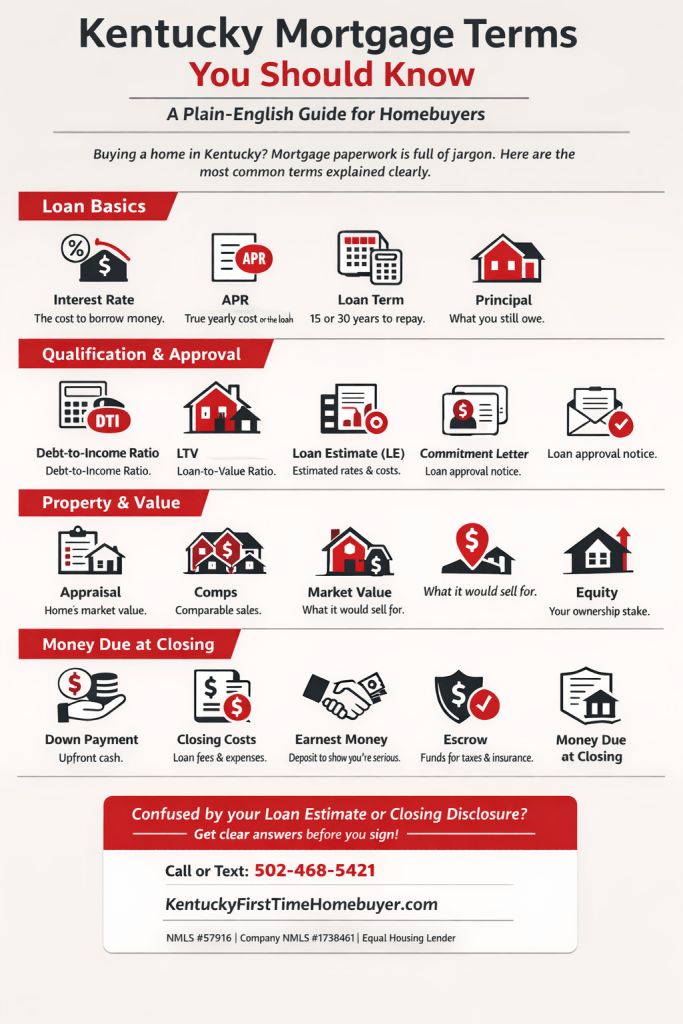
Essential Mortgage Terms Every Kentucky Homebuyer Should Know

Essential Mortgage Terms Every Kentucky Homebuyer Should Know

Buying a home in Kentucky can feel overwhelming when mortgage jargon starts flying.
This glossary breaks down common mortgage terms in plain English so you can make informed decisions.

Educational only. This information is not a commitment to lend. All loans are subject to credit approval and program guidelines.

Interest Rate

The percentage charged to borrow money for your mortgage loan.

APR (Annual Percentage Rate)

The true yearly cost of the loan, including interest and certain lender fees.

Loan Term

How long you have to repay the mortgage, commonly 15 or 30 years.

Debt-to-Income Ratio (DTI)

Your monthly debt divided by your gross monthly income. Lenders use this to determine affordability.

Down Payment

Money paid upfront toward the purchase of your Kentucky home.

Need Help Understanding Your Loan Paperwork?

I’m happy to review your Loan Estimate or Closing Disclosure and explain everything in plain English before you sign.

Call or Text: 502-905-3708
Website: KentuckyFirstTimeHomebuyer.com

NMLS #57916 | Company NMLS #1738461
Equal Housing Lender. This is not a commitment to lend.

Kentucky Mortgage Terms to Know (Plain-English Glossary)

If you’re buying a home in Kentucky, mortgage conversations can feel like a different language.
This page breaks down the most common mortgage terms, jargon, and vocabulary you’ll see in
loan paperwork, the Loan Estimate, and the Closing Disclosure.

Tip: When you see a word you don’t understand, copy it and use your browser search on this page:
Ctrl + F (Windows) or Cmd + F (Mac).

Educational only. This glossary explains common terms used in mortgage lending. It is not a loan
approval or a commitment to lend. Programs, rates, and guidelines can change.

Mortgage Glossary

Accrued Interest

Interest that has built up on a loan since the last payment date and hasn’t been paid yet.

Amortization

A repayment schedule that pays the loan down over time with monthly payments that include principal and interest.

Annual Percentage Rate (APR)

The annual cost of borrowing expressed as a percentage. APR includes the interest rate plus certain lender fees, points, and mortgage insurance when applicable.

Application Fee

A fee some lenders charge to cover initial processing costs for a mortgage application.

Appraisal

A written opinion of a home’s market value based on the property condition, location, and recent sales of similar homes.

Appraisal Fee

The cost paid for the appraiser to complete the appraisal report.

Borrower

The person(s) taking out the mortgage loan and agreeing to repay it.

Cap (Adjustable-Rate Mortgage)

A limit on how much an ARM interest rate can change during each adjustment period and/or over the life of the loan.

Certificate of Eligibility (COE)

A document confirming a veteran’s eligibility for a VA home loan benefit.

Certificate of Reasonable Value (CRV)

A VA-related appraisal determination used to support the value for a VA loan.

Closing (Settlement)

The day you sign final loan documents and the property ownership transfers to the buyer.

Closing Costs

Fees and prepaid items due at closing, such as lender fees, title fees, appraisal, recording fees, and prepaid taxes/insurance.

Closing Disclosure (CD)

A five-page form showing your final loan terms, monthly payment, and final closing costs. You typically receive it at least three business days before closing.

Commitment Letter

A lender document stating you’re approved subject to conditions (like appraisal, title, and final verification items).

Comparables (Comps)

Recently sold homes similar to the subject property that help determine market value.

Conventional Loan

A mortgage not insured or guaranteed by the government (not FHA, VA, or USDA).

Debt-to-Income Ratio (DTI)

Your total monthly debts divided by your gross monthly income (before taxes). DTI helps determine how much house you can qualify for.

Deed

The legal document that transfers property ownership from seller to buyer.

Department of Veterans Affairs (VA)

The federal agency that backs VA home loans for eligible service members and veterans.

Down Payment

Money paid upfront toward the purchase price. A larger down payment usually reduces the loan amount and can reduce mortgage insurance costs.

Earnest Money

A deposit made with the purchase contract to show the buyer is serious. It’s typically credited toward cash needed at closing.

Equal Credit Opportunity Act (ECOA)

A federal law that prohibits discrimination in lending based on protected characteristics.

Equity

The difference between the home’s current value and what you still owe on the mortgage.

Escrow

An account used to collect money monthly for property taxes and homeowners insurance, so those bills can be paid when due.

Hazard Insurance (Homeowners Insurance)

Insurance that protects your home against certain damages (like fire and storms) in exchange for a premium.

Homeowners Association (HOA)

An organization that manages shared community areas and enforces neighborhood rules. HOA dues may apply.

Interest Rate

The rate charged for borrowing the money. This is not the same as APR.

Loan Estimate (LE)

A three-page form that summarizes estimated loan terms, payments, and closing costs. It is typically provided within three business days after application.

Loan-to-Value (LTV)

The loan amount divided by the appraised value (or purchase price, depending on the loan). Lower LTV generally means lower lender risk.

Rate Lock (Lock-In Rate)

An agreement that holds an interest rate for a set time while the loan is processed (example: 30, 45, or 60 days).

Market Value

The price a home is likely to sell for in the current market based on supply, demand, and comparable sales.

Mortgage Insurance (MI)

Insurance that protects the lender if the borrower defaults. Often required when putting less than 20% down on conventional loans, and also common with FHA loans.

Origination Fee

A lender fee that covers certain administrative costs of underwriting and processing the mortgage.

Prepayment

Paying extra principal ahead of schedule to reduce interest costs and pay the mortgage off sooner.

Prepayment Penalty

A fee some loans charge if you pay off the mortgage early. Many modern mortgages do not have this, but it should always be checked.

Principal

The amount still owed on the loan balance (not including interest).

Realtor

A real estate professional who is a member of the National Association of Realtors.

Real Estate Settlement Procedures Act (RESPA)

A federal law requiring certain loan disclosures and protecting consumers from specific abusive settlement practices.

Second Mortgage

An additional loan secured by the home that is behind the first mortgage in lien priority.

Term

The length of the loan (commonly 15 or 30 years).

Title

Legal ownership rights to the property.

Title Insurance

Insurance that protects the lender and/or homeowner against certain losses related to title defects or ownership disputes.

Want help translating your Loan Estimate or Closing Disclosure?

If you’re buying a home in Kentucky and you want a clear explanation of your numbers (rate, APR, cash to close,
escrow, and closing costs), reach out and I’ll walk through it with you in plain English.

NMLS #57916 | Company NMLS #1738461 | Equal Housing Lender | http://www.nmlsconsumeraccess.org

Disclaimer: This website is not endorsed by the VA, FHA, USDA, HUD, or any government agency. It is an independent
educational resource created by a Kentucky mortgage professional. Content is for educational purposes only and does
not constitute a loan offer or guarantee of approval.

NMLS #57916 | Company NMLS #1738461 Free Info & Homebuyer Advice →

 explaining essential mortgage terms for homebuyers in Kentucky, including loan basics, qualification, property value, and money due at closing.

Kentucky Mortgage Broker Offering FHA, VA, USDA, Conventional, and KHC Down Payment Assistance Home Loans's avatarKentucky First-Time Home Buyer Programs | USDA, FHA, VA & KHC Loans

Glossary of Mortgage Terms to Know For A Kentucky Mortgage Loan.

ACCRUED INTEREST: Accumulated interest since the principal investment that has
not yet been paid.
AMORTIZATION: Paying off debt, principal and interest, with a fixed repayment schedule
in regular installments over a fixed period of time.
ANNUAL PERCENTAGE RATE (APR): The annual rate charged for borrowing money
expressed as a percentage. APR takes into account interest, discount points, lender fees
and mortgage insurance.
APPLICATION FEE: A fee charged by a lender to cover the initial costs of processing a
loan application.
APPRAISAL: A written estimate of a property’s current market value, based on the current
condition of the property and recent sales information from similar properties in the same
area.
APPRAISAL FEE: The cost to have a licensed, certified appraiser estimate the market value
of a property as of a specific date.
BORROWER: An individual who receives a loan from…

View original post 827 more words

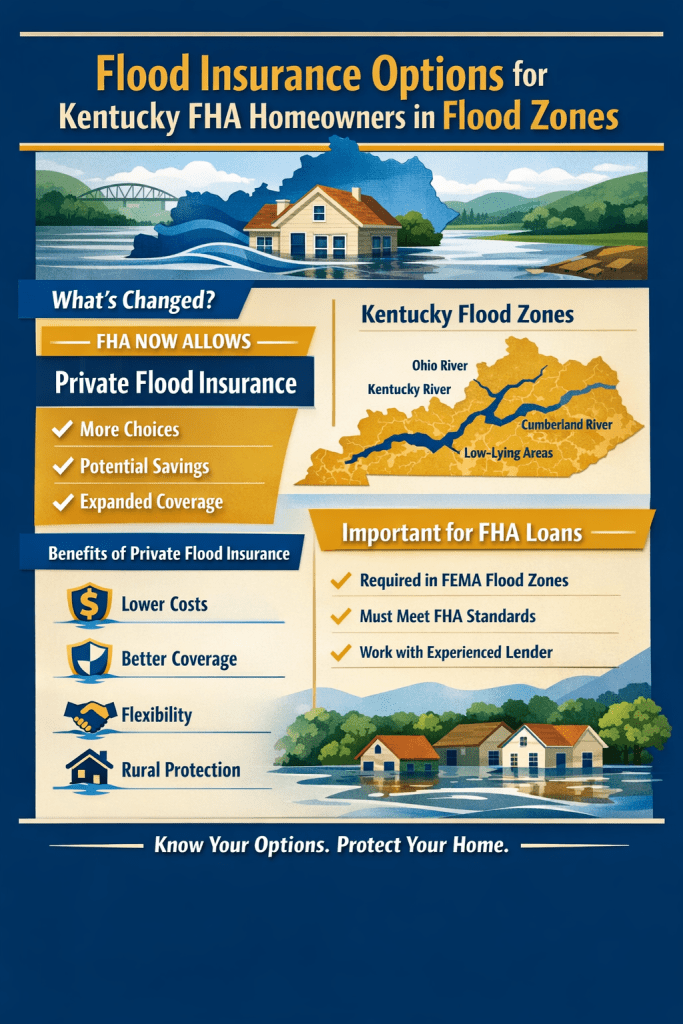
Kentucky FHA Mortgage Loans with Private Flood Insurance

HUD INCREASES FLOOD INSURANCE OPTIONS FOR KENTUCKY HOMEOWNERS WITH KENTUKY FHA MORTGAGES LIVING IN FLOOD AREAS

Federal Housing Administration to allow private flood insurance policies on insured single-family mortgages in special flood hazard areas

WASHINGTON – The U.S. Department of Housing and Urban Development (HUD), through the Federal Housing Administration (FHA), is announcing today that effective December 21, 2022, it will allow homeowners with FHA-insured mortgage financing to obtain flood insurance policies that conform to FHA requirements from private insurance providers. The change was announced through a final rule published in the Federal Register today and in a companion Mortgagee Letter, also published today, that provides implementation guidance for FHA-approved lenders.

FHA requires that insured mortgages for properties in Federal Emergency Management Agency (FEMA)-designated Special Flood Hazard Areas (SFHAs) have flood insurance. Previously, only flood insurance obtained through the National Flood Insurance Program (NFIP) was permissible for FHA-insured mortgages, which limited choices for consumers.

“Today, HUD is increasing the flood insurance choices available to individuals and families with FHA-insured loans in areas that FEMA has designated to be at special risk for flooding,” said HUD Secretary Marcia L. Fudge. “Flood insurance is required to ensure families and individuals are prepared if disaster strikes. Increasing consumer options for this important protection is one way we are building more resilient communities in the face of climate change.”

“We know borrowers face affordability challenges right now, yet a flood can be devastating to a family who is not properly insured,” said Federal Housing Commissioner Julia Gordon. “The choice to select a private flood insurance option may enable some borrowers to obtain policies that are less expensive or provide enhanced coverage.”

As part of its implementation, as of December 21, 2022, FHA will require lenders to provide detailed flood insurance coverage information when electronically submitting mortgages for FHA insurance on properties in SFHAs. This data collection is an objective included in HUD’s Climate Action Plan and will allow FHA to capture and analyze flood insurance information on mortgages in its portfolio at a more granular level than has been possible previously.

Ensuring that borrowers are protected against flood risk is a key component of HUD’s Climate Action Plan. In 2021, HUD released its Climate Action Plan in response to President Biden’s Executive Order on Tackling the Climate Crisis at Home and Abroad. HUD has been implementing this broad approach to the climate crisis that reduces climate pollution; increases resilience to the impacts of climate change; protects public health; delivers environmental justice; and spurs well-paying union jobs and economic growth. The action today further guides the integration of climate resilience and environmental justice into HUD’s core programs and policies. For more information about HUD’s work to advance sustainable communities and address climate change, visit hud.gov/climate.

#fha #fhaloans #fhaloan #floodinsurance #mortgage #homeloan #homebuying #homebuyingtips

First-time home buyers in Kentucky Joel Lobb

Joel Lobb specializes in a wide array of mortgage loans, including:
– **FHA Loans**: These loans are a great fit for buyers with lower credit scores or those who can afford only a minimal down payment.
– **VA Loans**: Tailored for veterans and active military members, offering favorable terms with little to no down payment.
– **USDA Loans**: Designed for rural home buyers, providing 100% financing options.
– **KHC Loans**: In collaboration with the Kentucky Housing Corporation, these loans come with down payment assistance, making them ideal for first-time buyers.

Complete Guide to FHA Loan Requirements in Kentucky

FHA loans are a popular choice for many first-time homebuyers in Kentucky. This is due to their flexible qualifying criteria. If you’re considering an FHA loan in the Bluegrass State, understanding the key qualifying factors is crucial. Here’s a comprehensive guide to the criteria you need to know:

  1. Credit Score Requirements:
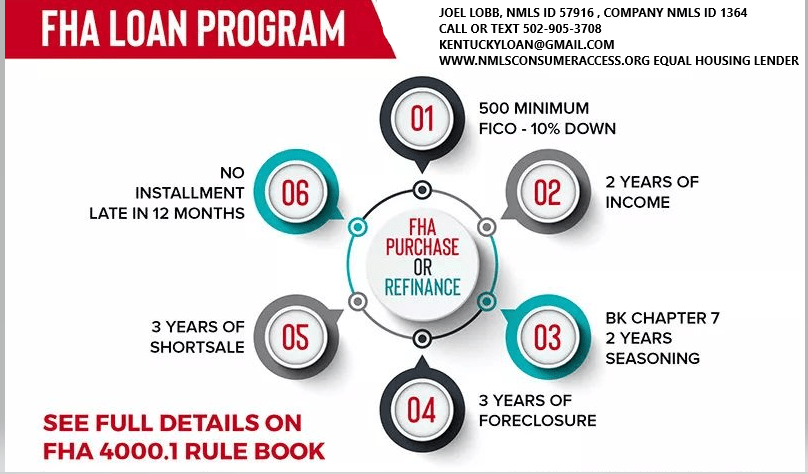
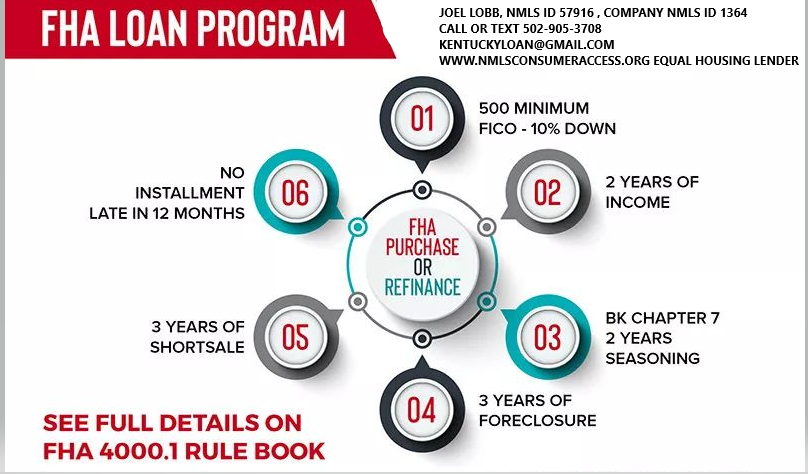
    • FHA loans are known for accommodating borrowers with lower credit scores. The minimum required credit score can vary. Typically, a credit score of 580 or higher is needed to qualify for the minimum down payment of 3.5%. Borrowers with credit scores between 500 and 579 might still qualify. They will need a higher down payment, usually around 10%.
  2. Down Payment:
    • The minimum down payment for an FHA loan in Kentucky is 3.5% of the home’s purchase price. This is advantageous for buyers who may not have substantial savings for a larger down payment, making homeownership more accessible.
  3. Work History:
    • Lenders typically look for a steady 2 year employment history when considering FHA loan applications. A consistent work history is beneficial. It is preferable to have worked with the same employer or within the same field. This helps demonstrate financial stability and the ability to repay the loan.
  4. Debt-to-Income Ratio (DTI):
    • The debt-to-income ratio is a crucial factor in mortgage approval. For FHA loans, the maximum allowable DTI ratio is typically around 40% to 45% of your gross monthly income. It can go higher up to 56% with good credit scores, a large down payment, or a shorter-term loan. Lenders may also consider higher ratios in certain cases if compensating factors are present.
  5. Bankruptcy and Foreclosure:
    • FHA loans have lenient guidelines regarding bankruptcy and foreclosure. Generally, borrowers with a past bankruptcy may qualify for an FHA loan after two years. This is possible if they have re-established good credit and demonstrated responsible financial behavior. For foreclosures, the waiting period is usually three years.
  6. Mortgage Term:
    • FHA loans offer various mortgage term options, including 15-year, 20 year, 25 year and 30-year fixed-rate loans. The choice of term depends on your financial goals and ability to manage monthly payments.
    • Occupancy: Primary residences with 1-4 units. Not for investment properties or second homes.
    • Mortgage Insurance on the loan for life of loan. Larger down payments and shorter terms will reduce the upfront mi and monthly mi premiums
    • can be used for refinances, not only for purchases.
    • No income limits nor property restrictions on where home is located
    • Can close within 30 days typically with good appraisal and title work

FHA Loan Requirements in Kentucky for Credit scores, Down payment, Debt Ratio and work history below

RequirementDetails
Credit Score– 580+: Eligible for a 3.5% down payment.
– 500-579: Requires a 10% down payment.
Down PaymentMinimum of 3.5% for qualified buyers; 10% for lower credit scores below 580 to 500 score range
Debt-to-Income Ratio (DTI)– Ideal: 45% or lower on front end ratio or housing ratio.
– Acceptable: Up to 57% with compensating factors. There are two ratios. Front end and back end with front end being maxed at 45% and the backed end ratio being 56.99% with an AUS approval. If manually underwritten, see guidelines here
Employment HistoryMust provide at least **2 years of consistent employment—College transcripts can supplement with a less than 2 year work history

Key Benefits of FHA Loans in Kentucky

  1. Low Credit Score Requirements
    • FHA loans accept borrowers with credit scores as low as 500. However, a score of 580+ qualifies you for the lowest down payment option.
  2. Low Down Payment Options
    • You can purchase a home with as little as 3.5% down if you meet credit requirements, making FHA loans more accessible than conventional loans.
  3. Competitive Interest Rates
    • FHA loans typically offer rates comparable to conventional mortgages. They may even offer lower rates. This could save you money over the life of the loan.
  4. Flexible Loan Uses
    • With an FHA 203(k) loan, you can bundle home purchase and renovation costs into a single mortgage.
  5. Assumable Loans
    • FHA loans can be transferred to a new buyer. This feature is especially valuable if you sell your home when interest rates are higher.

Understanding these qualifying criteria can help you navigate the FHA loan application process in Kentucky more effectively. Working with an experienced mortgage professional can provide valuable guidance. They offer assistance tailored to your specific financial situation and homeownership goals.

Joel Lobb  Mortgage Loan Officer

Any questions, please don’t hesitate to reach out via, text, email,  or call.  Advice is always free. 
 
One of Kentucky’s highest rated mortgage loan officers for FHA, VA, USDA, Kentucky Housing KHC and conventional mortgage loans.  
1 – 📅 Email – kentuckyloan@gmail.com 
2.  📞 Call/Text – 502-905-3708
 

Joel Lobb
Mortgage Loan Officer – Expert on Kentucky Mortgage Loans

🌐 Websitewww.mylouisvillekentuckymortgage.com
🏢 Address911 Barret Ave., Louisville, KY 40204


Evo Mortgage
Company NMLS# 1738461
Personal NMLS# 57916

For assistance with Kentucky mortgage loans, reach out via email, call, or text Joel Lobb directly.

Kentucky Local Home Loan Lender Services

✅ First-Time Home Buyers Welcome
✅ FHA, Rural Housing (USDA), VA, and Kentucky Housing Corporation (KHC) Loans
✅ Conventional Loan Options Available
✅ Fast Local Decision-Making
✅ Experienced Guidance Through the Home Buying Process


NMLS 57916  | Company NMLS #173846
The view and opinions stated on this website belong solely to the authors, and are intended for informational purposes only. The posted information does not guarantee approvalnor does it comprise full underwriting guidelines. This does not represent being part of a government agency. The views expressed on this post are mine and do not necessarily reflect the view of my employer. Not all products or services mentioned on this site may fit all people.
(www.nmlsconsumeraccess.org).
Kentucky First Time Homebuyers FHA, VA, USDA & Rural Housing, KHC and Fannie Mae mortgage loans
 

MINIMUM CREDIT SCORES REQUIRED FOR KENTUCKY FHA, VA, USDA MORTGAGE LOANS

  1. Kentucky FHA Loans: Kentucky FHA loans are known for their lenient credit score requirements, making them accessible to borrowers with lower credit scores. However, a minimum score of 500 to 580 is typically required, depending on the down payment.

  2. Kentucky VA Loans: VA loans offer flexible credit score requirements, while on paper VA states they don’t require a minimum score to insure the mortgage loan,  most lenders preferring a FICO score of 620 or higher. Veterans, active-duty service members, and eligible spouses can benefit from VA loan options.

  3. Kentucky USDA Loans: USDA loans are designed for rural homebuyers and require no minimum FICO score , but most lenders will want a credit score of 640 or higher. These loans offer zero down payment options for eligible properties.

  4. KHC Mortgage Loans: Kentucky Housing Corporation (KHC) mortgage loans may vary in credit score requirements depending on the lender. It’s essential to work with a knowledgeable mortgage broker like Joel Lobb to understand specific lender guidelines. KHC requires a minimum 620 credit score for FHA, VA, USDA and 660 for Conventional loan programs 


Text/call: 502-905-3708

email:
 kentuckyloan@gmail.com

http://www.mylouisvillekentuckymortgage.com/

Credit Score Requirements for Kentucky Home Buyers

What Credit Score Do You Need to Buy a House in Kentucky?

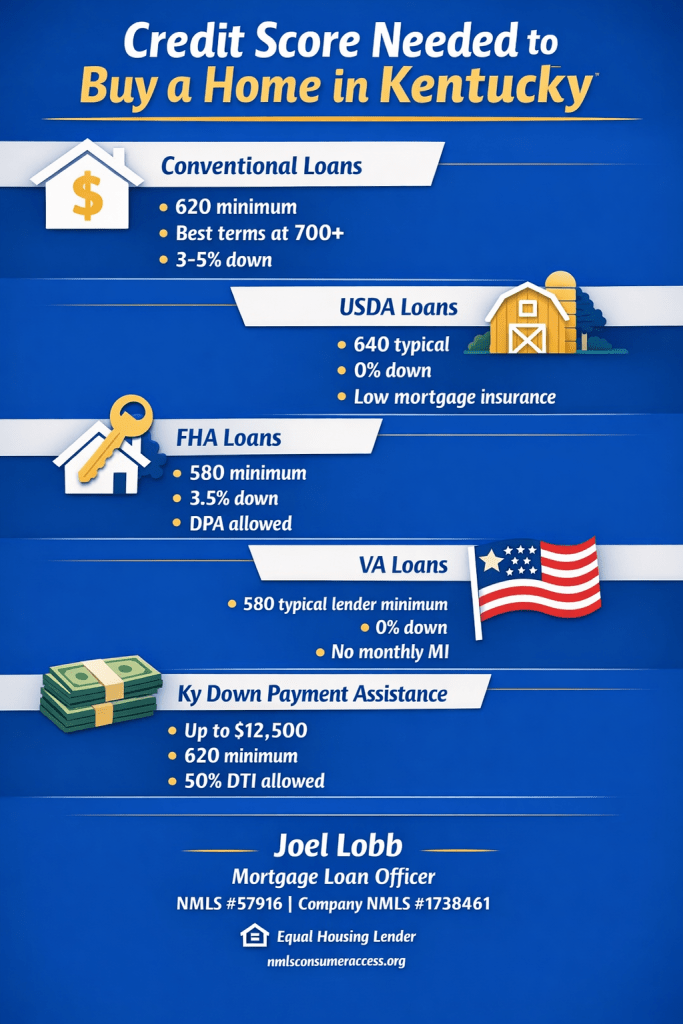
There is no single “magic number.” The credit score needed depends on the loan program (Conventional, USDA, FHA, VA, or Kentucky Housing Corporation down payment assistance). Here’s how it works in the real world for Kentucky buyers.

Credit Score Needed to Buy a Home in Kentucky infographic showing Conventional 620+, USDA 640 typical, FHA 580+, VA 580 typical lender minimum, and KY down payment assistance up to $12,500.
Quick guide: typical credit score ranges and key highlights by Kentucky mortgage program.

Conventional Loans in Kentucky

  • Minimum credit score generally starts at 620.
  • Most lenders prefer higher scores for 3%–5% down options.
  • Best pricing and easier approvals are typically with strong credit (often 700+).
  • Mortgage insurance (PMI) usually improves as scores increase.

USDA Rural Housing Loans in Kentucky

  • Many lenders target around 640 for automated approval through GUS (Guaranteed Underwriting System).
  • Manual underwriting may be possible when automated approval is not available.
  • 0% down payment required (eligible rural/suburban areas).
  • Typical fees include a 1% upfront guarantee fee and 0.35% annual fee (paid monthly).

USDA can be one of the best value options for Kentucky buyers with limited cash, provided the property is in an eligible area and the file meets income and underwriting requirements.

Kentucky FHA Loans

  • As low as 580 credit score with 3.5% down (typical baseline).
  • Gift funds, grants, and down payment assistance may be allowed.
  • Mortgage insurance is generally higher than USDA or VA, but rates can still be competitive.
  • Common waiting periods: 2 years after bankruptcy and 3 years after foreclosure (standard guideline).

Kentucky VA Loans

  • VA does not set a minimum credit score in its guidelines, but most lenders do.
  • Many VA lenders target around 580+ (lender overlay varies).
  • 0% down and no monthly mortgage insurance.
  • Clear CAIVRS is required (for federal delinquency screening).

Kentucky Down Payment Assistance (KHC)

  • Kentucky Housing Corporation (KHC) often offers up to $12,500 down payment assistance (program terms and funding can change).
  • Typically structured as a second mortgage paid back over 15 years.
  • Minimum credit score is commonly 620 across many KHC options; KHC conventional often requires 660.
  • Maximum debt-to-income ratios are commonly around 50/50 (program and investor rules apply).

Next step: get a clear pre-approval target

If you share your approximate credit score range, income type, and whether you’re looking in Louisville, Lexington, or rural Kentucky, I can point you to the most realistic program and the exact score threshold that will matter for approval.

Get Preapproved See $12,500 KHC Options


Joel Lobb, Mortgage Loan Officer

NMLS #57916 | Company NMLS #1738461

Equal Housing Lender | Verify at nmlsconsumeraccess.org

{ “@context”: “https://schema.org”, “@type”: “FAQPage”, “mainEntity”: [ { “@type”: “Question”, “name”: “What credit score do I need to buy a house in Kentucky?”, “acceptedAnswer”: { “@type”: “Answer”, “text”: “It depends on the loan program. Conventional financing often starts around 620, USDA lenders commonly target about 640 for automated approval, FHA can allow down to 580 with 3.5% down, and many VA lenders look for around 580 even though VA does not publish a minimum score. Kentucky Housing Corporation down payment assistance commonly requires around 620 (and KHC conventional often around 660). Final approval also depends on income, debt-to-income ratio, and underwriting findings.” } }, { “@type”: “Question”, “name”: “Can I buy a home in Kentucky with a 580 credit score?”, “acceptedAnswer”: { “@type”: “Answer”, “text”: “Often yes, depending on the full file. FHA commonly allows 580 with 3.5% down and can work well when you have limited savings or are using gift funds or down payment assistance. Lender overlays and underwriting results still apply.” } }, { “@type”: “Question”, “name”: “Is 640 a good credit score for a Kentucky mortgage?”, “acceptedAnswer”: { “@type”: “Answer”, “text”: “A 640 score can be workable for several programs. USDA lenders often target around 640 for automated approvals, and conventional approvals may be possible starting at 620, though terms improve as scores rise. Your debt-to-income ratio, income stability, and cash to close will strongly influence results.” } }, { “@type”: “Question”, “name”: “What credit score do I need for a USDA loan in Kentucky?”, “acceptedAnswer”: { “@type”: “Answer”, “text”: “Many lenders prefer around 640 to obtain an automated approval through the USDA Guaranteed Underwriting System (GUS). Manual underwriting may be possible in some cases, but it is typically more restrictive on ratios and documentation.” } }, { “@type”: “Question”, “name”: “Does the VA require a minimum credit score in Kentucky?”, “acceptedAnswer”: { “@type”: “Answer”, “text”: “VA guidelines do not publish a minimum credit score, but lenders usually do. Many VA lenders commonly target around 580 or higher, depending on the overall file and lender overlays.” } }, { “@type”: “Question”, “name”: “What credit score is needed for Kentucky Housing Corporation (KHC) down payment assistance?”, “acceptedAnswer”: { “@type”: “Answer”, “text”: “KHC program requirements vary, but a common minimum is around 620 for many options. KHC conventional commonly requires around 660. Eligibility also depends on income limits, purchase price limits, and underwriting findings.” } } ] }
What Credit Score Do You Need to Buy a House in Kentucky?

Kentucky FHA Loan Employment History Requirements

  • No matter what you must provide a 2 year employment history. Conventional or Kentucky FHA Mortgage Loan.  Conventional does not always need to be verified with a written work verification form
    • if you do not have a complete 2 year history you must explain any large gaps.  Typically I have seen this to be greater than 30 days.
    • you must have a 2 year history prior to the gap as well.  (two underwriters from two different lenders have recently told me the same thing)
    • also check your AUS-Automated Underwriting Findings  because that can help when speaking with your potential borrower.
    •  
  • Exception to the 2 year history is college or HS graduation
    • need official college transcripts or they can be unofficial if you get them with the web URL just like bank activity.
    • good idea to snag their diploma as well.
    •  
    • you probably don’t even need to use this exception if the person was a student but also worked and had a 2 year job history.
  •  Kentucky FHA Case Number Assignment
    • if there are any job gaps greater than 6 months in their two year history the borrower must be on their current job for at least 6 months before the FHA case number can be assigned.
    • again you must then get a 2 year employment history prior to the 6 month or more gap.  however far you must go back.
    •  
  •  
  • W2s / 1099s
    • even if you are not using the income to qualify from a part time job please get every single w2 / 1099 from your borrowers.  

fha pic

 
Kentucky FHA Mortgage Work History and Income Requirements.

1 –  Email – kentuckyloan@gmail.com 2.   Call/Text – 502-905-3708

Joel Lobb
Mortgage Loan Officer – Expert on Kentucky Mortgage Loans


🌐 Websitewww.mylouisvillekentuckymortgage.com
🏢 Address911 Barret Ave., Louisville, KY 40204


Evo Mortgage
Company NMLS# 1738461
Personal NMLS# 57916

For assistance with Kentucky mortgage loans, reach out via email, call, or text Joel Lobb directly.

Best Mortgage Options: Kentucky VA, FHA, USDA, and Fannie Mae

Comparing Kentucky VA loans to Kentucky USDA, FHA, and Fannie Mae loans in Kentucky

Kentucky VA loans Compared to Kentucky USDA, FHA, and Fannie Mae loans in Kentucky

When comparing Kentucky VA loans to Kentucky USDA, FHA, and Fannie Mae loans in Kentucky, several factors come into play. These factors include credit score requirements, income considerations, work history, and debt ratios. They also involve how each loan type treats bankruptcy and foreclosure. Let’s delve into the benefits and differences of each loan type:

Kentucky Mortgage Credit Score Requirements:

  • Kentucky VA Loan: VA loans typically have more flexible credit score requirements compared to conventional loans. While there’s no specific minimum score set by VA , most Kentucky VA lenders often look for a credit score of 620 or higher. I can do VA loans down to a 580 credit score.
  • Kentucky USDA Loan: USDA loans also offer flexibility, with no minimum score required per USDA guidelines, but most Kentucky USDA lenders will want a 640 score or higher. I Can do Kentucky USDA loans down to a 580 credit score on a manual underwrite.
  • Kentucky FHA Loan: FHA loans are known for accommodating borrowers with lower credit scores, often accepting scores as low as 500 with a 10% down payment or 580 with a 3.5% down payment.
  • Kentucky Fannie Mae Loan: Fannie Mae loans usually require a minimum credit score of 620 or higher, although some lenders may have slightly different requirements.

Kentucky Mortgage Income and Work History:

  • Kentucky VA Loan: VA loans consider your stable income and employment history but may be more lenient if you have a history of military service or steady employment. 2 years of employment needed for loan application-minimal job gaps
  • Kentucky USDA Loan: USDA loans often have income limits based on the area’s median income, and you need a stable income source. 2 years of employment needed for loan application-minimal job gaps
  • Kentucky FHA Loan: FHA loans consider your income stability and work history, with guidelines that vary by lender. 2 years of employment needed for loan application-minimal job gaps
  • Kentucky Fannie Mae Loan: Fannie Mae loans typically require a stable income and employment history, similar to conventional loans. 2 years of employment needed for loan application-minimal job gaps

Kentucky Mortgage Debt Ratio Requirements:

  • Kentucky VA Loan: VA loans generally have more lenient debt-to-income (DTI) ratio requirements, often allowing for a higher DTI compared to conventional loans. VA loans can get approved on much higher debt to income ratios vs FHA, USDA and Fannie Mae loans. 65% or higher in some situations but if manual underwrite, will want the ratios closer to 41% with good residual income for VA loan. VA loans are the only type of loans that require a residual income…FHA, Fannie Mae, USDA does not have residual income requirements
  • Kentucky USDA Loan: USDA loans have very strict DTI ratio limits, typically around 41% to 45% max on the backend ratio and 33% or less on the front end. By far the most restrictive on debt ratios vs FHA, VA, and Fannie Mae loans
  • Kentucky FHA Loan: FHA loans also have relatively flexible DTI ratio limits (56% back end ratio possible on a AUS approval), making them accessible to borrowers with moderate levels of debt. Front end ratio max 45%
  • Fannie Mae Loan: Fannie Mae loans follow standard DTI ratio guidelines similar to conventional loans. TYpically the second most restrictive on debt ratios right behind USDA loans on tighter debt to income ratio requirements, with the max back-end ratio no more than 50% –Front end ratio max 45%

Kentucky Mortgage Bankruptcy and Foreclosure Requirements:

  • Kentucky VA Loan: VA loans are more forgiving of past bankruptcy or foreclosure, often requiring a waiting period of 2 years for Chapter 7 bankruptcy and 1-2 years for foreclosure.
  • Kentucky USDA Loan: USDA loans have specific waiting periods after bankruptcy (3 years for Chapter 7) and foreclosure (3 years).
  • Kentucky FHA Loan: FHA loans have shorter waiting periods after bankruptcy (2 years for Chapter 7) and foreclosure (3 years).
  • Kentucky Fannie Mae Loan: Fannie Mae loans typically require longer waiting periods after bankruptcy (4-7 years) and foreclosure (7 years).

Advantages and Disadvantages of Kentucky VA loans, USDA, Fannie Mae and FHA:

  • Kentucky VA Loan Advantages: Zero down payment, competitive interest rates, no private mortgage insurance (PMI) requirement, lenient credit and DTI ratios, and flexible eligibility criteria for veterans and active-duty service members.
  • Kentucky VA Loan Disadvantages: Funding fee (although it can be rolled into the loan), limited to eligible veterans, service members, and some spouses.
  • Kentucky USDA Loan Advantages: Zero down payment, lower interest rates, flexible credit requirements, and available in eligible rural areas.
  • Kentucky USDA Loan Disadvantages: Limited to rural properties, income limits, and property eligibility criteria.
  • Kentucky FHA Loan Advantages: Low down payment (3.5%), flexible credit requirements, competitive interest rates, and accessible to first-time homebuyers.
  • Kentucky FHA Loan Disadvantages: Mortgage insurance premiums (MIP), stricter property standards, and limits on loan amounts.
  • Kentucky Fannie Mae Loan Advantages: Available for a wide range of properties, competitive interest rates, and options for low down payments.
  • Kentucky Fannie Mae Loan Disadvantages: Stricter credit and DTI requirements, potential for private mortgage insurance (PMI), and limited flexibility for borrowers with past financial challenges.

In summary, choosing the right loan type depends on your specific financial situation, eligibility criteria, and property location. VA loans offer excellent benefits for eligible veterans and service members, while USDA, FHA, and Fannie Mae loans provide alternatives with their own advantages and considerations.

Joel Lobb  Mortgage Loan Officer

Text/call: 502-905-3708
email: kentuckyloan@gmail.com

http://www.mylouisvillekentuckymortgage.com/

Kentucky FHA Manual Underwriting: A Complete Guide


KENTUCKY FHA MORTGAGE MANUAL UNDERWRITING GUIDELINES FOR VA RESIDUAL INCOME


Kentucky FHA Mortgage  Manual Undewriting Guidelines for FHA Mortgage Refer Eligible or Manual Downgrades


Continue reading “Kentucky FHA Manual Underwriting: A Complete Guide”

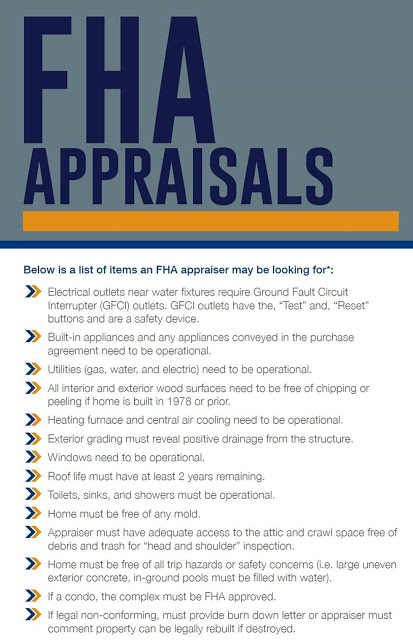
Kentucky FHA Appraisal Requirements For A Mortgage Loan Approval.

Kentucky FHA Appraisal Requirements For A Mortgage Loan Approval.

  • Ordered through a third party source. Interested/vested parties may not initiate the appraisal. I.E> buyers, sellers, realtors, loan officer, family members
  • Property must meet HUD’s minimum property standards. i.e.: permanent heat source, utilities must be on and in working order at time of inspection
  • Flips < 90 days – not allowed Per HUD -If current owner owned less than 90 days FHA will not insure. Sometimes a second appraisal will be required by FHA investor if sold within the last 6 months for a large profit. Receipts of work done may be needed to substantiate  increase in value of home in short-time period.
  • Transferred appraisal – ok
  • Appraisal valid 120 days – 30 day extension possible*
  • Property eligibility – No location restrictions.
  • New Construction Available

Kentucky FHA Appraisal Requirements For A Mortgage Loan Approval.

FHA MORTGAGE LOANS AND FLIPPING RULE FOR APPRAISALS
Resales Occurring 90 Days or Fewer after Acquisition:
 Not eligible for FHA financing
Resales occurring between 91 days and 180 Days after Acquisition:
 Obtain 2nd appraisal if resold between 91 to 180 days after acquisition
 Obtain 2nd appraisal if resale price is 100% or more over price paid by seller
 If 2nd appraisal is more than 5% lower than value of first appraisal, the lower value must be used
 Borrower not allowed to pay for 2nd appraisal
Exceptions to FHA Flipping Rules:
 Property purchased by an employer or relocation company due to relocation of an employee
 Resales by HUD – REO program
 Sales by other government agencies (i.e., IRS, court-ordered, DEA, etc.)
 Sales of non-profit agencies approved to purchase HUD properties
 Acquisition due to inheritance
 Sales of properties by federally chartered financial institutions
 Sales of properties by GSE’s
 Sales of properties by local or state governments
 Sales by builders selling a new home
 Sales of properties in federally declared disaster areas
NOTE: Mortgage Company must obtain a 12-month chain of title to document time restrictions above.
VA MORTGAGE AND FLIPPING RULE

 No Flipping Rules – Overlays may apply or at Underwriter’s discretion

 
USDA RURAL HOUSING MORTGAGE FLIPPING RULES
 Lender is responsible to ensure that any recently sold property’s value is strongly supported when a significant
increase between sale and purchase occurs.
 Lender must ensure that the appraisal value is supported with validated comps and protect the borrower from
predatory lending.

Fannie Mae Appraisal Flipping Rules
 No Flipping Rules – Lender overlays may apply
Freddie Mac
 No Flipping Rules – Lender overlays may apply

Applies to case numbers assigned on or after June 1, 2022

Updates the initial appraisal validity period from 120 days to 180 days from the effective date of the appraisal report;
Extends the appraisal update validity period from 240 days to one year from the effective date of the initial appraisal report;

Allows the appraisal update to be ordered AFTER an appraisal expires; and
Eliminates the optional 30-day extension.

✨This is big news for FHA ✨

The guideline change also puts FHA appraisal expirations on par with conventional loan expiration dates.

Kentucky FHA appraisals can take home buyers by surprise. That’s why we’ve put together some good-to-know info about the process. Feel free to use this to help educate your clients.

Joel Lobb
Senior  Loan Officer
(NMLS#57916)
text or call my phone: (502) 905-3708
email me at kentuckyloan@gmail.com
The view and opinions stated on this website belong solely to the authors, and are intended for informational purposes only. The posted information does not guarantee approval, nor does it comprise full underwriting guidelines. This does not represent being part of a government agency. The views expressed on this post are mine and do not necessarily reflect the view of my employer. Not all products or services mentioned on this site may fit all people. NMLS ID# 57916, (www.nmlsconsumeraccess.org). Mortgage loans only offered in Kentucky.
All loans and lines are subject to credit approval, verification, and collateral evaluation and are originated by lender. Products and interest rates are subject to change without notice.


http://www.emailmeform.com/builder/form/0bfJs9b6bK8TGoc6mQk9hIu