How to Qualify for FHA Loans in Kentucky: Key Guidelines

Kentucky FHA Loan Requirements 2026: Credit, Down Payment, Limits & Approval Guide | Joel Lobb
Updated for 2026

Kentucky FHA Loan Requirements 2026: Credit, Down Payment, Limits & Approval Guide

Everything Kentucky first-time homebuyers need to know — credit scores, down payment, debt-to-income, mortgage insurance, property rules, waiting periods, and the deal-killers many lenders do not explain upfront.

Get pre-approved in as little as 24 hours — even if your credit is not perfect.

3.5% Minimum Down Low down payment option
580 Minimum Score Credit-friendly program
43% Typical Max DTI Can go higher with AUS
1.75% Upfront MIP Usually financed
2 yrs Work History Same field is what matters
$0 Application Fee No upfront application cost

Trusted by 1,300+ Kentucky families • 20+ years experience • FHA, VA, USDA & KHC specialist

What Is an FHA Loan and Why Does It Matter in Kentucky?

An FHA loan is a mortgage insured by the Federal Housing Administration under HUD. The FHA does not lend money directly. Instead, it insures approved lenders against loss, which allows those lenders to offer more flexible approval guidelines than many conventional programs.

For Kentucky homebuyers, especially first-time buyers, FHA financing can be a practical path to homeownership because it may allow:

  • Lower minimum credit scores than many conventional loans
  • Down payment as low as 3.5%
  • Gift funds for down payment and closing costs
  • Higher debt-to-income ratios in many cases
  • A way to buy after bankruptcy or foreclosure once waiting periods are met

1. Income & Employment Requirements

Two-Year Work History Is the Baseline

FHA generally looks for a two-year employment history. That does not always mean two years with the same employer. The bigger issue is consistency in the same line of work and the ability to document stable income.

  • Two years of employment history is preferred
  • Job changes are usually fine if they are in the same field or a logical advancement
  • Recent graduates may be able to use education history to support the file
  • Self-employed borrowers generally need two years of tax returns
  • Part-time, overtime, bonus, and commission income usually need a history before counting
💡

Kentucky tip: A job change for more pay in the same field is usually not the problem. Unexplained gaps, inconsistent hours, and unstable earnings are what create underwriting friction.

2. Credit Score & Down Payment

FHA Credit Score Tiers

Credit Score Range Minimum Down Payment Real-World Status
620 and above 3.5% Most lender-friendly
580 to 619 3.5% Usually workable
500 to 579 10% Limited lender options
Below 500 Not eligible Not FHA eligible
⚠️

Lender overlays matter. FHA may allow lower scores, but many lenders set stricter internal minimums. That is why borrowers often hear one thing online and something very different when they actually apply.

3. Debt-to-Income Limits

Front-End and Back-End DTI

Debt-to-income ratio measures how much of your gross monthly income goes toward monthly debt obligations. FHA reviews both housing-only and total debt ratios.

DTI Type What It Includes Common Target
Front-End Mortgage payment, taxes, insurance, and FHA mortgage insurance About 31%
Back-End Housing payment plus all monthly debts on credit About 43%
💡

AUS flexibility: With a strong automated approval, debt ratios can often go above 43%. With manual underwriting, the file usually gets much tighter and compensating factors matter a lot more.

4. Acceptable Down Payment Sources

Funds Must Be Verified and Sourced

FHA is flexible about where funds come from, but not loose about documentation. Every dollar used for down payment and closing costs needs a clean paper trail.

Acceptable Sources

  • Personal checking or savings
  • Verified gift funds from family or eligible donors
  • Retirement account withdrawals or loans when documented
  • Sale of personal property with documentation
  • Approved down payment assistance programs

Common Problems

  • Cash deposits with no paper trail
  • Borrowed funds from unapproved sources
  • Undocumented transfers between accounts
  • Large deposits that cannot be explained
  • Gift funds without a gift letter and evidence of transfer
⚠️

Bottom line: The money itself is often not the issue. Documentation is the issue. If the money cannot be sourced, it can derail the approval even when the borrower otherwise qualifies.

5. Property Requirements

The Home Has to Meet FHA Standards

FHA is not just approving the borrower. It is also approving the collateral. The property must be safe, sound, and marketable.

  • The property must be owner-occupied as a primary residence
  • The appraisal must support value and FHA minimum property standards
  • Health and safety issues may need to be repaired before closing
  • Utilities generally need to be on for proper appraisal review
  • Manufactured homes have additional foundation and eligibility requirements
💡

Important: FHA financing can be used on single-family homes, many condos, certain multi-unit owner-occupied properties, and some manufactured homes, but every category has its own eligibility rules.

6. Bankruptcy & Foreclosure Waiting Periods

Waiting Periods Do Exist, but FHA Is More Forgiving Than Many Programs

Credit Event Typical FHA Waiting Period Notes
Chapter 7 Bankruptcy 2 years From discharge date in most cases
Chapter 13 Bankruptcy 12 months On-time trustee payments and court approval usually required
Foreclosure 3 years From completion date in most cases
Short Sale Varies May be sooner depending on how it reported and current credit profile

7. Federal Debt & the CAIVRS Check

CAIVRS Is the Federal Database Many Buyers Never Hear About

Before FHA approval, borrowers are checked through CAIVRS, the federal database that flags certain unresolved government-related defaults or claims.

  • Defaulted federally backed student loans
  • Prior FHA or other government-backed loan claims
  • Certain unresolved federal delinquencies or judgments
🚫

A CAIVRS hit can stop the deal cold. This is not something you finesse around. The underlying issue usually has to be resolved before the FHA loan can move forward.

8. FHA Mortgage Insurance Premium

Mortgage insurance is part of the FHA tradeoff. It is one reason FHA works for lower down payment and more flexible credit, but it also increases the payment.

Upfront MIP
1.75%
Usually financed into the loan amount
Annual MIP
0.45%–1.05%
Paid monthly as part of the mortgage payment

On a $200,000 FHA loan, the upfront mortgage insurance premium adds about $3,500 to the loan amount if financed. Monthly mortgage insurance varies, but it can make a meaningful difference in payment planning.

💡

Long-term strategy: Many FHA borrowers later refinance into a conventional loan once they build equity and improve credit, because FHA mortgage insurance does not work like conventional PMI in many cases.

The Top FHA Deal-Killers in Kentucky

After working through hundreds of FHA files, these are the issues that most often kill deals, delay closings, or force borrowers to regroup.

Credit overlays

The FHA guideline may say one thing, but the actual lender may require a higher score or cleaner profile.

Unsourced funds

Cash deposits, undocumented transfers, or gift money with no paper trail can stop the loan.

Appraisal issues

Safety, condition, value, or eligibility problems can delay or kill the transaction.

Federal debt problems

Defaulted student loans or other federal issues can cause a CAIVRS denial.

High debt ratios

If the automated system does not approve it, manual underwriting can get strict quickly.

Inconsistent income

Variable hours, weak earnings history, or recent instability can reduce qualifying income.

The Smart Long-Term FHA Strategy

FHA is often the best entry point, not always the best forever loan. For many Kentucky buyers, the real win is using FHA to get in the home now, then improving the credit profile and refinancing later when the numbers make sense.

1

Get pre-approved

Run the numbers honestly and determine what is actually workable today.

2

Use the right assistance

Layer in any available gift funds or down payment assistance that fits the file.

3

Buy with a plan

Get into the home, stabilize finances, build equity, and improve the credit profile.

4

Refinance later

Review conventional refinance options when rates, equity, and scores line up.

Frequently Asked Questions — Kentucky FHA Loans

Can I get an FHA loan with a 580 credit score in Kentucky?

Yes. FHA guidelines allow 580 with 3.5% down, but many lenders have overlays. Real-world approval depends on the full file, not just the score.

Is there down payment assistance available for Kentucky FHA loans?

Yes. Some Kentucky borrowers may qualify for Kentucky Housing Corporation down payment assistance, depending on income, credit, and program limits.

How long does FHA approval take in Kentucky?

A pre-approval can often be issued quickly with full documentation. From contract to closing, many FHA purchases land in the 30 to 45 day range, though every file is different.

Can I use an FHA loan to buy a duplex in Kentucky?

Yes, if you live in one unit as your primary residence and the property meets FHA rules. FHA is not for a pure non-owner-occupied investment purchase.

Does FHA mortgage insurance ever go away?

That depends on the loan structure, but many FHA borrowers eventually refinance into conventional financing once they have enough equity and improved credit.

What is the FHA loan limit for Kentucky in 2026?

Loan limits depend on property type and county rules in effect for the year. Always verify current limits for the specific property and loan structure before proceeding.

Ready to Apply for an FHA Loan in Kentucky?

Start your free mortgage review with Joel Lobb. Get straight answers on credit, income, down payment, and what you may qualify for now — without wasting time on the wrong program.

JL

Joel Lobb — Kentucky Mortgage Loan Officer

20+ years of experience | 1,300+ Kentucky families helped | FHA, VA, USDA, KHC & Conventional loans

NMLS #57916 Company NMLS #1738461 Licensed in Kentucky Equal Housing Lender

NMLS #57916 | Company NMLS #1738461 | Equal Housing Lender. This is not a commitment to lend. All loans are subject to credit approval and program requirements. This website is not affiliated with or endorsed by FHA, VA, USDA, KHC, or any government agency. Licensed in Kentucky only. NMLS Consumer Access

What are the Kentucky FHA Credit Score Requirements for Mortgage Loan Approvals?

The Best Kentucky Mortgage Loan Options When Looking for your first house in Kentucky Kentucky First-time Home Buyer Programs👀💯👇‼

Kentucky Mortgage Requirements for FHA, VA, USDA and Fannie Mae

FHA loan in Kentucky you will be confronted with minimum credit score requirements set forth by FHA and the lender. Even though FHA will insure the mortgage loan at a certain credit score, you will see that lenders will create  “credit-overlays” to protect their risk and ask for a higher credit score.

So keep in mind when you are getting an FHA  lenders will have higher credit score minimums in addition to the FHA Mortgage Insurance program.

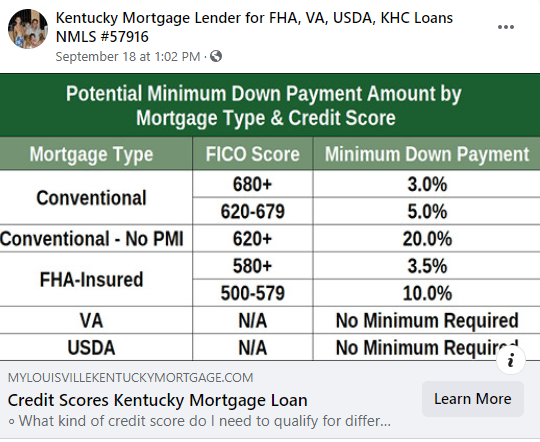
For a Kentucky Homebuyer wanting to purchase a home or refinance their existing FHA loan, FHA requires a 3.5% down payment and the borrower must have a 580 FICO Credit Score. If the score is below 580, then you would need 10% down and still qualify on a manual underwrite.

You must have a FICO score of at least 500 to be eligible for a Kentucky  FHA loan. If your FICO score is from 500 to 579, your down payment on the loan is 10 percent of the loan.

If your FICO score is 580 or higher, your down payment is only 3.5 percent. If your credit score is less than 580, it may be more cost-effective to take the necessary steps to improve your score before taking out the loan, rather than putting the money into a larger down payment.

How do they get the credit score:  There are three main credit bureaus in the US. Equifax, Experian, and Transunion. The three scores vary but should be relatively close as long as the same creditors are reporting to the same bureaus.

You will get a variation in the scores due to all creditors or collection companies don’t report to all three bureaus. This is why they take the mid score.  So if you have a 590 Experian, 680 Equifax, and 620 TransUnion, your qualifying credit score would be 620

Based on my experience with lenders that I deal with in Kentucky on FHA loans,  most lenders require 620 middle credit score for consideration for loan approval.

How do they get the score:  They take the mid score, so if you have a 590 Experian, 680 Equifax, and 620 TransUnion, your qualifying score would be 620.

Kentucky FHA Loans with less than 620 Score

If your score is below 620, a manual underwrite is where the AUS (Automated Underwriting System) refers your loan to a human being, and they look at the entire file to see if they can overturn and approve the mortgage loan because the Desktop Underwriting Automated Software could not approve you.

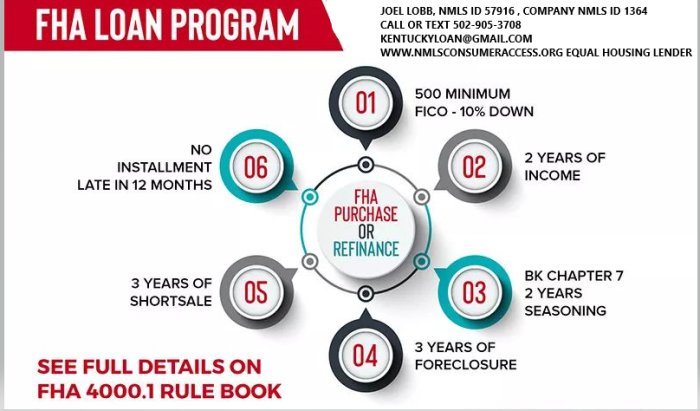
With scores below 620, they typically will want to verify your rent history, have no bankruptcies in the last two years, and no foreclosures in the last 3 years.

If you have had any lates since the bankruptcy this will probably result in a denial on a refer manual underwrite file.

Your max house payment will be set at 31% of your gross monthly income,  and your new house payment plus the bills you are paying on the credit report cannot be more than 43%.

Typically, on scores below 620 for FHA loans, they will also look at reserves or money you have saved up after the loan is made to try and qualify you. For example, if you have a 401k or savings account that has at least 4 months reserves (take your mortgage payment x 4) and this would equal your reserves. They look at this as a rainy day fund and could help you keep up on your bills if you were unemployed or could not work.

What credit score do you need to qualify for a Kentucky mortgage loan?

The first thing to keep in mind is that qualifying for a mortgage involves a lot more than just a credit score. While your FICO score is a very important ingredient, it is just one factor. Lenders also look at your income and level of debt, among other things.

As a rule of thumb, however, a credit score below 620 will make buying a home very difficult. A FICO score below 620 is considered sub-prime. In the past, there were mortgage companies that specialized in sub-prime mortgages. Because of the challenges in the credit market over the last year or so, however, sub-prime loans have become difficult if not impossible to obtain.

A FICO score between 600 and 640  is considered fair to good credit. But keep in mind, this range of credit scores does not guarantee you will qualify for a mortgage, and if you do qualify, it won’t get you the lowest interest rate possible. Still, to buy a home aim for a score of at least 620, recognizing that other factors weigh in the decision and that some banks may require a higher score.

What credit score do you need to get a low rate mortgage?

It uses to be that a score of about 720 would yield the lowest mortgage rates available. Today, the best rates kick in with a FICO score of 760. And interest rates go up significantly as your credit score drops. To give you an idea, the following table shows current rates by credit score and calculates a monthly principal and interest payment based on a $300,000 loan:

 
lenders will pull what they call a “tri-merge” credit report which will show three different fico scores from Transunion, Equifax, and Experian. The lenders will throw out the high and low scores and take the “middle score.” For example, if you had a 614, 610, and 629 score from the three main credit bureaus, your qualifying score would be 614.
 
 
So if you only have one score, you may not qualify. Lenders will have to pull their own credit report and scores so if you had it ran somewhere else or saw it on a website or credit card you may own, it will not matter to the lender, because they have to use their own credit report and scores.
 
Lastly, lenders will pull your credit report for free nowadays so this should not be a big deal as long as your scores are high enough.
 
 
offered by FHA, VA, USDA, Fannie Mae, and KHC all have their minimum fico score requirements and lenders will create overlays in addition to what the Government agencies will accept, so even if on paper FHA says they will go down to 580 or 500 in some cases on fico scores, 
 
If you have low fico scores it may make sense to check around with different lenders to see what their minimum fico scores are for loans.
The lenders I currently deal with have the following fico cutoffs for credit scores:
 
 
As you can see, different government-backed loan programs have different minimum score requirements with most lenders for an FHA, VA, or Fannie Mae loan, and 620  is required for the no down payment programs offered by USDA and KHC in Kentucky for First Time Home Buyers wanting to go no money down.


By paying down your credit card balances (credit utilization) and having a good pay history (payment history) ,this is the best way to raise your score. 

 The credit bureaus don’t update immediately, so I would not add to the balance or open any new bills or have any other lender do an inquiry on your credit report while we wait for the scores to hopefully go up in the next 30 days. Try to keep everything status quo and make your payments on time and keep your balances low or lower than what is now reporting on the credit report. 

FICO-Score-usage-by-industry@2x.png

How to improve your credit score!

Pay Every Single Bill on Time, or Early, Every Month

Please understand one thing; paying your bills on time each month is the single most important thing you can do to increase your credit scores.

Depending on the credit bureau, there are 4 or 5 main items that determine everyone’s credit score. Of those items, your history of paying bills makes up about 35% of the score. THIS IS HUGE!

Paying your bills on time shows lenders that you are responsible. It will also spare you from paying late fees whether it is a charge from a credit card or an added fee from your landlord.

Use a calendar, or a phone app, or some other organized system to make sure that you pay your bills on time every single month.

MAIN TIP: Do not pay ANY bill late!

Credit Cards: Lower Balances Are Always Better 


( If you don’t have a credit card, I suggest getting a secured credit card through Capital one Secured  Card Or Open Sky Credit card...click this link here 


Another big factor in calculating a credit score is the amount of credit card debt. Credit bureaus look at two things when analyzing your credit cards.

First, they look at your available credit limit. Second, they look at the existing balance on each card. From these two figures an available ratio is developed. As the ratio goes higher, so too will your credit score increase.

Here is one simple example. Suppose a person has the following credit cards, corresponding balances, and credit limits

Credit Card Current Balance Credit Limit
Chase Visa $105 $1,000
MarterCard from local bank $236 $1,500
BP MasterCard $87 $500
Totals $428 $3,000

From these numbers, we get the following calculation

$428/$3,000 = 14%

In other words, the person is using 14% of their available credit and they have 86% available credit. The closer that ratio is to 100%, the better the credit score will be.


MAIN TIP:
 Keep all credit card balances as low as possible.In this particular example, if they had a problem with their car, or needed medical attention or some other emergency, the person would have the money necessary to handle the situation without incurring new debt. This is wise on the consumer’s part and lenders like to see this kind of money management.

Credit Cards Part 2: 1 or 2 is Better Than a Wallet Full

The previous example showed a person that utilized just three credit cards. This is much better than someone who has 5+ credit cards, all with available balances. Why? Lenders do not like to see someone that has the potential to get too far in debt in a short amount of time.

Some people have 5, 10 or more credit cards and they use many of them. This shows a lack of restraint and control. It is much better, and neater, to have only 2 or 3 cards with low rates that handle all of your transactions. A lower number of cards are easier to manage and it does not give a person the temptation to go on a huge shopping spree that could take years to payoff.

MAIN TIP: Try to limit yourself to no more than 2-3 credit cards.

Keep the Good Stuff Right Where it is

Too many people make the mistake of paying off old debts, such as old credit cards, and then closing the account. This is actually a bad idea.

A small part of the credit score is based on the length of time a person has had credit. If you have a couple of credit cards with a long track history of making payments on time and keeping the balance at a manageable level, it is a bad idea to close out the card.

Similarly, if you have been paying on a car or motorcycle for a long time, do not be in a hurry to pay off the balance. Continue to make the payments like clockwork each month.

An account that has a good record will help your scores. An account that has a good record and multiple years of use will have an even better impact on your score.

MAIN TIP: Keep old accounts open if you have a good payment history with them.

Stop Filling Out Credit Applications

Multiple credit inquiries in a short amount of time can really hurt your credit scores. Lenders view the various inquiries as someone that is desperate and possibly on the verge of making a bad financial choice.Too many people make the mistake of getting more credit after they are approved for a loan. For example, if someone is approved for a new credit card, they feel good about their finances and decide to apply for credit with a local furniture store. If they get approved for the new furniture, they may decide to upgrade their car. This requires yet another loan. They are surprised to learn that their credit score has dropped and the interest rate on the new car loan will be much higher. What happened?

If you currently have 2 or 3 credit cards along with either a car loan or a student loan, don’t apply for any more debt. Make sure the payments on your current debt are all up to date and focus on paying them all down.

In a few months of making timely payments your scores should noticeably go up.

MAIN TIP: Limit your new loans as much as possible

Which credit scores do mortgage lenders use to qualify people for a mortgage?

While it’s common knowledge that mortgage lenders use FICO scores, most people with a credit history have three FICO scores, one from each of the three national credit bureaus (Experian, Equifax, and TransUnion). 

  • Which FICO Score is Used for Mortgages

Most lenders determine a borrower’s creditworthiness based on FICO® scores, a Credit Score developed by Fair Isaac Corporation (FICO™). This score tells the lender what type of credit risk you are and what your interest rate should be to reflect that risk. FICO scores have different names at each of the three major United States credit reporting companies. And there are different versions of the FICO formula. Here are the specific versions of the FICO formula used by mortgage lenders:

  • Equifax Beacon 5.0
  • Experian/Fair Isaac Risk Model v2
  • TransUnion FICO Risk Score 04

Lenders have identified a strong correlation between Mortgage performance and FICO Bureau scores (FICO score). FICO scores range from 300 to 850. The lower the FICO score, the greater the risk of default.

Which Score Gets Used?

Since most people have three FICO scores, one from each credit bureau, how do lenders choose which one to use?

For a FICO score to be considered “usable”, it must be based on adequate, concrete information. If there is too little information, or if the information is inaccurate, the FICO score may be deemed unusable for the mortgage underwriting process. Once the underwriter has determined if a score is usable or not, here’s how they decide which score(s) to use for an individual borrower:

  • If all three scores are different, they use the middle score
  • If two of the scores are the same, they use that score, regardless of whether the two repeated scores are higher or lower than the third score

Lenders have identified a strong correlation between Mortgage performance and FICO Bureau scores (FICO score). FICO scores range from 300 to 850. The lower the FICO score, the greater the risk of default.

If it helps to visualize this information:

Identifying the Underwriting Score
Example Score 1 Score 2 Score 3 Underwriting Score
Borrower 1 680 700 720 700
         

Joel Lobb

Mortgage Loan Officer

Individual NMLS ID #57916


Text/call:      502-905-3708

email:          kentuckyloan@gmail.com

https://www.mylouisvillekentuckymortgage.com/

email me at kentuckyloan@gmail.com

The view and opinions stated on this website belong solely to the authors, and are intended for informational purposes only. The posted information does not guarantee approval, nor does it comprise full underwriting guidelines. This does not represent being part of a government agency. The views expressed on this post are mine and do not necessarily reflect the view of my employer. Not all products or services mentioned on this site may fit all people. NMLS ID# 57916, (www.nmlsconsumeraccess.org). USDA Mortgage loans only offered in Kentucky.

All loans and lines are subject to credit approval, verification, and collateral evaluation

MINIMUM CREDIT SCORES REQUIRED FOR KENTUCKY FHA, VA, USDA MORTGAGE LOANS

  1. Kentucky FHA Loans: Kentucky FHA loans are known for their lenient credit score requirements, making them accessible to borrowers with lower credit scores. However, a minimum score of 500 to 580 is typically required, depending on the down payment.

  2. Kentucky VA Loans: VA loans offer flexible credit score requirements, while on paper VA states they don’t require a minimum score to insure the mortgage loan,  most lenders preferring a FICO score of 620 or higher. Veterans, active-duty service members, and eligible spouses can benefit from VA loan options.

  3. Kentucky USDA Loans: USDA loans are designed for rural homebuyers and require no minimum FICO score , but most lenders will want a credit score of 640 or higher. These loans offer zero down payment options for eligible properties.

  4. KHC Mortgage Loans: Kentucky Housing Corporation (KHC) mortgage loans may vary in credit score requirements depending on the lender. It’s essential to work with a knowledgeable mortgage broker like Joel Lobb to understand specific lender guidelines. KHC requires a minimum 620 credit score for FHA, VA, USDA and 660 for Conventional loan programs 


Text/call: 502-905-3708

email:
 kentuckyloan@gmail.com

http://www.mylouisvillekentuckymortgage.com/

Kentucky home loan credit scores and the minimum requirements for FHA, VA, USDA, and KHC mortgage loans in Kentucky.

Understanding Credit Scores for Kentucky Mortgage Loan Approval: Insights by Joel Lobb, Mortgage Broker

Are you considering applying for a mortgage loan in Kentucky but unsure about the credit score requirements? Joel Lobb, a trusted mortgage broker, provides valuable insights into credit scores and the minimum requirements for FHA, VA, USDA, and KHC mortgage loans in Kentucky. Let’s delve into the details and explore how credit scores impact your loan approval.

Kentucky Credit Scores and Kentucky Mortgage Approval

Your credit score plays a crucial role in determining your eligibility for a mortgage loan in Kentucky. Kentucky Mortgage Lenders use credit scores to assess your creditworthiness and evaluate the risk of lending to you. Different loan programs may have varying credit score requirements, so understanding these requirements is essential for prospective homebuyers.

Credit Score Models and Minimum Requirements

Here’s a chart illustrating the difference in credit score models and the minimum credit scores required for FHA, VA, USDA, and KHC mortgage loans in Kentucky:

Loan Program Credit Score Model Minimum Credit Score
FHA Loan

FICO® Score 2: Mortgage lenders get this version of the FICO® Score from Experian.

FICO® Score 4: Mortgage lenders get this version of the FICO® Score from TransUnion.

FICO® Score 5: Mortgage lenders obtain this version of the FICO® Score from Equifax.

500 to 580 –If less than 580, you will need 10% down payment and if over 580 or higher, 3.5%  minimum down payment
VA Loan

Equifax.

FICO® Score 2: Mortgage lenders get this version of the FICO® Score from Experian.

FICO® Score 4: Mortgage lenders get this version of the FICO® Score from TransUnion.

FICO® Score 5: Mortgage lenders obtain this version of the FICO® Score from Equifax.

No minimum score but most VA Lenders will want a 620 or higher
USDA Loan

FICO® Score 2: Mortgage lenders get this version of the FICO® Score from Experian.

FICO® Score 4: Mortgage lenders get this version of the FICO® Score from TransUnion.

FICO® Score 5: Mortgage lenders obtain this version of the FICO® Score from Equifax.

No minimum score, but most lenders will want a 640 or higher
KHC Mortgage Loan

FICO® Score 2: Mortgage lenders get this version of the FICO® Score from Experian.

FICO® Score 4: Mortgage lenders get this version of the FICO® Score from TransUnion.

FICO® Score 5: Mortgage lenders obtain this version of the FICO® Score from Equifax.

KHC requires a minimum 620 credit score for FHA, VA, USDA and 660 for Conventional loan programs 

Key Insights

  1. Kentucky FHA Loans: Kentucky FHA loans are known for their lenient credit score requirements, making them accessible to borrowers with lower credit scores. However, a minimum score of 500 to 580 is typically required, depending on the down payment.

  2. Kentucky VA Loans: VA loans offer flexible credit score requirements, while on paper VA states they don’t require a minimum score to insure the mortgage loan,  most lenders preferring a FICO score of 620 or higher. Veterans, active-duty service members, and eligible spouses can benefit from VA loan options.

  3. Kentucky USDA Loans: USDA loans are designed for rural homebuyers and require no minimum FICO score , but most lenders will want a credit score of 640 or higher. These loans offer zero down payment options for eligible properties.

  4. KHC Mortgage Loans: Kentucky Housing Corporation (KHC) mortgage loans may vary in credit score requirements depending on the lender. It’s essential to work with a knowledgeable mortgage broker like Joel Lobb to understand specific lender guidelines. KHC requires a minimum 620 credit score for FHA, VA, USDA and 660 for Conventional loan programs 

Expert Guidance from Joel Lobb

Joel Lobb specializes in helping clients navigate the mortgage process, including understanding credit score requirements. With Joel Lobb’s expertise and personalized guidance, you can improve your credit score, explore loan options, and increase your chances of mortgage loan approval.

Contact Joel Lobb today to learn more about credit scores and mortgage loan approval in Kentucky. Start your journey towards homeownership with confidence and expert assistance.


This article provides valuable information about credit scores required for mortgage loan approval in Kentucky, along with a chart illustrating the minimum requirements for FHA, VA, USDA, and KHC mortgage loans. Joel Lobb’s expertise and guidance add credibility and assurance to prospective homebuyers seeking mortgage financing.

Joel Lobb  Mortgage Loan Officer

American Mortgage Solutions, Inc.
10602 Timberwood Circle
Louisville, KY 40223
Company NMLS ID #1364

Text/call: 502-905-3708
fax: 502-327-9119
email:
 kentuckyloan@gmail.com

http://www.mylouisvillekentuckymortgage.com/


NMLS 57916  | Company NMLS #1364/MB73346135166/MBR1574


The view and opinions stated on this website belong solely to the authors, and are intended for informational purposes only. The posted information does not guarantee approvalnor does it comprise full underwriting guidelines. This does not represent being part of a government agency. The views expressed on this post are mine and do not necessarily reflect the view of my employer. Not all products or services mentioned on this site may fit all people.
NMLS ID# 57916, (www.nmlsconsumeraccess.org).


What is the minimum fico credit score required for a Mortgage Loan Approval in Kentucky?

What credit score is needed to buy a house in Kentucky?


When you think credit score, you probably think FICO
Since the Fair Isaac Corporation introduced its FICO scoring system in 1989, “What is my FICO score?” has become a common question. FICO scores have burrowed their way into all kinds of lending decisions, most notably mortgages, credit cards, and rentals.

But over the last decade or so, FICO’s market dominance has been challenged by a newcomer called VantageScore. As the result of a collaboration between the three major credit reporting agencies (CRAs) — Experian, Equifax, and TransUnion — VantageScore uses similar scoring methods to FICO but with slightly different results.

So what are the differences, and more importantly, do they really matter to you, the consumer? The short answer: usually no. But you might want to look at different scores for different needs or goals.In this article, we’ll cover the five main differences between FICO and VantageScore and tell you which one to watch.

What credit score is needed to buy a house?

1. Difference in scoring models

FICO and VantageScore aren’t the only scoring models on the market. Lenders use a multitude of scoring methods to determine your creditworthiness and make financial decisions. But despite the numerous options, FICO and VantageScore are likely the only scores you’ll ever personally see.How do FICO and VantageScore rate you? Both use the same basic criteria:

  1. Payment history
  2. Length of credit
  3. Types of credit
  4. Credit usage
  5. Recent inquiries

Although both FICO and VantageScore consider much of the same information, they gather their data in different ways.

FICO bases its scoring model on credit reports from millions of consumers at once. They gather these reports from the three major credit bureaus and analyze the reports’ anonymous consumer data to generate an accurate scoring model.Alternatively, VantageScore uses a combined set of consumer credit files, also obtained from those same three credit bureaus, to come up with a single formula.

Both FICO and VantageScore issue scores ranging from 300 to 850. In the past, VantageScore has used a range of 501 to 990, but the range was adjusted when VantageScore 3.0 was issued in 2013. VantageScore’s numerical rankings now match FICO’s, which makes it easier for consumers and lenders to implement the VantageScore model — plus, it’s less confusing for consumers who check both their FICO score and VantageScore.

2. Variance in scoring requirements

If you don’t have a long history of credit, VantageScore is the score you want to monitor. Before it’s able to establish your credit score, FICO requires at least six months of credit history and at least one account reported to a CRA within the last six months. VantageScore only requires one month of history and one account reported within the past two years.

Because VantageScore allows a shorter credit history and a long period for reported accounts, it’s able to issue credit ratings to millions of consumers who wouldn’t qualify for FICO scores. Considering how everyone from employers to landlords wants to see your credit score these days, if you’re new to credit or haven’t been using it recently, VantageScore might be able to prove your trustworthiness before FICO has enough data to issue a rating.

3. Significance of late payments

A history of late payments will impact both your FICO score and your VantageScore. Both models consider these factors:

  1. How recently the last late payment occurred
  2. How many of your accounts have had late payments
  3. How many payments you’ve missed on an account

However, while FICO treats all late payments the same, VantageScore judges them differently — it penalizes late mortgage payments more harshly than other types of credit.If you’ve had late payments on your credit cards, they will have about the same impact on both your FICO and your VantageScore. But if you’ve had late payments on your mortgage, you might find you have a higher FICO score than VantageScore.

4. Impact of credit inquiries

You’ve probably heard you shouldn’t open too many credit cards in a short period of time. One reason for this is every time you apply for a credit card, the lender does a “hard inquiry” to check your creditworthiness.

VantageScore and FICO both penalize consumers who have multiple hard inquiries in a short period of time, and they both do “deduplication.” Deduplication is important for things like auto loans, where your application may be sent to multiple lenders, thereby resulting in multiple inquiries. Both FICO and VantageScore don’t count each of these inquiries separately — they deduplicate them, or consider them one inquiry.  However, the timespan they use for deduplication differs.

FICO uses a 45-day span to deduplicate your credit inquiries. VantageScore limits its focus to only a 14-day range. VantageScore also looks at multiple hard inquiries for all types of credit, including credit cards. FICO considers only mortgages, auto loans, and student loans.

Inquiries aren’t your biggest concern when it comes to your credit score, but they do have an impact. If you want to buy a house or a car, restrict hard inquiries as much as possible to avoid lowering your credit score.

5. Influence of low-balance collections

VantageScore and FICO both have penalties for accounts sent to collection agencies. However, FICO might give you a bit more of a break when it comes to low-amount collection accounts.

FICO ignores all collections where the original balance was under $100. It also doesn’t count collection accounts you’ve paid off. VantageScore, on the other hand, ignores only paid collection accounts, regardless of the original balance amount.

Keep your credit high

Regardless of the differences between FICO and VantageScore, the essential advice for keeping your credit score high remains the same:

  • Avoid late payments. Pay your bills, and pay them on time.
  • Keep your credit balances low. Don’t max out your credit cards, and try to keep your cumulative balance to less than 30% — the lower the better.
  • Apply for new credit only when you have to. Don’t open a bunch of new cards in a short period of time, and don’t close old accounts without good reason.

Which credit scores do mortgage lenders use to qualify people for a mortgage?

While it’s common knowledge that mortgage lenders use FICO scores, most people with a credit history have three FICO scores, one from each of the three national credit bureaus (Experian, Equifax, and TransUnion). 

  • Which FICO Score is Used for Mortgages

Most lenders determine a borrower’s creditworthiness based on FICO® scores, a Credit Score developed by Fair Isaac Corporation (FICO™). This score tells the lender what type of credit risk you are and what your interest rate should be to reflect that risk. FICO scores have different names at each of the three major United States credit reporting companies. And there are different versions of the FICO formula. Here are the specific versions of the FICO formula used by mortgage lenders:

  • Equifax Beacon 5.0
  • Experian/Fair Isaac Risk Model v2
  • TransUnion FICO Risk Score 04

 Lenders have identified a strong correlation between Mortgage performance and FICO Bureau scores (FICO score). FICO scores range from 300 to 850. The lower the FICO score, the greater the risk of default.

Which Score Gets Used?

Since most people have three FICO scores, one from each credit bureau, how do lenders choose which one to use?

For a FICO score to be considered “usable”, it must be based on adequate, concrete information. If there is too little information, or if the information is inaccurate, the FICO score may be deemed unusable for the mortgage underwriting process. Once the underwriter has determined if a score is usable or not, here’s how they decide which score(s) to use for an individual borrower:

  • If all three scores are different, they use the middle score
  • If two of the scores are the same, they use that score, regardless of whether the two repeated scores are higher or lower than the third score

Lenders have identified a strong correlation between Mortgage performance and FICO Bureau scores (FICO score). FICO scores range from 300 to 850. The lower the FICO score, the greater the risk of default.

If it helps to visualize this information:

Identifying the Underwriting Score
ExampleScore 1Score 2Score 3Underwriting Score
Borrower 1680700720700

Joel Lobb (NMLS#57916)

Senior Loan Officer

American Mortgage Solutions, Inc.
10602 Timberwood Circle Suite 3
Louisville, KY 40223

Company ID #1364 | MB73346

Text/call 502-905-3708

kentuckyloan@gmail.com

If you are an individual with disabilities who needs accommodation, or you are having difficulty using our website to apply for a loan, please contact us at 502-905-3708.

Disclaimer: No statement on this site is a commitment to make a loan. Loans are subject to borrower qualifications, including income, property evaluation, sufficient equity in the home to meet Loan-to-Value requirements, and final credit approval. Approvals are subject to underwriting guidelines, interest rates, and program guidelines and are subject to change without notice based on applicant’s eligibility and market conditions. Refinancing an existing loan may result in total finance charges being higher over the life of a loan. Reduction in payments may reflect a longer loan term. Terms of any loan may be subject to payment of points and fees by the applicant Equal Opportunity Lender. NMLS#57916http://www.nmlsconsumeraccess.org/

NMLS Consumer Access for Joel Lobb

Accessibility for Website

Privacy Policy


Joel Lobb

Joel Lobb, American Mortgage Solutions (Statewide)

Joel has worked with KHC for 12 of his 20 years in the mortgage lending business. Joel said, “A lot of my clients would not have been able to purchase a home of their own or possibly delayed their purchase due to lack of down payment but with the $6,000 DAP loan program, this gets them into a house sooner and starts their path to homeownership while building equity instead of throwing their money away.”

When you’re ready to purchase a home in Joel’s area, contact him at:
Phone: 502-905-3708
Email: Kentuckyloan@gmail.com
Website: www.mylouisvillekentuckymortgage.com

What are the requirements to  qualify for a Kentucky FHA Mortgage?

What are the requirements to  qualify for a Kentucky FHA Mortgage in 2020?

Kentucky  FHA loan is a mortgage that is insured by the Government agency under Housing and Urban Development that is called FHA or short for Federal Housing Administration. The loan was established for Kentucky Home buyers will very little or no money down home loans with more  lenient credit score and  income requirements  and tends to be more forgiving about credit history with regard to bankruptcy and foreclosures, higher debt to income ratios and job history with limited work history for home buyers will only 2 years work history or less.

Kentucky FHA Credit Score Requirements and Down Payment Requirements

The Kentucky FHA  home loan  program may accept credit scores as low as 580 and require at least a 3.5 percent down payment of the sales price on a purchase. If you have a credit score below 580, then  a 10 percent down payment or more may be acceptable some FHA lenders in Kentucky , providing you meet all program guidelines in regards to debt to income ratios, assets, and income requirements .  The loan cannot be used for rental properties and does allow for co-signers if they are related.

Remember, these guidelines are set forth by FHA and all lenders do not have to offer these guidelines, to whereas they may a higher credit score or more money down or income restrictions on how much you can qualify for.

Kentucky FHA Mortgage Loans and Bankruptcy or Foreclosure

In case you had a  blemish on your credit report with a bankruptcy, short sale or foreclosure, follow these guidelines.

Kentucky FHA loans requires a passage of two years since the discharge date of a chapter 7 bankruptcy. A chapter 13 bankruptcy may be acceptable after at least 12 months of an on time pay-back period and the borrower has received permission from bankruptcy court to enter the mortgage transaction, and you qualify with the new house payment along with other debts on the credit report.

Three years must pass if you went through a short sale or foreclosure. The date starts when the home was sold, not when you entered the transaction toward foreclosure or short sale period. Sometimes the house will not sell to 1-2 years later after the foreclosure and this is when the passage date starts. Keep this in mind on your next FHA loan pre-approval if you have had a bankruptcy or foreclosure in the past.

Kentucky FHA Loans and Mortgage Insurance

FHA loans have two forms of mortgage insurance which protects the lender for any losses suffered if the borrower defaults on the payment. ne is called upfront mortgage insurance premium (UFMIP) which has a rate of 1.75% of the loan amount. The fee can be added to the loan amount or paid in full as part of your closing costs. In addition, FHA loans also have a 0.8-0.85% (of the loan amount) monthly mortgage insurance. In most cases, this mortgage insurance remains for the life of the loan. To eliminate the mortgage insurance, the borrower must refinance the loan into a non-FHA loan program and have 20% equity in the property.

In addition to the down payment requirements on a FHA loan, they’re closing costs and prepaids to pay at closing. The  seller can contribute up to 6% of the sales price to help the buyer with closing costs and prepaid expenses. Closing costs vary from lender to lender and your prepaids would be the same no matter which lender you choose because this is a function of the property ‘s home insurance premium quote you obtain and the property tax bill on the home set by PVA.

Sometimes the lender can pay a credit toward these expenses at closing with a lender credit which lets the lender credit back to you with a higher rate to reduce the costs of the loan’s costs at closing for out of pocket expenses.

All Kentucky FHA loans are assumable, which means that when the homeowner sells a home, the buyer may be able to take on the existing loan and terms (e.g.: balance, rate and remaining loan amount). Of course, anyone interested in the assumable loan feature must go through the approval process (credit check, income verification) with the current lender on the property. This is a very rare occurrence because most sellers are going to sell the home for more than they owe on it.

Kentucky FHA Loan Requirements


The view and opinions stated on this website belong solely to the authors, and are intended for informational purposes only. The posted information does not guarantee approval, nor does it comprise full underwriting guidelines. This does not represent being part of a government agency. The views expressed on this post are mine and do not necessarily reflect the view of my employer. Not all products or services mentioned on this site may fit all people. NMLS ID# 57916, (www.nmlsconsumeraccess.org). USDA Mortgage loans only offered in Kentucky.

All loans and lines are subject to credit approval, verification, and collateral evaluation

FHA says as many as 50,000 mortgages will be affected by new lending rules

Two weeks ago, the FHA took steps to limit risk to its single-family portfolio, announcing that it will flag some loans for manual underwriting. FHA’s Chief Risk Officer Keith Becker told the WSJ just how many loans the agency thinks will be affected, adding that the FHA felt that it was appropriate to take some steps to mitigate the risks we’re seeing.

FHA Loan Changes for Kentucky Home Buyers in 2019


Two weeks ago, the Federal Housing Administration took steps to mitigate risks to its single-family portfolio, announcing updates to its TOTAL Mortgage Scorecard that will flag some loans for manual underwriting.

The move upset a number of lenders who feared that some of their borrowers would be shut out of FHA financing and that borrowers who began the process but no longer qualified under new guidelines would be angry.

Turns out, their fears have some merit.

An FHA official told The Wall Street Journal that approximately 40,000 to 50,000 loans a year will likely be affected, which amounts to about 4-5% to all the mortgages the FHA insures on an annual basis.

“We have continued to endorse loans with more and more credit risk,” said FHA’s Chief Risk Officer Keith Becker. “We felt that it was appropriate to take some steps to mitigate the risks we’re seeing.”

The WSJ points out that the move is a complete reversal of the agency’s 2016 decision to loosen underwriting standards, nixing an old rule that required manual underwriting for loans with credit scores below 620 and a debt-to-income ratio above 43%.

close dialog
Stay ahead of the market with
Daily Update
Around the clock coverage and information about the US mortgage and housing industry
Sign Up
No thanks

But the agency’s annual report to Congress released in November revealed risk trends that threatened to drain the program, among them a significant increase in cash-out refinances, a drop in average borrower credit score, and a jump in borrowers with high DTIs.

Requiring manual underwriting for riskier loans is intended to curb these risks, and there’s a good chance a number of borrowers will no longer qualify.

According to Becker, it’s likely that many of the loans flagged for manual underwriting won’t end up passing muster.


Source: FHA says as many as 50,000 mortgages will be affected by new lending rules

Latest FHA shift to mitigate risks may shut out some Kentucky home buyers wanting FHA Loans in 2019

Kentucky FHA Loan Changes for Fico and Credit Scores for 2019


Latest FHA shift to mitigate risks may shut out some homebuyers:

Kentucky FHA Loan Changes for FICO Scores and Credit Scores for 2019

Kentucky FHA Loan Changes for Fico and Credit Scores for 2019

Last week, the Federal Housing Administration took steps to mitigate risks to its single-family portfolio, announcing updates to its TOTAL Mortgage Scorecard that may flag some loans for manual underwriting.
The change applies to all loans with case numbers assigned on or after March 18th, meaning that it is likely to affect some of the loans currently sitting in an FHA lender’s pipeline.
Chatter among members of the lending community suggests a number of originators are unhappy about the changes, fearing that the end result may be that some of their borrowers will be shut out of FHA financing.
Some said the FHA did not go about implementing the changes the right way, creating confusion about how the risk is being mitigated, while others said they felt as if the rug had been pulled out from under them, and fear that borrowers who no longer qualify will be angry, according to email exchanges between lenders and mortgage brokers, shared with HousingWire.
For its part, the FHA said it is taking necessary steps to address some of the risk trends apparent in its single-family portfolio and flagged as concerning in its 2018 Report to Congress.
Specifically, FHA loans have seen a substantial increase in cash-out refinances, a drop in the average borrower credit score, and an increase in borrowers with high debt-to-income ratios.
In its letter about the Scorecard updates, the FHA said that the number of FHA refinances that are cash-outs increased 60% in 2018, and that almost a quarter of all FHA loans in 2018 had a DTI ratio above 50%.
The average credit scores for FHA borrowers has also declined, falling to 670 in 2018 – the lowest average since 2008.
Combined, these factors are signaling untenable risk for the agency as they flag the potential for the program to drain the Mutual Mortgage Insurance Fund.
“Federal Housing Commissioner Montgomery has publicly stated numerous times in recent months that FHA must seek the right balance between managing risk and fulfilling its mission of supporting sustainable home-ownership,” the FHA said in its letter.
“To be successful long term, FHA must maintain the integrity of its insurance endorsements,” it continued. “This includes assessing the causes of the increase in higher-risk credit characteristics in the portfolio and making prudent and necessary changes to re calibrate and adjust its policies as warranted to manage credit risk.”
The agency said the updates to its Scorecard are just the first step it will be taking to address these risk factors.
“FHA will carefully monitor the impact of this change and is preparing to implement additional changes to maintain a better balance of managing risk and fulfilling its mission,” the agency stated.


I can answer your questions and usually get you pre-approved the same day. 


Call or Text me at 502-905-3708 with your mortgage questions.
Email Kentuckyloan@gmail.com

Joel Lobb
Mortgage Loan Officer
Individual NMLS ID #57916
 
American Mortgage Solutions, Inc.
10602 Timberwood Circle 
Louisville, KY 40223
Company NMLS ID #1364

Text/call:      502-905-3708

fax:            502-327-9119
email:
          kentuckyloan@gmail.com


Source: Latest FHA shift to mitigate risks may shut out some homebuyers