
Kentucky FHA Streamline Refinance

Kentucky FHA Streamline Refinance: Lower Your FHA Payment With Less Hassle

If you already have an FHA mortgage in Kentucky and you’re searching online for a way to lower your house payment, an FHA Streamline Refinance may be the fastest path to a lower monthly payment. In many cases it requires less documentation than a standard refinance, and it often does not require a new appraisal.

This guide breaks down how an FHA Streamline Refinance works in Kentucky, what “mortgage insurance” (MI) changes mean for your payment, how streamline differs from a regular refinance, and what the closing costs typically look like. Then you’ll see a side-by-side payment example so you can quickly estimate how much you might save.

Call or text 502-905-3708 for a free FHA refinance review (Kentucky only).


Quick links


What is an FHA Streamline Refinance?

An FHA Streamline Refinance is a refinance option for homeowners who already have an FHA-insured mortgage. It’s called “streamline” because the process can be simpler than a standard refinance.

In many cases, a streamline can be used to:

  • Lower your interest rate and reduce your monthly principal-and-interest payment
  • Move from an adjustable-rate to a fixed-rate mortgage (or vice versa)
  • Shorten your term (for example, 30 years to 15 years) or adjust the term to fit your budget
  • Potentially improve long-term cost if your current FHA mortgage insurance is high

Important: FHA streamline refinances generally require a “net tangible benefit,” meaning the refinance must clearly improve your situation (most commonly a lower payment or more stable terms).

External authority link (FHA basics): HUD.gov


Streamline vs regular refinance in Kentucky

People often ask, “Is streamline the same as a normal refinance?” It’s not. Here’s the practical difference for Kentucky homeowners.

Category FHA Streamline Refinance Regular Refinance (full documentation)
Who it’s for Only borrowers with an existing FHA mortgage FHA, Conventional, VA, USDA refis (depending on eligibility)
Appraisal Often not required (depends on lender/transaction type) Typically required
Income/asset documentation Often reduced compared to a full refinance (lender overlays may apply) Full documentation is standard
Credit qualification Can be simplified (lender overlays may require a minimum score) Full credit underwriting is standard
Cash out Not a cash-out program Cash-out may be available (program rules apply)
Main goal Lower payment and/or improve terms with fewer steps Rate/term improvement, payoff liens, or cash-out depending on goals

If you want to pull equity out, you’re usually looking at a different product (such as an FHA cash-out refinance or another cash-out option). A streamline is built for payment improvement, not cash-out.

Internal link suggestions (add your own URLs):


Closing costs for a streamline: what you’ll actually pay

Even when a streamline is “simpler,” there are still real costs. Here are the common categories you’ll see on a Loan Estimate:

  • Lender fees (origination/underwriting/processing, if charged)
  • Title work and settlement fees
  • Recording and state/local charges
  • Prepaid interest, escrow setup (taxes/insurance), if applicable
  • Mortgage insurance items (depending on FHA rules for your specific case)

Many homeowners search for “no-cost FHA streamline.” What that usually means is the lender credit covers some or all closing costs. It does not mean the refinance is free. A lender credit typically comes with a slightly higher rate. The right choice depends on your break-even timeline and how long you plan to keep the home.

CTA: Call or text 502-905-3708 and I’ll run both options side-by-side: (1) lowest rate, (2) lowest out-of-pocket.


Payment example chart: interest rate vs mortgage insurance

Most borrowers focus only on interest rate. With FHA loans, mortgage insurance can also be a meaningful part of the monthly payment. Below is a simple example to help you compare.

Example assumptions (for illustration only):

  • Base loan amount: $200,000
  • 30-year term
  • Principal and interest only (taxes and insurance not included)
  • Mortgage insurance shown as an estimated monthly MI amount
Scenario Interest rate Estimated monthly P&I Estimated monthly FHA MI Estimated total (P&I + MI) Estimated monthly savings
Current FHA loan (example) 7.00% $1,330 $170 $1,500
Streamline refinance (example) 5.75% $1,168 $135 $1,303 $197

How to read this:

  • The rate reduction lowers principal and interest.
  • Mortgage insurance may also change based on FHA rules for your specific FHA case number/endorsement date and the new loan structure.
  • Your real payment change depends on your current balance, remaining term, current MI factor, escrow, and pricing on the day you lock.

If you want, I can run your exact numbers and provide a clear “before vs after” worksheet.


How to apply for an FHA Streamline Refinance in Kentucky

Here’s the clean step-by-step path I use with Kentucky FHA homeowners:

  1. Quick review call (10 minutes): current FHA loan, payment, goals, occupancy, and timeframe.
  2. Case-specific eligibility check: confirm streamline eligibility and net tangible benefit.
  3. Pricing options: compare “lowest rate” vs “lender credit/no out-of-pocket” options.
  4. Disclosures and documentation: provide whatever your lender’s overlay requires (often reduced vs full refi).
  5. Title work and closing: finalize closing costs, escrows, and signing.

Primary CTA:

Call or text 502-905-3708 for a free Kentucky FHA Streamline Refinance review.
You’ll get a clear estimate of payment savings, costs, and break-even timeline.

External links for topical authority (add as needed):


FAQs: Kentucky FHA refinance questions

Will an FHA streamline refinance require an appraisal in Kentucky?

Often, no. Many streamline refinances are completed without a new appraisal, but lender overlays and transaction specifics can change the requirements.

Can I do an FHA Streamline if my home value is down?

Possibly. Since many streamlines do not require a new appraisal, value changes may not prevent approval. The final answer depends on the lender’s overlay and the exact streamline type.

Can I roll closing costs into the loan?

In many refinance structures, some costs may be financed or offset with lender credit. The right approach depends on your break-even timeline and monthly savings.

Is a streamline always the best refinance choice?

No. If you need cash-out, want to remove mortgage insurance via a different program, or need to restructure debt, a full refinance may be a better fit. The correct recommendation comes from a side-by-side comparison.


Free Kentucky FHA refinance review

Joel Lobb
Mortgage Broker
NMLS #57916
Licensed in Kentucky only
Company NMLS #1738461
Call or text: 502-905-3708
www.nmlsconsumeraccess.org

Not a commitment to lend. All loans subject to credit approval and underwriting. Program guidelines and lender overlays can change without notice. Not affiliated with any government agency, including FHA.
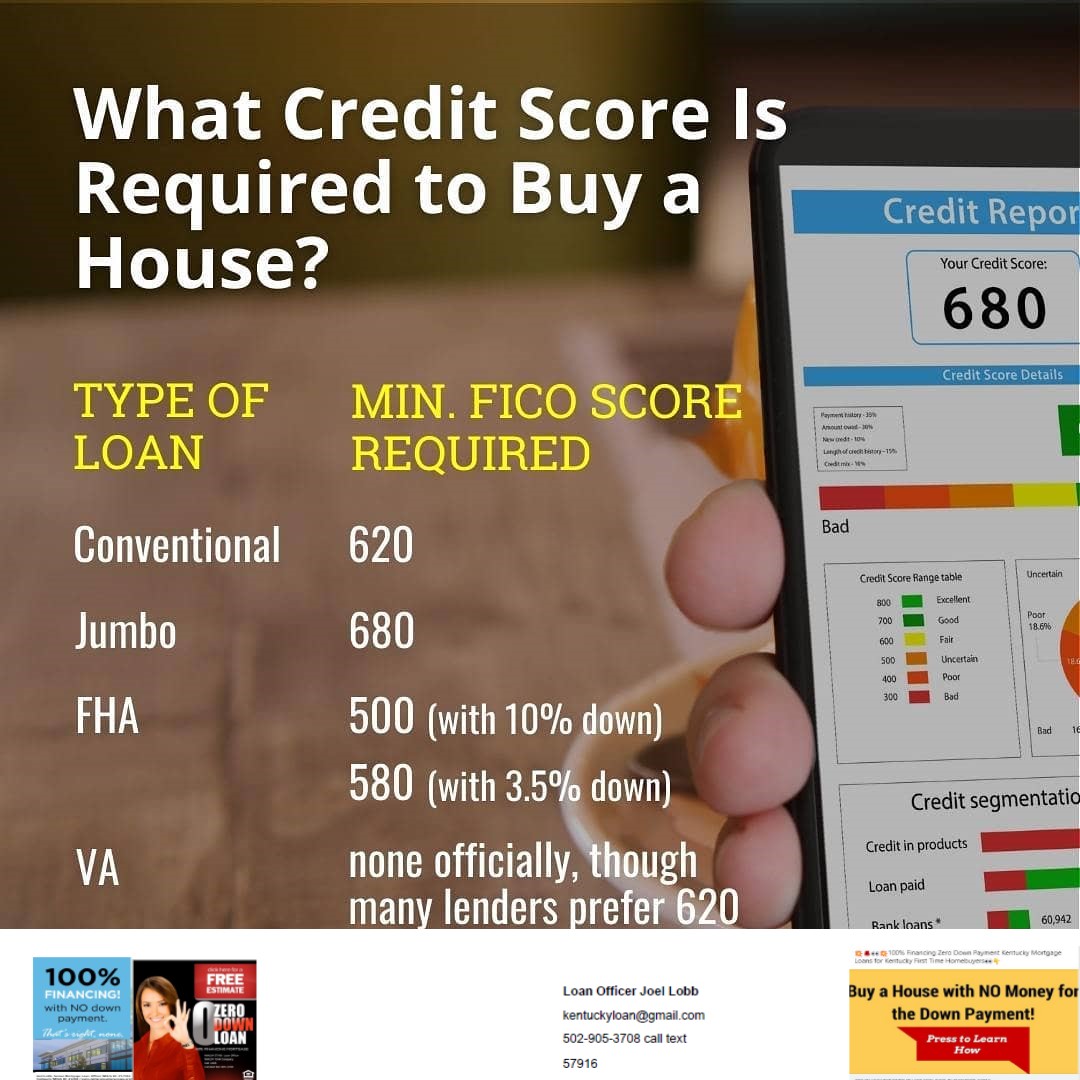
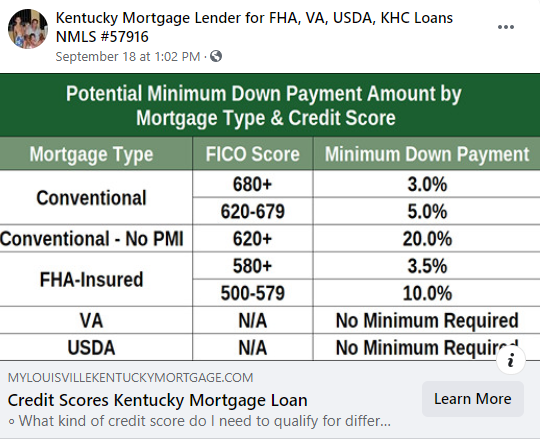
Credit scores required for A Kentucky Mortgage Loan Approval for FHA, VA, USDA and Conventional Fannie Mae

192199974_1008928599679889_572699217267405025_n
What credit score is needed to buy a house in Kentucky?

Ultimately, there is no singular credit score that can guarantee you a mortgage approval. Each lender is free to set their own credit score requirements.

But many loan types are insured by government organizations. And lenders cannot accept borrowers with credit scores below the minimum these organizations set. The four most popular home loan types are:

Conventional: Not backed by any government agency, but must meet the Fannie Mae and Freddie Mac underwriting guidelines
FHA: Loans backed by the Federal Housing Administration
VA: Loans backed by the US Department of Veterans Affairs (for military members)
USDA: Loans backed by the US Department of Agriculture (for low- to moderate-income families who buy homes in rural areas)

And here are the minimum credit score requirements for each of these loan types:

Conventional: 
620 SCORE NEEDED. BUT TO GET APPROVED FOR A FANNIE MAE LOAN MOSTLY LIKE YOU WILL NEED A 720 SCORE OR HIGHER IF YOU HAVE LESS THAN 20% EQUITY POSITION OR LESS THAN 20% DOWN PAYMENT DUE TO PRIVATE MORTGAGE INSURANCE
FHA: 
580 for a 3.5% down payment
500 for down payments of at least 10%
**MOST FHA LENDERS WILL WANT A 580 to 620  CREDIT SCORE NOWADAYS

VA: 
No minimum BUT MOST VA LENDERS WILL WANT A 580 to 620 CREDIT SCORE
USDA: 
No minimum, but with a credit score of at least 620 to 640 you could qualify for streamlined credit analysis and chances of approval goes way down if score is below 640…

unnamed-2020-09-27t195228.502

Joel Lobb
Senior  Loan Officer

(NMLS#57916)
 Fax:     (502) 327-9119
 
 Company ID #1364 | MB73346

The difference between a front-end and a back-end debt-to-income ratio for a Kentucky Mortgage Loan FHA, VA, KHC, USDA, Fannie Mae

The difference between a front-end and a back-end debt-to-income ratio for a Kentucky Mortgage Loan FHA, VA, KHC, USDA, Fannie Mae.

via The difference between a front-end and a back-end debt-to-income ratio for a Kentucky Mortgage Loan FHA, VA, KHC, USDA, Fannie Mae.

FHA-backed mortgages will be halted in a shutdown | Money – WYFF Home

FHA-backed mortgages will be halted in a shutdown | Money – WYFF Home.


The good news is that most government-backed home loans – those purchased and securitized by Fannie Mae and Freddie Mac – will be unaffected by a shutdown. Those companies pay for their operations out of the fees that they charge lenders.

The bad news is that loans guaranteed by the Federal Housing Administration, the Veteran’s Administration and the rural development loans of the United States Department of Agriculture, won’t be processed. If an application for an FHA-insured loan has not been approved by the time of the shutdown, it will have to wait until after the shutdown ends.

FHA-backed loans accounted for 45% of all mortgages used to purchase homes issued in 2012, according to the Federal Reserve. The FHA alone insures about 60,000 loans a month.


Read more: http://www.wyff4.com/news/money/FHA-backed-mortgages-will-be-halted-in-a-shutdown/-/9323996/22157598/-/fkmhqwz/-/index.html#ixzz2gWiF9kf7


Joel Lobb (NMLS#57916)
Senior  Loan Officer
502-905-3708 cell
502-813-2795 fax
kentuckyloan@gmail.com

Key Financial Mortgage Co. (NMLS #1800)*
107 South Hurstbourne Parkway*

Louisville, KY 40222*


2013 Louisville Kentucky Mortgage programs

Business, Credit and Collection, Credit history, Credit score, Fannie Mae, Federal Housing Administration, Federal takeover of Fannie Mae and Freddie Mac, FHA, FHA loan, First-time buyer, kentucky usda lenders, Loan, louisville, Refinancing, United States Department of Agriculture, USDA, VA loan, Zero down home loans

via 2013 Louisville Kentucky Mortgage programs.

via 2013 Louisville Kentucky Mortgage programs.

Interest Rates

Interest Rates.


 Reservation System Open Monday – Friday from 10:00 a.m. to 9:00 p.m.

Rates subject to change without notice.

Secondary Market Interest Rates — 45-Day Lock

Loan Type

Rate without Down Payment Assistance

Rate with Down Payment Assistance

FHA, VA & RHS

  • 640 credit score
  • AUS approval
  • Purchases & Refinances

4.250%

4.750%

Conventional

  • 680 credit score
  • No MI required
  • LTV 80.01% -97.00%
  • *DU AUS approval
  • Purchases

5.375%

5.375%

Mortgage Revenue Bond Interest Rates — 45-Day Lock

Loan Type

Rate without Down Payment Assistance

Rate with Down Payment Assistance

FHA, VA & RHS

  • 640 credit score
  • AUS approval
  • Purchases

4.250%

4.750%

Conventional

  • 680 credit score
  • No MI required
  • LTV 80.01% -97.00%
  • *DU AUS approval
  • Purchases

5.375%

5.375%

 * Run through DU for Approve/Eligible BEFORE reserving with KHC.  Select HFA Preferred Risk Sharing program located on Additional Data Screen.

Understanding PMI

Understanding PMI.

via Understanding PMI.

Understanding PMI

Trust me for your next FHA loan  Call 502-905-3708
Trust me for your next FHA loan Call 502-905-3708

Joel Lobb (NMLS#57916)
Senior  Loan Officer
502-905-3708 cell
502-813-2795 fax
jlobb@keyfinllc.com

Key Financial Mortgage Co. (NMLS #1800)*
107 South Hurstbourne Parkway*

Louisville, KY 40222*

Steps for refinancing FHA Mortgage Loans

Kentucky FHA Streamline Refinance

Image adapted from US fed gov't source nationa...
Image adapted from US fed gov’t source nationalatlas.gov Category:Congressional districts of Kentucky (Photo credit: Wikipedia)

Our Kentucky FHA lenders can help you buy a home with no money down or refinance to the lowest rates possible!

via Kentucky FHA Streamline Refinance.

via Kentucky FHA Streamline

Kentucky FHA Streamline Refinance Calculator

Refinance.

Kentucky FHA Streamline Refinance

Kentucky FHA Streamline Refinance

Kentucky FHA Streamline Refinance

Kentucky FHA loan requirements – 2013 – 7 tips – Louisville Kentucky Mortgage

Kentucky FHA loan requirements – 2013 – 7 tips – Louisville Kentucky Mortgage.

via Kentucky FHA loan requirements – 2013 – 7 tips – Louisville Kentucky Mortgage.

What is the 2012 Credit Score Range Needed for an FHA Loan?

What is the 2012 Credit Score Range Needed for an FHA Loan?.

The Best Kind of Loan for Your Credit Score

The Best Kind of Loan for Your Credit Score.


I’m often asked if having certain types of credit or loans is better or worse than other types of credit or loans.

I get questions like, “John, is it better to have a car loan or a mortgage for my scores?” I also hear, “John, is it better to have a secured card or an unsecured card for my scores?”

In fact, you can swap in almost any type of credit-related account and I’ve been asked about that scenario.

I’ve been getting this type of question for almost 15 years now, and it seems that people believe there’s value or a penalty for having certain types of loans or accounts on your credit reports. That’s completely understandable and, thankfully, almost a complete myth.

Credit Cards

First, let’s tackle the secured credit card, versus the unsecured credit card, versus the charge card question. The assumption is that the type of card has a direct impact on your credit scores. That’s an incorrect assumption, meaning, you’re not penalized or rewarded for having one type of card over another.

That doesn’t mean one form of plastic isn’t better or worse for your credit than another.  For example, a secured credit card is easier to max out than an unsecured credit card.

Why? The reason is because secured cards have considerably lower credit limits than unsecured credit cards. It has nothing to do with the fact that one is secured and one isn’t. It has everything to do with the credit limits.

Installment Loans

When it comes to installment loans, the issue of credit limits disappears because installment loans don’t have credit limits. They do, however, have original loan amounts.

An auto loan is likely to have a considerably lower loan amount than a mortgage, home equity loan and perhaps even a student loan. And, balances do matter on installment loans, albeit slightly.

Exactly like credit cards, credit scores do not treat installment loans of one variety or another differently. The collateral issue of balances can cause variable score impact, however.

Defaulting

One thing we haven’t addressed yet is the issue of missing payments and defaulting. Defaulting on a credit card, secured card, charge card, auto loan, mortgage, or any other kind of credit card, is treated equally — as one default.

You’re not penalized because you’ve defaulted on one variety of credit account versus another. You can, however, have a much larger default amount on a mortgage than any other type of credit account and that’s where the score impact can be variable.

The bottom line is: it’s not really the type of account that’s important, but it’s the incident that matters.

One Exception to the Rule

There is one very small exception to this rule. In fact, it’s so small that I thought very hard about omitting it.

There’s a chance your score could be negatively impacted if you have too many finance company accounts on your credit reports. These are the loans offered by consumer finance lenders who often target the near or subprime consumer.

Notwithstanding the consumer finance issue, the lender is also meaningless in your scores. So, you don’t get rewarded for doing business with a large, well-known credit card issuer and you don’t get penalized for doing business with a subprime credit card issuer.

In fact, credit scores are brand agnostic when it comes to your credit accounts. The most important factor is how you manage them.

Editor’s Note: This article by John Ulzheimer was originally published on MintLife.

See more from Mint.com:

Read more: http://www.minyanville.com/trading-and-investing/personal-finance/articles/credit-score-credit-score-meaning-installment/10/25/2012/id/45351#ixzz2APp8zSGT