Best Mortgage Options: Kentucky VA, FHA, USDA, and Fannie Mae

Comparing Kentucky VA loans to Kentucky USDA, FHA, and Fannie Mae loans in Kentucky

Kentucky VA loans Compared to Kentucky USDA, FHA, and Fannie Mae loans in Kentucky

When comparing Kentucky VA loans to Kentucky USDA, FHA, and Fannie Mae loans in Kentucky, several factors come into play. These factors include credit score requirements, income considerations, work history, and debt ratios. They also involve how each loan type treats bankruptcy and foreclosure. Let’s delve into the benefits and differences of each loan type:

Kentucky Mortgage Credit Score Requirements:

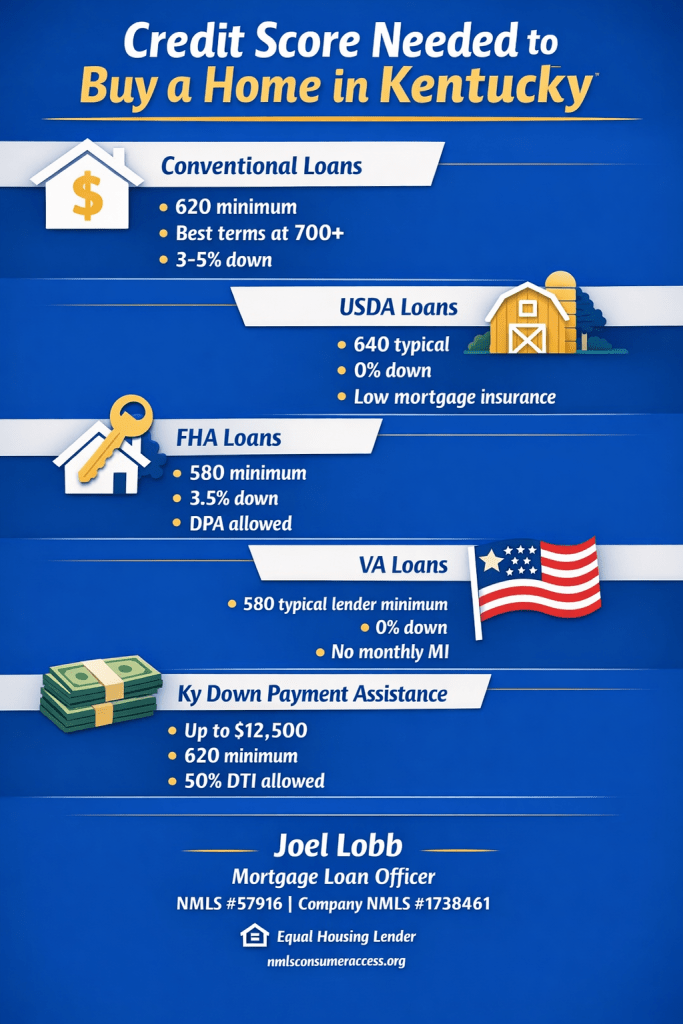
  • Kentucky VA Loan: VA loans typically have more flexible credit score requirements compared to conventional loans. While there’s no specific minimum score set by VA , most Kentucky VA lenders often look for a credit score of 620 or higher. I can do VA loans down to a 580 credit score.
  • Kentucky USDA Loan: USDA loans also offer flexibility, with no minimum score required per USDA guidelines, but most Kentucky USDA lenders will want a 640 score or higher. I Can do Kentucky USDA loans down to a 580 credit score on a manual underwrite.
  • Kentucky FHA Loan: FHA loans are known for accommodating borrowers with lower credit scores, often accepting scores as low as 500 with a 10% down payment or 580 with a 3.5% down payment.
  • Kentucky Fannie Mae Loan: Fannie Mae loans usually require a minimum credit score of 620 or higher, although some lenders may have slightly different requirements.

Kentucky Mortgage Income and Work History:

  • Kentucky VA Loan: VA loans consider your stable income and employment history but may be more lenient if you have a history of military service or steady employment. 2 years of employment needed for loan application-minimal job gaps
  • Kentucky USDA Loan: USDA loans often have income limits based on the area’s median income, and you need a stable income source. 2 years of employment needed for loan application-minimal job gaps
  • Kentucky FHA Loan: FHA loans consider your income stability and work history, with guidelines that vary by lender. 2 years of employment needed for loan application-minimal job gaps
  • Kentucky Fannie Mae Loan: Fannie Mae loans typically require a stable income and employment history, similar to conventional loans. 2 years of employment needed for loan application-minimal job gaps

Kentucky Mortgage Debt Ratio Requirements:

  • Kentucky VA Loan: VA loans generally have more lenient debt-to-income (DTI) ratio requirements, often allowing for a higher DTI compared to conventional loans. VA loans can get approved on much higher debt to income ratios vs FHA, USDA and Fannie Mae loans. 65% or higher in some situations but if manual underwrite, will want the ratios closer to 41% with good residual income for VA loan. VA loans are the only type of loans that require a residual income…FHA, Fannie Mae, USDA does not have residual income requirements
  • Kentucky USDA Loan: USDA loans have very strict DTI ratio limits, typically around 41% to 45% max on the backend ratio and 33% or less on the front end. By far the most restrictive on debt ratios vs FHA, VA, and Fannie Mae loans
  • Kentucky FHA Loan: FHA loans also have relatively flexible DTI ratio limits (56% back end ratio possible on a AUS approval), making them accessible to borrowers with moderate levels of debt. Front end ratio max 45%
  • Fannie Mae Loan: Fannie Mae loans follow standard DTI ratio guidelines similar to conventional loans. TYpically the second most restrictive on debt ratios right behind USDA loans on tighter debt to income ratio requirements, with the max back-end ratio no more than 50% –Front end ratio max 45%

Kentucky Mortgage Bankruptcy and Foreclosure Requirements:

  • Kentucky VA Loan: VA loans are more forgiving of past bankruptcy or foreclosure, often requiring a waiting period of 2 years for Chapter 7 bankruptcy and 1-2 years for foreclosure.
  • Kentucky USDA Loan: USDA loans have specific waiting periods after bankruptcy (3 years for Chapter 7) and foreclosure (3 years).
  • Kentucky FHA Loan: FHA loans have shorter waiting periods after bankruptcy (2 years for Chapter 7) and foreclosure (3 years).
  • Kentucky Fannie Mae Loan: Fannie Mae loans typically require longer waiting periods after bankruptcy (4-7 years) and foreclosure (7 years).

Advantages and Disadvantages of Kentucky VA loans, USDA, Fannie Mae and FHA:

  • Kentucky VA Loan Advantages: Zero down payment, competitive interest rates, no private mortgage insurance (PMI) requirement, lenient credit and DTI ratios, and flexible eligibility criteria for veterans and active-duty service members.
  • Kentucky VA Loan Disadvantages: Funding fee (although it can be rolled into the loan), limited to eligible veterans, service members, and some spouses.
  • Kentucky USDA Loan Advantages: Zero down payment, lower interest rates, flexible credit requirements, and available in eligible rural areas.
  • Kentucky USDA Loan Disadvantages: Limited to rural properties, income limits, and property eligibility criteria.
  • Kentucky FHA Loan Advantages: Low down payment (3.5%), flexible credit requirements, competitive interest rates, and accessible to first-time homebuyers.
  • Kentucky FHA Loan Disadvantages: Mortgage insurance premiums (MIP), stricter property standards, and limits on loan amounts.
  • Kentucky Fannie Mae Loan Advantages: Available for a wide range of properties, competitive interest rates, and options for low down payments.
  • Kentucky Fannie Mae Loan Disadvantages: Stricter credit and DTI requirements, potential for private mortgage insurance (PMI), and limited flexibility for borrowers with past financial challenges.

In summary, choosing the right loan type depends on your specific financial situation, eligibility criteria, and property location. VA loans offer excellent benefits for eligible veterans and service members, while USDA, FHA, and Fannie Mae loans provide alternatives with their own advantages and considerations.

Joel Lobb  Mortgage Loan Officer

Text/call: 502-905-3708
email: kentuckyloan@gmail.com

http://www.mylouisvillekentuckymortgage.com/

Kentucky FHA Loan Credit Score Requirements

What credit score do you need to qualify for a Kentucky FHA loan? Straight talk: the Federal Housing Administration (FHA) requires a minimum credit score of 500 to be eligible. However, your final terms depend on your score and your lender’s additional requirements (known as overlays).

FHA Minimum Credit Guidelines (HUD)

  • 580 and up: Eligible for 96.5% financing — 3.5% down.
  • 500–579: Eligible for 90% financing — 10% down.
  • Under 500: Not eligible for FHA financing.

Two Things You Must Satisfy

There are two layers of approval you must clear:

  1. HUD/FHA rules: The official, baseline eligibility outlined in the HUD Handbook (FHA’s mortgage insurance rules).
  2. Lender overlays: Individual lenders can and do impose stricter standards — often requiring scores from 580 to 620 or higher.

Why Lenders Use Overlays

Lenders add overlays to manage risk. Even if you meet FHA’s minimums, lenders evaluate:

  • Debt-to-income (DTI) ratio
  • Employment and income stability
  • Source of down payment
  • Recent credit history (late payments, collections, bankruptcies)

What Score Range Gets Approved Most Often?

In practice, most FHA approvals fall in the 600–699 range. Lower-score approvals (500–579) are possible but typically carry higher down payments, stricter DTI limits, and sometimes higher rates.

Next Steps — If Your Score Is Below 580

If you’re below 580, you have tactical options:

  • Consider targeted credit repair to remove inaccurate items and lower utilization.
  • Increase your down payment to reduce lender risk.
  • Shop lenders — some local Kentucky lenders have more flexible overlays than others.
  • Explore alternative programs: VA loans, USDA loans, and KHC programs may have different criteria.

Bottom Line

Meet FHA’s minimum of 500 to be eligible, but 580 or higher is the practical target to get the best terms (3.5% down and competitive rates). Your lender’s overlay will often be the deciding factor — so work with a lender who understands Kentucky’s market and can help you position your application.

Get pre-approved — Start your free application

About the author: Joel Lobb — Mortgage Broker specializing in FHA, VA, USDA, and KHC loans across Kentucky. Learn more about Joel or contact us to schedule a consultation.

Disclaimer: This content is provided for informational purposes and is not endorsed by FHA or HUD. Lending rules change; consult a loan officer for current eligibility and program details.

Best mortgage rates today in Kentucky for FHA, VA, USDA and Conventional Home Loans

How to get the best mortgage rates today in Kentucky involves understanding the differences between Kentucky FHA, VA, USDA, and conventional home loans. Each loan type has its own criteria, benefits, and rate determinants. Here’s an overview of how to obtain the best rates for each:

1. Kentucky FHA Loans

Federal Housing Administration (FHA) loans are popular among Kentucky first-time homebuyers due to their flexible credit requirements and low down payments.

Best Practices to Secure the Best Rates:

  • Credit Score: Aim for a score of 720 or higher. While Kentucky FHA loans accept lower scores, higher scores typically secure better rates.
  • Down Payment: Putting down more than the minimum 3.5% can sometimes lower the interest rate. 500 is the minimum score with 10 % down and 580 and above score will you get you to a minimum down payment of 3.5%
  • Debt-to-Income Ratio (DTI): Maintain a DTI of 56.99% or lower to increase your chances of getting a favorable rate.
  • Shopping Around: Compare offers from different lenders in Kentucky for FHA lenders. Each lender may have different rates and terms for FHA loans.
  • Larger Loan amounts: will yield better rates. A lender will get you a better rate if the loan is larger due to they will make more money on the loan vs a small loan amount.

2. Kentucky VA Loans

Veterans Affairs (VA) loans are available to veterans, active-duty service members, and certain members of the National Guard and Reserves. These loans often offer lower rates and do not require a down payment or private mortgage insurance (PMI).

Best Practices to Secure the Best Kentucky VA loan Rates:

  • Credit Score: A score of 720 or higher is generally preferred, although some lenders might accept lower scores. No minimum score set by VA lenders in Kentucky
  • Service History: Ensure your service record meets the eligibility requirements. 2 year work history usually needed
  • Loan Comparison: Even within VA loans, rates can vary between lenders. Obtain multiple quotes to find the best rate.
  • Funding Fee: Understanding the VA funding fee and including it in your budget can help in comparing the true cost of loans.

3. Kentucky USDA Loans

United States Department of Agriculture (USDA) loans are designed for rural and suburban homebuyers who meet certain income requirements.

Best Practices to Secure the Best Kentucky USDA Loan Rates:

  • Credit Score: Aim for a score of 720 or higher to access better rates. No minimum score for USDA loans
  • Income Limits: Ensure your income falls within the USDA’s eligibility guidelines for your area.
  • Property Location: The home must be in an eligible rural or suburban area. Use the USDA’s property eligibility tool to confirm.
  • Guaranteed Loan Program: USDA offers both direct and guaranteed loan programs. The guaranteed loan program often has more favorable terms.

4. Kentucky Conventional Loans

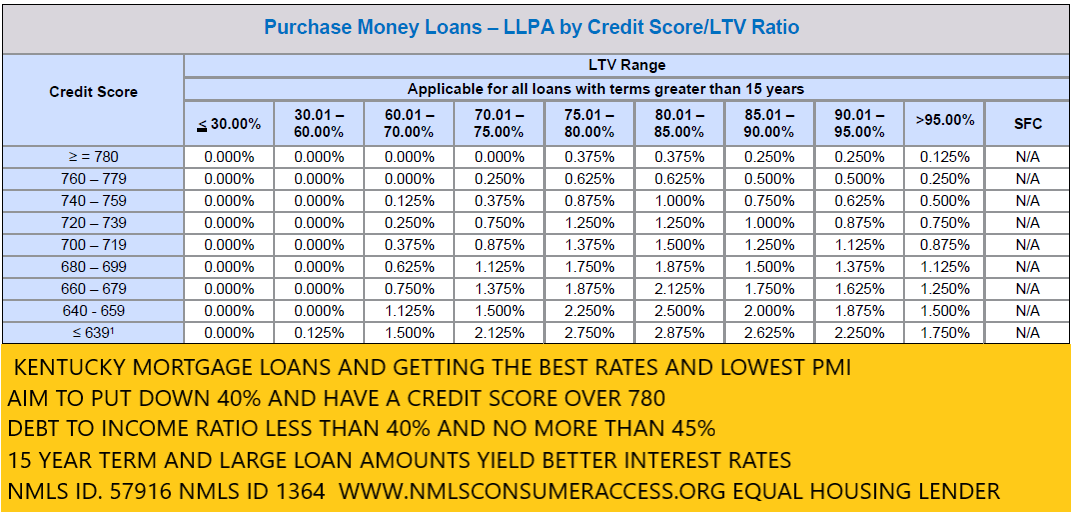
Conventional loans are not insured or guaranteed by the government and typically require higher credit scores and down payments. They are much more sensitive to down payments, credit score, debt to income ratio when it comes to getting the best rate and getting loan approval. They will typically have a higher rate than government backed mortgage loans in Kentucky like FHA, VA, and USDA, but the mortgage insurance is cheaper and not for life of loan and require less red tape to close.

Best Practices to Secure the Best Conventional loan Rates:

  • Credit Score: A score of 780 or higher is ideal to secure the best rates. Minimum credit score for Conventional loans in Kentucky is 620
  • Down Payment: A larger down payment (40% or more) can significantly lower your interest rate and eliminate PMI.
  • DTI Ratio: A DTI ratio of 45% or lower is preferred.
  • Loan Term: Consider shorter loan terms (15 or 20 years) for lower rates, though monthly payments will be higher.
  • Large Loan Amounts: Larger Loan Amounts will yield better rates vs a small loan amount.

General Tips for All Loan Types to get the lowest Mortgage Rates in Kentucky

  • Credit Score, debt ratio, : Maintain a strong credit history, stable income, and low debt levels.
  • Rate Shopping: Use online comparison tools and consult multiple lenders. Rates can vary significantly with each lender.
  • Points: Consider paying points to lower your interest rate. This is an upfront fee that can reduce your monthly payments over the loan term.
  • Pre-approval: Get pre-approved for a mortgage to understand what rate you qualify for and to strengthen your offer when shopping for a home.
  • Locking Loan: Lock in for a shorter term. For example, lock in the rate for 30 days vs 60 days and you will get a better rate. Be aware if you go past the lock the date, you will be subject to worse case pricing.

By understanding the specific requirements and best practices for each loan type, you can position yourself to secure the most favorable mortgage rates in Kentucky.–


NMLS ID# 57916, (www.nmlsconsumeraccess.org).

Your Trusted Kentucky Mortgage Expert Joel Lobb

Your Trusted Kentucky Mortgage Expert

I specialize in assisting Kentucky First-Time Homebuyers with mortgage loans, including FHA, VA, USDA & Rural Housing, KHC (Kentucky Housing Corporation), and Fannie Mae programs. With over 20 years of experience in the mortgage industry, I’ve helped more than 1,300 Kentucky families achieve their dream of homeownership or refinance their current mortgages to secure lower payments.

Whether you’re a first-time buyer or looking to refinance, I am here to guide you through every step of the process with personalized attention, expert advice, and the best loan options available to fit your unique needs.

Down Payment Assistance:
For Kentucky first-time homebuyers, we still have down payment assistance available through KHC programs. These funds can make a huge difference in reducing upfront costs and making homeownership more accessible.

Why Work With Me?

  • Local Expertise: I know the ins and outs of Kentucky’s housing market and loan programs.
  • Fast Approvals: I offer free mortgage applications with same-day approvals to keep the process moving quickly.
  • Customized Loan Solutions: Whether you’re buying a home or refinancing, I’ll find the right loan program to fit your needs.
  • Personalized Service: I treat every client like family, ensuring you’re supported and informed throughout the process.

About My Website
Visit my website for a wealth of resources tailored to Kentucky homebuyers. You’ll find:

  • Step-by-step guides for first-time homebuyers.
  • Information on loan programs like FHA, VA, USDA, and KHC.
  • Tools to help you calculate potential payments and affordability.
  • Blog posts with tips and updates on the Kentucky housing market.
  • secure portal to start your loan application and upload documents.

Please Note: My website is not endorsed by the FHA, VA, USDA, or any government agency. It is an independent platform created to educate and assist homebuyers with expert advice and accessible tools.

Contact Me Anytime
📞 Call/Text: 502-905-3708
📧 Emailkentuckyloan@gmail.com
🌐 Websitewww.mylouisvillekentuckymortgage.com

Licensing Info: Kentucky Mortgage Loan Only

  • NMLS Personal ID: 57916


Email ThisBlogThis!Share to XShare to FacebookShare to Pinterest

Joel Lobb, Mortgage Broker FHA, VA, KHC, USDA

Why Work With Me? Local Expertise: I know the ins and outs of Kentucky’s housing market and loan programs. Fast Approvals: I offer free mortgage applications with same-day approvals to keep the process moving quickly. Customized Loan Solutions: Whether you’re buying a home or refinancing, I’ll find the right loan program to fit your needs. Personalized Service: I treat every client like family, ensuring you’re supported and informed throughout the process. About My Website Visit my website for a wealth of resources tailored to Kentucky homebuyers. You’ll find: Step-by-step guides for first-time homebuyers. Information on loan programs like FHA, VA, USDA, and KHC. Tools to help you calculate potential payments and affordability. Blog posts with tips and updates on the Kentucky housing market. A secure portal to start your loan application and upload documents. Please Note: My website is not endorsed by the FHA, VA, USDA, or any government agency. It is an independent platform created to educate and assist homebuyers with expert advice and accessible tools.

https://reviewsonmywebsite.com/js/v2/embed.js?id=8ed8fd45a2fd062872f56952886c1ec5

How Medical Debt Impacts Credit Scores and Mortgage Approval for Kentucky Homebuyers

Medical Debt and Mortgage Approval for Kentucky Homebuyers

Medical debt has long been a challenge for many Americans. It particularly affects credit scores and the ability to secure a mortgage loan. Fortunately, the Consumer Financial Protection Bureau (CFPB) has finalized a new rule. This rule is set to remove medical debt from consumer credit reports. As a result, more opportunities may open up for homebuyers in Kentucky. Here’s how this change can affect your mortgage approval process. Also, understand what you need to know about medical debt and credit scores in Kentucky.

What’s Changing with Medical Debt and Credit Reports?

The CFPB has implemented a new rule to remove medical debt from credit reports. This change is significant for borrowers in Kentucky. Medical debt often lowers credit scores. It creates hurdles in the mortgage approval process.

Here’s what to expect from the new rule:

  1. Implementation Timeline: The rule is expected to take effect in at least 60 days.
  2. Debt Removed: Over $49 billion in medical debt will be erased from credit reporting systems.
  3. Consumer Impact: An estimated 15+ million Americans will see their credit reports improved.
  4. Credit Score Boost: Consumers affected by this change could see an average credit score increase of 20 points.
  5. Mortgage Approvals: This change is anticipated to result in over 22,000 additional mortgage approvals annually across the U.S.

How Medical Debt Affects Credit Scores in Kentucky

Before this rule, unpaid medical bills often appeared on credit reports, negatively impacting credit scores. In Kentucky, this has been a common issue for homebuyers trying to secure mortgage loans.

Key Effects of Medical Debt on Credit Scores:

  1. Lower Credit Scores: Medical debt can drag down your FICO score, making it harder to qualify for favorable loan terms.
  2. Higher Interest Rates: A lower score often leads to higher interest rates on mortgages.
  3. Mortgage Denials: In some cases, excessive medical debt could result in outright denials of loan applications.

Even with medical debt on your report, mortgage lenders may consider compensating factors. These factors include stable income, down payment assistance, or other positive financial attributes.


How Credit Scores Impact Mortgage Loan Approval in Kentucky

Mortgage lenders in Kentucky use credit scores as one of the primary factors to determine loan eligibility. Here’s how it works:

  1. Credit Score Requirements by Loan Type:
    1. FHA Loans: Minimum credit score of 580 with a 3.5% down payment. Scores as low as 500 may be considered with a 10% down payment.
    2. Conventional Loans: Minimum credit score of 620 or higher.
    3. VA Loans: No minimum credit score set by the VA, but most lenders prefer a score of 580-620.
    4. USDA Loans: Minimum credit score of 640 for automatic approval, though manual underwriting is possible for lower scores.
  2. Impact of Credit Score on Interest Rates:
    Higher credit scores lead to better mortgage rates. Lower scores can result in higher monthly payments.
  3. Debt-to-Income Ratio (DTI):
    Lenders calculate your DTI to ensure you can manage your mortgage payments alongside other debts. Medical debt previously factored into this calculation, potentially increasing your DTI and reducing your borrowing power.


 Email – kentuckyloan@gmail.com 

   Call/Text – 502-905-3708

Joel Lobb
Mortgage Loan Officer – Expert on Kentucky Mortgage Loans


 Websitewww.mylouisvillekentuckymortgage.com
Address: 911 Barret Ave., Louisville, KY 40204


Evo Mortgage
Company NMLS# 1738461
Personal NMLS# 57916

For assistance with Kentucky mortgage loans, reach out via email, call, or text Joel Lobb directly.

How to Qualify for an FHA Mortgage Loan in Kentucky: A Guide for First-Time Homebuyers

There are many ways to get the mortgage to buy your first home. The FHA is one option. If you are a first-time homebuyer in Kentucky, an FHA loan could be the perfect option for you. There are many flexible requirements, low down payments, and financial assistance options available. These are just a few of the many things that can help make homeownership more accessible.


What is an FHA Loan?

An FHA loan is a government-backed mortgage insured by the Federal Housing Administration (FHA). It’s designed for low-to-moderate-income borrowers, offering relaxed qualification standards compared to conventional loans. Here are the main advantages:

  • Low down payment: As little as 3.5% of the purchase price.
  • Lower credit score requirements: Minimum score of 500 with 10% down or 580 with 3.5% down.
  • Seller-paid closing costs: Sellers can contribute up to 6% of the purchase price.
  • Flexible qualifying criteria: Higher debt-to-income (DTI) ratios and options for non-occupant co-signers.

How to Qualify for a Kentucky FHA Loan

1. Credit Score Requirements

  • 580 or higher: You’ll need a minimum credit score of 580 to qualify for the 3.5% down payment option.
  • 500-579: You can still qualify with a 10% down payment, but many lenders prefer a score of 580 or higher.
  • Bankruptcy or Foreclosure:
    • Chapter 7 bankruptcy: Must be 2 years removed, with good credit since.
    • Chapter 13 bankruptcy: Can qualify after 1 year of on-time payments with trustee approval.
    • Foreclosure: Must be 3 years removed, unless there are extenuating circumstances.

2. Income and Debt-to-Income Ratio

  • DTI ratio: Typically, up to 45%% of your income can go toward your mortgage payment, and up to 56.9% can go toward all debts, depending on your credit and financial history.
  • Work history: You must have a stable employment history of at least 2 years in the same field. Recent graduates can use college transcripts as a substitute.

3. Down Payment and Gift Options

  • 3.5% down payment: This can be gifted by a family member, employer, or nonprofit organization, drawn off a retirement account like a 401k or money saved up.
  • Cash deposits: Cash cannot be used as proof of funds for your down payment—only traceable sources are allowed.

4. Property Requirements

  • Must be your primary residence. FHA loans are not for investment properties or second homes.
  • Eligible property types: Single-family homes, townhomes, condos (must be approved condo development on HUD approved list), duplexes, and some manufactured homes (if affixed to a permanent foundation).
  • Appraisal: The property must be appraised by an FHA-approved appraiser to meet HUD standards.

5. Mortgage Insurance Premium (MIP)

  • Upfront MIP: 1.75% of the loan amount, which can be rolled into the loan.
  • Annual MIP: 0.45%-1.05% of the loan amount, depending on the down payment and loan term.

Kentucky FHA Loan Limits for 2025

In all Kentucky counties, the FHA loan limit is $524,225 for a single-family home up to $1,008,300 for a four-unit property


Why Choose an FHA Loan as a Kentucky First-Time Buyer?

Pros

  • Lower credit thresholds: You can qualify with a credit score as low as 500.
  • Smaller down payments: With as little as 3.5% down with a 580 credit score
  • Seller-paid costs: The seller can pay a significant portion of your closing costs.
  • Higher debt to income ratios
  • Lenient on past bankruptcies and foreclosures.

Cons

  • Mortgage insurance: You’ll pay MIP for the life of the loan if your down payment is less than 10%.
  • Property requirements: Homes must meet specific standards, which may limit your options.
  • a lot of sellers will not accept an FHA mortgage as a offer due to property may need work to meet FHA HUD minimum standards
  • Purchase price limits and only can be used for primary residence

FHA Loans vs. Conventional Loans

Feature FHA Loan Conventional Loan
Credit Score 500+ 620+
Down Payment 3.5% (580+ credit score) 3%-20%
Mortgage Insurance Required for life of loan Can be removed at 20% equity
Debt-to-Income Ratio Up to 55% Up to 45%
Property Standards Strict requirements More flexibility

Other Kentucky First-Time Homebuyer Programs

1. Kentucky Housing Corporation (KHC)

  • Down payment assistance up to $10,000.
  • Tax credit programs for first-time buyers.

2. USDA Loans

  • Zero-down-payment option for eligible rural areas.
  • Minimum credit score of 620-640 preferred.

3. VA Loans

  • No down payment or private mortgage insurance required for eligible veterans. No minimum credit score, higher debt to income ratios allowed and no monthly mortgage insurance and low 30 year fixed rates

Need Help Getting Approved for an FHA Loan in Kentucky?

As an experienced mortgage loan officer specializing in FHA loans for Kentucky first-time homebuyers, I’m here to guide you every step of the way.

Contact Me Today:

Joel Lobb
Mortgage Loan Officer – Expert on Kentucky Mortgage Loans

Websitewww.mylouisvillekentuckymortgage.com
Address: 911 Barret Ave., Louisville, KY 40204


Evo Mortgage
Company NMLS# 1738461
Personal NMLS# 57916

Equal Housing Lender

www.nmlsconsumeraccess.org

For assistance with Kentucky mortgage loans, reach out via email, call, or text Joel Lobb directly.

FHA mortgage qualifying criteria for Kentucky

Here’s a concise overview of the FHA mortgage qualifying criteria for Kentucky:

  1. Credit score: Minimum 580 for 3.5% down payment, 500-579 for 10% down payment
  2. Debt-to-income ratio: Generally 43% or less, though exceptions may be made
  3. Down payment: Minimum 3.5% of purchase price (with 580+ credit score)
  4. Employment: Steady income for at least two years
  5. Property requirements: Must meet FHA standards and be primary residence
  6. Loan limits: Vary by county in Kentucky
  7. Mortgage insurance: Required for the life of the loan
  8. Income limits: None, but must be able to afford monthly payments
  1. Credit score:
    • 580 or higher allows for a 3.5% down payment
    • 500-579 requires a 10% down payment
    • Lenders may have higher requirements
  2. Debt-to-income ratio (DTI):
    • Front-end ratio (housing expenses) should be 31% or less of income
    • Back-end ratio (all debts) should be 43% or less
    • Some lenders may allow higher ratios with compensating factors
  3. Down payment:
    • Can come from savings, gifts, or down payment assistance programs
    • Seller can contribute up to 6% of the sale price towards closing costs
  4. Employment:
    • Must show stable income for at least two years
    • Self-employed borrowers need two years of tax returns
  5. Property requirements:
    • Must be safe, sound, and secure
    • Appraiser will check for minimum property standards
  6. Loan limits in Kentucky:
    • Vary by county, ranging from Kentucky  FHA loan limits by county FHA limit $498,257
  7. Mortgage insurance:
    • Upfront premium of 1.75% of loan amount
    • Annual premium between 0.45% and 1.05%, depending on loan terms
  8. Income requirements:
    • No maximum income limit
    • Must be able to afford payments, including taxes and insurance

Additional information:

  • FHA loans are assumable
  • Allow for lower credit scores compared to conventional loans
  • More flexible on previous bankruptcies or foreclosures

FHA mortgage insurance for Kentucky borrowers:

FHA loans require two types of mortgage insurance:

  1. Upfront Mortgage Insurance Premium (UFMIP):
    • 1.75% of the base loan amount
    • Paid at closing or can be financed into the loan
    • Example: On a $200,000 loan, UFMIP would be $3,500
  2. Annual Mortgage Insurance Premium (MIP):
    • Paid monthly as part of your mortgage payment
    • Rates vary based on loan term and loan-to-value (LTV) ratio:
      • For 30-year loans with LTV > 95%: 0.85% annually
      • For 30-year loans with LTV ≤ 95%: 0.80% annually
      • For 15-year loans with LTV > 90%: 0.70% annually
      • For 15-year loans with LTV ≤ 90%: 0.45% annually

Key points about FHA mortgage insurance:

  • Unlike conventional loans, FHA MIP is required for the life of the loan in most cases
  • MIP can only be removed by refinancing to a conventional loan once you have 20% equity
  • The annual MIP is divided by 12 and added to your monthly mortgage payment

For example, on a $200,000 30-year loan with 3.5% down payment:

  • Annual MIP rate: 0.85%
  • Annual MIP amount: $200,000 x 0.85% = $1,700
  • Monthly MIP payment: $1,700 / 12 = $141.67 added to your mortgage payment

 Let’s compare FHA mortgage insurance to private mortgage insurance (PMI) on conventional loans:

FHA Mortgage Insurance:

  1. Required for all FHA loans, regardless of down payment
  2. Upfront premium of 1.75% of loan amount
  3. Annual premium of 0.45% to 0.85%, depending on loan terms
  4. Generally lasts for the life of the loan
  5. Same rates for all borrowers, regardless of credit score

Conventional Loan PMI:

  1. Only required if down payment is less than 20%
  2. No upfront premium (typically)
  3. Annual premium varies widely, usually 0.15% to 1.95%
  4. Can be removed when loan-to-value ratio reaches 78%
  5. Rates vary based on credit score, down payment, and loan terms

Key differences:

  1. Cost: FHA can be more expensive long-term due to the upfront premium and inability to remove MIP without refinancing
  2. Duration: Conventional PMI can be cancelled, FHA MIP typically cannot
  3. Flexibility: Conventional PMI offers more options (lender-paid, single premium, etc.)
  4. Credit impact: FHA MIP doesn’t vary by credit score, conventional PMI does

Advantages of FHA:

  • May be cheaper short-term, especially for lower credit scores
  • Easier to qualify for with lower credit scores or higher debt-to-income ratios

Advantages of Conventional:

  • Potentially lower long-term costs, especially for borrowers with good credit
  • Ability to remove PMI without refinancing

FHA Loan Appraisals:

  1. Stricter standards: FHA appraisals are more rigorous and detailed.
  2. Dual purpose: Assess both the value and the property condition.
  3. Minimum Property Standards (MPS): Must meet specific safety, security, and soundness requirements.
  4. Repairs: May require repairs to be completed before loan approval.
  5. Appraiser qualifications: Must be FHA-approved.
  6. Validity period: Typically valid for 120 days.
  7. Cost: Generally more expensive due to additional requirements.

Conventional Loan Appraisals:

  1. Focus on value: Primarily concerned with determining the property’s market value.
  2. Less stringent: Fewer specific property condition requirements.
  3. Condition ratings: Use more general ratings (C1-C6) for property condition.
  4. Repairs: Less likely to require repairs before closing.
  5. Appraiser qualifications: No special FHA approval needed.
  6. Validity period: Usually 60-90 days, but can vary by lender.
  7. Cost: Typically less expensive than FHA appraisals.

Key differences:

  • FHA appraisals are more thorough and may catch more potential issues.
  • Conventional appraisals offer more flexibility for properties in less-than-perfect condition.
  • FHA appraisals may lead to required repairs, potentially delaying closing or affecting negotiations.

Credit score requirements FHA vs USDA, VA, and conventional loans

Here’s a comparison of credit score requirements for FHA, USDA, VA, and conventional loans:

FHA Loans:

  • Minimum score: 500
  • 500-579: Requires 10% down payment
  • 580+: Eligible for 3.5% down payment
  • Many lenders prefer 620+ for better terms

USDA Loans:

  • Minimum score: 640 (set by most lenders)
  • USDA itself doesn’t set a minimum, but 640 is standard
  • Scores below 640 may require manual underwriting

VA Loans:

  • No official minimum set by the VA
  • Most lenders require 620+
  • Some may go as low as 580
  • Lower scores may require manual underwriting

Conventional Loans:

  • Minimum score: 620 for most lenders
  • 620-659: Higher rates and stricter requirements
  • 660-679: Better terms
  • 740+: Best rates and terms
  • 780+: Optimal pricing and easiest approval

Key points:

  1. FHA is most lenient, accepting scores as low as 500
  2. Conventional loans typically have the highest requirements
  3. USDA and VA fall in between, with most lenders requiring 580-640
  4. Higher scores generally mean better rates and terms across all loan types

Joel Lobb  Mortgage Loan Officer

American Mortgage Solutions, Inc.
10602 Timberwood Circle
Louisville, KY 40223
Company NMLS ID #1364

Text/call: 502-905-3708

email:
 kentuckyloan@gmail.com
http://www.mylouisvillekentuckymortgage.com/

NMLS 57916  | Company NMLS #1364/MB73346135166/MBR1574

MINIMUM CREDIT SCORES REQUIRED FOR KENTUCKY FHA, VA, USDA MORTGAGE LOANS

  1. Kentucky FHA Loans: Kentucky FHA loans are known for their lenient credit score requirements, making them accessible to borrowers with lower credit scores. However, a minimum score of 500 to 580 is typically required, depending on the down payment.

  2. Kentucky VA Loans: VA loans offer flexible credit score requirements, while on paper VA states they don’t require a minimum score to insure the mortgage loan,  most lenders preferring a FICO score of 620 or higher. Veterans, active-duty service members, and eligible spouses can benefit from VA loan options.

  3. Kentucky USDA Loans: USDA loans are designed for rural homebuyers and require no minimum FICO score , but most lenders will want a credit score of 640 or higher. These loans offer zero down payment options for eligible properties.

  4. KHC Mortgage Loans: Kentucky Housing Corporation (KHC) mortgage loans may vary in credit score requirements depending on the lender. It’s essential to work with a knowledgeable mortgage broker like Joel Lobb to understand specific lender guidelines. KHC requires a minimum 620 credit score for FHA, VA, USDA and 660 for Conventional loan programs 

Joel Lobb  Mortgage Loan Officer

American Mortgage Solutions, Inc.
10602 Timberwood Circle
Louisville, KY 40223
Company NMLS ID #1364

Text/call: 502-905-3708

email:
 kentuckyloan@gmail.com

http://www.mylouisvillekentuckymortgage.com/


Kentucky first time home buyer loan requirements

Kentucky first time home buyer loan requirements

Buying your first house in Kentucky involves several steps, which can vary depending on the type of loan program you choose. Here’s a detailed guide on the steps and requirements for various Kentucky First Time Home Buyer loan programs:

1. Kentucky FHA Loans

Credit Score:

  • Minimum credit score typically required is 580 for 3.5% down payment.
  • Scores between 500-579 may qualify with a 10% down payment.

Income:

  • Stable and sufficient income to cover the mortgage payments.

Work History:

  • At least 2 years of consistent employment history.

Down Payment:

  • 3.5% of the purchase price if the credit score is 580 or higher.

FICO Score:

  • Minimum FICO score of 580 for maximum financing.

Bankruptcy and Foreclosure:

  • Chapter 7 bankruptcy: 2 years from discharge with reestablished good credit.
  • Chapter 13 bankruptcy: 1 year of the payout period with satisfactory payment history.
  • Foreclosure: 3 years from completion date.

Debt Ratio:

  • Typically, a maximum debt-to-income (DTI) ratio of 56.9% on backend and 45% on the front end debt ratio. 

Collections:

  • Must be addressed if they affect the borrower’s ability to repay the loan. Collections not required to be paid but must count in debt to income ratio sometimes if aggregate total on credit report is over $1000 total…Non-medical bills only, medical bills don’t count and usually not required to be paid or figure a payment unless you have a judgement of garnishment against your paystubs.

Mortgage Insurance:

  • Required for all FHA loans. Includes an upfront mortgage insurance premium (UFMIP) and monthly mortgage insurance premiums (MIP).

Time to Close:

  • Approximately 30-45 days.

Appraisal Requirements:

  • Property must meet minimum property standards set by HUD.

Mortgage Documents Needed for Pre-Approval Letter in Kentucky to Buy a House using a Kentucky FHA loan:

  • Proof of income (pay stubs, last two years W-2s, tax returns).
  • Proof of employment. Last two years 
  • Proof of assets (last two bank statements). 401k or retirement account and stocks and bonds.
  • Kentucky Mortgage Credit report for all three credit bureaus Experian, Equifax and Transunion

2. Kentucky USDA Rural Housing Loans

Credit Score:

  • Minimum credit score of 640 is preferred for automated underwriting. No minimum score required.
  • Scores below 640 may qualify with manual underwriting down to a 580 credit score

Income:

  • Must meet USDA income eligibility guidelines (typically low to moderate income). 2 year history of income. 

Work History:

  • Stable employment history, usually for the past 2 years.

Down Payment:

  • No down payment required (100% financing).

FICO Score:

  • Minimum FICO score of 640 for automated underwriting. can go down to 580 possible

Bankruptcy and Foreclosure:

  • Chapter 7 bankruptcy: 3 years from discharge.
  • Chapter 13 bankruptcy: 1 year of the payout period with satisfactory payment history.
  • Foreclosure: 3 years from completion date.

Debt Ratio:

  • Typically, 33% for housing expenses and 45% for total DTI.

Collections:

  • Must be resolved if they impact the ability to repay the loan. Collections typically don’t have to be paid but may have to count a payment in your debt to income ratio if aggregate is over 1k and non-medical 

Mortgage Insurance:

  • Annual fee and upfront guarantee fee.  Currently 1% upfront and .35% month

Time to Close:

  • Approximately 30-45 days, including USDA processing time.

Appraisal Requirements:

  • Must meet HUD FHA standards.

Mortgage Documents Needed for Pre-Approval:

  • Proof of income (pay stubs, last two years W-2s, tax returns).
  • Proof of employment. Last two years 
  • Proof of assets (last two bank statements). 401k or retirement account and stocks and bonds.
  • Kentucky Mortgage Credit report for all three credit bureaus Experian, Equifax and Transunion

3. Kentucky VA Home Loan

Credit Score:

  • No minimum credit score requirement by the VA, but lenders typically require a score of 620.

Income:

  • Sufficient income to cover mortgage payments and other obligations.

Work History:

  • Stable employment, usually for the past 2 years.

Down Payment:

  • No down payment required (100% financing).

FICO Score:

  • Typically, a minimum FICO score of 620.

Bankruptcy and Foreclosure:

  • Chapter 7 bankruptcy: 2 years from discharge.
  • Chapter 13 bankruptcy: 1 year of the payout period with satisfactory payment history.
  • Foreclosure: 2 years from completion date.

Debt Ratio:

  • Typically, a maximum DTI ratio of 41%.

Collections:

  • Must be resolved if they impact the ability to repay the loan.

Mortgage Insurance:

  • No mortgage insurance, but a VA funding fee is required.

Time to Close:

  • Approximately 30-45 days.

Appraisal Requirements:

  • Property must meet VA Minimum Property Requirements (MPRs).

Mortgage Documents Needed for Pre-Approval:

Advertisement

  • Certificate of Eligibility (COE).
  • Credit report.
  • Proof of income (pay stubs, last two years W-2s, tax returns).
  • Proof of employment. Last two years 
  • Proof of assets (last two bank statements). 401k or retirement account and stocks and bonds.
  • Kentucky Mortgage Credit report for all three credit bureaus Experian, Equifax and Transunion
  •  

4. Kentucky Down Payment Assistance Loans

Credit Score:

  • Varies depending on the program; typically, a minimum of 580 for some programs and with KHC it requires a 620 score. .

Income:

  • Must meet specific program income limits. 

Work History:

  • Stable employment history. Last two years 

Down Payment:

  • Assistance provided to cover down payment and closing costs. 25k welcome home grant, 10k down payment assistance loan from KHC and 5% grant used available toward closing costs and down payment

FICO Score:

  • Minimum FICO score requirement varies by program.

Bankruptcy and Foreclosure:

  • Varies by program.

Debt Ratio:

  • Typically aligns with Kentucky FHA, VA, or USDA requirements.

Collections:

  • Must be addressed if they impact the ability to repay the loan. 

Mortgage Insurance:

  • Depends on the primary loan program (FHA, VA, USDA).

Time to Close:

  • Approximately 45-60 days.

Appraisal Requirements:

  • Must meet the requirements of the primary loan program.

Mortgage Documents Needed for Pre-Approval:

  • Proof of income (pay stubs, W-2s, tax returns).
  • Proof of employment.
  • Proof of assets (bank statements).
  • Credit report.

5. 100% Financing Loans in Kentucky

Credit Score:

  • Varies depending on the program; typically, a minimum of 620-640.

Income:

  • Must meet specific program income limits.

Work History:

  • Stable employment history.

Down Payment:

  • No down payment required (100% financing).

FICO Score:

  • Minimum FICO score requirement varies by program.

Bankruptcy and Foreclosure:

  • Varies by program; typically 2-3 years from discharge or completion.

Debt Ratio:

  • Varies by program, typically around 41-45%.

Collections:

  • Must be addressed if they impact the ability to repay the loan.

Mortgage Insurance:

  • Depends on the primary loan program (FHA, VA, USDA).

Time to Close:

  • Approximately 30-45 days.

Appraisal Requirements:

  • Must meet the requirements of the primary loan program.

Mortgage Documents Needed for Pre-Approval:

  • Proof of income (pay stubs, W-2s, tax returns).
  • Proof of employment.
  • Proof of assets (bank statements).
  • Credit report.

General Steps for Buying Your First Home in Kentucky

  1. Check Your Credit Score:
    • Obtain a copy of your credit report and check your credit score.
  2. Determine Your Budget:
    • Use a mortgage calculator to estimate your monthly payments and determine a comfortable budget.
  3. Get Pre-Approved:
    • Contact a mortgage lender to get pre-approved for a loan. Provide necessary documents for income, employment, and assets.
  4. Choose a Real Estate Agent:
    • Select a knowledgeable real estate agent to help you find a home that meets your needs and budget.
  5. Start House Hunting:
    • Visit properties, attend open houses, and narrow down your choices.
  6. Make an Offer:
    • Once you find a home, work with your real estate agent to make a competitive offer.
  7. Home Inspection:
    • Hire a professional inspector to check the condition of the home.
  8. Finalize Your Loan:
    • Work with your lender to finalize the loan application and submit all required documents.
  9. Appraisal:
    • The lender will order an appraisal to determine the home’s value.
  10. Closing:
    • Review and sign all closing documents. Pay any remaining closing costs and receive the keys to your new home.

Following these steps and meeting the specific requirements of your chosen loan program will help you successfully purchase your first home in Kentucky.

Joel Lobb  Mortgage Loan Officer

American Mortgage Solutions, Inc.
10602 Timberwood Circle
Louisville, KY 40223
Company NMLS ID #1364

Text/call: 502-905-3708

email:
 kentuckyloan@gmail.com

http://www.mylouisvillekentuckymortgage.com/

NMLS 57916  | Company NMLS #1364/MB73346135166/MBR1574


Kentucky home loan credit scores and the minimum requirements for FHA, VA, USDA, and KHC mortgage loans in Kentucky.

Understanding Credit Scores for Kentucky Mortgage Loan Approval: Insights by Joel Lobb, Mortgage Broker

Are you considering applying for a mortgage loan in Kentucky but unsure about the credit score requirements? Joel Lobb, a trusted mortgage broker, provides valuable insights into credit scores and the minimum requirements for FHA, VA, USDA, and KHC mortgage loans in Kentucky. Let’s delve into the details and explore how credit scores impact your loan approval.

Kentucky Credit Scores and Kentucky Mortgage Approval

Your credit score plays a crucial role in determining your eligibility for a mortgage loan in Kentucky. Kentucky Mortgage Lenders use credit scores to assess your creditworthiness and evaluate the risk of lending to you. Different loan programs may have varying credit score requirements, so understanding these requirements is essential for prospective homebuyers.

Credit Score Models and Minimum Requirements

Here’s a chart illustrating the difference in credit score models and the minimum credit scores required for FHA, VA, USDA, and KHC mortgage loans in Kentucky:

Loan Program Credit Score Model Minimum Credit Score
FHA Loan

FICO® Score 2: Mortgage lenders get this version of the FICO® Score from Experian.

FICO® Score 4: Mortgage lenders get this version of the FICO® Score from TransUnion.

FICO® Score 5: Mortgage lenders obtain this version of the FICO® Score from Equifax.

500 to 580 –If less than 580, you will need 10% down payment and if over 580 or higher, 3.5%  minimum down payment
VA Loan

Equifax.

FICO® Score 2: Mortgage lenders get this version of the FICO® Score from Experian.

FICO® Score 4: Mortgage lenders get this version of the FICO® Score from TransUnion.

FICO® Score 5: Mortgage lenders obtain this version of the FICO® Score from Equifax.

No minimum score but most VA Lenders will want a 620 or higher
USDA Loan

FICO® Score 2: Mortgage lenders get this version of the FICO® Score from Experian.

FICO® Score 4: Mortgage lenders get this version of the FICO® Score from TransUnion.

FICO® Score 5: Mortgage lenders obtain this version of the FICO® Score from Equifax.

No minimum score, but most lenders will want a 640 or higher
KHC Mortgage Loan

FICO® Score 2: Mortgage lenders get this version of the FICO® Score from Experian.

FICO® Score 4: Mortgage lenders get this version of the FICO® Score from TransUnion.

FICO® Score 5: Mortgage lenders obtain this version of the FICO® Score from Equifax.

KHC requires a minimum 620 credit score for FHA, VA, USDA and 660 for Conventional loan programs 

Key Insights

  1. Kentucky FHA Loans: Kentucky FHA loans are known for their lenient credit score requirements, making them accessible to borrowers with lower credit scores. However, a minimum score of 500 to 580 is typically required, depending on the down payment.

  2. Kentucky VA Loans: VA loans offer flexible credit score requirements, while on paper VA states they don’t require a minimum score to insure the mortgage loan,  most lenders preferring a FICO score of 620 or higher. Veterans, active-duty service members, and eligible spouses can benefit from VA loan options.

  3. Kentucky USDA Loans: USDA loans are designed for rural homebuyers and require no minimum FICO score , but most lenders will want a credit score of 640 or higher. These loans offer zero down payment options for eligible properties.

  4. KHC Mortgage Loans: Kentucky Housing Corporation (KHC) mortgage loans may vary in credit score requirements depending on the lender. It’s essential to work with a knowledgeable mortgage broker like Joel Lobb to understand specific lender guidelines. KHC requires a minimum 620 credit score for FHA, VA, USDA and 660 for Conventional loan programs 

Expert Guidance from Joel Lobb

Joel Lobb specializes in helping clients navigate the mortgage process, including understanding credit score requirements. With Joel Lobb’s expertise and personalized guidance, you can improve your credit score, explore loan options, and increase your chances of mortgage loan approval.

Contact Joel Lobb today to learn more about credit scores and mortgage loan approval in Kentucky. Start your journey towards homeownership with confidence and expert assistance.


This article provides valuable information about credit scores required for mortgage loan approval in Kentucky, along with a chart illustrating the minimum requirements for FHA, VA, USDA, and KHC mortgage loans. Joel Lobb’s expertise and guidance add credibility and assurance to prospective homebuyers seeking mortgage financing.

Joel Lobb  Mortgage Loan Officer

American Mortgage Solutions, Inc.
10602 Timberwood Circle
Louisville, KY 40223
Company NMLS ID #1364

Text/call: 502-905-3708
fax: 502-327-9119
email:
 kentuckyloan@gmail.com

http://www.mylouisvillekentuckymortgage.com/


NMLS 57916  | Company NMLS #1364/MB73346135166/MBR1574


The view and opinions stated on this website belong solely to the authors, and are intended for informational purposes only. The posted information does not guarantee approvalnor does it comprise full underwriting guidelines. This does not represent being part of a government agency. The views expressed on this post are mine and do not necessarily reflect the view of my employer. Not all products or services mentioned on this site may fit all people.
NMLS ID# 57916, (www.nmlsconsumeraccess.org).


Understanding Credit Score Requirements for Mortgage Loans in Kentucky

Are you considering buying a home in the beautiful state of Kentucky? Securing a mortgage loan is a crucial step in the homebuying process, and one of the key factors lenders evaluate is your credit score. Understanding the credit score requirements for mortgage loan approval in Kentucky can help you prepare and improve your chances of securing financing for your dream home.

Importance of Credit Scores

Your credit score is a numerical representation of your creditworthiness based on your credit history. Lenders use this score to assess the risk of lending to you. A higher credit score typically indicates lower risk to lenders, making you more likely to qualify for a mortgage loan and secure better terms and interest rates.

Credit Score Requirements in Kentucky

While specific credit score requirements can vary among lenders and mortgage programs, there are some general guidelines to consider when applying for a mortgage loan in Kentucky.

  1. Conventional Loans: Conventional mortgage loans are not insured or guaranteed by the government. Many lenders prefer borrowers to have a credit score of at least 620 to qualify for a conventional loan. However, some lenders may require higher scores, especially for competitive interest rates.
  2. FHA Loans: The Federal Housing Administration (FHA) offers loans with more lenient credit score requirements compared to conventional loans. In Kentucky, borrowers may be eligible for an FHA loan with a credit score as low as 500, provided they can make a 10% down payment. A credit score of 580 or higher may qualify for a lower down payment option of 3.5%.
  3. VA Loans: If you’re a veteran, active-duty service member, or eligible spouse, you may qualify for a VA loan guaranteed by the Department of Veterans Affairs. VA loans typically have more flexible credit score requirements, and some lenders may consider borrowers with credit scores below 620.
  4. USDA Loans: The U.S. Department of Agriculture (USDA) offers loans to eligible rural and suburban homebuyers with low to moderate incomes. Credit score requirements for USDA loans in Kentucky can vary, but many lenders prefer scores of 640 or higher.

Tips for Improving Your Credit Score

If your credit score is below the desired threshold for a mortgage loan, don’t despair. There are steps you can take to improve your creditworthiness over time:

  • Check Your Credit Report: Obtain a free copy of your credit report from each of the three major credit bureaus—Equifax, Experian, and TransUnion—and review them for errors or discrepancies.
  • Pay Bills on Time: Your payment history is one of the most significant factors affecting your credit score. Make sure to pay all your bills, including credit cards, loans, and utilities, on time.
  • Reduce Credit Card Balances: Aim to keep your credit card balances low relative to your credit limits. High credit utilization can negatively impact your credit score.
  • Avoid Opening New Credit Accounts: While having a mix of credit accounts can be beneficial, opening multiple new accounts within a short period can lower your credit score.

Conclusion

In Kentucky, credit score requirements for mortgage loans can vary depending on the type of loan and lender you choose. While higher credit scores generally improve your chances of loan approval and favorable terms, there are loan programs available for borrowers with less-than-perfect credit.

Before applying for a mortgage loan, it’s essential to review your credit report, understand your credit score, and take steps to improve it if necessary. By demonstrating responsible financial behavior and maintaining a good credit history, you can increase your likelihood of securing a mortgage loan and achieving your homeownership goals in Kentucky.