Kentucky FHA Manual Underwriting: A Complete Guide


KENTUCKY FHA MORTGAGE MANUAL UNDERWRITING GUIDELINES FOR VA RESIDUAL INCOME


Kentucky FHA Mortgage  Manual Undewriting Guidelines for FHA Mortgage Refer Eligible or Manual Downgrades


Continue reading “Kentucky FHA Manual Underwriting: A Complete Guide”

2026 FHA Loan Options for Kentucky Homebuyers

Kentucky FHA Loan Requirements – Updated for 2026

Kentucky FHA loan guidelines are established by the U.S. Department of Housing and Urban Development (HUD). FHA loans remain one of the most flexible mortgage options available to Kentucky homebuyers, particularly first-time buyers, borrowers rebuilding credit, and households using down payment assistance.

Employment and Income Requirements

Borrowers must demonstrate a stable employment history covering the most recent two years. This does not require the same employer, but the work history must show consistency in the same industry or line of work.

Recent college graduates may satisfy the two-year work history requirement by providing college transcripts, provided the current employment aligns logically with the education received.

Self-employed borrowers must document a minimum two-year history of self-employment and provide the most recent two years of federal tax returns filed with the IRS. FHA underwriting uses a two-year average of qualifying income, adjusted for business stability and trends.

All income must be verifiable through acceptable documentation such as pay stubs, W-2s, or tax returns. Cash income, undocumented deposits, or bank-statement-only income is not permitted for FHA qualifying purposes.

Down Payment Requirements

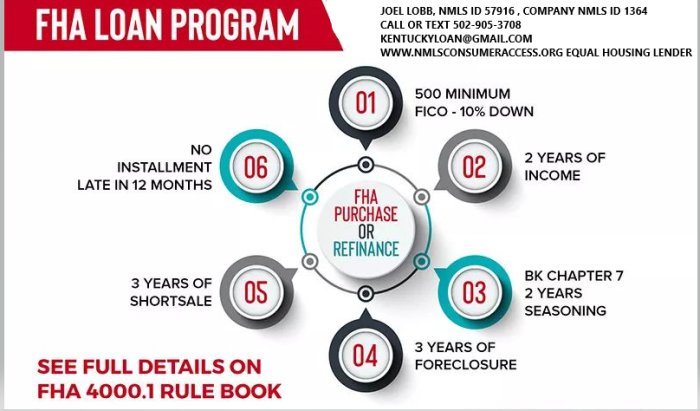
FHA loans require a minimum down payment of 3.5 percent for borrowers with credit scores of 580 or higher.

Borrowers with credit scores between 500 and 579 are limited to a maximum loan-to-value of 90 percent, requiring a minimum 10 percent down payment. In practice, most lenders apply overlays requiring higher credit scores, typically between 580 and 620, even though HUD technically allows lower scores.

Down payment funds must come from an approved source. Acceptable sources include personal savings, retirement account loans or withdrawals, and properly documented gift funds. Large or undocumented cash deposits are not allowed and remain one of the most common reasons for FHA loan delays or denials in underwriting.

Occupancy and Property Use

FHA loans are for primary residences only. The borrower must occupy the property as their primary home and move in within 60 days of closing. FHA financing may not be used for rental properties or investment homes.

Appraisal and Property Standards

The property must be appraised by a Kentucky-licensed, FHA-approved appraiser. The home must meet HUD’s minimum property standards, meaning it must be safe, sound, and secure.

Common appraisal concerns include peeling paint, exposed wiring, missing handrails, roof condition, and health or safety hazards. Most FHA appraisal issues are correctable prior to closing.

Debt-to-Income Ratio Guidelines

FHA evaluates two debt ratios:

The housing ratio (front-end), which includes principal, interest, property taxes, homeowners insurance, mortgage insurance, and HOA dues, is typically capped at 31 percent of gross monthly income.

The total debt ratio (back-end), which includes the housing payment plus all other monthly obligations reported on credit, is typically capped at 43 percent.

However, borrowers receiving an “Approve/Eligible” finding through FHA’s automated underwriting system may qualify with higher ratios, depending on credit scores, cash reserves, and other compensating factors.

Credit Score and Credit History Requirements

The minimum FHA credit score for maximum financing remains 580 in 2026. This does not guarantee approval, as lenders apply additional underwriting standards and overlays.

Borrowers must demonstrate acceptable recent payment history. FHA places significant weight on the most recent 12 months of credit performance.

Bankruptcy and Foreclosure Guidelines

Chapter 7 bankruptcy requires a minimum waiting period of two years from discharge, with re-established good credit and on-time payments afterward.

Chapter 13 bankruptcy may be eligible after at least 12 months of on-time plan payments, with trustee approval, and the borrower must qualify including the Chapter 13 payment.

Foreclosure generally requires a three-year waiting period from the date of foreclosure completion. Exceptions may be considered only for documented extenuating circumstances beyond the borrower’s control. Job relocation alone does not qualify as an extenuating circumstance.

Federal Debt and CAIVRS Requirements

Borrowers may not have delinquent federal debt, defaulted federal student loans, unpaid federal judgments, or unresolved FHA claims.

Lenders are required to check the CAIVRS (Credit Alert Interactive Voice Response System) database for all federally backed loans, including FHA, VA, USDA, and SBA loans. Title 31 of the U.S. Code prohibits delinquent federal debtors from receiving federal loan insurance or guarantees.

If a CAIVRS alert appears, the debt must be resolved or paid in full before closing.

FHA Gift Fund Rules for Down Payments

FHA permits gift funds for down payments and closing costs, provided there is no expectation of repayment.

Acceptable gift sources include relatives, employers, labor unions, close friends with a documented relationship, charitable organizations, and government or public entities.

Unacceptable gift sources include the seller, real estate agents, brokers, builders, or any party with a financial interest in the transaction.

A proper gift letter is required, stating that repayment is not expected. The donor must provide identifying information and documentation showing the transfer of funds from their account to the borrower.

Government and Employer Assistance Programs

Borrowers without access to family gift funds may qualify for state, local, or employer-assisted housing programs that provide down payment or closing cost assistance. In Kentucky, FHA loans can often be paired with Kentucky Housing Corporation (KHC) down payment assistance programs, subject to income limits and program availability.

How FHA Loans Are Used in Kentucky

FHA does not directly lend money. Instead, it insures loans made by FHA-approved lenders. These loans are designed for borrowers with limited down payment funds, past credit challenges, or non-traditional credit profiles.

Many Kentucky borrowers who do not qualify for conventional financing are still able to achieve homeownership through FHA-insured loans at competitive interest rates.

Pros and Cons of FHA Loans

Advantages include low down payment requirements, flexible credit standards, and the ability to combine FHA loans with down payment assistance programs.

Disadvantages include mandatory mortgage insurance. FHA charges an upfront mortgage insurance premium of 1.75 percent of the loan amount, which can be financed, and an annual mortgage insurance premium that ranges from approximately 0.45 percent to 1.05 percent depending on loan term, loan-to-value, and origination date. This annual premium is paid monthly and, in most cases, remains for the life of the loan unless refinanced.

Final Thoughts for Kentucky Homebuyers in 2026

FHA loans continue to be a practical, reliable option for Kentucky homebuyers who need flexibility without sacrificing long-term stability. While FHA guidelines are forgiving compared to conventional loans, preparation matters. Clean documentation, stable income, responsible credit behavior, and proper sourcing of funds are essential to a smooth approval.

Working with an experienced Kentucky FHA lender can help you navigate overlays, improve credit positioning, and pair FHA financing with available assistance programs.


Joel Lobb
NMLS #57916
Text or Call 502-905-3708
kentuckyloan@gmail.com
www.mylouisvillekentuckymortgage.com

Company NMLS #1738461
Equal Housing Lender

Information is provided for educational purposes only and does not guarantee loan approval. All loans are subject to underwriting guidelines, program availability, and lender approval.

What does Identity Of Interest mean for FHA Loans?

Does FHA Restrict down payment requirements on Identity of Interest Transactions?

The 85 percent maximum LTV restriction does not apply for Kentucky FHA Loans in regards to FHA Identity-of-Interest transactions under the following circumstances:

👇👇👇

FAMILY MEMBER TRANSACTIONS•  the principal residence of another family member; or  a property owned by another family member in which the borrower has been a tenant for at least six months immediately predating the sales contract. A lease or other written evidence to verify occupancy is required.

BUILDER’S EMPLOYEE PURCHASE• An employee of a builder, who is not a family member, purchases one of the builder’s new houses or models as a principal residence.

CORPORATE TRANSFER • A corporation transfers an employee to another location, purchases the employee’s house, and sells the house to another employee.

TENANT PURCHASE• the current tenant purchases the property where the tenant has rented the property for at least six months immediately predating the sales contract. A lease or other written evidence to verify occupancy is required.

Source: FHA Handbook 4000.1

What You Need To Know About Identity Of Interest Transactions
 
10602 Timberwood Circle Suite 3
Louisville, KY 40223


Text/call 502-905-3708
kentuckyloan@gmail.com

http://www.nmlsconsumeraccess.org/
If you are an individual with disabilities who needs accommodation, or you are having difficulty using our website to apply for a loan, please contact us at 502-905-3708.
Disclaimer: No statement on this site is a commitment to make a loan. Loans are subject to borrower qualifications, including income, property evaluation, sufficient equity in the home to meet Loan-to-Value requirements, and final credit approval. Approvals are subject to underwriting guidelines, interest rates, and program guidelines and are subject to change without notice based on applicant’s eligibility and market conditions. Refinancing an existing loan may result in total finance charges being higher over the life of a loan. Reduction in payments may reflect a longer loan term. Terms of any loan may be subject to payment of points and fees by the applicant  Equal Opportunity Lender. NMLS#57916http://www.nmlsconsumeraccess.org/
— Some products and services may not be available in all states. Credit and collateral are subject to approval. Terms and conditions apply. This is not a commitment to lend. Programs, rates, terms and conditions are subject to change without notice. The content in this marketing advertisement has not been approved, reviewed, sponsored or endorsed by any department or government agency

5 Things I Wish I’d Knew Before Getting an FHA Mortgage

FHAdownpaymentsKentucky FHA Loan Requirements

Kentucky FHA Mortgage Loans with Private Flood Insurance

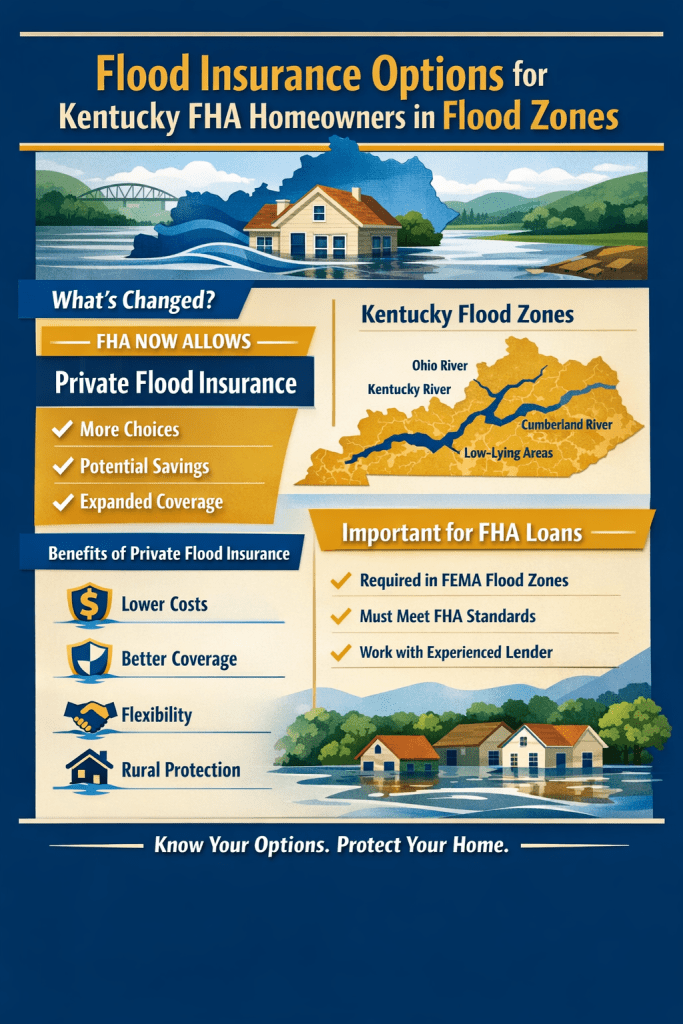
HUD INCREASES FLOOD INSURANCE OPTIONS FOR KENTUCKY HOMEOWNERS WITH KENTUKY FHA MORTGAGES LIVING IN FLOOD AREAS

Federal Housing Administration to allow private flood insurance policies on insured single-family mortgages in special flood hazard areas

WASHINGTON – The U.S. Department of Housing and Urban Development (HUD), through the Federal Housing Administration (FHA), is announcing today that effective December 21, 2022, it will allow homeowners with FHA-insured mortgage financing to obtain flood insurance policies that conform to FHA requirements from private insurance providers. The change was announced through a final rule published in the Federal Register today and in a companion Mortgagee Letter, also published today, that provides implementation guidance for FHA-approved lenders.

FHA requires that insured mortgages for properties in Federal Emergency Management Agency (FEMA)-designated Special Flood Hazard Areas (SFHAs) have flood insurance. Previously, only flood insurance obtained through the National Flood Insurance Program (NFIP) was permissible for FHA-insured mortgages, which limited choices for consumers.

“Today, HUD is increasing the flood insurance choices available to individuals and families with FHA-insured loans in areas that FEMA has designated to be at special risk for flooding,” said HUD Secretary Marcia L. Fudge. “Flood insurance is required to ensure families and individuals are prepared if disaster strikes. Increasing consumer options for this important protection is one way we are building more resilient communities in the face of climate change.”

“We know borrowers face affordability challenges right now, yet a flood can be devastating to a family who is not properly insured,” said Federal Housing Commissioner Julia Gordon. “The choice to select a private flood insurance option may enable some borrowers to obtain policies that are less expensive or provide enhanced coverage.”

As part of its implementation, as of December 21, 2022, FHA will require lenders to provide detailed flood insurance coverage information when electronically submitting mortgages for FHA insurance on properties in SFHAs. This data collection is an objective included in HUD’s Climate Action Plan and will allow FHA to capture and analyze flood insurance information on mortgages in its portfolio at a more granular level than has been possible previously.

Ensuring that borrowers are protected against flood risk is a key component of HUD’s Climate Action Plan. In 2021, HUD released its Climate Action Plan in response to President Biden’s Executive Order on Tackling the Climate Crisis at Home and Abroad. HUD has been implementing this broad approach to the climate crisis that reduces climate pollution; increases resilience to the impacts of climate change; protects public health; delivers environmental justice; and spurs well-paying union jobs and economic growth. The action today further guides the integration of climate resilience and environmental justice into HUD’s core programs and policies. For more information about HUD’s work to advance sustainable communities and address climate change, visit hud.gov/climate.

#fha #fhaloans #fhaloan #floodinsurance #mortgage #homeloan #homebuying #homebuyingtips

Kentucky FHA Mortgage Loan Lender Guidelines

KENTUCKY FHA MORTGAGE GUIDELINES FOR 2020

  • FHA – 620+ Min Fico Approve Eligible / NO OVERLAYS-NONE!
  • FHA – 620+ FICO for PURCH, RT, C/O including Flips & High Balance
  • FHA – 640+ REFERS OK!—no overlays -u/w directly to 4000.1
  • FHA – 640+ MANUALS up to 50% DTI (with 2 comp factors)
  • FHA – 620+ No DTI CAP – Follow AUS Findings!!! (with approved eligible)
  • FHA – 620+ NO Minimum Credit History or Trades with AUS Approval!
  • FHA – 620+ – No VOR Unless Required by DU Findings!
  • FHA – Transfer appraisals from ANY lender/AMC OK!
  • FHA – ORDER YOUR APPRAISAL FROM 20+ AMCs YOU CHOOSE!
  • FHA – Collections – HUD Guides Apply –
  • FHA – Mortgage Lates OK if AUS Approved!!!
  • FHA – ESCROW STATE – Non Purchasing Spouse derogs ignored – only affects DTI
  • FHA – Borrower w/ Work Permits, Non-Resident Alien OK!
  • FHA – 1 Day off Market for Cashout Refi! – Must be off market before date of loan application!
  • FHA – Rental Income on 2-4 units ok FTHB
  • FHA – STREAMLINE – 620 Minimum 
  • FHA – Streamline – 620 Score – No Appraisal, No Income, No AVM, No Credit Qualifying!!!
  • FHA – Streamline -Investment and 2nd Homes OK!
  • FHA – Streamline – Mtg only on subject property only!

Lending 101: FHA Loans In Kentucky

Lending 101: FHA Loans In Kentucky

Kentucky FHA loans are great loan program that is not just for first-time buyers!

Here are some of our favorite features of Kentucky FHA loans:

  1. Low down payment – FHA requires 3.5 % down. For qualified buyers, this money may be able to be gifted from a family member.
  2. No income limits – There are no income limits placed on the borrower or the household.
  3. Credit scores – Interest rates and underwriting requirements are less credit score sensitive than other loan programs. In some scenarios, we are able to lend to buyers with scores in the mid-500s. *Note: Credit scores under 580 will require a 10% down payment.
  4. Manufactured homes – No problem with FHA! Manufactured homes must be on a permanent foundation and have been built after June 1976.
  5. Rehab loans – Utilizing the FHA 203K program, we can do purchase and refinance loans that roll the cost of rehabs or repairs into the loan amount.
  6. No geographic restrictions – FHA loans can be done anywhere,
  7. Generous Debt-to-Income Ratios – For most buyers, FHA allows for a higher debt load than other programs. FHA may be the only program for some borrowers with high credit card and/or student loan debt.
  8. Non-Occupant Co-Borrowers – FHA is one of the few programs that allow non-occupant co-borrowers. While a non-occupant co-borrower cannot help in scenarios where a buyer has a low score and cannot qualify on their own, it is a great solution for buyers who have low income or income that can’t be documented.

Want to learn more about FHA loans? Contact any member of our team today, reply to this email, or give us a call at 502-905-3708 and ask to speak to a mortgage loan originator.

Student Loans In Collections, What Can I Do to get Approved For A Kentucky Mortgage ?

Student Loans In Collections, What Can I Do?
If you have public student loans in collections, you really have three options to resolve it so it is not a CAIVRS issue.
1.      Pay it off in full – Not typically an option because very rarely do the clients have the funds to do so.
2.      Consolidation – Only takes about 90 days to consolidate and resolve CAIVRS issues. However, you push forward the last activity dates, DLA, and also introduce a new credit trade line that dilutes the length of the credit history. So you will normally see a drop in credit score.
3.      Rehabilitation – It is the slowest of all the options, but is the best thing for the clients’ credit scores. It is a 9 month commitment and once the client makes 9 consecutive payments, they will change the collection status to a good standing status. This will typically net a 40-100 point boost in the score depending on how many other collections are on the credit report.
If your client does not know who is servicing the student loan, they can contact the Student Loan Default Resolution Team at 1-800-621-3115 or visit the website at myeddebt.ed.gov
Bonus Tip: Private student loans do not adhere to consolidation or rehabilitation rules. If the client has private student loans in collections they will need to pay them off in full, or they will need to set up a payment plan on them. They will still remain in collections with a payment, but if you can get a qualified credit score you can push forward the loan including the liability payment towards the debt to income ratio.
As always, we bring you the best content so you can do what you do best, CLOSE LOANS! If you aren’t already sending us every credit challenged borrower you have, what is stopping you?
Guidelines for KY FHA, VA, USDA and VA Mortgage loans with Student Loans on A Credit Report:
Kentucky Fannie Mae or Conventional Guidelines for Student Loans:
  • If a monthly payment is on the credit report, the lender may use that amount for qualifying purposes.
  • If a monthly payment is on the credit report is incorrect, the lender may use the monthly payment on the most recent student loan statement
  • If the monthly payment on the credit report is zero, the lender must use one of the following options to calculate the payment for qualifying purposes
  1. Document the borrower is on an income driven payment plan and the actual monthly payment is zero
  2.  Use 1% of the outstanding student loan balance as the monthly payment
  3. Calculate a fully amortized payment using documented loan repayment terms
Kentucky FHA Mortgage Loans Guidelines:
Regardless of the payment status (currently in payment or deferred), the lender must use either:
  • The greater of:
  1. 1% of the outstanding balance; or
  2. The monthly payment reported on the credit; or
  •  Calculate a fully amortized payment using documented loan repayment terms
Kentucky USDA or Rural Housing Guidelines:
 
 
Regardless of the payment amount reporting on the credit, the lender must include the payment as follows:
  • A permanent amortized, fixed payment may be used in the debt ratio when the lender retains documentation to verify the payment is fixed, the interest rate is fixed, and the repayment term is fixed.
  • Payments for deferred loans, Income Based Repayment (IBR), Graduated, Adjustable, and other types of repayment agreements which are not fixed cannot be used in the total debt ratio calculation. One percent of the loan balance reflected on the credit report must be used as the monthly payment. No additional documentation is required.
Kentucky  VA Mortgage Guidelines for Student Loan:
  • If the borrower can document the student loan will be deferred 12 months from the closing date, the monthly payment does not need to be considered
  • If a student loan is in repayment or scheduled to begin repayment within 12 months from the closing date, the threshold payment amount must be calculated by  using 5% of the loan balance divided by 12 months
  • If the payment reporting on the credit report is greater than the threshold payment calculation amount, then the credit report payment must be used for ratios.
  • If the payment reporting on the credit report is less than the threshold payment calculation and the lender is using the lower payment to qualify the borrower then:
  1. A statement from the student loan servicer reflecting the actual loan terms and payment information must be included in the file.
  2. The statement must be dated within 60 days of closing
  3. It is the underwriter’s discretion to use the lower payment

As you can see, Fannie Mae or Conventional loans is the most lenient when it comes to qualifying for a mortgage loan with someone that has a lot of student loans on their credit report.


How long do you have to wait to get approved for a mortgage loan after a bankruptcy in Kentucky?

GETTING A MORTGAGE LOAN IN KENTUCKY WHEN YOU HAVE HAD A BANKRU
ARE YOU CURRENTLY IN A CHAPTER 13 BANKRUPTCY OR HAD A CHAPTER 7 BANKRUPTCY IN THE PAST?

Qualifying For A Kentucky Mortgage After Bankruptcy

Home Buyers can qualify for a Kentucky mortgage after bankruptcy:

  • 2 year waiting period to qualify for FHA Loan to qualify for a FHA Loans after discharge of Chapter 7.
  • One year into a Chapter 7 Bankruptcy to qualify for a Chapter Loan into a Chapter 13 Bankruptcy repayment plan.
  • No waiting period after a Chapter 13 Bankruptcy discharge date.
  • 4 year waiting period to qualify for a Chapter 7 Bankruptcy discharge date to qualify for a Conventional Loan.
  • Two year waiting period to qualify for a Chapter 13 after Chatper 13 discharged date to qualify for a Conventional Loan.
  • Four year waiting period to qualify for a Conventional Loan if you had a mortgage part of bankruptcy but the foreclosure needs to be be finalized

Bankruptcy Chart for FHA, VA, USDA and Fannie Mae Guidelines for Chapter 7, Chapter 13 and Foreclosure and Short Sale

Joel Lobb (NMLS#57916)
Senior  Loan Officer
 
American Mortgage Solutions, Inc.
10602 Timberwood Circle Suite 3
Louisville, KY 40223
Company ID #1364 | MB73346


Text/call 502-905-3708
kentuckyloan@gmail.com

Disclaimer: No statement on this site is a commitment to make a loan. Loans are subject to borrower qualifications, including income, property evaluation, sufficient equity in the home to meet Loan-to-Value requirements, and final credit approval. Approvals are subject to underwriting guidelines, interest rates, and program guidelines and are subject to change without notice based on applicant’s eligibility and market conditions. Refinancing an existing loan may result in total finance charges being higher over the life of a loan. Reduction in payments may reflect a longer loan term. Terms of any loan may be subject to payment of points and fees by the applicant  Equal Opportunity Lender.

Five strategies for first time home buyers Kentucky 2018

What You Need To Know About A Mortgage… BEFORE You Get One!!!

Qualifying for a Mortgage

Home LoansMortgage companies are in business to make money by lending money that is secured by an asset large enough to sell and recover their capital if the borrower is no longer able or willing to pay the payments. They are not in the business of owning property and would rather not have to foreclose on a loan, repossess the property and sell it to recapture their capital. This does happen but it is not their primary business. They would rather have their borrowers make their payments so that they could collect the interest and move on down the road. To increase their odds of that happening, mortgage companies look at several areas of your financial history to determine if you will meet their standards. This is called Qualifying for a Mortgage.

What the mortgage company finds when they look at these areas will help determine the type of mortgage that is available to you and the interest rate you will pay on the money that you borrow.

The areas that they are interested in looking at are:

Job History

Lenders want to know if you have been in your current job and/or profession for at least two years. They also want to know if you are retired or self-employed.

Income

TaxesMortgage lenders want to know how much your monthly income is before taxes are taken out (Gross Monthly Income). Typically you will be asked to provide check stubs for the last 30 days and Federal Tax Returns or W-2’s for the last two years to prove your income.

If you are self-employed and it is difficult for you to prove your gross income to the lender you may be able to get a “stated income” loan. If that is the route that you take, your income must be “reasonable” for your profession. Since stated income loans are riskier for the lender you will generally have a higher interest rate.

Credit History

Mortgage lenders really like it if you have a history of paying your bills on time. This is reflected in your credit report and FICO score. If you have “bad credit”, you are NOT automatically disqualified from getting a mortgage. Lower credit scores will increase the interest rate that you will be required to pay and sometimes that increase will be quite significant.

Debt Load

You can have an awesome job with an income to make Bill Gates jealous and a great credit score but if you have already acquired too much long term debt you may not qualify for the loan you want.

Assets

Mortgage lenders will want to check your bank accounts to make sure that you have the cash necessary to pay the down payment and closing costs and that you have “reserves” available to make the loan payment. Often, the lender will require 3-6 months reserves. (Reserves can be in a 401K or other retirement account that you can pull the money out of)

Requested Loan Amount

The loan you are requesting will need to be proportional to your ability to make the payments. Be reasonable with your house buying expectations – don’t expect to buy a lot more house than you can afford. The recent housing bust defined the term “house poor” and got a lot of people into financial trouble. Again, mortgage lenders would much rather you make your monthly house payments because everyone loses if they have to foreclose.

Determining YOUR Mortgage Interest Rate

The market place determines the range of interest rates available for any mortgage and the lending rates change daily. The specific interest rate you will pay is based on how well qualified you are and the type of loan you want.

Interest rates are typically based on the answers to these questions:

How Good Is Your Credit Score? 

FICO ScoreThe most widely used score is the FICO score, the credit score created by Fair Isaac Corporation. Lenders use the FICO Score to help them make billions of credit decisions every day. Fair Isaac calculates the FICO Score based solely on information in consumer credit reports maintained by the credit reporting agencies.

FICO credit scores range from 300 to 850. That FICO Score is calculated by a mathematical equation that evaluates many types of information from your credit report, at that agency. By comparing this information to the patterns in hundreds of thousands of past credit reports, the FICO Score estimates your level of future credit risk.

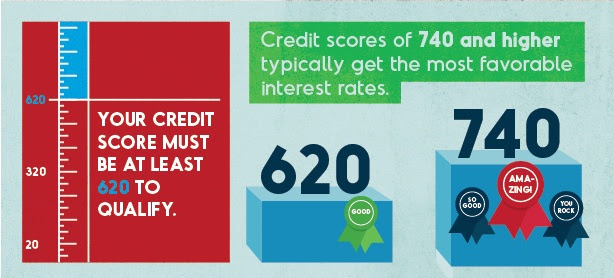
With the top end of the credit score being 850, anything above about 720 is considered excellent. Some local lenders set 740 as the benchmark for their preferred interest rates. Having a lower credit score DOES NOT mean you will not get a loan. You may qualify BUT your interest rate will be higher than someone with better credit.

How Big Is Your Down-Payment?
The Down-Payment is the amount of your own money you are going to put into buying the property. The more money you put into the property on the front end, the lower the risk of you not paying the payments. The amount of your down payment also directly affects the amount of your loan (purchase price – down payment = loan amount). This is called the Loan to Value Ratio (LTV).

The LTV is the percentage of the value of the house that the mortgage will cover (loan amount / purchase price x 100). For example, the property you are interested in buying is selling for $100,000. You have $20,000 for the down-payment and want a mortgage for the other $80,000. The LTV for this mortgage is 80%.

Similar to the LTV is the Combined Loan to Value Ratio (CLTV). The CLTV is used when 2 loans are used to finance the home purchase. You may see or hear terms like “80-20” or “80-15-5”. This refers to the 1st lien percentage (80), the 2nd lien percentage (20 or 15) and the down payment percentage (5).

How Much Debt Do You Currently Have?

It only makes sense that the more debt you have the riskier the loan is for the lender. There is a finite amount of income in all of our households and it all gets allocated every month. Lenders use a “debt-to-income” ratio to determine how qualified you are for the loan based on how much debt you already have.

Your Debt to Income Ratio (DTI) is the percentage of your income that you owe in debt on a monthly basis. For example, if you make $5,000 per month, and have debt payments (car loans, credit cards, student loans, etc.) of $2,000, your DTI ratio is 40%. The higher this ratio is, the less likely you will be to qualify for a low interest rate.

Conventional loans typically have a qualifying ratio of 28/36. FHA loans will sometimes allow for a higher debt load of 29/41 qualifying ratio.

The first number in a qualifying ratio is the maximum percentage of your gross monthly income that can be applied to your mortgage. That includes the loan principal and interestprivate mortgage insuranceproperty taxeshomeowners insurance, and homeowner’s association dues.

The second number is the maximum percentage of your gross monthly income that can be applied to housing expenses and recurring debt. Recurring debt includes monthly payments for carsboatsmotorcycleschild support payments and monthly credit card payments.

 Example:  of a 28/36 qualifying ratio:

Gross monthly income of $5,000 x .28 = $1400 can be applied to housing.

Gross monthly income of $5,000 x .36 = $1,800 can be applied to recurring debt plus housing expenses

Example: of a 29/41 qualifying ratio:

Gross monthly income of $5,000 x .29 = $1,450 can be applied to housing.

Gross monthly income of $5,000 x .41 = $2,050 can be applied to recurring debt plus housing expenses

These are just general guidelines and everyone’s personal finances are unique.

 

Here is a KEY point to remember…

Your credit score is one of the most vital piece of information when qualifying for a loan and you can greatly affect it too. 

Below are the important items I will discuss:

  • What is a credit report?
  • What do mortgage lenders use to determine my credit score?
  • What does FICO stand for?
  • What determines my FICO score?
  • What’s a good FICO score?
  • What if my FICO score is below 620?
  • Can I get a copy of my credit report?
  • Ah Ha! Now I understand all things credit and I’m this much closer to owning my home!

What is a credit report?

A credit report record’s your credit history including information about:

  • Your identity: name, social security number, date of birth and possibly employment information.
  • Your existing credit: credit card accounts, mortgages, car loans, students loans etc.including credit terms, how much you owe, and your payment history.
  • Your public record: Judgments against you, tax liens or bankruptcies.
  • Recent Credit Inquiries: Requests for your information from companies extending credit such as credit card companies, auto loans, etc.

Be aware, credit card companies, car companies and mortgage lenders use slightly different models to determine credit risk. Today we are focusing on Mortgage related credit.

How do lenders calculate my credit score?

Your credit score is the key to your castle. Your home is most likely the most expensive purchase you will ever make. Therefore, when buying a home, lenders use a different system for assessing risk than credit card companies or even auto loan companies use.

Mortgage lenders use a comprehensive system of checking credit called a Residential Mortgage Credit Report (RMCR), commonly called a “Tri-Merge” report. The RMCR report combines your three credit reports from the three national credit bureaus, Equifax, Experian, and TransUnion. Each credit reporting agency calculates your credit score or FICO Score differently. Therefore, pulling from all three bureaus gives lenders a more complete picture of your credit behavior.

Once pulled, lenders use the average of these three scores, usually the middle score, to determine loan qualification and interest rate. For example, if Equifax gives you a 720, Experian a 730 and TransUnion a 740, the lender will use the 730 FICO Score to help determine the terms of your mortgage. If you are applying for a loan jointly, your partner’s three reports will also be pulled.

What does FICO stand for?

FICO stands Fair, Isaac and Company. Over 25 years ago, lenders began using FICO’s scoring model, or algorithm, to fairly and more accurately determine a person’s credit risk. Since it’s inception, FICO’s continually updates its’ algorithms to reflect more current lending trends and consumer behaviors. Today, FICO Scores are used by over 90% of enders. Importantly, your FICO score can impact your loan interest rates, terms, approvals and more.

What determines my FICO score?

A Mortgage FICO score is determined by an algorithm that generally looks at five credit factors including payment history, current level of indebtedness, types of credit used, length of credit history and new credit accounts.

What’s a good FICO score?

To qualify for a conventional loan, most Mortgage lenders require a FICO score of 620+. The best interest rates go to borrowers with a 740+ FICO score. For each 40 point drop, borrowers can expect to see a slightly higher interest rates by about 0.2 percentage points.  If a borrower drops below 660, the increase is likely to be twice as big, a 0.43 percentage point increase. If your credit score is below 620, it is very difficult to get a conventional loan in today’s marketplace. However, don’t be discouraged. You may still be able to buy a home.
Qualifying Credit Scores

What if my FICO or credit score is below 620?

If your score is below 620, you may still be able to buy a home. There are several options:

  • Put more money down. Some lenders offset a weak credit score with a higher down payment. A higher down payment gives you more equity in your home, lowering the lender’s risk.
  • You may qualify for a non conventional government issued loan such as an FHA, Veterans Affairs and/or U.S. Department of Agriculture loan which have less stringent lending requirements.
  • You may work to get that credit score up!
    • Correct any errors on your report. Analyze your credit items line by line. If you notice a mistake, dispute it right away with either the credit bureau providing the report or the company that providing the incorrect information to the credit bureau.
    • Make all your payments on time. Late payments are the No. 1 way to lower  your credit score.
    • Pay down revolving debt. Keeping your credit balances low helps to raise your score.
    • Sit back and relax. As long as you’re paying down debt and making payments on time, your credit score will eventually rise on its own.

Can I get a copy of my credit report after a lender has pulled it?

Yes! In fact, you can get one free credit report every twelve months from each of the nationwide credit bureaus—Equifax, Experian, and TransUnion. You may also purchase your credit score at any time from any of the credit bureaus. Some Mortgage lenders will tell you your score when you apply for a loan or even give you a copy of your report but they are not required to do so. However, if a lender denies you credit, under the Fair Credit Reporting Act (FCRA) you are entitled to a free copy of your personal credit report if you have received notice that in the past 60 days you have been declined credit.

You ALWAYS get a free copy of your credit report from me.

If you’re ready to buy a new home and want to shop around for the best deal on a mortgage…

Looking for a mortgage, auto or student loan may cause multiple lenders to request your credit report, even though you are only looking for one loan. To compensate for this, the score ignores mortgage, auto, and student loan inquiries made in the 30 days prior to scoring. So, if you find a loan within 30 days, the inquiries won’t affect your score while you’re rate shopping. In addition, the score looks on your credit report for mortgage, auto, and student loan inquiries older than 30 days. If it finds some, it counts those inquiries that fall in a typical shopping period as just one inquiry when determining your score. For FICO scores calculated from older versions of the scoring formula, this shopping period is any 14 day span. For FICO scores calculated from the newest versions of the scoring formula, this shopping period is any 45 day span. Each lender chooses which version of the FICO scoring formula it wants the credit reporting agency to use to calculate your FICO score.

What Type of Loan Are You Looking For?

40 year fixed, 30 year fixed, 20 year fixed, 15 year fixed, 10 Year Fixed, Adjustable Rate, etc. All of these loan types have different interest rate ranges.

Locking Your Interest Rate

Once you have completed a loan application, determined what type of loan you want and qualified for that loan you can “lock” the interest rate for that loan. Locking the Interest Rate means, for the period of the “lock” you are guaranteed that interest rate. Lock periods are typically 15, 30 or 60 days, although you may be able to get an extended lock period.

Once you lock your interest rate:

If you do not close on the loan before the lock period expires, you will NOT have a guaranteed interest rate anymore. And, the longer the lock period, the higher the rate will be. For example, a 15 day lock may be at 5.125%, a 30 day lock at 5.25%, and a 60 day lock at 5.375%. So, before locking your loan, be sure you are not locking for too long a time or for too short a time.

Interest rates fluctuate daily and may go up or down. By locking your rate, you are betting that rates will go up in the future.

 What does “Buying Down” the Interest Rate Mean?

You can reduce the interest rate on your mortgage by paying “points” at closing. A point is 1% of the value of the loan, so a point on a $200,000 loan is $2,000. If you “buy down” you loan to a lower interest rate you will have lower monthly payments and pay less interest over the life of the loan. However, “buying down” you loan to a lower interest rate means more money out of your pocket on the front end when you close the loan. You should do the math and weigh each side of the equation before making a decision about buying down the interest rate or not.

http://www.emailmeform.com/builder/form/0bfJs9b6bK8TGoc6mQk9hIu


What Are The Closing Costs and Fees?

There are four types of closing costs and fees…

Those charged by the mortgage company and/or mortgage broker, those charged by 3rd party vendors, those charged by the Title Company, Escrow Company or Escrow Attorney and Pre-Paid Charges.

Lender Fees

These can include loan origination fees and Broker fees which are usually a percentage of the loan amount; administrative fees and application fees, processing fees and underwriting fees. These last fees usually run from $100 to $500, and ALL of them are negotiable.

3rd Party Vendor charges

These are charges collected by the lender and paid to outside companies that provide a service. These are not usually negotiable and can include appraisal charges, flood certification fees, courier charges, document prep fees, mortgage lender attorney fees, etc.

Title Company charges

These are the fees charged by the Title Company, Escrow Company or Escrow Attorney. They are usually set by the state and are not negotiable. These charges include title insurance, attorney fees, state/county/city registration fees, etc.

Pre-Paid Charges

If the lender will be establishing an escrow account to pay taxes and insurance, the buyer will pre-pay taxes and insurance to establish an escrow account and will pre-pay the interest on the loan until the end of the month in which the loan closes.

 Does The Closing Date Really Matter?

The day you choose to close determines the amount of pre-paid interest you will have to pay. Closing at the end of the month means that you will pay less pre-paid interest. For example, if you close on October 1st you will pay 31 days of pre-paid interest. If you close on October 31st you will pay 1 day of pre-paid interest.

When Is My First Payment Due?

It doesn’t matter what day of the month you close on, you will not have your first loan payment due until a month has passed. So, if you close in October, your first payment is due in December – you get November for free!

What Is PMI?

Private Mortgage Insurance (PMI) is required on all loans that have a LTV greater than 80%. PMI is an insurance premium that you pay every month as part of your monthly payment. However, PMI is not intended to protect you. PMI is insurance coverage that protects the mortgage lender against default on the loan. If you stop making your payments, the mortgage lender is paid a percentage of the loan amount (usually 25% to 35%) by the insurance company.

We suggest that our clients use a local mortgage lender and avoid the big banks. Local lenders provide excellent service, you talk to the same person throughout the loan process, if something is (or isn’t) happening with the loan they can easily check on it with someone right there in their office.

What Other Questions Do You Have?

http://www.emailmeform.com/builder/form/0bfJs9b6bK8TGoc6mQk9hIu

If you have mortgage questions, ask them in the comments section so others will get the answer too.

If you want a personalized answer for your unique situation call, text, or email me.


The view and opinions stated on this website belong solely to the authors, and are intended for informational purposes only. The posted information does not guarantee approval, nor does it comprise full underwriting guidelines. This does not represent being part of a government agency. The views expressed on this post are mine and do not necessarily reflect the view of my employer. Not all products or services mentioned on this site may fit all people. NMLS ID# 57916, (www.nmlsconsumeraccess.org). Mortgage loans only offered in Kentucky.


http://www.emailmeform.com/builder/form/0bfJs9b6bK8TGoc6mQk9hIu
Labels: 100% Financing, 2017 KY First Time Buyer Programs, conventional loans, down payment assistance, fha, First Time Home Buyers, grants first time home buyer kentucky, kentucky va mortgage, khc, rhs, usda

Fill out my form!


Posted By Blogger to Kentucky First Time Home Buyer Mortgage Loans