FHA vs. Conventional Loans: A Kentucky Homebuyer’s Guide

FHA vs. Conventional Loans: Which Is Better for Kentucky Homebuyers?

Compare FHA and conventional loans for Kentucky homebuyers. Learn credit requirements, down payments, mortgage insurance, and which loan fits your situation.

When comparing FHA loans vs conventional loans in Kentucky, the decision comes down to four core factors: credit score, down payment, debt-to-income ratio, and mortgage insurance. Both loan programs are widely used across Louisville, Lexington, Northern Kentucky, and rural areas, but they serve very different borrower profiles.

FHA Loans: Built for Flexibility

Kentucky FHA loans are designed for buyers who need more flexibility. FHA financing is often a strong option for borrowers with credit scores under 680, limited savings, or little to no cash reserves after closing. FHA also allows buyers to qualify sooner after major credit events, including foreclosures that are three to seven years old and short sales that occurred two to four years ago.

Another major advantage of FHA loans in Kentucky is gifting. The entire down payment and most closing costs can be covered with gift funds from approved sources. This makes FHA especially popular with first-time homebuyers and buyers using down payment assistance programs.

FHA Mortgage Insurance (MIP) Breakdown:

  • Upfront mortgage insurance premium: 1.75% of loan amount (rolled into the loan)
  • 30-year loans with less than 5% down: 0.85% annually
  • 30-year loans with 5%+ down: 0.80% annually
  • 15-year loans: 0.45% to 0.70% annually (depending on down payment)

Conventional Loans: For Stronger Credit

Kentucky conventional loans are best suited for borrowers with stronger credit and more money saved. Conventional financing generally favors buyers with credit scores above 680, at least five percent down, and reserves remaining after closing. Borrowers with foreclosures over seven years old or short sales that occurred five to seven years ago typically fit conventional guidelines more easily.

One of the biggest advantages of conventional loans is mortgage insurance flexibility. Unlike FHA, there is no upfront mortgage insurance premium. Monthly private mortgage insurance can be lower for borrowers with strong credit, and PMI automatically drops off once the loan reaches roughly 80 percent loan-to-value. FHA mortgage insurance, by contrast, usually lasts for the life of the loan when the down payment is less than ten percent.

Quick Comparison Table

Factor FHA Loans Conventional Loans
Credit Score Required 580+ 3.5% down payment (some lenders 500+ 10% down payment) 720+ typically
Down Payment 3.5% (with 580+ score) 3-5% minimum, typically 5%
Mortgage Insurance Required on all loans (lifetime with <10% down) Only if less than 20% down; drops at 80% LTV
Upfront Insurance Premium 1.75% None
Gift Funds 100% of down payment allowed Limited or restricted
Max Debt-to-Income Up to 56.99% (with compensating factors) Typically 45%
Property Types Owner-occupied only Owner-occupied and investment
Appraisal Standards Stricter More flexible

The Bottom Line

FHA loans are ideal for Kentucky buyers rebuilding credit, using gift funds, or purchasing with limited savings. Conventional loans reward borrowers with stronger credit, larger down payments, and long-term equity goals.

Most homeowners do not keep a mortgage for 30 years. Because many refinance or sell within five to seven years, FHA’s lifetime mortgage insurance is often less of a concern than it appears on paper. In many cases, the lower interest rate and easier approval standards outweigh the insurance cost.

Joel Lobb
Mortgage Broker – FHA, VA, USDA, KHC, Fannie Mae
EVO Mortgage • Helping Kentucky Homebuyers Since 2001
📞 Call/Text: 502-905-3708
📧 Email: kentuckyloan@gmail.com
🌐 Website: www.mylouisvillekentuckymortgage.com
🏠 Address: 911 Barret Ave, Louisville, KY 40204
NMLS #57916 | Company NMLS #1738461
Free Info & Homebuyer Advice →
Kentucky Mortgage Loan Expert
FHA | VA | USDA | KHC Down Payment Assistance | Fannie Mae
Equal Housing Lender. This is not a commitment to lend. All loans are subject to credit approval and program requirements.

Options for Bad Credit Home Buyers in Kentucky

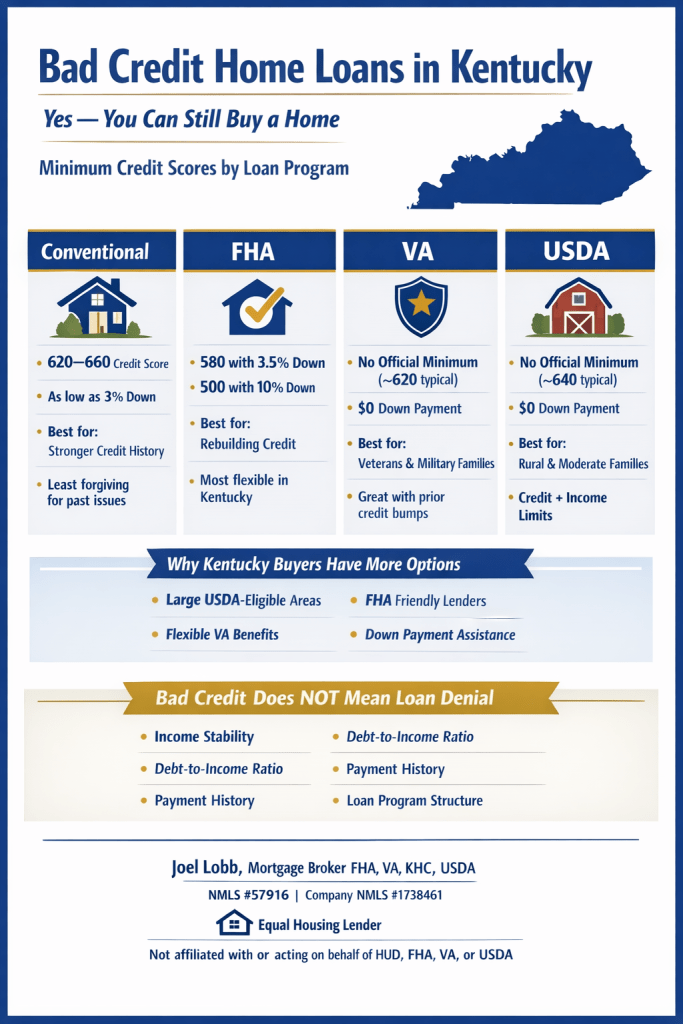
Bad Credit Home Loans in Kentucky

Many Kentucky homebuyers assume a low credit score automatically disqualifies them from buying a home. That assumption is incorrect. Several mortgage programs are specifically designed to help buyers with past credit issues qualify for financing sooner than expected.

In Kentucky, the most common loan options for buyers with bad or fair credit include FHA, VA, USDA, and select conventional loan programs. Each option has different credit score thresholds, down payment requirements, and underwriting flexibility.

Minimum Credit Score Requirements by Loan Type

Conventional loans typically require a minimum credit score between 620 and 660, depending on the program and automated underwriting results. While down payments can be as low as 3 percent, conventional loans are generally the least forgiving when it comes to recent late payments, collections, or limited credit history.

FHA loans in Kentucky are the most common solution for buyers rebuilding credit. FHA financing allows approvals with credit scores as low as 580 with only 3.5 percent down. In limited cases, buyers with scores down to 500 may qualify with a 10 percent down payment, provided the overall risk profile is strong.

Eligible service members and veterans may benefit from VA loans in Kentucky, which do not have an official minimum credit score requirement set by the agency. Most lenders look for scores around 620, but VA loans remain one of the most flexible options available, offering zero down payment and no monthly mortgage insurance.

For buyers purchasing outside major metro areas, USDA loans in Kentucky can provide 100 percent financing with competitive interest rates. While there is no official minimum credit score, most USDA lenders require a 640 score for automated approval, along with meeting income and household eligibility guidelines.

Why Kentucky Buyers Often Qualify With Lower Credit Scores

  • Large portions of Kentucky qualify for USDA rural housing loans
  • FHA loans are widely accepted by Kentucky lenders
  • VA loans provide exceptional flexibility for eligible veterans
  • Down payment assistance programs can be layered correctly with the right loan structure

What Mortgage Underwriters Actually Review

Mortgage approval is based on the full financial picture, not just the credit score. Underwriters evaluate income stability, work history, debt-to-income ratio, recent payment behavior, available assets, and how the loan is structured.

In many cases, a borrower with a lower credit score but strong income stability and clean recent payment history can be a stronger approval than someone with a higher score and excessive debt.

Bottom Line for Kentucky Homebuyers

Bad credit does not automatically mean loan denial. The right loan program, structured correctly from the start, often matters more than the credit score alone. Many Kentucky buyers qualify months or even years sooner than they expect once their options are reviewed properly.

NMLS #57916 | Company NMLS #1738461
Equal Housing Lender.
This is not a commitment to lend. All loans are subject to credit approval and program requirements.

Bad Credit Home Loans in Kentucky

Kentucky FHA Loan Updates: What You Need to Know


Kentucky FHA Loan Guidelines for Credit, Down payment, income,


Kentucky FHA Loans: New Guidelines for Collections & Disputes 2026

Kentucky FHA Loans: New 2026 Guidelines

Collections, Disputes & Judgements Explained

If you’re a Kentucky first-time homebuyer with collections, disputes, or judgements on your credit report, you’re not alone—and you’re not disqualified from homeownership. The Federal Housing Administration (FHA) recently updated its lending guidelines to provide more flexibility and clarity around credit challenges.

Whether you’ve faced financial hardship, billing disputes, or collection accounts, understanding these new FHA rules could be the key to securing your Kentucky mortgage.

📋 Effective Date: All loans with case numbers assigned on or after September 9th, 2026

Understanding FHA Loans with Bad Credit, Disputes & Collections

What Are Disputed Accounts on Your Credit Report?

A disputed account appears on your credit report when you’ve officially challenged information you believe is inaccurate or incorrect. Many Kentucky borrowers don’t realize that disputed accounts can affect their ability to qualify for an FHA loan. The good news? FHA has clarified how these accounts will be evaluated going forward.

Collection Accounts & FHA Loan Qualification

Collection accounts are one of the biggest obstacles for Kentucky first-time homebuyers trying to get approved. Under the new 2026 FHA guidelines, the agency has provided specific underwriting rules that actually offer more opportunity than you might think.

Judgements on Credit Reports

If you have judgements on your credit report, FHA underwriters will evaluate them carefully, but they don’t automatically disqualify you. The new guidelines provide specific direction on how these accounts are assessed during the mortgage approval process.

New FHA Guidelines for Collections, Judgements & Disputes

Collection Account Rules: The $2,000 Threshold

Here’s how FHA Fannie Mae’s DU (Desktop Underwriter) system now handles collection accounts:

If your collection accounts total $2,000 or more cumulatively:

  1. Pay in Full — The collection debt(s) must be paid in full prior to or at closing, OR
  2. Payment Plan — You can establish a payment arrangement with the creditor, and the monthly payment is included in your debt-to-income ratio, OR
  3. 5% Payment Calculation — Include a monthly payment of 5% of the outstanding balances of each collection account in your debt-to-income ratio

If your collection accounts total less than $2,000: These may be treated more favorably during underwriting, though FHA DU will still require verification.

💡 Important for Kentucky Borrowers: If you’re married and in a community property state, collection accounts from your spouse are also counted toward this threshold—even if they’re a non-borrowing spouse.

Manual Underwriting Triggers

Certain credit situations require manual underwriting instead of automated approval. Your Kentucky FHA application will likely be manually reviewed if:

  • $1,000 or more in disputed derogatory credit accounts appears on your credit report
  • 20% or greater decline in self-employed income
  • Mortgage lates within the last 12 months

While manual underwriting takes longer, it doesn’t mean you’ll be denied. Many Kentucky borrowers with credit challenges are successfully approved through manual underwriting because a trained loan officer can explain your circumstances and compensating factors.

Payment History Requirements for FHA Approval

FHA has strict (but achievable) payment history standards:

  • All mortgage and installment loan payments must be on time within the last 12 months
  • No more than two 30-day late payments within the last 24 months
  • No derogatory credit on revolving accounts (credit cards, lines of credit) in the last 12 months
  • Collection accounts must be addressed per the guidelines above

Additional 2026 FHA Updates

New Well Water Testing Requirements

If you’re purchasing a Kentucky home with a private well, be aware of updated FHA requirements for well water testing:

Well water tests must now be:

  • Performed by a disinterested third party (not you, the seller, or anyone with a financial interest in the transaction)
  • Conducted using a method acceptable to your local health authority
  • Documented before approval

Well water testing is now required for:

  • Newly constructed properties and/or new wells
  • Properties with deficiencies in the well or water quality identified by an appraiser
  • Areas where water safety issues have been reported or are known
  • Properties near dumps, landfills, industrial sites, farms, or hazardous waste areas
  • Properties where the well and septic system are less than 100 feet apart

Overtime, Bonus & Tip Income: Simplified Calculations

Good news for Kentucky borrowers with variable income: FHA has clarified how overtime, bonuses, and tips are calculated for loan qualification.

Your overtime, bonus, or tip income will be calculated as the LESSER of:

  1. Average income earned over the previous 2 years (or the total time if earned less than 2 years), OR
  2. Average income earned over the previous year

Commission & Business Expense Requirements Removed

FHA has completely eliminated previous requirements regarding unreimbursed business expenses and commission income or automobile allowances. This aligns FHA guidelines with current IRS tax law, making it easier for self-employed borrowers and those with commission-based income to qualify.

Interested Party Contribution (IPC) Limits

Under the 2026 guidelines, mortgagees and third-party originators are now explicitly included in IPC limits. This means:

  • Lenders cannot contribute toward your down payment to artificially lower your upfront costs
  • Exception: Premium pricing credits don’t count against IPC limits—unless the lender is also acting as the seller, agent, builder, or developer

DTI Requirements & Qualification

31% Front-End / 43% Back-End FHA

31% of your gross monthly income can go toward housing costs. 43% of your gross monthly income can go toward all monthly debts.

No compensating factors required to meet these ratios, making FHA one of the most accessible loan programs for Kentucky borrowers.

Documentation You’ll Need for Underwriting

If your Kentucky FHA application requires manual underwriting due to credit challenges, be prepared to provide:

Employment & Income Documentation

  • Verbal Verification of Employment (VOE)
  • Paystubs covering the most recent 30-day period
  • W2s for the past 2 years
  • 2-year employment history

Housing & Credit History

  • Verification of Rent (VOR) or 12 months of cancelled checks if credit report doesn’t show last 12 months of housing payment history
  • Letter of Explanation (LOX) for any derogatory credit or late payments within the last 24 months

Cash Reserves

  • At least 1 month in reserves from your own funds (cannot be a gift)
  • 3 months required if purchasing a 3-4 unit property

Ready to Get Approved for a Kentucky FHA Loan?

With over 20 years of experience helping Kentucky families overcome credit challenges to achieve homeownership, I specialize in FHA loans for borrowers with collections, disputes, judgements, late payments, and more.

📧 kentuckyloan@gmail.com

📞 502-905-3708 (Call or Text)

I offer free FHA mortgage applications with same-day approvals. Let’s discuss your options today.

About Joel Lobb – Kentucky Mortgage Loan Officer

With over 20 years of mortgage industry experience, I’ve helped more than 1,300 Kentucky families secure homeownership through FHA, VA, USDA, KHC, and Fannie Mae programs.

Licensing & Credentials

  • License Type: Kentucky Mortgage Loan Only
  • NMLS Personal ID: 57916
  • Company NMLS ID: 1738461
  • Verify License: www.nmlsconsumeraccess.org

Kentucky FHA Loan Programs Available

  • ✓ Collections & Disputed Accounts
  • ✓ Judgements
  • ✓ Bad Credit & Low Credit Scores
  • ✓ Late Payments (within 24 months)
  • ✓ Self-Employed & Variable Income
  • ✓ Down Payment Assistance (KHC Programs)
  • ✓ First-Time Homebuyer Programs
FHA Collections & Disputes Infographic * { margin: 0; padding: 0; box-sizing: border-box; } body { font-family: ‘Segoe UI’, Tahoma, Geneva, Verdana, sans-serif; background: linear-gradient(135deg, #f5f7fa 0%, #c3cfe2 100%); padding: 20px; display: flex; justify-content: center; align-items: center; min-height: 100vh; } .infographic { background: white; width: 100%; max-width: 900px; border-radius: 15px; box-shadow: 0 10px 40px rgba(0,0,0,0.15); overflow: hidden; } .header { background: linear-gradient(135deg, #1e3c72 0%, #2a5298 100%); color: white; padding: 40px 30px; text-align: center; } .header h1 { font-size: 2.2em; margin-bottom: 10px; font-weight: 700; } .header p { font-size: 1.1em; opacity: 0.95; } .content { padding: 40px 30px; } .section { margin-bottom: 50px; } .section-title { font-size: 1.6em; color: #1e3c72; margin-bottom: 25px; padding-bottom: 15px; border-bottom: 3px solid #2a5298; display: flex; align-items: center; } .section-title .icon { font-size: 1.8em; margin-right: 15px; } .collection-flow { display: grid; grid-template-columns: 1fr 1fr 1fr; gap: 20px; margin-bottom: 30px; } .flow-box { background: linear-gradient(135deg, #667eea 0%, #764ba2 100%); color: white; padding: 25px; border-radius: 10px; text-align: center; position: relative; } .flow-box.option { background: linear-gradient(135deg, #f093fb 0%, #f5576c 100%); } .flow-box h3 { font-size: 1.3em; margin-bottom: 15px; } .flow-box p { font-size: 0.95em; line-height: 1.6; } .flow-box .amount { font-size: 1.4em; font-weight: bold; margin: 15px 0; color: #fff; } .flow-box .arrow { position: absolute; right: -25px; top: 50%; transform: translateY(-50%); font-size: 1.8em; color: #2a5298; } .flow-box:last-child .arrow { display: none; } @media (max-width: 768px) { .collection-flow { grid-template-columns: 1fr; } .flow-box .arrow { display: none; } } .options-grid { display: grid; grid-template-columns: 1fr 1fr 1fr; gap: 15px; margin-top: 25px; } .option-card { background: linear-gradient(135deg, #ffeaa7 0%, #fdcb6e 100%); padding: 20px; border-radius: 8px; border-left: 5px solid #e17055; text-align: center; } .option-card h4 { color: #d63031; margin-bottom: 10px; font-size: 1.1em; } .option-card p { color: #333; font-size: 0.9em; line-height: 1.5; } .option-card .number { font-size: 1.5em; color: #d63031; font-weight: bold; margin-bottom: 10px; } @media (max-width: 768px) { .options-grid { grid-template-columns: 1fr; } } .disputed-section { background: #fff3cd; border-left: 5px solid #ff9800; padding: 25px; border-radius: 8px; margin-bottom: 30px; } .disputed-section h3 { color: #856404; margin-bottom: 15px; font-size: 1.3em; } .disputed-section p { color: #333; line-height: 1.7; margin-bottom: 15px; } .trigger-list { display: grid; grid-template-columns: 1fr 1fr; gap: 20px; margin-top: 25px; } .trigger-item { background: #fff; border: 2px solid #e74c3c; border-radius: 8px; padding: 20px; text-align: center; } .trigger-item .icon { font-size: 2em; margin-bottom: 10px; color: #e74c3c; } .trigger-item h4 { color: #e74c3c; margin-bottom: 8px; font-size: 1em; } .trigger-item p { color: #555; font-size: 0.9em; } .payment-history { background: #e8f5e9; border: 2px solid #4caf50; border-radius: 8px; padding: 25px; margin-top: 25px; } .payment-history h3 { color: #2e7d32; margin-bottom: 20px; font-size: 1.3em; } .requirement-item { display: flex; align-items: flex-start; margin-bottom: 15px; padding-bottom: 15px; border-bottom: 1px solid #c8e6c9; } .requirement-item:last-child { border-bottom: none; margin-bottom: 0; padding-bottom: 0; } .requirement-item .check { color: #4caf50; font-weight: bold; margin-right: 15px; font-size: 1.3em; flex-shrink: 0; } .requirement-item p { color: #333; line-height: 1.6; } .dti-box { background: linear-gradient(135deg, #3498db 0%, #2980b9 100%); color: white; padding: 30px; border-radius: 10px; text-align: center; margin-top: 25px; } .dti-box h3 { margin-bottom: 20px; font-size: 1.4em; } .dti-values { display: grid; grid-template-columns: 1fr 1fr; gap: 20px; } .dti-item { background: rgba(255,255,255,0.15); padding: 15px; border-radius: 8px; } .dti-item .label { font-size: 0.9em; opacity: 0.9; } .dti-item .value { font-size: 2em; font-weight: bold; margin-top: 5px; } .footer { background: #f8f9fa; padding: 25px; text-align: center; border-top: 2px solid #e0e0e0; color: #666; } .footer p { margin-bottom: 10px; font-size: 0.95em; } .footer strong { color: #2a5298; } .key-takeaway { background: linear-gradient(135deg, #667eea 0%, #764ba2 100%); color: white; padding: 20px; border-radius: 8px; text-align: center; margin-top: 30px; font-size: 1.1em; font-weight: 600; }

FHA Loans & Collections

Your Guide to Disputed Accounts & Collections 2026

💰 Collection Accounts: The $2,000 Threshold

Step 1: Check Total

Add up all collection accounts on your credit report

Step 2: Compare

$2,000?

Is your total more or less?

Step 3: Choose Path

Select your payment strategy

1

Pay in Full

Pay before or at closing

2

Payment Plan

Monthly payment included in DTI

3

5% Calculation

5% of balance added to DTI

Disputed Accounts

What Triggers Manual Underwriting?

If you have $1,000 or more in disputed derogatory accounts, your application will be reviewed by a human underwriter instead of automated approval. This isn’t bad news—it means your circumstances can be explained!

⚠️

$1,000+ Disputes

Disputed derogatory accounts trigger manual review

📉

Self-Employment Drop

20% or greater income decline

Recent Mortgage Lates

Late payments in the last 12 months

Good News

Manual review = opportunity to explain!

Payment History Requirements

What FHA Requires

All mortgage & installment payments on time in the last 12 months

No more than 2 late payments (30 days) within the last 24 months

No derogatory credit on revolving accounts (credit cards) in the last 12 months

Collections must be addressed per the $2,000 threshold rules

📊 FHA Debt-to-Income Ratios

Your Maximum DTI Limits

Front-End Ratio
31%

Housing costs only

Back-End Ratio
43%

All monthly debts

No compensating factors required to meet these ratios

💡 Bad credit ≠ No approval. Collections and disputes can be managed with the right strategy!

Understanding FHA’s Identity of Interest Transactions

Does FHA Restrict down payment requirements on Identity of Interest Transactions?

The 85 percent maximum LTV restriction does not apply for Kentucky FHA Loans in regards to FHA Identity-of-Interest transactions under the following circumstances:

👇👇👇

FAMILY MEMBER TRANSACTIONS•  the principal residence of another family member; or  a property owned by another family member in which the borrower has been a tenant for at least six months immediately predating the sales contract. A lease or other written evidence to verify occupancy is required.

BUILDER’S EMPLOYEE PURCHASE• An employee of a builder, who is not a family member, purchases one of the builder’s new houses or models as a principal residence.

CORPORATE TRANSFER • A corporation transfers an employee to another location, purchases the employee’s house, and sells the house to another employee.

TENANT PURCHASE• the current tenant purchases the property where the tenant has rented the property for at least six months immediately predating the sales contract. A lease or other written evidence to verify occupancy is required.

Source: FHA Handbook 4000.1

What You Need To Know About Identity Of Interest Transactions


Text/call 502-905-3708
kentuckyloan@gmail.com

http://www.nmlsconsumeraccess.org/
If you are an individual with disabilities who needs accommodation, or you are having difficulty using our website to apply for a loan, please contact us at 502-905-3708.
Disclaimer: No statement on this site is a commitment to make a loan. Loans are subject to borrower qualifications, including income, property evaluation, sufficient equity in the home to meet Loan-to-Value requirements, and final credit approval. Approvals are subject to underwriting guidelines, interest rates, and program guidelines and are subject to change without notice based on applicant’s eligibility and market conditions. Refinancing an existing loan may result in total finance charges being higher over the life of a loan. Reduction in payments may reflect a longer loan term. Terms of any loan may be subject to payment of points and fees by the applicant  Equal Opportunity Lender. NMLS#57916http://www.nmlsconsumeraccess.org/
— Some products and services may not be available in all states. Credit and collateral are subject to approval. Terms and conditions apply. This is not a commitment to lend. Programs, rates, terms and conditions are subject to change without notice. The content in this marketing advertisement has not been approved, reviewed, sponsored or endorsed by any department or government agency

USDA Rural Housing Loans in Kentucky 

If you’re looking to buy a home in rural Kentucky, USDA loans may let you buy with zero down payment. Income limits apply, and the property must be in an eligible rural area. The good news? USDA loans are currently open — no shutdown. Getting pre-approved is free and there’s no obligation. If you want to see if you qualify, let’s get started.
If you’re looking to buy a home in rural Kentucky, USDA loans may let you buy with zero down payment.
Income limits apply, and the property must be in an eligible rural area.
The good news? USDA loans are currently open — no shutdown.
Getting pre-approved is free and there’s no obligation.
If you want to see if you qualify, let’s get started.