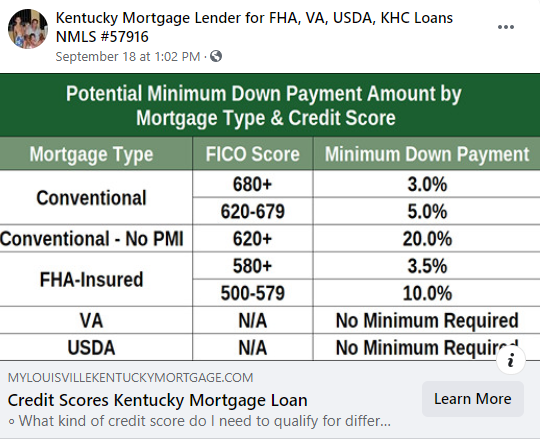
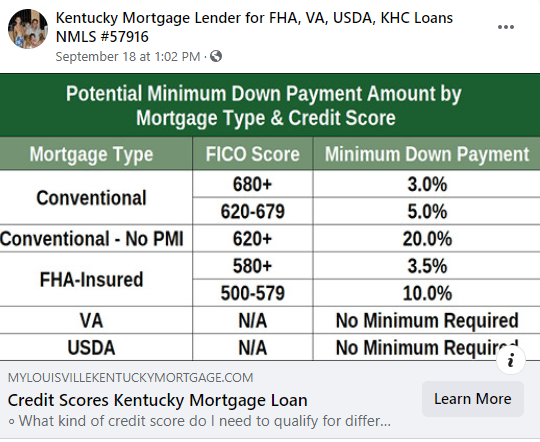
The type of mortgage you’re applying for determines the minimum requirements you’ll have to meet for your down payment, credit score, and debt-to-income ratio.
Find out what type of loan you might qualify for or what aspects of your finances you’ll need to improve to get a better shot at qualifying for a mortgage.
Loan Type
Min. Down Payment
Min. Credit Score
Max DTI
Property Type
Conventional
3%
620
45%
Primary, secondary, investment
VA
0%
none
none
Primary
FHA
3.5%
500
50%
Primary
USDA
0%
none
41%
Primary
Keep in mind: The minimum down payment, minimum credit score, and maximum DTI shown in the table apply to mortgages used to purchase a primary residence. While you can use a conventional loan or a jumbo loan to purchase a home for another purpose, you might need a larger down payment, a higher credit score, more cash reserves, or all three.
Credit score needed to buy a house
Mortgage lending is risky, and lenders want a way to quantify that risk. They use your three-digit credit score to gauge the risk of loaning you money since your credit score helps predict your likelihood of paying back a loan on time. Lenders also consider other data, such as your income, employment, debts and assets to decide whether to offer you a loan.
Different lenders and loan types have different borrower requirements, loan terms and minimum credit scores. Here are the requirements for some of the most common types of mortgages.
Conventional loan
Minimum credit score: 620
A conventional loan is a mortgage that isn’t backed by a federal agency. Most mortgage lenders offer conventional loans, and many lenders sell these loans to Fannie Mae or Freddie Mac — two government-sponsored enterprises. Conventional loans can have either fixed or adjustable rates, and terms ranging from 10 to 30 years.
You can get a conventional loan with a down payment as low as 3% of the home’s purchase price, so this type of loan makes sense if you don’t have enough for a traditional down payment. However, if your down payment is less than 20%, you’re required to pay for private mortgage insurance (PMI), which is an insurance policy designed to protect the lender if you stop making payments. You can ask your servicer to cancel PMI once the principal balance of your mortgage falls below 80% of the original value of your home.
FHA loan
Minimum credit score (10% down): 500
Minimum credit score (3.5% down): 580
FHA loans are backed by the Federal Housing Administration (FHA), a part of the U.S. Department of Housing and Urban Development (HUD). The FHA incentivizes lenders to make mortgage loans available to borrowers who might not otherwise qualify by guaranteeing the federal government will repay the mortgage if the borrower stops making payments. This makes an FHA loan a good option if you have a lower credit score.
FHA loans come in 15- or 30-year terms with fixed interest rates. Unlike conventional mortgages, which only require PMI for borrowers with less than 20% down, all FHA borrowers must pay an up-front mortgage insurance premium (MIP) and an annual MIP, as long as the loan is outstanding.
VA loan
Minimum credit score: N/A
VA loans are mortgages backed by the U.S. Department of Veterans Affairs (VA). The VA guarantees loans made by VA-approved lenders to qualifying veterans or service members of the U.S. armed forces, or their spouses. This type of loan is a great option for veterans and their spouses, especially if they don’t have the best credit and don’t have enough for a down payment.
VA loans are fixed-rate mortgages with 10-, 15-, 20- or 30-year terms.
Most VA loans don’t require a down payment or monthly mortgage insurance premiums. However, they do require a one-time VA funding fee, that ranges from 1.4% to 3.6% of the loan amount.
USDA loan
Minimum credit score: N/A
The U.S. Department of Agriculture guarantees loans for borrowers interested in buying homes in certain rural areas. USDA loans don’t require a minimum down payment, but you have to meet the USDA’s income eligibility limits, which vary by location.
All USDA mortgages have fixed interest rates and 30-year repayment terms.
USDA-approved lenders must pay an up-front guarantee fee of up to 3.5% of the purchase price to the USDA. That fee can be passed on to borrowers and financed into the home loan. If the home you want to buy is within an eligible rural area (defined by the USDA) and you meet the other requirements, this could be a great loan option for you.
What else do mortgage lenders consider?
Your credit score isn’t the only factor lenders consider when reviewing your loan application. Here are some of the other factors lenders use when deciding whether to give you a mortgage.
Debt-to-income ratio — Your debt-to-income (DTI) ratio is the amount of debt payments you make each month (including your mortgage payments) relative to your gross monthly income. For example, if your mortgage payments, car loan and credit card payments add up to $1,800 per month and you have a $6,000 monthly income, your debt-to-income ratio would be $1,800/$6,000, or 30%. Most conventional mortgages require a DTI ratio no greater than 36%. However, you may be approved with a DTI up to 45% if you meet other requirements.
Employment history — When you apply for a mortgage, lenders will ask for proof of employment — typically two years’ worth of W-2s and tax returns, as well as your two most recent pay stubs. Lenders prefer to work with people who have stable employment and consistent income.
Down payment — Putting money down to buy a home gives you immediate equity in the home and helps to ensure the lender recoups their loss if you stop making payments and they need to foreclose on the home. Most loans — other than VA and USDA loans — require a down payment of at least 3%, although a higher down payment could help you qualify for a lower interest rate or make up for other less-than-ideal aspects of your mortgage application.
The home’s value and condition — Lenders want to ensure the home collateralizing the loan is in good condition and worth what you’re paying for it. Typically, they’ll require an appraisal to determine the home’s value and may also require a home inspection to ensure there aren’t any unknown issues with the property.
The Federal Housing Administration (FHA) Mortgagee Letter (ML) 22-17 announced that FHA’s Technology Open To Approved Lenders (TOTAL) Mortgage Scorecard will begin scoring a borrower’s positive rental payment history as part of the credit risk analysis when they are applying for FHA-insured financing.
TOTAL will begin scoring on or after October 30, 2022, as well as for case numbers assigned on or after September 20, 2021, allowing lenders to implement the guidance on existing pipeline cases without the need to obtain a new case number.
A Collection Account refers to a Borrower’s loan or debt that has been submitted to a collection agency by a creditor.
If the credit reports used in the analysis show cumulative outstanding collection account balances of $2,000 or greater, the lender must:
• verify that the debt is paid in full at the time of or prior to settlement using an acceptable source of funds;
• verify that the Borrower has made payment arrangements with the creditor and include the monthly payment in the Borrower’s Debt-to-Income ratio (DTI); or
• if a payment arrangement is not available, calculate the monthly payment using 5 percent of the outstanding balance of each collection and include the monthly payment in the Borrower’s DTI.
Collection accounts of a non-borrowing spouse in a community property state must be included in the $2,000 cumulative balance and analyzed as part of the Borrower’s ability to pay all collection accounts, unless excluded by state law. Unless the lender uses 5 percent of the outstanding balance, the lender must provide the following documentation:
• evidence of payment in full, if paid prior to settlement;
• the payoff statement, if paid at settlement; or
• the payment arrangement with creditor, if not paid prior to or at settlement.
For manually underwritten loans, the lender must determine if collection accounts were a result of:
• the Borrower’s disregard for financial obligations;
• the Borrower’s inability to manage debt; or
• extenuating circumstances.
The lender must document reasons for approving a mortgage when the Borrower has any collection accounts. The Borrower must provide a letter of explanation, which is supported by documentation, for each outstanding collection account. The explanation and supporting documentation must be consistent with other credit information in the file.
FHA has published the following guideline updates, which will be effective for all Kentucky FHA loans with case numbers assigned on or after September 9th
Specific verbiage for Well Water Testing has been added indicating that it must be performed by a disinterested party in a method acceptable to the local health authority. The borrower or any other interested party may not have contact with the sample. Additionally, cases mandating a Well Water Test have been added to include (but not limited to) the following
Newly constructed properties and/or wells
Properties with deficiencies in the well or well water as determined by an appraiser
Areas where water has been reported or is otherwise known to be unsafe
Properties located in close proximity to dumps, landfills, industrial sites, farms, or other sites that could contain hazardous waste
Properties where distance between well and septic systems is less than 100 feet
Average Overtime, Bonus, or Tip income earned over the previous 2 years (or if earned less than 2 years, the total length of time it has been received); OR
Average Overtime, Bonus, or Tip income earned over the previous year
All requirements regarding unreimbursed business expenses and Commission Income or Automobile Allowances has been completely removed to align with current IRS tax laws
Rent Below Fair Market has been defined as an inducement to purchase when the borrower is allowed to live in the property rent free or at a rental amount more than 10 percent under the fair market rent as determined by the appraiser.
Clarification has been added that Reduction in Term for Kentucky FHA Mortgage Streamline Refinances refers specifically to the reduction of the remaining amortization period of the existing mortgage.
FHA Guidelines For Bankruptcy, income, down payment, mortgage insurance, credit scores, work history for FHA loan
If you have questions about qualifying as first time home buyer in Kentucky, please call, text, email or fill out free prequalification below for your next mortgage loan pre-approval.
This web site is not the FHA, VA, USDA, HUD or any other government organization responsible for managing, insuring, regulating or issuing residential mortgage loans.
All approvals and rates are not guaranteed, and are only issued based on standard mortgage qualifying guidelines
Remember, we are even available this weekend for pre-qualifications or questions. Call our cell phone or email us. If you miss us, leave a message and we WILL call you back
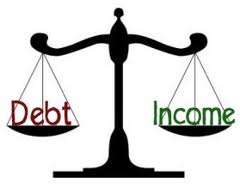
Your debt-to-income ratio, technically speaking, is all of your monthly debt payments divided by your gross monthly income—that is, the percentage of your gross monthly income that goes towards payments for rent, mortgage, credit cards, and other debt. This is how lenders measure your ability to manage the monthly mortgage payments to repay the money you’ll be borrowing.
To calculate your debt-to-income ratio, add up your monthly debts—this includes car payments, credit cards, mortgages, and student loans. Divide this amount by your monthly gross income, and you’ll get your DTI ratio.
For reference, the standard maximum DTI for conventional loans is 45%, and for FHA loans it’s 55%. Of course, the maximum DTI depends on the home loan.
Check your debt-to-income ratio (DTI). Mortgage lenders want to know how much debt you have compared to your income. It’s called your debt-to-income (DTI) ratio, and the better it is, the better mortgage terms you’ll get.
Find your DTI by plugging your financial numbers into Trulia’s affordability calculator. The percentage is found by dividing your debt by your income. For example, if your total debt is $3,000 a month (including your new mortgage payment), and your gross income is $6,000 a month, your DTI would be 50%.
Lenders typically prefer DTI to be no more than 36%—although some types of mortgages allow for a DTI of 50%. To lower yours, you can pay down debt or bring in more income.
One of the main pieces of an FHA loan approval is the borrower’s debt to income calculation. It is important that home buyers understand how this number is calculated and what they can do to improve their chances of getting approved.
Payments Included in Debt Ratios
Certain payments must be considered as part of a person’s overall debt when calculating the ratios. Items such as:
Payments for car loans
Payments on credit cards
Payments on unsecured loans
Child support payments
Alimony
Items Excluded from Debt Ratios
There are also some items not included in the debt to income ratio for FHA loans. Common examples would be:
Current rent payment
Money spent on entertainment
Expenses paid for child care
How to Overcome High Debt to Income Ratios
If a borrower has a compensating factor, it is possible for people with ratios higher than the proposed guidelines to get an approval for an FHA loan. Here are some examples of compensating factors:
Paying more than 10% of the purchase price as a down payment
Using income and expense records from the past two years to demonstrate that you have the ability and discipline to pay the housing expense
Having a large balance in a savings, investment or retirement account
For people that have a high debt to income ratio, it is possible to reduce the numbers. Paying off debt, such as credit cards or car loans can help. Sometimes it may be necessary to sell an expensive vehicle and get a cheaper payment in order to qualify for a loan.
$6000 Down for Your Dream Home with Down Payment Assistance
An exciting new program is making it easier for you to get your dream home faster and with more money in your pocket. Geared toward homebuyers who may need help coming up with down payment or closing costs, the Mortgage Down Payment Assistance Program (DPA) can turn you into a homebuyer today!
You do not need to be a first time homebuyer
Down payment assistance programs normally require you to be a first time homebuyer; however, this new program does not have this requirement. There are also various first mortgage options this program can be tied to, including FHA and USDA loans.
KHC recognizes that down payments, closing costs, and prepaids are stumbling blocks for many potential home buyers. Here are several loan programs to help. Your KHC-approved lender can help you apply for the program that meets your need.
Regular DAP
Purchase price up to $346,644 with Secondary Market.
Assistance in the form of a loan up to $6,000 in $100 increments.
Repayable over a ten-year term at 5.50 percent.
Available to all KHC first-mortgage loan recipients.
Affordable DAP
Purchase price up to $346,644 with Secondary Market.
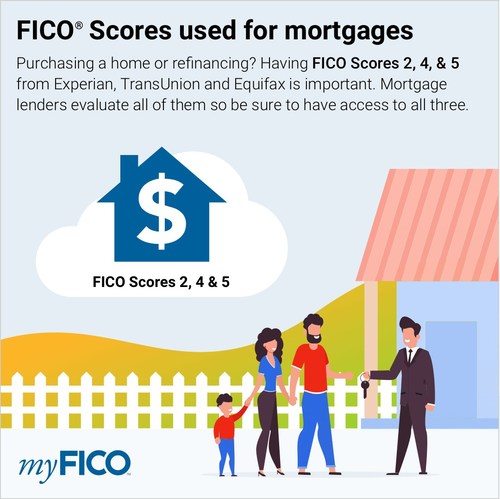
FICO is used by 90% of lenders, according to myFICO, and has been around
since 1989. (VantageScore only hit the scene in 2006.)
If you’re not sure which scoring model a lender will use, just ask!
FICO Scores used for mortgages
USDA loan:
Most lenders prefer at least a 620
The U.S. Department of Agriculture insures for low- to moderate-income homebuyers. The USDA does not set a minimum credit score requirement and does not require a down payment.
Conventional loan:
620 is the minimum but in reality most will need a 720 or higher for a pre-approval if you are putting down less than 20%
Conventional loans aren’t insured by a government agency either, but they are covered by mortgage loan companies Fannie Mae and Freddie Mac. The down payment amount varies.
VA loan:
Most lenders prefer at least a 580
A Veterans Affairs loan is backed by the U.S. Department of Veterans Affairs and meant for military members and their spouses. These loans don’t require a minimum score or money down.
FHA loan:
500 (with 10% down payment) or 580 (with 3.5% down payment)
FHA loans, those guaranteed by the Federal Housing Administration, are for higher-risk borrowers who have poor credit and little money saved for a down payment. The credit requirements can fluctuate based on how much of a down payment you can afford.Most lenders have overlays now wanting a minimum 620 credit score even for FHA loans.
Are you interested in seeing how your current credit score might affect a new mortgage?
Let’s take a look together.
Joel Lobb
Mortgage Loan Officer
Individual NMLS ID #57916
American Mortgage Solutions, Inc.
10602 Timberwood Circle
Louisville, KY 40223
Company NMLS ID #1364
What Will My Lender Use? FICO is used by 90% of lenders, according to myFICO, and has been around since 1989. (VantageScore only hit the scene in 2006.) If you’re not sure which scoring model a lender will use, just ask! USDA loan: Most lenders prefer at least a 620 The U.S. Department of Agriculture … Continue reading Credit Score Information For Kentucky Home buyers
What credit score is needed to buy a house in Kentucky?
Ultimately, there is no singular credit score that can guarantee you a mortgage approval. Each lender is free to set their own credit score requirements.
But many loan types are insured by government organizations. And lenders cannot accept borrowers with credit scores below the minimum these organizations set. The four most popular home loan types are:
Conventional: Not backed by any government agency, but must meet the Fannie Mae and Freddie Mac underwriting guidelines
FHA: Loans backed by the Federal Housing Administration
VA: Loans backed by the US Department of Veterans Affairs (for military members)
USDA: Loans backed by the US Department of Agriculture (for low- to moderate-income families who buy homes in rural areas)
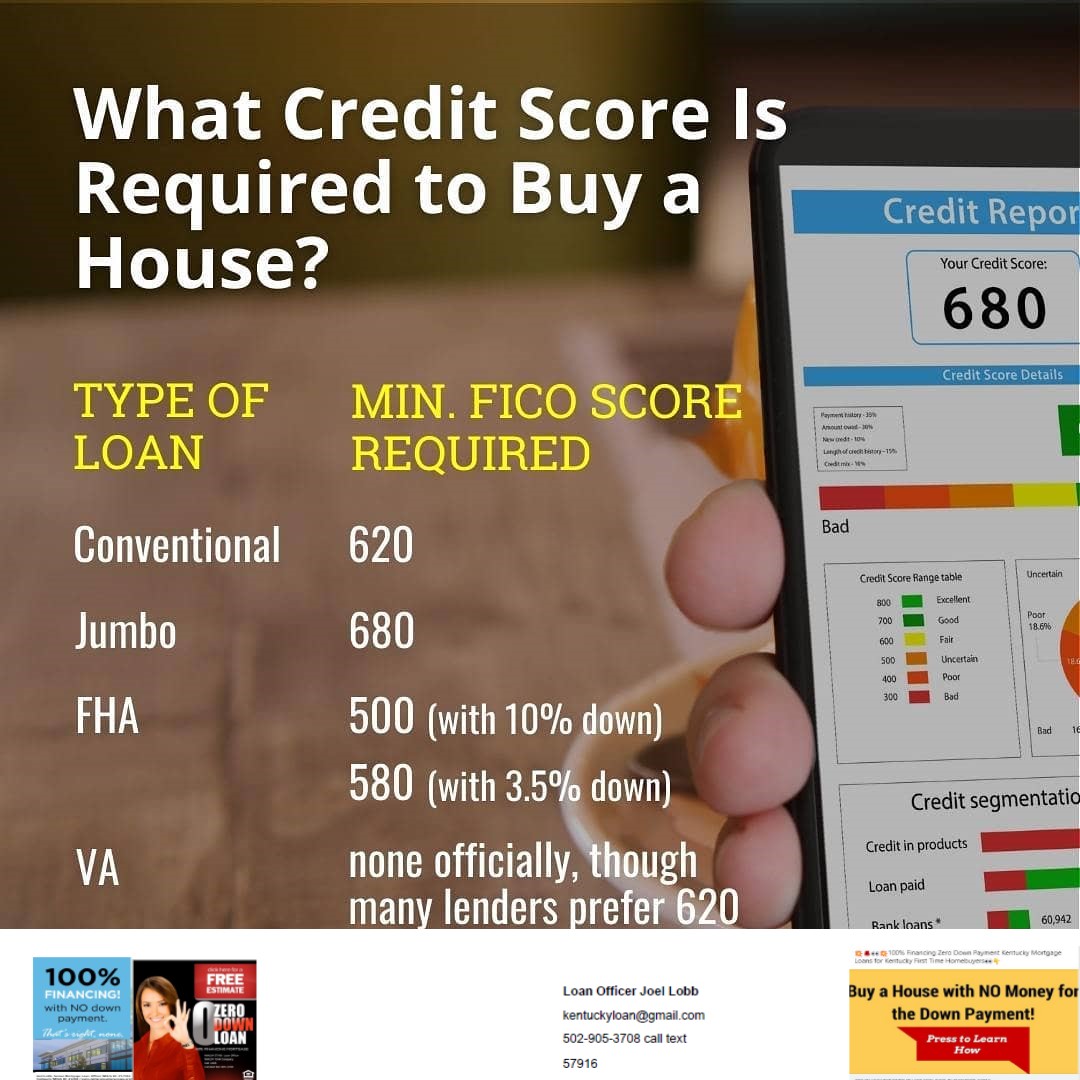
And here are the minimum credit score requirements for each of these loan types:
Conventional:
620 SCORE NEEDED. BUT TO GET APPROVED FOR A FANNIE MAE LOAN MOSTLY LIKE YOU WILL NEED A 720 SCORE OR HIGHER IF YOU HAVE LESS THAN 20% EQUITY POSITION OR LESS THAN 20% DOWN PAYMENT DUE TO PRIVATE MORTGAGE INSURANCE
FHA:
580 for a 3.5% down payment
500 for down payments of at least 10%
**MOST FHA LENDERS WILL WANT A 580 to 620 CREDIT SCORE NOWADAYS
VA:
No minimum BUT MOST VA LENDERS WILL WANT A 580 to 620 CREDIT SCORE
USDA:
No minimum, but with a credit score of at least 620 to 640 you could qualify for streamlined credit analysis and chances of approval goes way down if score is below 640…
When you think credit score, you probably think FICO Since the Fair Isaac Corporation introduced its FICO scoring system in 1989, “What is my FICO score?” has become a common question. FICO scores have burrowed their way into all kinds of lending decisions, most notably mortgages, credit cards, and rentals.
But over the last decade or so, FICO’s market dominance has been challenged by a newcomer called VantageScore. As the result of a collaboration between the three major credit reporting agencies (CRAs) — Experian, Equifax, and TransUnion — VantageScore uses similar scoring methods to FICO but with slightly different results.
So what are the differences, and more importantly, do they really matter to you, the consumer? The short answer: usually no. But you might want to look at different scores for different needs or goals.In this article, we’ll cover the five main differences between FICO and VantageScore and tell you which one to watch.
What credit score is needed to buy a house?
1. Difference in scoring models
FICO and VantageScore aren’t the only scoring models on the market. Lenders use a multitude of scoring methods to determine your creditworthiness and make financial decisions. But despite the numerous options, FICO and VantageScore are likely the only scores you’ll ever personally see.How do FICO and VantageScore rate you? Both use the same basic criteria:
Payment history
Length of credit
Types of credit
Credit usage
Recent inquiries
Although both FICO and VantageScore consider much of the same information, they gather their data in different ways.
FICO bases its scoring model on credit reports from millions of consumers at once. They gather these reports from the three major credit bureaus and analyze the reports’ anonymous consumer data to generate an accurate scoring model.Alternatively, VantageScore uses a combined set of consumer credit files, also obtained from those same three credit bureaus, to come up with a single formula.
Both FICO and VantageScore issue scores ranging from 300 to 850. In the past, VantageScore has used a range of 501 to 990, but the range was adjusted when VantageScore 3.0 was issued in 2013. VantageScore’s numerical rankings now match FICO’s, which makes it easier for consumers and lenders to implement the VantageScore model — plus, it’s less confusing for consumers who check both their FICO score and VantageScore.
2. Variance in scoring requirements
If you don’t have a long history of credit, VantageScore is the score you want to monitor. Before it’s able to establish your credit score, FICO requires at least six months of credit history and at least one account reported to a CRA within the last six months. VantageScore only requires one month of history and one account reported within the past two years.
Because VantageScore allows a shorter credit history and a long period for reported accounts, it’s able to issue credit ratings to millions of consumers who wouldn’t qualify for FICO scores. Considering how everyone from employers to landlords wants to see your credit score these days, if you’re new to credit or haven’t been using it recently, VantageScore might be able to prove your trustworthiness before FICO has enough data to issue a rating.
3. Significance of late payments
A history of late payments will impact both your FICO score and your VantageScore. Both models consider these factors:
How recently the last late payment occurred
How many of your accounts have had late payments
How many payments you’ve missed on an account
However, while FICO treats all late payments the same, VantageScore judges them differently — it penalizes late mortgage payments more harshly than other types of credit.If you’ve had late payments on your credit cards, they will have about the same impact on both your FICO and your VantageScore. But if you’ve had late payments on your mortgage, you might find you have a higher FICO score than VantageScore.
4. Impact of credit inquiries
You’ve probably heard you shouldn’t open too many credit cards in a short period of time. One reason for this is every time you apply for a credit card, the lender does a “hard inquiry” to check your creditworthiness.
VantageScore and FICO both penalize consumers who have multiple hard inquiries in a short period of time, and they both do “deduplication.” Deduplication is important for things like auto loans, where your application may be sent to multiple lenders, thereby resulting in multiple inquiries. Both FICO and VantageScore don’t count each of these inquiries separately — they deduplicate them, or consider them one inquiry. However, the timespan they use for deduplication differs.
FICO uses a 45-day span to deduplicate your credit inquiries. VantageScore limits its focus to only a 14-day range. VantageScore also looks at multiple hard inquiries for all types of credit, including credit cards. FICO considers only mortgages, auto loans, and student loans.
Inquiries aren’t your biggest concern when it comes to your credit score, but they do have an impact. If you want to buy a house or a car, restrict hard inquiries as much as possible to avoid lowering your credit score.
5. Influence of low-balance collections
VantageScore and FICO both have penalties for accounts sent to collection agencies. However, FICO might give you a bit more of a break when it comes to low-amount collection accounts.
FICO ignores all collections where the original balance was under $100. It also doesn’t count collection accounts you’ve paid off. VantageScore, on the other hand, ignores only paid collection accounts, regardless of the original balance amount.
Keep your credit high
Regardless of the differences between FICO and VantageScore, the essential advice for keeping your credit score high remains the same:
Avoid late payments. Pay your bills, and pay them on time.
Keep your credit balances low. Don’t max out your credit cards, and try to keep your cumulative balance to less than 30% — the lower the better.
Apply for new credit only when you have to. Don’t open a bunch of new cards in a short period of time, and don’t close old accounts without good reason.
Which credit scores do mortgage lenders use to qualify people for a mortgage?
While it’s common knowledge that mortgage lenders use FICO scores, most people with a credit history have three FICO scores, one from each of the three national credit bureaus (Experian, Equifax, and TransUnion).
Which FICO Score is Used for Mortgages
Most lenders determine a borrower’s creditworthiness based on FICO® scores, a Credit Score developed by Fair Isaac Corporation (FICO™). This score tells the lender what type of credit risk you are and what your interest rate should be to reflect that risk. FICO scores have different names at each of the three major United States credit reporting companies. And there are different versions of the FICO formula. Here are the specific versions of the FICO formula used by mortgage lenders:
Equifax Beacon 5.0
Experian/Fair Isaac Risk Model v2
TransUnion FICO Risk Score 04
Lenders have identified a strong correlation between Mortgage performance and FICO Bureau scores (FICO score). FICO scores range from 300 to 850. The lower the FICO score, the greater the risk of default.
Which Score Gets Used?
Since most people have three FICO scores, one from each credit bureau, how do lenders choose which one to use?
For a FICO score to be considered “usable”, it must be based on adequate, concrete information. If there is too little information, or if the information is inaccurate, the FICO score may be deemed unusable for the mortgage underwriting process. Once the underwriter has determined if a score is usable or not, here’s how they decide which score(s) to use for an individual borrower:
If all three scores are different, they use the middle score
If two of the scores are the same, they use that score, regardless of whether the two repeated scores are higher or lower than the third score
Lenders have identified a strong correlation between Mortgage performance and FICO Bureau scores (FICO score). FICO scores range from 300 to 850. The lower the FICO score, the greater the risk of default.
If it helps to visualize this information:
Identifying the Underwriting Score
Example
Score 1
Score 2
Score 3
Underwriting Score
Borrower 1
680
700
720
700
Joel Lobb (NMLS#57916)
Senior Loan Officer
American Mortgage Solutions, Inc. 10602 Timberwood Circle Suite 3 Louisville, KY 40223
Company ID #1364 | MB73346
Text/call 502-905-3708
kentuckyloan@gmail.com
If you are an individual with disabilities who needs accommodation, or you are having difficulty using our website to apply for a loan, please contact us at 502-905-3708.
Disclaimer: No statement on this site is a commitment to make a loan. Loans are subject to borrower qualifications, including income, property evaluation, sufficient equity in the home to meet Loan-to-Value requirements, and final credit approval. Approvals are subject to underwriting guidelines, interest rates, and program guidelines and are subject to change without notice based on applicant’s eligibility and market conditions. Refinancing an existing loan may result in total finance charges being higher over the life of a loan. Reduction in payments may reflect a longer loan term. Terms of any loan may be subject to payment of points and fees by the applicant Equal Opportunity Lender. NMLS#57916http://www.nmlsconsumeraccess.org/
Joel Lobb, American Mortgage Solutions (Statewide)
Joel has worked with KHC for 12 of his 20 years in the mortgage lending business. Joel said, “A lot of my clients would not have been able to purchase a home of their own or possibly delayed their purchase due to lack of down payment but with the $6,000 DAP loan program, this gets them into a house sooner and starts their path to homeownership while building equity instead of throwing their money away.”









 Kentucky FHA Mortgage Lender