
Understanding USDA Loan Asset Requirements in Kentucky

USDA Loan Asset Requirements in Kentucky: What First-Time Homebuyers Need to Know

If you’re applying for a USDA Rural Housing loan in Kentucky, understanding the asset documentation requirements is a critical step in the approval process. Whether you’re a first-time homebuyer in Louisville, Lexington, or a rural Kentucky community, here’s exactly what you need to know about assets when applying for a USDA mortgage loan.

Do You Need Assets to Qualify for a USDA Loan in Kentucky?

Good news for many Kentucky homebuyers — assets are not required to qualify for a USDA Rural Housing loan. However, if you do disclose assets on your loan application, every asset listed must be supported with proper documentation. Incomplete or unsupported asset disclosures can delay or jeopardize your approval.

USDA Loan Asset Documentation Requirements

Below is a complete breakdown of how different types of assets are handled under USDA Rural Housing loan guidelines in Kentucky:

1. Bank Accounts (Checking & Savings)

To verify funds held in a bank account, your lender will require one of the following:

  • A completed Verification of Deposit (VOD) showing the average 2-month balance, or
  • Two consecutive months of bank statements dated within 45 days of the loan application date

Important: Cash on hand is not acceptable as a verified asset for USDA loan purposes. All funds must be traceable and documented.

2. Large Deposits or Sudden Increases in Liquid Assets

If your bank statements show large, unexplained deposits or a significant jump in your account balance, your lender will require a satisfactory written explanation along with supporting documentation. This is a standard USDA underwriting requirement designed to ensure the source of funds is legitimate and not a loan.

3. Earnest Money Deposits

Your earnest money deposit (the good-faith deposit made when you go under contract on a home) may be counted as an asset — provided it is not already reflected in your existing liquid asset balances. Be sure to provide a copy of your cancelled check or wire confirmation as documentation.

4. Retirement Accounts (401k, IRA, Pension)

Retirement accounts such as a 401(k) or IRA can be used as assets for USDA loan qualification, but only at 60% of the vested account balance. This adjustment accounts for early withdrawal penalties and taxes. A current account statement is required.

5. Gift Funds

Gift funds from a family member or approved donor are allowed under USDA guidelines. To properly document a gift, you will need:

  • A signed gift letter from the donor clearly stating the amount of the gift
  • Confirmation that the gift does not need to be repaid
  • Documentation showing the transfer of funds (bank statements, wire transfer, etc.)

6. Proceeds from the Sale of Real Property

If you are using proceeds from the sale of a home or other real estate, you must provide a HUD-1 Settlement Statement or equivalent closing disclosure showing the actual net cash proceeds received by the borrower after all costs and payoffs.

7. Stocks, Bonds, and Investment Accounts

Stocks, bonds, and brokerage accounts must be documented with an official statement from the stockbroker or financial institution managing the portfolio. The statement should show current market value and be dated within 45 days of application.

8. Net Family Assets Greater Than $5,000 — Income Calculation Rule

This is an often-overlooked USDA guideline. If a household’s net family assets exceed $5,000, USDA requires that the greater of the following be counted as income:

  • The actual income earned from those net family assets (e.g., interest, dividends), or
  • A percentage of the asset value based on the current passbook savings rate

This imputed income is added to your annual household income and can affect USDA income eligibility. Be sure to discuss this with your loan officer if you have significant savings, investments, or property holdings.


Why Asset Documentation Matters for Your Kentucky USDA Loan Approval

USDA underwriters review asset documentation not just to verify your down payment and closing costs, but also to ensure your loan complies with federal housing guidelines. Incomplete or missing asset paperwork is one of the most common reasons for loan delays in Kentucky. Working with an experienced local mortgage loan officer who knows USDA guidelines inside and out can make all the difference.

Get Pre-Approved for a USDA Loan in Kentucky Today

With over 20 years of experience helping Kentucky families achieve homeownership, I specialize in USDA Rural Housing loans, FHA, VA, KHC (Kentucky Housing Corporation), and Conventional mortgage loans. I offer free mortgage pre-qualifications with same-day approvals on most applications.

If you’re a first-time homebuyer in Kentucky with little or no money saved for a down payment, ask me about Kentucky Housing Corporation (KHC) down payment assistance programs — funds are still available and can significantly reduce your upfront costs.
Contact Joel Lobb — Kentucky Mortgage Loan Officer

Joel Lobb | Senior Mortgage Loan Officer

📞 Call or Text: (502) 905-3708

📧 Email: kentuckyloan@gmail.com

🌐 Website: www.mylouisvillekentuckymortgage.com

NMLS #57916 | Company NMLS #1738461

Verify license: www.nmlsconsumeraccess.org

Kentucky Mortgage License Only

⚖️ Equal Housing Lender
This website is not affiliated with or endorsed by HUD, FHA, VA, USDA, or any government agency. It is an independent platform created to educate and assist Kentucky homebuyers.

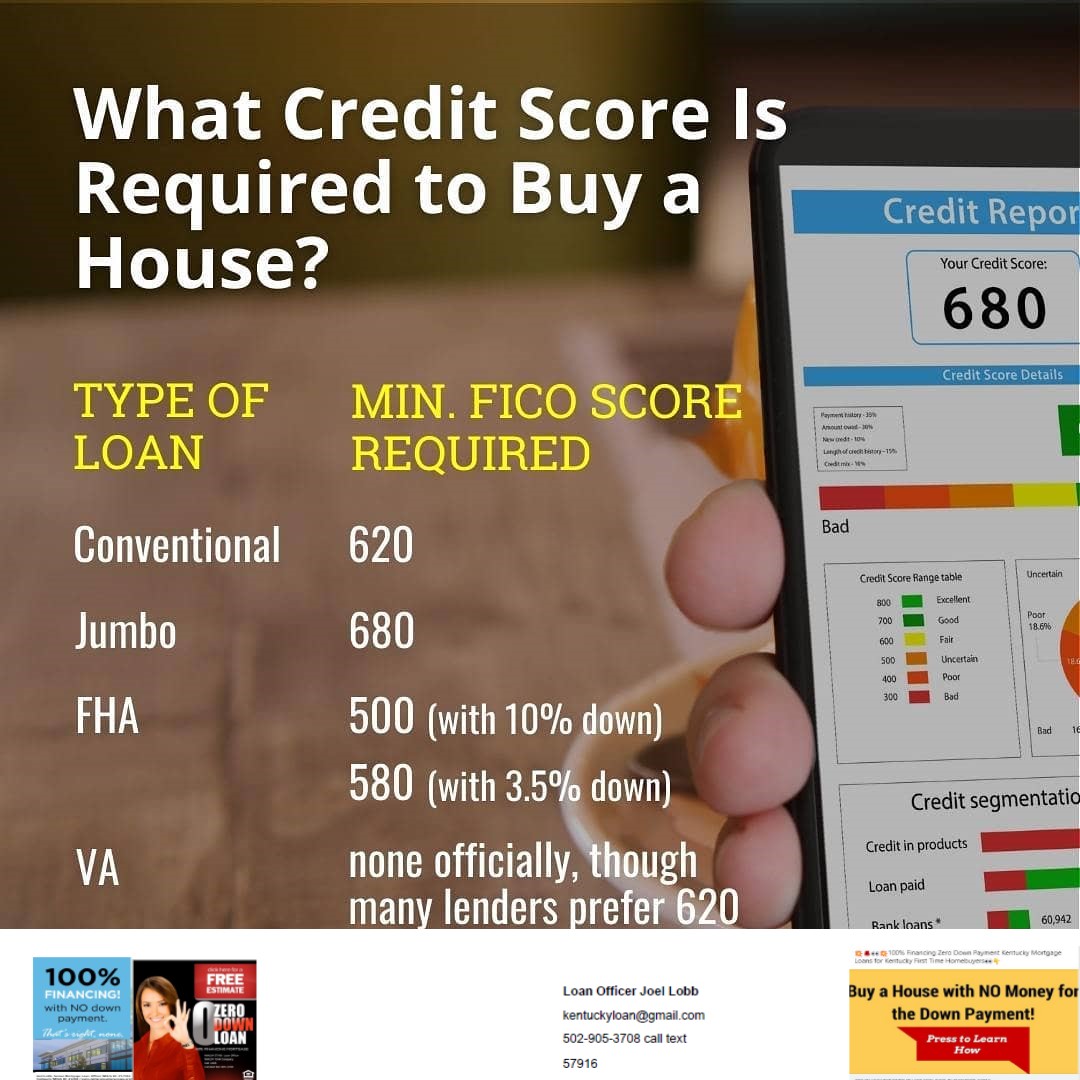
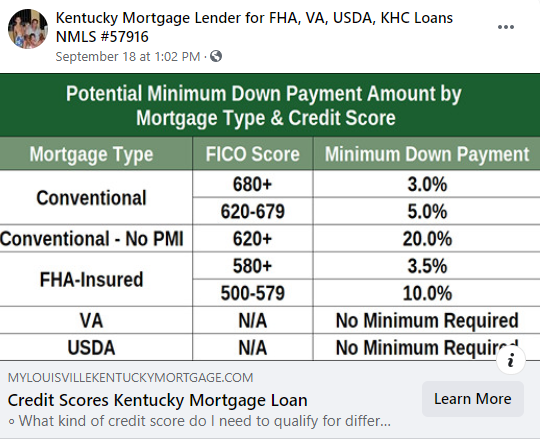
Credit scores required for A Kentucky Mortgage Loan Approval for FHA, VA, USDA and Conventional Fannie Mae

192199974_1008928599679889_572699217267405025_n
What credit score is needed to buy a house in Kentucky?

Ultimately, there is no singular credit score that can guarantee you a mortgage approval. Each lender is free to set their own credit score requirements.

But many loan types are insured by government organizations. And lenders cannot accept borrowers with credit scores below the minimum these organizations set. The four most popular home loan types are:

Conventional: Not backed by any government agency, but must meet the Fannie Mae and Freddie Mac underwriting guidelines
FHA: Loans backed by the Federal Housing Administration
VA: Loans backed by the US Department of Veterans Affairs (for military members)
USDA: Loans backed by the US Department of Agriculture (for low- to moderate-income families who buy homes in rural areas)

And here are the minimum credit score requirements for each of these loan types:

Conventional: 
620 SCORE NEEDED. BUT TO GET APPROVED FOR A FANNIE MAE LOAN MOSTLY LIKE YOU WILL NEED A 720 SCORE OR HIGHER IF YOU HAVE LESS THAN 20% EQUITY POSITION OR LESS THAN 20% DOWN PAYMENT DUE TO PRIVATE MORTGAGE INSURANCE
FHA: 
580 for a 3.5% down payment
500 for down payments of at least 10%
**MOST FHA LENDERS WILL WANT A 580 to 620  CREDIT SCORE NOWADAYS

VA: 
No minimum BUT MOST VA LENDERS WILL WANT A 580 to 620 CREDIT SCORE
USDA: 
No minimum, but with a credit score of at least 620 to 640 you could qualify for streamlined credit analysis and chances of approval goes way down if score is below 640…

unnamed-2020-09-27t195228.502

Joel Lobb
Senior  Loan Officer

(NMLS#57916)
 Fax:     (502) 327-9119
 
 Company ID #1364 | MB73346

FHA Back to Work Extenuating Circumstances Works!

FHA Back to Work Extenuating Circumstances Works, FHA Back to Work Program, Success Story, FHA Loans

via FHA Back to Work Extenuating Circumstances Works!.

Louisville Kentucky FHA Loan Streamline Refinance

FHA Loan Streamline Refinance Program Is Helping USA Homeowners to Refinance Mortgage with Lower Mortgage Payments (via SBWire)

Market And The Mortgage Rate Prevalent In The Market Tend To Change Constantly. Today, Due To The Drastic Drop In The Housing, Millions Of People Are Suffering From Declined Worth Of Their Homes. In Order To Allow Them To Refinance Their Mortgage, FHA…

Continue reading “Louisville Kentucky FHA Loan Streamline Refinance”

Understanding PMI

Understanding PMI.

via Understanding PMI.

Understanding PMI

Trust me for your next FHA loan  Call 502-905-3708
Trust me for your next FHA loan Call 502-905-3708

Joel Lobb (NMLS#57916)
Senior  Loan Officer
502-905-3708 cell
502-813-2795 fax
jlobb@keyfinllc.com

Key Financial Mortgage Co. (NMLS #1800)*
107 South Hurstbourne Parkway*

Louisville, KY 40222*

Steps for refinancing FHA Mortgage Loans

KEYC – Mankato News, Weather, Sports – – US rate on 30-year mortgage falls to 3.93 pct.

KEYC - Mankato News, Weather, Sports - - US rate on 30-year mortgage falls to 3.93 pct.

KEYC – Mankato News, Weather, Sports – – US rate on 30-year mortgage falls to 3.93 pct..

100 down kentucky fha loan Adjustable-rate mortgage Co-signingCredit historyCredit score Down payment Fannie Mae Federal Housing Administrationfha FHA insured loan fha kentuckyFixed rate mortgageFrankfort Kentucky home loan InsuranceKentuckykentucky fha loankentucky fha rates kentucky housing corpkentucky usda loans khcky first time home buyerLexington KentuckyLoan Loan-to-value ratio louisvilleLouisville Kentucky louisville mortgage ratesMortgage Mortgage denied Mortgage insuranceMortgage loan Mount Sterling KentuckyPaducah Kentuckyrates Rates TodayReal estate refinanceRefinancing United States United States Department of Agriculture United States Department of Housing and Urban Development usda vazero down loan kentucky

What is the 2012 Credit Score Range Needed for an FHA Loan?

What is the 2012 Credit Score Range Needed for an FHA Loan?.

FHA single-family purchases, refinances escalate | HousingWire

FHA single-family purchases, refinances escalate | HousingWire.

The Best Kind of Loan for Your Credit Score

The Best Kind of Loan for Your Credit Score.


I’m often asked if having certain types of credit or loans is better or worse than other types of credit or loans.

I get questions like, “John, is it better to have a car loan or a mortgage for my scores?” I also hear, “John, is it better to have a secured card or an unsecured card for my scores?”

In fact, you can swap in almost any type of credit-related account and I’ve been asked about that scenario.

I’ve been getting this type of question for almost 15 years now, and it seems that people believe there’s value or a penalty for having certain types of loans or accounts on your credit reports. That’s completely understandable and, thankfully, almost a complete myth.

Credit Cards

First, let’s tackle the secured credit card, versus the unsecured credit card, versus the charge card question. The assumption is that the type of card has a direct impact on your credit scores. That’s an incorrect assumption, meaning, you’re not penalized or rewarded for having one type of card over another.

That doesn’t mean one form of plastic isn’t better or worse for your credit than another.  For example, a secured credit card is easier to max out than an unsecured credit card.

Why? The reason is because secured cards have considerably lower credit limits than unsecured credit cards. It has nothing to do with the fact that one is secured and one isn’t. It has everything to do with the credit limits.

Installment Loans

When it comes to installment loans, the issue of credit limits disappears because installment loans don’t have credit limits. They do, however, have original loan amounts.

An auto loan is likely to have a considerably lower loan amount than a mortgage, home equity loan and perhaps even a student loan. And, balances do matter on installment loans, albeit slightly.

Exactly like credit cards, credit scores do not treat installment loans of one variety or another differently. The collateral issue of balances can cause variable score impact, however.

Defaulting

One thing we haven’t addressed yet is the issue of missing payments and defaulting. Defaulting on a credit card, secured card, charge card, auto loan, mortgage, or any other kind of credit card, is treated equally — as one default.

You’re not penalized because you’ve defaulted on one variety of credit account versus another. You can, however, have a much larger default amount on a mortgage than any other type of credit account and that’s where the score impact can be variable.

The bottom line is: it’s not really the type of account that’s important, but it’s the incident that matters.

One Exception to the Rule

There is one very small exception to this rule. In fact, it’s so small that I thought very hard about omitting it.

There’s a chance your score could be negatively impacted if you have too many finance company accounts on your credit reports. These are the loans offered by consumer finance lenders who often target the near or subprime consumer.

Notwithstanding the consumer finance issue, the lender is also meaningless in your scores. So, you don’t get rewarded for doing business with a large, well-known credit card issuer and you don’t get penalized for doing business with a subprime credit card issuer.

In fact, credit scores are brand agnostic when it comes to your credit accounts. The most important factor is how you manage them.

Editor’s Note: This article by John Ulzheimer was originally published on MintLife.

See more from Mint.com:

Read more: http://www.minyanville.com/trading-and-investing/personal-finance/articles/credit-score-credit-score-meaning-installment/10/25/2012/id/45351#ixzz2APp8zSGT

Restoring your credit scores after filing for bankruptcy

Restoring your credit scores after filing for bankruptcy.

via Restoring your credit scores after filing for bankruptcy.

Kenttucky Fhamortgage Loansupdated Guidelines Louisville Ky

Kenttucky Fhamortgage Loansupdated Guidelines Louisville Ky.