What Credit Score Do You Need to Buy a House in Kentucky?
There is no single “magic number.” The credit score needed depends on the loan program (Conventional, USDA, FHA, VA, or Kentucky Housing Corporation down payment assistance). Here’s how it works in the real world for Kentucky buyers.
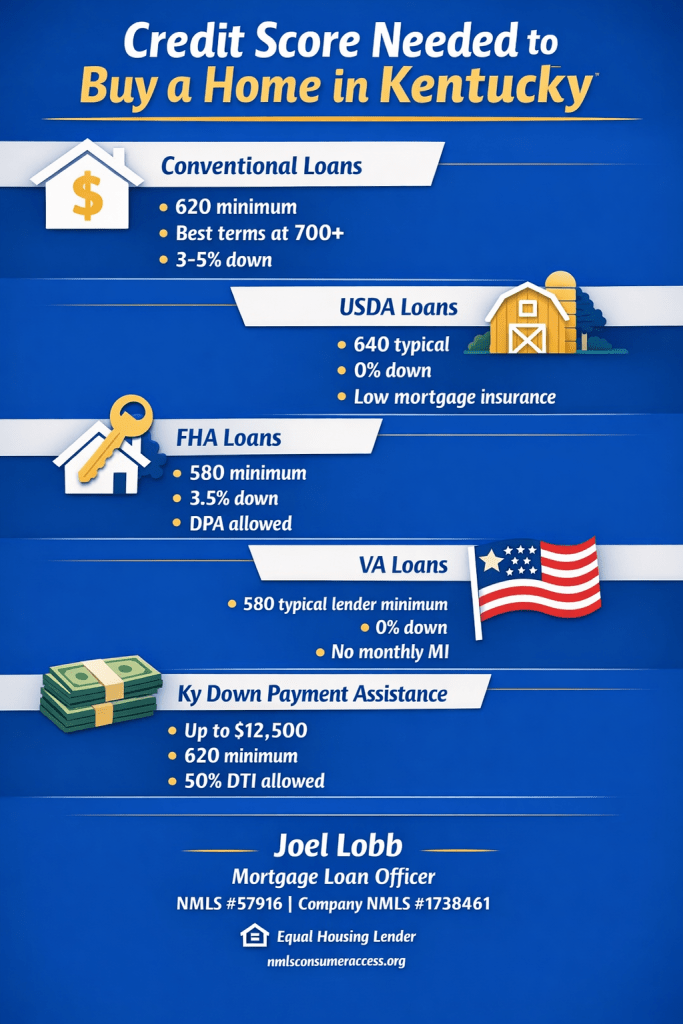
Quick guide: typical credit score ranges and key highlights by Kentucky mortgage program.
Conventional Loans in Kentucky
Minimum credit score generally starts at 620.
Most lenders prefer higher scores for 3%–5% down options.
Best pricing and easier approvals are typically with strong credit (often 700+).
Mortgage insurance (PMI) usually improves as scores increase.
USDA Rural Housing Loans in Kentucky
Many lenders target around 640 for automated approval through GUS (Guaranteed Underwriting System).
Manual underwriting may be possible when automated approval is not available.
0% down payment required (eligible rural/suburban areas).
Typical fees include a 1% upfront guarantee fee and 0.35% annual fee (paid monthly).
USDA can be one of the best value options for Kentucky buyers with limited cash, provided the property is in an eligible area and the file meets income and underwriting requirements.
Kentucky FHA Loans
As low as 580 credit score with 3.5% down (typical baseline).
Gift funds, grants, and down payment assistance may be allowed.
Mortgage insurance is generally higher than USDA or VA, but rates can still be competitive.
Common waiting periods: 2 years after bankruptcy and 3 years after foreclosure (standard guideline).
Kentucky VA Loans
VA does not set a minimum credit score in its guidelines, but most lenders do.
Many VA lenders target around 580+ (lender overlay varies).
0% down and no monthly mortgage insurance.
Clear CAIVRS is required (for federal delinquency screening).
Kentucky Down Payment Assistance (KHC)
Kentucky Housing Corporation (KHC) often offers up to $12,500 down payment assistance (program terms and funding can change).
Typically structured as a second mortgage paid back over 15 years.
Minimum credit score is commonly 620 across many KHC options; KHC conventional often requires 660.
Maximum debt-to-income ratios are commonly around 50/50 (program and investor rules apply).
Next step: get a clear pre-approval target
If you share your approximate credit score range, income type, and whether you’re looking in Louisville, Lexington, or rural Kentucky, I can point you to the most realistic program and the exact score threshold that will matter for approval.
{
“@context”: “https://schema.org”,
“@type”: “FAQPage”,
“mainEntity”: [
{
“@type”: “Question”,
“name”: “What credit score do I need to buy a house in Kentucky?”,
“acceptedAnswer”: {
“@type”: “Answer”,
“text”: “It depends on the loan program. Conventional financing often starts around 620, USDA lenders commonly target about 640 for automated approval, FHA can allow down to 580 with 3.5% down, and many VA lenders look for around 580 even though VA does not publish a minimum score. Kentucky Housing Corporation down payment assistance commonly requires around 620 (and KHC conventional often around 660). Final approval also depends on income, debt-to-income ratio, and underwriting findings.”
}
},
{
“@type”: “Question”,
“name”: “Can I buy a home in Kentucky with a 580 credit score?”,
“acceptedAnswer”: {
“@type”: “Answer”,
“text”: “Often yes, depending on the full file. FHA commonly allows 580 with 3.5% down and can work well when you have limited savings or are using gift funds or down payment assistance. Lender overlays and underwriting results still apply.”
}
},
{
“@type”: “Question”,
“name”: “Is 640 a good credit score for a Kentucky mortgage?”,
“acceptedAnswer”: {
“@type”: “Answer”,
“text”: “A 640 score can be workable for several programs. USDA lenders often target around 640 for automated approvals, and conventional approvals may be possible starting at 620, though terms improve as scores rise. Your debt-to-income ratio, income stability, and cash to close will strongly influence results.”
}
},
{
“@type”: “Question”,
“name”: “What credit score do I need for a USDA loan in Kentucky?”,
“acceptedAnswer”: {
“@type”: “Answer”,
“text”: “Many lenders prefer around 640 to obtain an automated approval through the USDA Guaranteed Underwriting System (GUS). Manual underwriting may be possible in some cases, but it is typically more restrictive on ratios and documentation.”
}
},
{
“@type”: “Question”,
“name”: “Does the VA require a minimum credit score in Kentucky?”,
“acceptedAnswer”: {
“@type”: “Answer”,
“text”: “VA guidelines do not publish a minimum credit score, but lenders usually do. Many VA lenders commonly target around 580 or higher, depending on the overall file and lender overlays.”
}
},
{
“@type”: “Question”,
“name”: “What credit score is needed for Kentucky Housing Corporation (KHC) down payment assistance?”,
“acceptedAnswer”: {
“@type”: “Answer”,
“text”: “KHC program requirements vary, but a common minimum is around 620 for many options. KHC conventional commonly requires around 660. Eligibility also depends on income limits, purchase price limits, and underwriting findings.”
}
}
]
}
What Credit Score Do You Need to Buy a House in Kentucky?
Are you considering buying a home in the beautiful state of Kentucky? Securing a mortgage loan is a crucial step in the homebuying process, and one of the key factors lenders evaluate is your credit score. Understanding the credit score requirements for mortgage loan approval in Kentucky can help you prepare and improve your chances of securing financing for your dream home.
Importance of Credit Scores
Your credit score is a numerical representation of your creditworthiness based on your credit history. Lenders use this score to assess the risk of lending to you. A higher credit score typically indicates lower risk to lenders, making you more likely to qualify for a mortgage loan and secure better terms and interest rates.
Credit Score Requirements in Kentucky
While specific credit score requirements can vary among lenders and mortgage programs, there are some general guidelines to consider when applying for a mortgage loan in Kentucky.
Conventional Loans: Conventional mortgage loans are not insured or guaranteed by the government. Many lenders prefer borrowers to have a credit score of at least 620 to qualify for a conventional loan. However, some lenders may require higher scores, especially for competitive interest rates.
FHA Loans: The Federal Housing Administration (FHA) offers loans with more lenient credit score requirements compared to conventional loans. In Kentucky, borrowers may be eligible for an FHA loan with a credit score as low as 500, provided they can make a 10% down payment. A credit score of 580 or higher may qualify for a lower down payment option of 3.5%.
VA Loans: If you’re a veteran, active-duty service member, or eligible spouse, you may qualify for a VA loan guaranteed by the Department of Veterans Affairs. VA loans typically have more flexible credit score requirements, and some lenders may consider borrowers with credit scores below 620.
USDA Loans: The U.S. Department of Agriculture (USDA) offers loans to eligible rural and suburban homebuyers with low to moderate incomes. Credit score requirements for USDA loans in Kentucky can vary, but many lenders prefer scores of 640 or higher.
Tips for Improving Your Credit Score
If your credit score is below the desired threshold for a mortgage loan, don’t despair. There are steps you can take to improve your creditworthiness over time:
Check Your Credit Report: Obtain a free copy of your credit report from each of the three major credit bureaus—Equifax, Experian, and TransUnion—and review them for errors or discrepancies.
Pay Bills on Time: Your payment history is one of the most significant factors affecting your credit score. Make sure to pay all your bills, including credit cards, loans, and utilities, on time.
Reduce Credit Card Balances: Aim to keep your credit card balances low relative to your credit limits. High credit utilization can negatively impact your credit score.
Avoid Opening New Credit Accounts: While having a mix of credit accounts can be beneficial, opening multiple new accounts within a short period can lower your credit score.
Conclusion
In Kentucky, credit score requirements for mortgage loans can vary depending on the type of loan and lender you choose. While higher credit scores generally improve your chances of loan approval and favorable terms, there are loan programs available for borrowers with less-than-perfect credit.
Before applying for a mortgage loan, it’s essential to review your credit report, understand your credit score, and take steps to improve it if necessary. By demonstrating responsible financial behavior and maintaining a good credit history, you can increase your likelihood of securing a mortgage loan and achieving your homeownership goals in Kentucky.
The type of mortgage you’re applying for determines the minimum requirements you’ll have to meet for your down payment, credit score, and debt-to-income ratio.
Find out what type of loan you might qualify for or what aspects of your finances you’ll need to improve to get a better shot at qualifying for a mortgage.
Loan Type
Min. Down Payment
Min. Credit Score
Max DTI
Property Type
Conventional
3%
620
45%
Primary, secondary, investment
VA
0%
none
none
Primary
FHA
3.5%
500
50%
Primary
USDA
0%
none
41%
Primary
Keep in mind: The minimum down payment, minimum credit score, and maximum DTI shown in the table apply to mortgages used to purchase a primary residence. While you can use a conventional loan or a jumbo loan to purchase a home for another purpose, you might need a larger down payment, a higher credit score, more cash reserves, or all three.
Credit score needed to buy a house
Mortgage lending is risky, and lenders want a way to quantify that risk. They use your three-digit credit score to gauge the risk of loaning you money since your credit score helps predict your likelihood of paying back a loan on time. Lenders also consider other data, such as your income, employment, debts and assets to decide whether to offer you a loan.
Different lenders and loan types have different borrower requirements, loan terms and minimum credit scores. Here are the requirements for some of the most common types of mortgages.
Conventional loan
Minimum credit score: 620
A conventional loan is a mortgage that isn’t backed by a federal agency. Most mortgage lenders offer conventional loans, and many lenders sell these loans to Fannie Mae or Freddie Mac — two government-sponsored enterprises. Conventional loans can have either fixed or adjustable rates, and terms ranging from 10 to 30 years.
You can get a conventional loan with a down payment as low as 3% of the home’s purchase price, so this type of loan makes sense if you don’t have enough for a traditional down payment. However, if your down payment is less than 20%, you’re required to pay for private mortgage insurance (PMI), which is an insurance policy designed to protect the lender if you stop making payments. You can ask your servicer to cancel PMI once the principal balance of your mortgage falls below 80% of the original value of your home.
FHA loan
Minimum credit score (10% down): 500
Minimum credit score (3.5% down): 580
FHA loans are backed by the Federal Housing Administration (FHA), a part of the U.S. Department of Housing and Urban Development (HUD). The FHA incentivizes lenders to make mortgage loans available to borrowers who might not otherwise qualify by guaranteeing the federal government will repay the mortgage if the borrower stops making payments. This makes an FHA loan a good option if you have a lower credit score.
FHA loans come in 15- or 30-year terms with fixed interest rates. Unlike conventional mortgages, which only require PMI for borrowers with less than 20% down, all FHA borrowers must pay an up-front mortgage insurance premium (MIP) and an annual MIP, as long as the loan is outstanding.
VA loan
Minimum credit score: N/A
VA loans are mortgages backed by the U.S. Department of Veterans Affairs (VA). The VA guarantees loans made by VA-approved lenders to qualifying veterans or service members of the U.S. armed forces, or their spouses. This type of loan is a great option for veterans and their spouses, especially if they don’t have the best credit and don’t have enough for a down payment.
VA loans are fixed-rate mortgages with 10-, 15-, 20- or 30-year terms.
Most VA loans don’t require a down payment or monthly mortgage insurance premiums. However, they do require a one-time VA funding fee, that ranges from 1.4% to 3.6% of the loan amount.
USDA loan
Minimum credit score: N/A
The U.S. Department of Agriculture guarantees loans for borrowers interested in buying homes in certain rural areas. USDA loans don’t require a minimum down payment, but you have to meet the USDA’s income eligibility limits, which vary by location.
All USDA mortgages have fixed interest rates and 30-year repayment terms.
USDA-approved lenders must pay an up-front guarantee fee of up to 3.5% of the purchase price to the USDA. That fee can be passed on to borrowers and financed into the home loan. If the home you want to buy is within an eligible rural area (defined by the USDA) and you meet the other requirements, this could be a great loan option for you.
What else do mortgage lenders consider?
Your credit score isn’t the only factor lenders consider when reviewing your loan application. Here are some of the other factors lenders use when deciding whether to give you a mortgage.
Debt-to-income ratio — Your debt-to-income (DTI) ratio is the amount of debt payments you make each month (including your mortgage payments) relative to your gross monthly income. For example, if your mortgage payments, car loan and credit card payments add up to $1,800 per month and you have a $6,000 monthly income, your debt-to-income ratio would be $1,800/$6,000, or 30%. Most conventional mortgages require a DTI ratio no greater than 36%. However, you may be approved with a DTI up to 45% if you meet other requirements.
Employment history — When you apply for a mortgage, lenders will ask for proof of employment — typically two years’ worth of W-2s and tax returns, as well as your two most recent pay stubs. Lenders prefer to work with people who have stable employment and consistent income.
Down payment — Putting money down to buy a home gives you immediate equity in the home and helps to ensure the lender recoups their loss if you stop making payments and they need to foreclose on the home. Most loans — other than VA and USDA loans — require a down payment of at least 3%, although a higher down payment could help you qualify for a lower interest rate or make up for other less-than-ideal aspects of your mortgage application.
The home’s value and condition — Lenders want to ensure the home collateralizing the loan is in good condition and worth what you’re paying for it. Typically, they’ll require an appraisal to determine the home’s value and may also require a home inspection to ensure there aren’t any unknown issues with the property.




 Kentucky FHA Mortgage Lender