Kentucky FHA Down Payment Requirements, Credit Scores and Mortgage Insurance

How Credit Scores Impact Kentucky  FHA Loan Down Payment Requirements


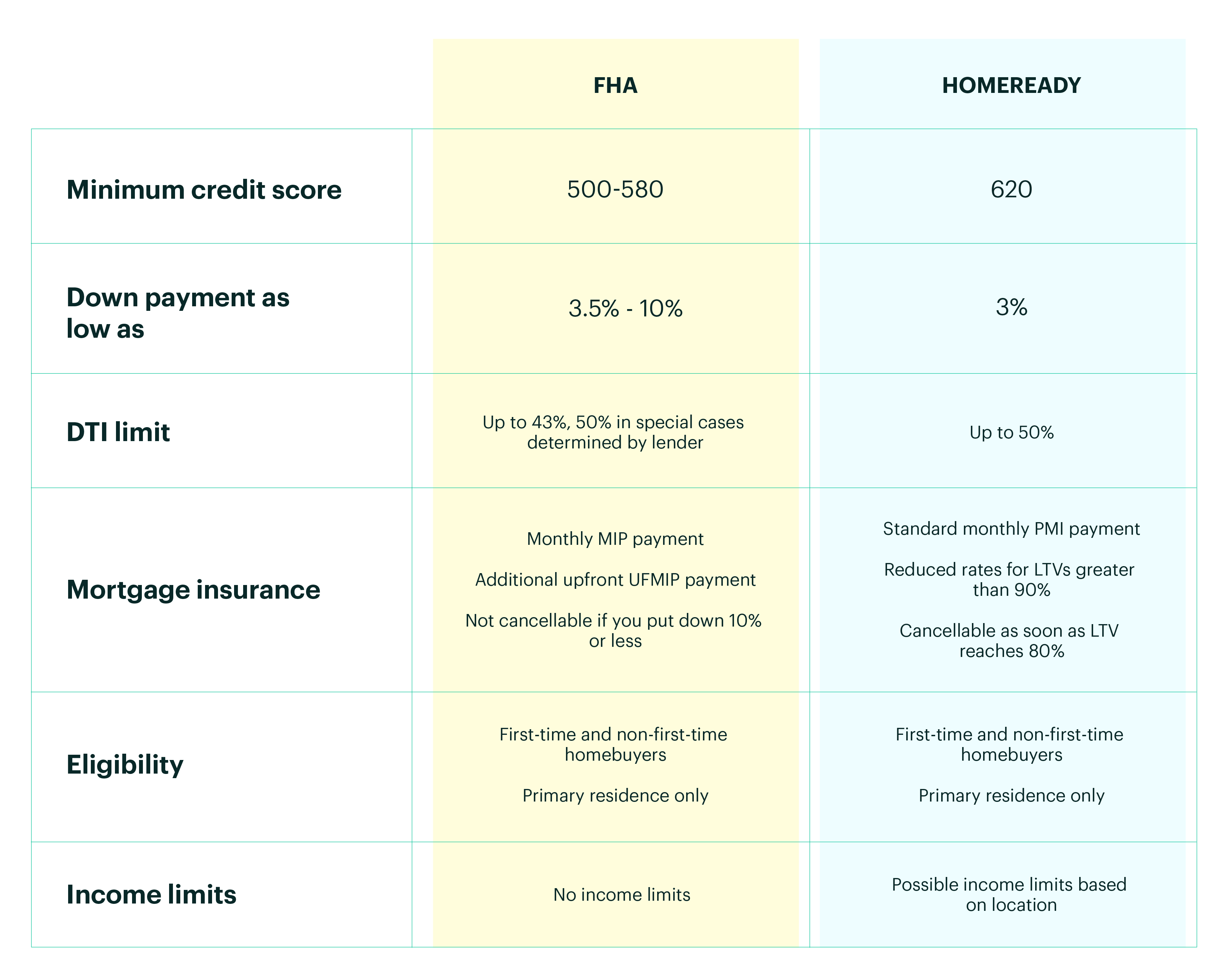
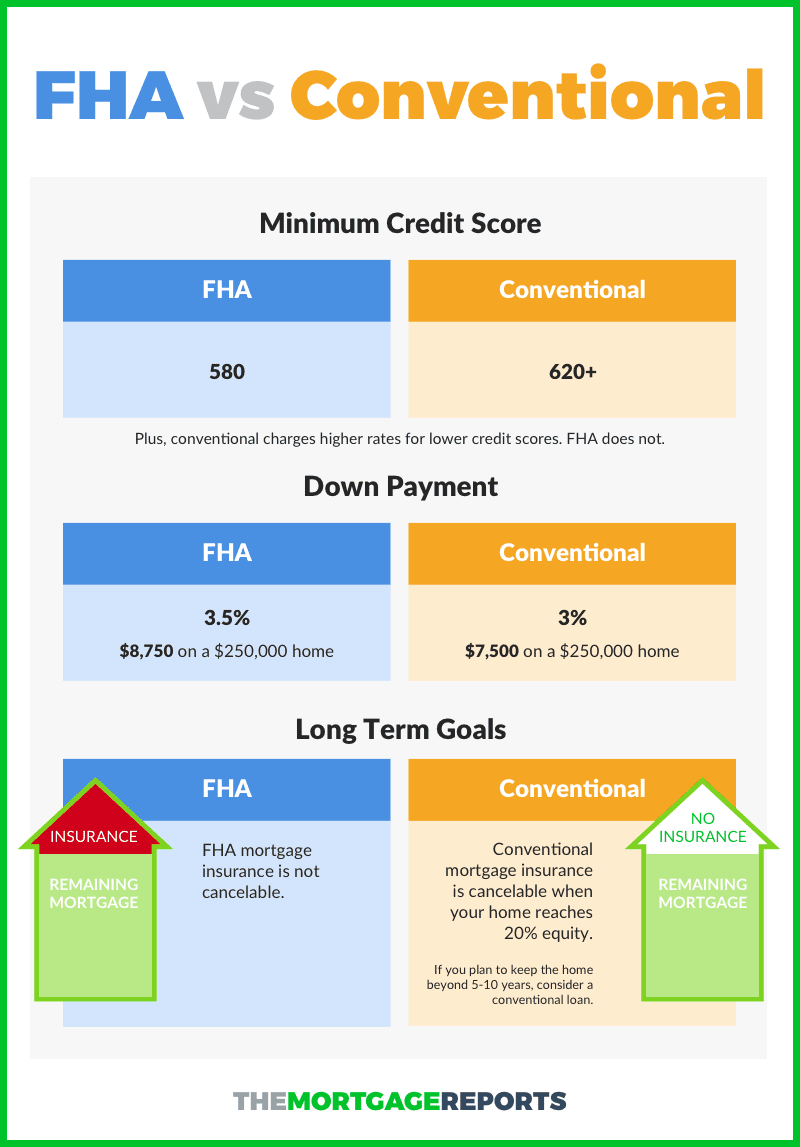
Kentucky Home Buyers credit scores are one of  the largest factors in determining the amount of a down payment for an FHA loan.   A credit score of 580 or higher, 3.5 percent is the minimum required for a down payment. Anyone with a credit score of 500 to 579 will have to save 10 percent for a down payment to obtain an FHA loan.

What Are Mortgage Insurance Requirements on Kentucky FHA Loans?

FHA loans are required to pay mortgage insurance premiums, often known as upfront mortgage insurance premiums and monthly annual premiums.

 
  • Upfront mortgage insurance premium: 1.75 percent of the loan amount and is paid when the borrower gets the loan. The premium can be rolled into the mortgage.
  • Annual mortgage insurance premium: 0.45 percent to 1.05 percent, depending on the term of the loan (15 years vs. 30 years), the loan amount and the initial loan-to-value ratio, or LTV. This premium amount is divided by 12 and paid monthly.

For a homeowner who borrows $150,000, this means the upfront mortgage insurance premium would be $2,625 and your annual premium would range from $675 ($56.25 per month) to $1,575 ($131.25 per month), depending on the length of the mortgage.

Unlike traditional mortgage insurance premiums, homeowners are required to pay FHA premiums for the entire term of the mortgage. The only time you can stop paying them is to refinance into a non-FHA loan or to sell the house.

Down Payment Gifts and Rules for Kentucky FHA Loans Kentucky borrowers choose an FHA loan can receive money as a gift to help towards the total amount of the down payment.

There are several rules that homeowners need to keep in mind. Gifts can come from friends, family members, labor unions and employers, according to data from the Department of Housing and Urban Development (HUD).

Even non-profit organizations can provide money for a contribution toward a down payment.

In addition, each state offers various assistance programs for down payments for both FHA buyers in Kentucky lacking the down payment.

People obtaining an Kentucky FHA loan are also eligible for these programs. I.e. Kentucky Housing Dap Funds, Welcome Grants In Kentucky


How to Ditch FHA Mortgage Insurance Premiums

Originally Posted On: https://thelindleyteam.com/how-to-ditch-fha-mortgage-insurance-premiums/ When you get a mortgage, you’re signing a million sheets of paper and agreeing to pay a lot…

Source: How to Ditch FHA Mortgage Insurance Premiums


When you get a mortgage, you’re signing a million sheets of paper and agreeing to pay a lot of things that you may not understand at the time. Closing costs, down payments, inspections, real estate agent fees, home insurance, escrow, and so on and so forth. One of the numbers that may have gotten rolled into that list is mortgage insurance premiums.

If you got an FHA loan, you’re almost certainly paying FHA mortgage insurance premiums. Read on to learn more about what these are, how much you might be paying each month, and how you can get out from under them.

What Are FHA Mortgage Insurance Premiums?

Before the Federal Housing Administration was founded, in order to qualify to buy a house, mortgage applicants had to have excellent credit and a large down payment. This made it harder for people to buy homes, so the FHA was established to make this process easier for first-time homebuyers. The FHA does not actually give loans they just insure them.

Mortgage insurance is a policy that protects your lender in case you default on your loan. It allows lenders to make higher-risk loans without worrying about losing money. You pay the premiums for that insurance policy as a part of your agreement with the loan.

Mortgage Insurance Rates

If your loan was $625,000 or less and you got a thirty-year fixed-rate mortgage and you paid less than 5 percent on a down payment, you’ll have an annual mortgage insurance premium of 0.85 percent of your loan. If you put down more than 5 but less than 10 percent, you’ll pay 0.8 percent for the life of the loan. If you put down more than 10 percent, you’ll pay 0.8 percent for the first eleven years of the loan

For loans less than $625,000 with a fifteen-year fixed-rate note where you paid less than 10 percent down, you’ll pay 0.7 percent of your loan amount every year for the life of the loan. If you paid more than 10 percent, you’ll pay 0.45 percent every year for the first eleven years.

If you have a mortgage greater than $625,000 with a thirty-year fixed-rate loan and you paid less than 10 percent down, you’ll pay 1 percent of your mortgage every year for the life of the loan. If you paid more than 10 percent down, you’ll pay a slightly higher 1.05 percent, but only for the first eleven years.

And finally, if your loan is greater than $625,000, you have a 15-year fixed-rate mortgage, and you paid less than ten percent down, you’ll pay 0.95 percent of your loan every year for the life of the loan. If you paid more than 10 percent but less than 22 percent, you’ll pay 0.7 percent for the first eleven years of the loan. And if you paid more than 22 percent, you’ll pay 0.45 percent every year for the first eleven years.

How to Get Out of Mortgage Insurance

The good news is that you aren’t stuck forever. Once you get about 20 percent equity in your house, either through improvements or paying down the loan, you can refinance your mortgage. With that 20 percent, you should be able to get a mortgage that doesn’t require FHA protection.

Even if you don’t yet have 20 percent equity in the house, you may be able to refinance into a lower mortgage insurance premium bracket. If you can get 10 percent to put down on your new mortgage, for instance, you may be able to drop to a lower monthly percentage that you’re paying.

Reappraise

Depending on where you live and what work you’ve done on the house, you may be able to get 20 percent equity without having to pay all that money in. If property values in your area are on the rise, your home may be worth more now than when you bought it. The same goes for home improvements, and that total may leave you with more than 20 percent equity in your home so you can refinance out of your mortgage insurance.

A great way to determine if this is the case for you is to have your home appraised again. A home appraisal will cost somewhere between $300 and $400. If you’re paying $520 a month for mortgage insurance premiums (1 percent on a $625,000 loan), this will pay for itself immediately.

How to Refinance

Once you get 20 percent equity in your house, no matter how you do it, you can refinance into a new mortgage. Start by shopping around and applying for a new mortgage with three or four lenders. This will give you an idea of what sort of interest rates you’re looking at and what your new monthly payment should be.

Once you find a lender you like, lock in your interest rate and start on the process of getting the loan closed. You’ll need a fair amount of paperwork for both the application and closing processes. Your last several pay stubs, tax returns, credit reports, and statements of your assets and outstanding debts are a good place to start.

What are the requirements to  qualify for a Kentucky FHA Mortgage?

What are the requirements to  qualify for a Kentucky FHA Mortgage in 2020?

Kentucky  FHA loan is a mortgage that is insured by the Government agency under Housing and Urban Development that is called FHA or short for Federal Housing Administration. The loan was established for Kentucky Home buyers will very little or no money down home loans with more  lenient credit score and  income requirements  and tends to be more forgiving about credit history with regard to bankruptcy and foreclosures, higher debt to income ratios and job history with limited work history for home buyers will only 2 years work history or less.

Kentucky FHA Credit Score Requirements and Down Payment Requirements

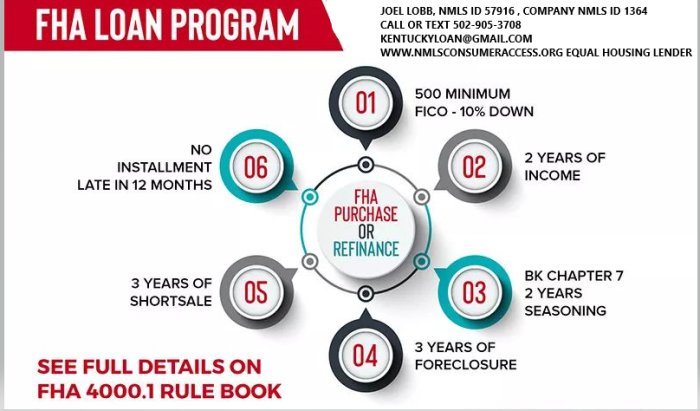
The Kentucky FHA  home loan  program may accept credit scores as low as 580 and require at least a 3.5 percent down payment of the sales price on a purchase. If you have a credit score below 580, then  a 10 percent down payment or more may be acceptable some FHA lenders in Kentucky , providing you meet all program guidelines in regards to debt to income ratios, assets, and income requirements .  The loan cannot be used for rental properties and does allow for co-signers if they are related.

Remember, these guidelines are set forth by FHA and all lenders do not have to offer these guidelines, to whereas they may a higher credit score or more money down or income restrictions on how much you can qualify for.

Kentucky FHA Mortgage Loans and Bankruptcy or Foreclosure

In case you had a  blemish on your credit report with a bankruptcy, short sale or foreclosure, follow these guidelines.

Kentucky FHA loans requires a passage of two years since the discharge date of a chapter 7 bankruptcy. A chapter 13 bankruptcy may be acceptable after at least 12 months of an on time pay-back period and the borrower has received permission from bankruptcy court to enter the mortgage transaction, and you qualify with the new house payment along with other debts on the credit report.

Three years must pass if you went through a short sale or foreclosure. The date starts when the home was sold, not when you entered the transaction toward foreclosure or short sale period. Sometimes the house will not sell to 1-2 years later after the foreclosure and this is when the passage date starts. Keep this in mind on your next FHA loan pre-approval if you have had a bankruptcy or foreclosure in the past.

Kentucky FHA Loans and Mortgage Insurance

FHA loans have two forms of mortgage insurance which protects the lender for any losses suffered if the borrower defaults on the payment. ne is called upfront mortgage insurance premium (UFMIP) which has a rate of 1.75% of the loan amount. The fee can be added to the loan amount or paid in full as part of your closing costs. In addition, FHA loans also have a 0.8-0.85% (of the loan amount) monthly mortgage insurance. In most cases, this mortgage insurance remains for the life of the loan. To eliminate the mortgage insurance, the borrower must refinance the loan into a non-FHA loan program and have 20% equity in the property.

In addition to the down payment requirements on a FHA loan, they’re closing costs and prepaids to pay at closing. The  seller can contribute up to 6% of the sales price to help the buyer with closing costs and prepaid expenses. Closing costs vary from lender to lender and your prepaids would be the same no matter which lender you choose because this is a function of the property ‘s home insurance premium quote you obtain and the property tax bill on the home set by PVA.

Sometimes the lender can pay a credit toward these expenses at closing with a lender credit which lets the lender credit back to you with a higher rate to reduce the costs of the loan’s costs at closing for out of pocket expenses.

All Kentucky FHA loans are assumable, which means that when the homeowner sells a home, the buyer may be able to take on the existing loan and terms (e.g.: balance, rate and remaining loan amount). Of course, anyone interested in the assumable loan feature must go through the approval process (credit check, income verification) with the current lender on the property. This is a very rare occurrence because most sellers are going to sell the home for more than they owe on it.

Kentucky FHA Loan Requirements


The view and opinions stated on this website belong solely to the authors, and are intended for informational purposes only. The posted information does not guarantee approval, nor does it comprise full underwriting guidelines. This does not represent being part of a government agency. The views expressed on this post are mine and do not necessarily reflect the view of my employer. Not all products or services mentioned on this site may fit all people. NMLS ID# 57916, (www.nmlsconsumeraccess.org). USDA Mortgage loans only offered in Kentucky.

All loans and lines are subject to credit approval, verification, and collateral evaluation

How to qualify for a Kentucky FHA Home Loan ?

How to qualify for a Kentucky FHA Home Loan ?

Image result for fha loans ky


FHA stands for the Federal Housing Administration which is a government agency created to increase home-ownership across the United States all the way back in 1934. The agency itself doesn’t offer home loans but insures loan that are offered by private lenders (i.e. mortgage companies).

It’s important to understand the different types of loan programs available to you and what benefits and drawbacks there are to each type.

For example, if you’re looking to find a fixer upper this may not be the right loan program for you. But an FHA loan may be a better fit for you if you have little cash saved up for a down payment or if you don’t have a high credit score.

Kentucky FHA loan requirements:

  • At least 18 years old to apply
  • No age limit. just must be 18 years of age to apply.
  • Must occupy the home as a primary residence, no rental homes or investment property
  • An appraisal must be done by an FHA-approved appraiser.Typically FHA appraisal in Kentucky costs anywhere from low-end $325 to $525 with most FHA lenders in KY.
  • Home inspection is not required
  • Termite inspection not required
  • 2 years removed from Chapter 7 bankruptcy, and 1 year in Chapter 13 bankruptcy is possible to get a loan while in bankruptcy
  • Foreclosure or short sale on previous home mortgage requires 3 years removal from those dates.
  • Mortgage insurance (MIP) is required
  • Upfront Mortgage Insurance Premium is 1.75% and monthly mortgage insurance is .85% or .80% depending on loan term and loan to value.
  • Mortgage insurance is for life of loan.
  • No matter your credit scores, everyone pays the same mortgage insurance premiums.
  • Must have 2 years of employment history proving a reliable source of income
  • 500 FICO score requirement with at least 10% down payment
  • 580 FICO score requirement with at least 3.5% down payment
  • Gifts and down payment assistance programs are allowed to meet your down payment requirements. Cannot come from seller, but seller can contribute up to 6% of the sales price toward buyer’s closing costs and prepaids.
  • Student loan payments are factored into the debt-to-income ratio when applying. Typically if loans are deferred, or in an income=based repayment plan, the FHA underwriters will use 1% of the outstanding balance, which sometimes can make it difficult to qualify.
  • Your debt-to-income ratio must not be higher than 31% or total debt obligation cannot be higher than 43% of your current income. This is for a manual underwriter, meaning that if the AUS underwriting system by mortgage lenders will approve you for a higher debt to income ratio, that is fine.


Joel Lobb (NMLS#57916)
Senior  Loan Officer
American Mortgage Solutions, Inc.
10602 Timberwood Circle Suite 3
Louisville, KY 40223
Company ID #1364 | MB73346

Text/call 502-905-3708kentuckyloan@gmail.com

If you are an individual with disabilities who needs accommodation, or you are having difficulty using our website to apply for a loan, please contact us at 502-905-3708.

Disclaimer: No statement on this site is a commitment to make a loan. Loans are subject to borrower qualifications, including income, property evaluation, sufficient equity in the home to meet Loan-to-Value requirements, and final credit approval. Approvals are subject to underwriting guidelines, interest rates, and program guidelines and are subject to change without notice based on applicant’s eligibility and market conditions. Refinancing an existing loan may result in total finance charges being higher over the life of a loan. Reduction in payments may reflect a longer loan term. Terms of any loan may be subject to payment of points and fees by the applicant  Equal Opportunity Lender. NMLS#57916http://www.nmlsconsumeraccess.org/

— Some products and services may not be available in all states. Credit and collateral are subject to approval. Terms and conditions apply. This is not a commitment to lend. Programs, rates, terms and conditions are subject to change without notice. The content in this marketing advertisement has not been approved, reviewed, sponsored or endorsed by any department or government agency. Rates are subject to change and are subject to borrower(s) qualification.

FHA vs Conventional Infograhic

How to get rid of Mortgage Insurance on a Kentucky Mortgage Loan.

Eliminate FHA Mortgage Insurance On Your Kentucky FHA Loan.
 
 
Mortgage insurance premium can add almost $200 to the payment on a $265,000 FHA mortgage.  The decision to get an FHA loan may have been the lower down payment requirement or the lower credit score levels, but now that you have the loan, is it possible to eliminate it?
 
Mortgage Insurance Premium protects lenders in case of a borrower’s default and is required on FHA loans.  The Up-Front MIP is currently 1.75% of the base loan amount and paid at the time of closing.  Annual MIP for loans with greater than 95% loan-to-value is .85% per year. 
 
For loans with FHA case numbers assigned before June 3, 2013, when the loan is paid down to 78% of the original loan amount, the MIP can be cancelled.  The borrower may need to contact the current servicer.
 
However, for loans greater than 90% with FHA case numbers assigned on or after that date, the MIP is required for the term of the loan.
 
Most homeowners with FHA mortgages are not eligible to cancel the MIP because they either originated their loan after June 3, 2013, put less than 10% down payment and/or got a 30-year loan.  If they have at least 20% equity in the home, they can refinance the home with an 80% conventional loan which in most cases, does not require mortgage insurance.
 
With normal amortization on a 30-year loan, it takes approximately 11-years to reduce the original loan to the 78-80% requirement based on normal amortization.  There is another dynamic involved which is the appreciation on the home.  As the home goes up in value and the unpaid balance goes down, the equity increases.
 
If the homeowners believe that they have enough equity that would eliminate the need for mortgage insurance, they can investigate refinancing with a conventional loan.  Borrowers refinancing will incur expenses in starting a new mortgage and the interest rate may be higher than the existing rate.  Analysis will determine how long it will take to recapture the cost of refinancing.

 
American Mortgage Solutions, Inc.
10602 Timberwood Circle Suite 3
Louisville, KY 40223
Company ID #1364 | MB73346


Text/call 502-905-3708
kentuckyloan@gmail.com

http://www.nmlsconsumeraccess.org/
If you are an individual with disabilities who needs accommodation, or you are having difficulty using our website to apply for a loan, please contact us at 502-905-3708.
Disclaimer: No statement on this site is a commitment to make a loan. Loans are subject to borrower qualifications, including income, property evaluation, sufficient equity in the home to meet Loan-to-Value requirements, and final credit approval. Approvals are subject to underwriting guidelines, interest rates, and program guidelines and are subject to change without notice based on applicant’s eligibility and market conditions. Refinancing an existing loan may result in total finance charges being higher over the life of a loan. Reduction in payments may reflect a longer loan term. Terms of any loan may be subject to payment of points and fees by the applicant  Equal Opportunity Lender. NMLS#57916http://www.nmlsconsumeraccess.org/
— Some products and services may not be available in all states. Credit and collateral are subject to approval. Terms and conditions apply. This is not a commitment to lend. Programs, rates, terms and conditions are subject to change without notice. The content in this marketing advertisement has not been approved, reviewed, sponsored or endorsed by any department or government agency. Rates are subject to change and are subject to borrower(s) qualification.