
This type of loan is administered by KHC in the state of Kentucky. They typically have $12,500 down payment assistance year around, that is in the form of a second mortgage that you pay back over 15 years at a interest rate of 4.75% depending on your income in the household.
▶ Click to watch on YouTube
Joel has worked with KHC for 12 of his 20 years in the mortgage lending business. Joel said, “A lot of my clients would not have been able to purchase a home of their own or possibly delayed their purchase due to lack of down payment but with the $6,000 DAP loan program, this gets them into a house sooner and starts their path to homeownership while building equity instead of throwing their money away.”
<!– WordPress.com-friendly page content (no , no , no ) –>
Kentucky FHA Loans (2026): Requirements, Down Payment, Credit Scores, and How to Get Approved
If you are buying a home in Kentucky and want a low down payment option with more flexible credit guidelines,
an FHA loan is often the most practical path. This guide covers the FHA rules that matter in 2026, the common
underwriting issues that slow people down, and the fastest way to get a clean pre-approval.
Minimum down payment: 3.5% with 580+ credit score; 10% with 500–579 (case-by-case).
Primary residence only (no investment property).
FHA appraisal required and the home must meet FHA property standards.
Seller concessions allowed up to 6% of the sales price toward certain closing costs and fees.
Mortgage insurance is required (upfront + monthly/annual).
Want me to price your payment and cash-to-close fast? Text “FHA” to
502-905-3708
and I will reply with a document checklist.
Credit Score Guidelines for Kentucky FHA Loans
FHA guidelines allow:
580+ credit score: eligible for the 3.5% minimum down payment option.
500–579 credit score: may be eligible with 10% down (approval depends on the full file).
Below 500: generally not eligible for FHA financing.
Important: lenders can add “overlays” (stricter requirements than FHA). That is why two lenders can give two
different answers on the same borrower. If you want a straight answer, I will review your scenario and tell you
what is realistically approvable.
Down Payment and Closing Costs (What Kentucky Buyers Actually Pay)
FHA requires a minimum down payment based on credit score. Closing costs are separate and typically include lender
fees, title, escrow, and prepaid items like taxes and homeowners insurance.
3 ways Kentucky FHA buyers reduce cash-to-close
Seller concessions (up to 6% of the sales price, when allowed and properly structured).
KHC Down Payment Assistance (for eligible borrowers using a KHC first mortgage).
Lender credits (higher rate trade-off to reduce upfront costs, when it makes sense).
FHA loan limits change by county and are updated periodically. The cleanest way to avoid outdated numbers is to
pull your county limit directly from HUD.
If you text me your county (or the property address), I will confirm the current FHA limit and your max purchase price:
502-905-3708.
Debt-to-Income Ratio (DTI): What FHA Looks At
FHA underwriting looks at housing expense compared to income and total monthly debts compared to income.
A common baseline guideline you will see referenced is 31% for housing and 43% for total debt, with exceptions
possible depending on automated underwriting results and compensating factors.
Housing ratio (front-end): proposed house payment compared to gross monthly income.
Total DTI (back-end): house payment plus monthly debts compared to gross monthly income.
If your DTI is tight, the fix is usually one of these: adjust purchase price, restructure debt, improve credit,
or document additional qualifying income correctly.
Types of FHA Loans Kentucky Buyers Use Most
FHA 203(b) Standard Purchase
The most common FHA loan for buying a primary residence in Kentucky.
FHA 203(k) Renovation Loan
Combines purchase plus renovation costs into one loan for qualifying homes that need repairs or updates.
FHA Streamline Refinance
For existing FHA borrowers looking to reduce payment with simplified documentation (when eligible).
FHA Cash-Out Refinance
For homeowners who want to access equity (subject to FHA rules and underwriting).
Kentucky Housing Corporation (KHC) offers down payment assistance for eligible borrowers using a KHC first mortgage.
KHC’s Regular DAP has been listed as assistance up to $12,500, repayable over 15 years at 4.75% (subject to program
terms, eligibility, and availability). Confirm current options here:
KHC Down Payment Assistance.
If you want a straight answer on eligibility (income limits, purchase price limits, and which first mortgage fits),
call or text me:
502-905-3708.
How to Apply for an FHA Loan in Kentucky (Simple Process)
Quick consult (10 minutes): goals, county, price range, and down payment plan.
Document review: paystubs, W-2s, bank statements, and ID.
Run automated underwriting and issue a clean pre-approval.
Kentucky FHA loans can be an excellent option for first-time homebuyers and borrowers with lower incomes or less-than-perfect credit. They can also be an easy way to refinance. .
Features and benefits:
Low down payment from borrower or other approved source1
580 credit score with 96.5 Financing and down to 500 score with 500 score on case by case
Streamline option refinance with no appraisal
Up to 6% seller contributions to pay your closing costs and prepaids
AUS with FHA TOTAL Mortgage Scorecard
Waivers for some ratio and documentation
Purchase, rate/term, or cash-out refinance of a primary residence. Program terms available may vary based on the state or county in which the financed property is located. Mortgage insurance is required. CONSIDERATIONS: Important information will be provided to you in the disclosures you receive after we have received your application and the loan documents you are provided at loan closing. Please consult your tax advisor regarding the deductibility of interest. Contributions may have limitations based upon occupancy and loan to value ratios and cannot be used for purposes of down payment, reserve requirement or meet minimum contribution requirements Programs for qualified borrowers. All borrowers are subject to credit approval, underwriting approval and product requirements, including loan to value, credit score limits and other lender terms and conditions. Fees and charges may vary by state and are subject to change without notice. Some restrictions may apply. Not a commitment to lend. 11/22
Getting An FHA Loan
In order to get an FHA loan to buy your next house, it’s a good idea to first check your credit score. That way, you can see what your maximum LTV would be through the FHA and decide whether an FHA loan might be right for you.
Depending on which FHA lender you’re working with, it may also be a good idea to get pre-qualified for an FHA loan. This can help you establish how much you’ll likely be able to borrow and what your interest rate may be.
Application and Underwriting
Once you’ve identified a home you want to purchase and are ready to formally apply for your mortgage loan, you’ll need to choose an FHA-approved lender and work through its individual application and underwriting process. The application process will include completion of a Uniform Residential Loan Application.
As part of your application, you’ll also need to get an appraisal for the home you’re buying, so your lender can ensure your loan won’t violate FHA’s LTV limits. From there, you’ll need to work through your individual lender’s underwriting process, which will include showing proof of income, running credit checks and demonstrating that you can afford your down payment.
Some of the documentation you’ll likely need to supply for underwriting include:
A credit report
Employment history for two years
Income verification with recent pay stubs, bank statements and/or three years of tax returns
Proof that you are using the loan for a primary residence
An FHA-approved appraisal
After you complete your lender’s application process and underwriting, your lender can formally approve your loan and you can close on your home.
Who Should Consider FHA Loans
FHA loans don’t have stated income maximums or minimums, but are generally designed to benefit low- to moderate-income Americans who would have trouble qualifying for conventional financing or affording the down payment required by other loans.
Some potential cases when FHA loans can be particularly helpful include:
First-time homebuyers who can’t afford a large down payment
People who are rebuilding their credit
Seniors who need to convert equity in their homes to cash
Types Of FHA Loans
There are more than a dozen home loan programs available through the FHA. Many of these programs are ideal for different borrowers in a variety of circumstances, offering everything from 30-year fixed-rate mortgages to adjustable rates, improvement loans, refinancing solutions and even reverse mortgages.
Some of the most popular FHA loan programs are:
FHA Section 203(b) loan. The FHA’s most popular home loan program, offering fixed rates on properties from one to four units.
FHA Section 203(k) loan. FHA mortgages designed to help homebuyers finance up to $35,000 in improvements to their new homes.
Streamline Refinancing. An option for existing FHA borrowers to refinance their loans with streamlined underwriting.
FHA Loans Vs. Conventional Mortgages
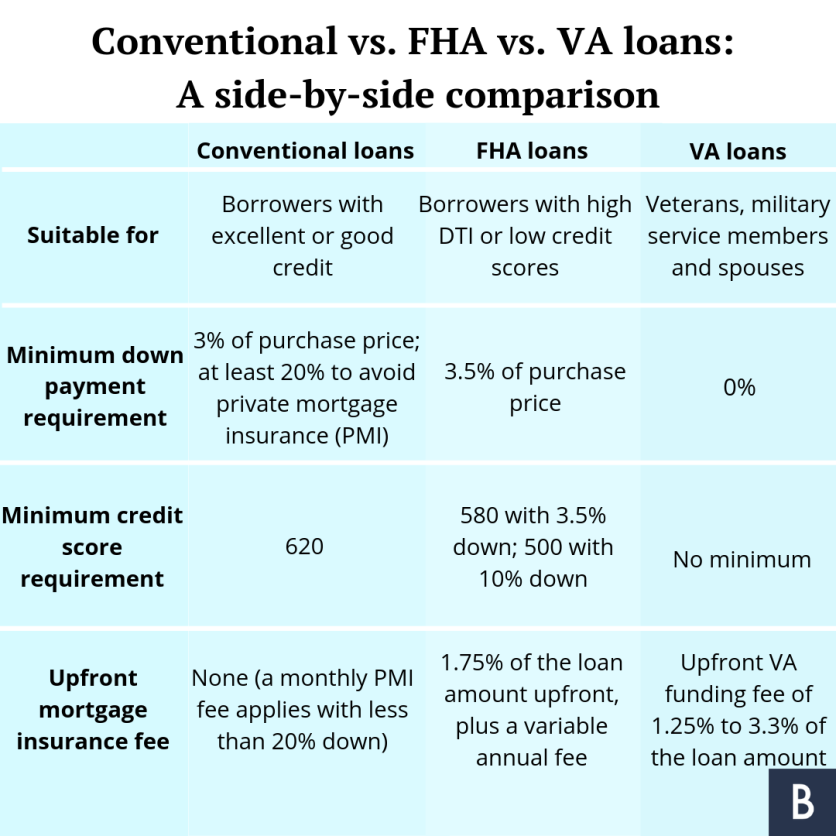
Most conventional mortgages require down payments of at least 20% of a home’s purchase price in order to avoid paying private mortgage insurance, along with minimum credit scores of 620 to 640 in order to qualify. With private mortgage insurance (PMI) that helps homeowners pay their mortgage if they lose their jobs, some lenders require lower down payments.
FHA loans have two types of built-in mortgage insurance that allow borrowers to buy homes with as little as 3.5% down—or 10% if they have bad credit. In addition, these loans allow homebuyers to qualify for lower interest rates than they would get with conventional mortgages, all because their loans are federally insured.
FHA Loan
Conventional Mortgage
Minimum credit score
500
620
Minimum down payment
3.5% if your credit score is 580 or higher; 10% for scores under 580
20% to avoid mortgage insurance
Maximum loan term
30 years
30 years
Mortgage insurance requirement
Two types of mortgage insurance required
Required if down payment is under 20%
Pros of FHA Loans
High maximum loan-to-value
Competitive interest rates
Multiple programs available
Can qualify with bad credit
Closing costs are sometimes paid by lenders
Cons of FHA Loans
Mortgage insurance is required for extra cost
Only available for a primary residence
Must show proof of income
Debt-to-income ratio must be under 43% (slightly lower than a conventional loan requires)
Bottom Line
The Federal Housing Administration (FHA) was created in the 1930s in response to the Great Depression to help Americans who couldn’t otherwise afford the dream of homeownership.
Today, the FHA continues to help Americans through more than a dozen loan programs that help Americans with low incomes or bad credit qualify for lower interest rates than they would otherwise get, and buy homes with much smaller down payments than those required by conventional lending tools. The FHA does this by working with approved lenders to insure loans across the country and by building two types of mortgage insurance into all of the loans that it insures.
So, if you have poor credit or are struggling to save for a down payment, you may want to consider using an FHA loan for your next home purchase.
A debt to income ratio, commonly referred to as DTI, is the ratio of the amount of monthly expenses you have relative to your gross (before tax) income.
The automated underwriter will look at two ratios when analyzing your DTI: your front end DTI ratio and your back end DTI ratio.
Front End DTI
The front end DTI is the ratio of your new housing payment including taxes and insurance relative to the amount of income you earn. The front end DTI ratio excludes all other debts and simply analyzes your income relative to the payments on the new mortgage plus tax and insurance.
So, if your mortgage payments including tax and insurance are $1,000 and you earn $4,000 per month in gross income, your front end DTI would be 25% ($1,000 / $4,000 = 25%).
Kentucky offers several grant programs to help residents achieve their dream of homeownership. These programs provide financial assistance to eligible buyers, making the purchase of a home more affordable. Here’s an overview of the current grant options available to Kentucky homebuyers:
1. Kentucky Housing Corporation (KHC) Down Payment Assistance Program
The KHC offers up to $12,500 in down payment assistance to eligible first-time homebuyers. This program can be used in conjunction with KHC’s first mortgage loans.
Eligibility:
Must be a first-time homebuyer or not have owned a home in the past three years
Meet income and purchase price limits, which vary by county
Complete a homebuyer education course
2. Kentucky Affordable Housing Trust Fund
This program provides funds to create or preserve affordable housing for low-income households. While not a direct grant to homebuyers, it can help create affordable housing opportunities.
3. USDA Rural Development Grant
Although not specific to Kentucky, this federal program is available in many rural areas of the state.
Key features:
Provides loans and grants for low-income individuals in rural areas
Can be used for home purchases or repairs
Income limits and location restrictions apply
4. Louisville Metro Down Payment Assistance Program
Specific to Louisville, this program offers forgivable loans of up to $25,000 to help with down payment and closing costs.
Eligibility:
Must be a first-time homebuyer
Income must be at or below 80% of the area median income
Property must be located within Louisville Metro
5. Lexington Homeownership Assistance Program
This program, specific to Lexington, provides up to $15,000 in down payment and closing cost assistance.
Eligibility:
Must be a first-time homebuyer
Income must be at or below 80% of the area median income
Property must be located within Lexington-Fayette Urban County
6. Individual Development Account (IDA) Program
While not exclusive to homebuying, this program can help prospective homeowners save for a down payment.
Key features:
Provides matching funds for savings (typically $2 for every $1 saved)
Can be used for homeownership, education, or starting a small business
Income and asset limits apply
7. Welcome Home Grant
Feature
Welcome Home Grant
KHC DPA
Type
Grant (no repayment if retained)
Repayable loan (second mortgage)
Amount Typical
Up to ~$20,000*
Up to $12,500
Payback
None if stays 5+ years*
Monthly payments over 15 yrs
Retention/Terms
5-year deed restriction
Standard mortgage second lien
Income Limits
≤80% MRB household
MRB or Secondary Market
Qualifying Income
Household inclusive
Dependent on mortgage product underwriter
First-Time Buyer
Optional
Depends on mortgage product
Access
Through FHLB member lenders
Through KHC-approved lenders
Availability
Seasonal, limited
Ongoing
How to Apply
To apply for these grants, contact the respective program administrators:
For city-specific programs: Contact your local housing authority or visit the city’s official website
Welcome Home Grant
Program is administered through participating FHLB Cincinnati member lenders (banks and credit unions that belong to the FHLB system).
Buyers must contact a participating mortgage lender early and reserve funds once the program opens (often first-come, first-served).
A fully executed purchase contract and signed mortgage application are typically required to reserve funds.
KHC DPA
Must work with a KHC-approved lender; you cannot apply directly to KHC.
The KHC-approved lender will bundle the first mortgage and the DPA second mortgage into one closing transaction.
Implication:
Both programs require lender participation. The Welcome Home Grant is tied to a different funding source (FHLB) than KHC’s internal DPA loan.
Be aware that grant availability and terms may change. Therefore, you should check with the program administrators for the most up-to-date information. Additionally, many of these programs require participants to complete homebuyer education courses. These courses can provide valuable information about the homebuying process.
By taking advantage of these grant programs, Kentucky residents can make their dream of homeownership more attainable. Explore all options. Consult with housing counselors or financial advisors. This will help you determine the best path to homeownership for your specific situation.